“Ammunition will get you through times of no food, but food won’t get you through times of no ammo.” ― Joe Haldeman
The comparative analysis of 7.62 mm and 5.56 mm caliber rifles assumes a pivotal role within military discourse. 7.62mm caliber rifle emphasizes high penetration power and extended range abilities. 5.56mm caliber weapon prioritizes manageable recoil and enhanced magazine capacity. The introduction of rifling in Germany during the 15th century was a huge advancement in firearm accuracy. Rifles originally evolved from grooves within barrel of muskets and shotguns.
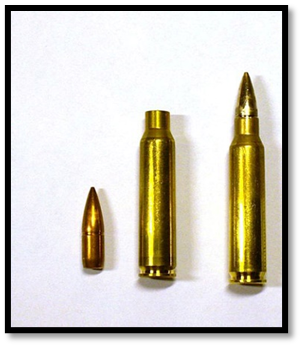
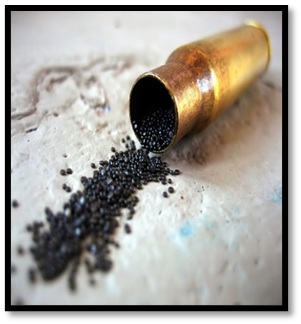
- The article unfolds in following sequence:
- Part I : Brief History and earlier firearms
- Part II : Merits and Demerits
- Part III : Weight Comparison
- Part IV : Range Comparison
- Part V : Cost Effectiveness
Earliest Fire Arm
It was loaded using a powder flask and bullets with separate ignitions. The projectile used was a ball shaped round.Its powder charge and bullet wrapped in a combustible paper sheathThe metallic cart with a single unit of powder, bullet and primer revolutionised the field of ammunition.
7.62 mm cartridge
The 7.62 mm caliber is one of the most popular choices of ammunition manufacturers due to the good ratio of the bullet weight to the muzzle velocity. It was first used by the Imperial Russian Army in late 1800s. This led to the creation of Mosin-Nagant bolt-action rifle. (The Mosin–Nagant is a five-shot, bolt-action, internal magazine–fed military rifle).
Because the 7.62 mm NATO was so effective out to ranges of 1,000 meters and more, it was quickly chambered in bolt-action precision sniper rifles, starting with the M40 in 1966 by the Marine Corps.
5.56 mm cartridge
The 5.56 x 45mm NATO, commonly referred to as five-five-six NATO, is a rimless, bottlenecked intermediate rifle cartridge that was formally standardized by NATO in 1980. Developed by FN Herstal of Belgium in 1970s, it evolved from the earlier .223 Remington design and was adopted to meet the changing demands of modern infantry combat.
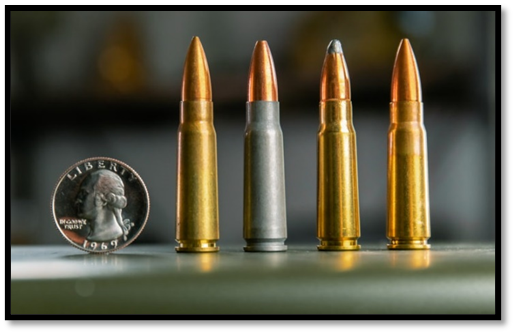
As NATO’s second standardized service rifle cartridge, it provided a lighter, high-velocity alternative to the heavier 7.62 x 51mm NATO, enabling improved controllability, higher ammunition carry capacity, and enhanced effectiveness for contemporary battlefield conditions.
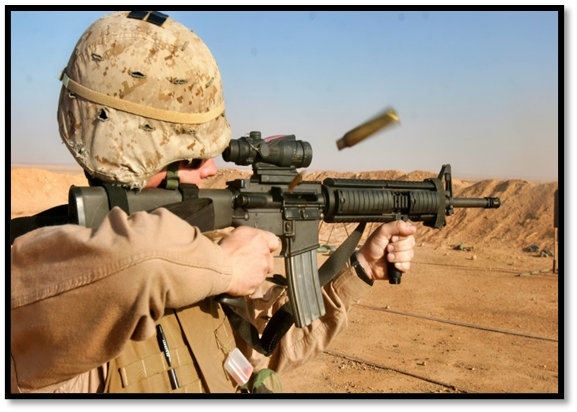
Acceptance of M16 by US Army as standard Infantry weapon was one of the key events in evolution of 5.56 x 45 mm ammunition.
Merits of 7.62 mm Caliber Rifles
High Penetration as compared to 5.56 mm Caliber Rifles
Reliability
Ballistic Performance
Maximum effective range with optical sight
Lethal even at longer range
De-Merits of 7.62 mm Caliber Rifles
More weight and size as compared to 5.56 mm Caliber Rifles
More recoil
Delayed re – aiming
Low rate of sustained fire
Ammo weight
Merits of 5.56 mm Caliber Rifles
Capable of penetrating steel helmets and light barriers at distance
Lesser Recoil
Lighter in Weight as compared to 7.62 mm Caliber Rifles
Flatter Trajectory
Psychological Effects
Cost Effectiveness
De-Merits of 7.62 mm Caliber Rifles
Reduced Penetration Power as compared to 7.62 mm Caliber Rifles
Reduced Range
Climatic Effects
Frequent Stoppages
Limited Potentials as compared to 7.62 mm Caliber Rifles
Weight Comparison
| 5.56 X 45 (.223) | 7.62 X 51 (.308) | ||
| No of grains | 55-62 | No of grains | 144-160 |
| Wt of 1 rd | 12.5 g | Wt of 1 rd | 24 g |
| Wt of 30 rd | 375 g | Wt of 20 rd | 480 g |
| Wt of 120 rd | 1500 g | Wt of 120 rd | 2880 g |
5.56 mm weapons are light in weight and dimensions as compared to 7.62 weapons which are bigger in size as well as heavy
The penetration power of 5.56 mm caliber is more than 7.62 mm caliber.
 However, at longer ranges it is reduced due to light weight of the projectile and MV.
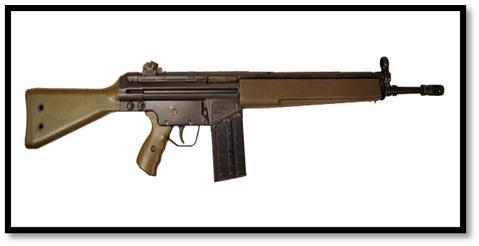
The pen power of 7.62 mm caliber at longer ranges is quite effective.
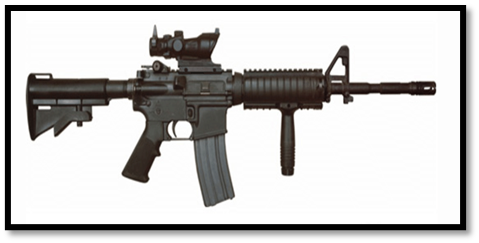
Range Comparison
Small caliber like 5.56 mm is designed to engage targets at close quarters.7.62 mm caliber due to its projectile weight can eff engage targets at longer range.The 5.56mm offers a flatter trajectory, less recoil, and allows for more rounds, making it great for close-to-medium range (under 300-400 yards) general use.
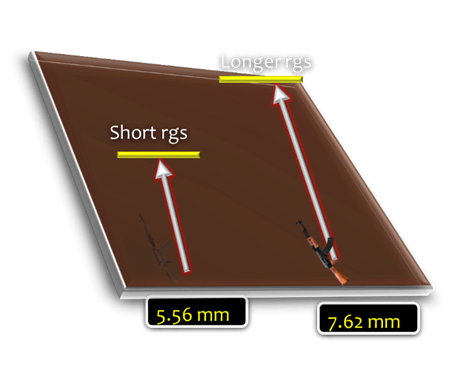
While the heavier 7.62mm (especially 7.62 NATO) delivers more energy, better barrier penetration, and superior performance at longer ranges (beyond 600 yards), though with more recoil and less ammo capacity, with the choice depending on the mission.
Cost Effectiveness
5.56 mm ammunition is substantially cheaper than 7.62 mm ammunition. 20 rounds of 5.56 ammo costs USD 4.29 whereas 20 rounds of 7.62 ammo costs USD 6.37.
5.56 mm (Bulk Steel/ Reman): ~$0.29 – $0.38 per round & 5.56mm (Brass FMJ Bulk): ~$0.32 – $0.38 per round (e.g., PMC, Federal).
7.62 x 39mm (Steel FMJ): ~$0.35 – $0.60 per round & 7.62x39mm (Brass FMJ): ~$0.50 – $0.70 per round.
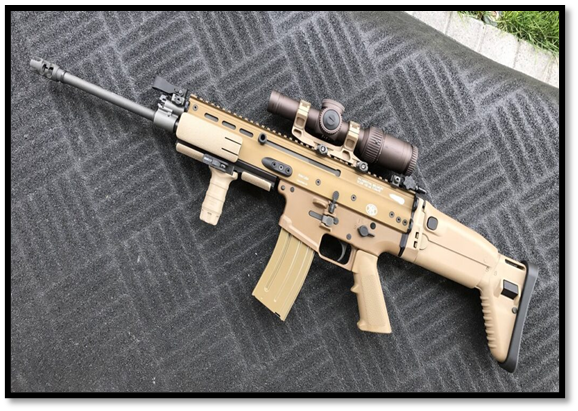
The 5.56×45mm NATO became the epicenter of modern military rifle cartridges. Its adoption influenced global small arms design, leading to lighter rifles, improved capacity magazines, and greater logistical efficiency. Today, it remains the primary caliber for NATO-standard service rifles, carbines, and light machine guns, including the M16, M4, FN SCAR, Steyr AUG, and others.