
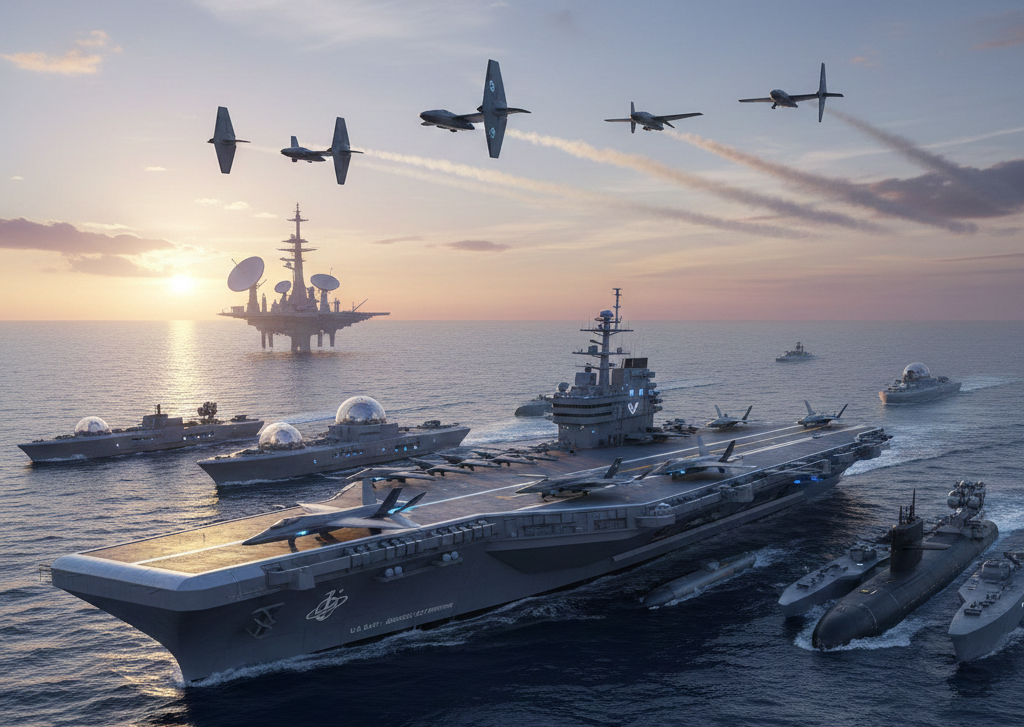
“It follows then as certain as that night succeeds the day, that without a decisive naval force we can do nothing definitive, and with it, everything honorable and glorious.” (George Washington)
Introduction
The U.S. Navy stands at a crossroads where enduring maritime doctrines, many more than a century old intersect with cutting-edge technologies such as hypersonic strike systems, unmanned platforms, directed energy weapons, and networked combat systems. Traditional concepts of sea power, articulated by Alfred Thayer Mahan in the late 19th century, emphasized control of maritime trade routes, forward projection of military strength, and decisive battles at sea as determinants of global influence. These principles continue to underpin U.S. naval strategy, even as technological advances demand doctrinal adaptation.
Today’s maritime environment features a spectrum of technologies; from hypersonic missiles that travel at speeds above Mach 5, to drones and unmanned surface vessels (USVs) that extend the fleet’s reach at lower risk and cost. The evolution of naval capabilities requires a careful reassessment of doctrinal fundamentals including how sea power is defined, how naval dominance is achieved, and how navies operate in highly contested domains. This paper examines how the U.S. Navy is reconciling century-old strategic tenets with transformational technologies to ensure sustained naval supremacy in the 21st century.
THE U.S. NAVY’S GLOBAL NAVAL POSTURE AND CAPABILITIES
Fleet Composition and Global Reach
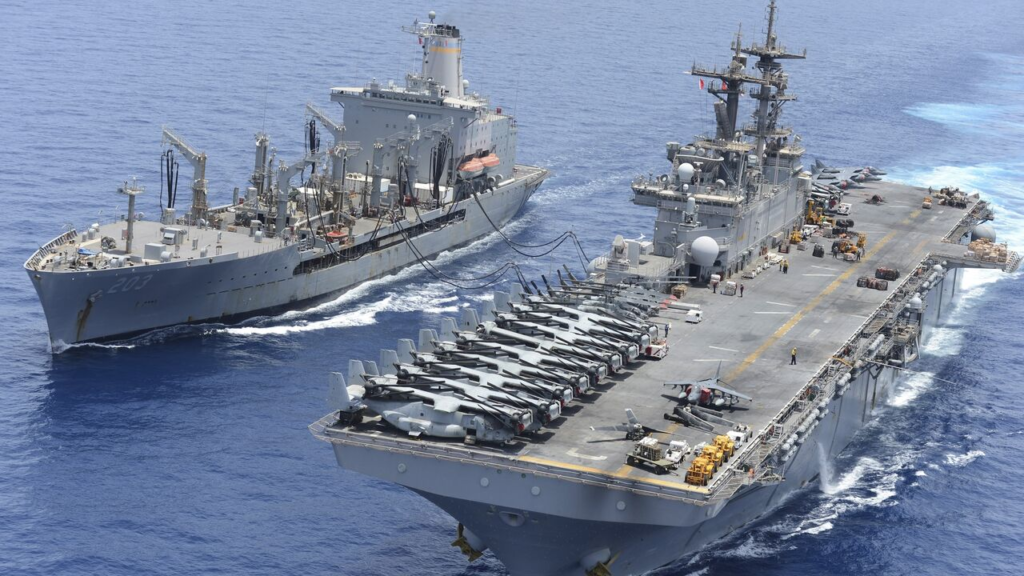
Much like the British Royal Navy at the height of the British Empire, the United States Navy today enjoys a level of command over the seas that gives Washington unmatched global influence. For decades, the Navy’s size, reach, and technological sophistication have allowed the United States to project power across continents during both war and peace without relying on foreign territory or permanent bases. This maritime dominance has been a central pillar of U.S. foreign policy and military strategy.
However, many analysts argue that the U.S. Navy is approaching a historic turning point. Mounting budgetary pressures, rising operational costs, and the rapid naval modernization of China are challenging long-standing assumptions about American maritime supremacy. If not addressed effectively, these factors could gradually erode the Navy’s ability to dominate the world’s oceans.
Why Navies Matter: The Core Advantages
The sea covers nearly three-quarters of the Earth’s surface, and control of this vast domain offers unique advantages that land-based forces cannot replicate. A capable navy provides unmatched global access, enabling states to patrol critical sea lanes, approach distant coastlines, and position forces close to major population centers and strategic chokepoints.
The United States qualifies as a true maritime superpower because its warships can sail thousands of miles within days and remain on station for extended periods without violating another state’s sovereignty. This ability allows the Navy to operate discreetly or visibly, depending on political intent, making it an exceptionally flexible instrument of national power—especially during international crises.
Equally important is the Navy’s unmatched strategic lift capability. It can transport troops, heavy equipment, fuel, ammunition, food, and humanitarian supplies across oceans to sustain prolonged military operations far from home. As noted by U.S. Joint Forces Command in its 2010 strategy document, America’s ability to project military power for over six decades has rested heavily on its near-complete control of the global commons—particularly the maritime domain.
The Role of the U.S. Navy
A navy’s role is shaped by its reach and capabilities. The United States is one of only a few nations with a blue-water navy, meaning it can operate independently across the open oceans. Many other states, constrained by geography or resources, maintain only green-water (regional/coastal) or brown-water (riverine) forces.
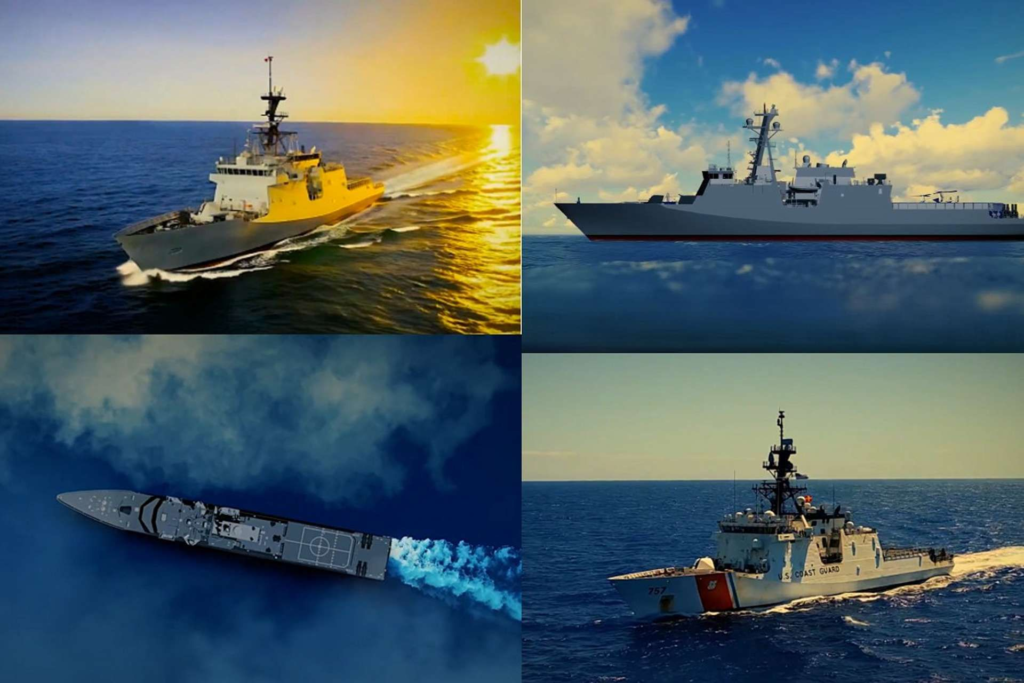
While the Navy’s power ultimately rests on its ability to use or threaten force, its mission extends well beyond combat. It also performs vital diplomatic, policing, and humanitarian roles. These missions are often carried out jointly with the Marine Corps; America’s amphibious assault force and the Coast Guard, which specializes in maritime law enforcement, search and rescue, and sanctions enforcement.
Together, these three services define U.S. sea power through several interconnected functions:
- Forward presence: The Navy maintains regular deployments in strategically important regions, signaling sustained though not permanent U.S. commitment.
- Deterrence: By maintaining credible combat power, the Navy discourages adversaries from acting against U.S. interests. Ballistic-missile submarines, which form a key leg of the nuclear triad, are especially valued for their stealth and survivability.
- Sea control: The ability to dominate specific maritime areas for limited periods enables shipping protection, sealift operations, blockades, and freedom of maneuver.
- Power projection: The Navy can strike targets ashore using missiles, aircraft, or amphibious forces and sustain these operations over time.
- Maritime security: With roughly 90 percent of global trade moving by sea, the Navy plays a major role in protecting commerce and maintaining order through counter-piracy, counter-narcotics, and environmental protection missions.
- Humanitarian assistance: Naval forces routinely respond to disasters by delivering medical aid, food, and logistical support. A recent example includes the construction of an offshore pier near Gaza to facilitate humanitarian deliveries.
Size and Composition of the Fleet
With approximately 290 ships, the U.S. Navy is not the largest by number but remains the most powerful. It operates eleven nuclear-powered aircraft carriers, compared to China’s three and Russia’s single carrier. Analysts caution, however, that raw numbers alone are misleading. The real measure of naval strength lies in whether the fleet can meet national security and foreign policy objectives.
The U.S. Navy currently operates a fleet of just over 280 active ships, making it one of the most capable maritime forces in history. While exact numbers fluctuate due to maintenance cycles, decommissionings, and reserve status, the fleet’s structure reflects a deliberate emphasis on power projection, sea control, and global reach. The Navy’s long-term objective remains a fleet of 355 or more ships, though recent official counts vary slightly depending on how support vessels and reserve units are classified.
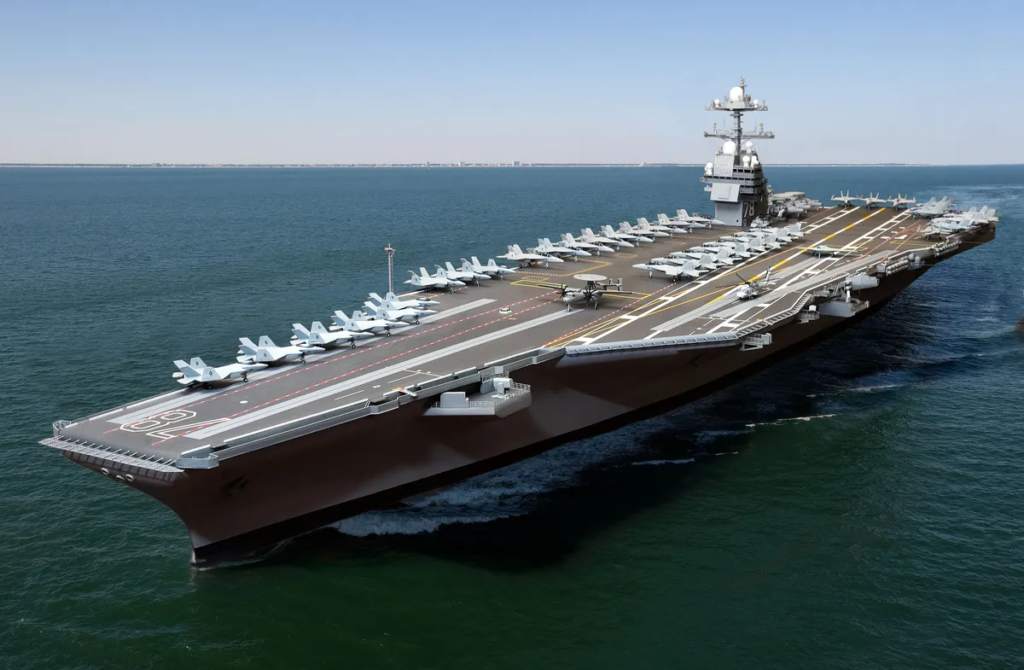
At the core of this fleet are 11 nuclear-powered aircraft carriers, drawn from the Nimitz and next-generation Ford classes. These vessels form the backbone of U.S. naval power projection, enabling sustained air operations far from American shores without reliance on host-nation bases.
Beneath the surface, the Navy maintains a robust undersea force consisting of approximately 50 nuclear-powered attack submarines (SSNs). These are supplemented by ballistic-missile submarines (SSBNs), which provide a survivable leg of the nuclear triad, and guided-missile submarines (SSGNs), optimized for long-range precision strikes and special operations support. Combined, the submarine force numbers roughly 70 to 80 boats, making it one of the most lethal and survivable elements of U.S. military power.
On the surface warfare side, the Navy fields more than 70 guided-missile destroyers (DDGs), primarily of the Arleigh Burke class. These ships serve as the fleet’s primary escorts, air and missile defense platforms, and multi-mission combatants. Complementing them are around 17 Ticonderoga-class guided-missile cruisers, which, despite their age, continue to play a critical role in fleet air defense and command-and-control functions.
Amphibious warfare remains another essential pillar of the Navy’s force structure. The fleet includes more than 23 large amphibious assault ships, such as the LHA and LHD classes, designed to deploy Marine Expeditionary Units and support expeditionary operations. These vessels provide the United States with a unique capability to project ground forces from the sea, conduct crisis response, and operate in contested littoral environments.
Leadership and Command Structure
The Department of the Navy is led by a civilian Secretary and the Chief of Naval Operations (CNO), the senior uniformed officer. The Marine Corps, while part of the department, has its own commandant. Both serve on the Joint Chiefs of Staff. Operational command does not flow through the service chiefs. Instead, authority runs from the President to the Secretary of Defense and then to the eleven combatant commands; seven geographic and four functional. Commands such as Indo-Pacific Command are heavily naval in character due to their maritime focus.
The Coast Guard, though not part of the Navy, frequently operates alongside it and can be placed under naval command during wartime. It has played key roles in enforcing sanctions, particularly against North Korea.
How the Navy Deploys Forces
The most recognizable naval formation is the carrier strike group, centered on a nuclear-powered aircraft carrier. Each group typically includes a cruiser, several destroyers, an attack submarine, and a logistics ship, with over 7,000 sailors and Marines. At any given time, two to three carrier strike groups are deployed globally.
Following the October 7, 2023, Hamas attack on Israel, the USS Gerald R. Ford strike group was deployed to the eastern Mediterranean as a signal of U.S. support. Another key formation is the amphibious ready group, built around an assault ship and a Marine Expeditionary Unit, supported by transport and dock-landing ships. These vessels, such as USS Wasp and Kearsarge, resemble aircraft carriers but are optimized for amphibious warfare.
Strategic Challenges Ahead
The Navy faces serious challenges in the decades ahead, particularly in the western Pacific, where China is actively contesting U.S. influence. Beijing is expanding its naval power, offering development loans to small island states, and pursuing strategic access rather than economic gain. Analysts describe this competition as a form of pre-conflict geopolitical maneuvering reminiscent of World War II–era island hopping. China’s naval modernization includes new carriers, submarines, and surface combatants, alongside controversial maritime claims and the construction of artificial islands in the South China Sea. These actions threaten freedom of navigation and challenge regional stability.
Another growing concern is the spread of anti-access and area denial (A2/AD) weapons designed to push U.S. forces farther from contested regions. Hypersonic anti-ship missiles are particularly alarming. Russia’s reported use of a hypersonic missile in Ukraine in February 2024 highlighted the reality of this threat. Some experts argue that such weapons make large carriers obsolete, while others maintain that carriers will adapt and remain central to power projection.
Finally, many analysts identify domestic fiscal pressure as the most serious long-term threat. As the U.S. population ages and spending on healthcare, social security, and debt interest rises, defense budgets may shrink. The national debt is projected to approach 190 percent of GDP over the next three decades, potentially constraining future naval investment.
THE ROOTS OF NAVAL DOCTRINE AND CONTINUITY INTO MODERNITY
Mahanian Foundations of Sea Power
Alfred Thayer Mahan’s theories, particularly expressed in The Influence of Sea Power upon History, posited that a nation’s ability to control the seas was fundamental to its global influence and strategic advantage. Mahan asserted that naval power derived from a state’s command of maritime commerce, its possession of a strong battle fleet, and its capacity to project force beyond territorial waters.
Even today, Mahan’s emphasis on control of maritime lines of communication (MLOCs), fleet mobility, and power projection resonates in U.S. naval strategy. The doctrine of forward presence, built on deploying carrier strike groups, expeditionary strike groups, and amphibious task forces across global chokepoints (such as the Strait of Hormuz and the South China Sea), reflects Mahan’s insights on sea control and deterrence. Modern naval thought simply extends these ideas into multi-domain operations where sea control contributes to joint land, air, and space campaigns.
Modern U.S. Naval Strategy
U.S. Naval Doctrine Publication 1: Naval Warfare states that naval forces enable deterrence and crisis response by controlling critical maritime terrain, supporting joint operations, and denying adversaries freedom of action. This aligns conceptually with Mahan’s framework while acknowledging technological change and domain convergence.
Throughout the 20th century, U.S. strategic dominance at sea from the World War II Pacific island campaigns to the Cold War’s nuclear deterrent patrols demonstrated the direct link between naval capability and national power. The expansion of aircraft carrier task forces, nuclear ballistic missile submarines (SSBNs), and later, networked battle groups, were institutional manifestations of this doctrine. Today’s doctrinal challenge lies in integrating decision superiority, rapid long-range strike, autonomy, and resilient networks into traditional sea power frameworks.
NAVAL CAPABILITIES IN THE AGE OF HYPERSONICS AND DRONES
Sea-Based Hypersonic Weapons and Prompt Strike Capabilities
Hypersonic weapons defined as missiles or glide bodies that travel faster than Mach 5 represent a transformational leap in strike capability, enabling dramatically shorter time-to-target and enhanced survivability against enemy defenses. The U.S. Navy’s Conventional Prompt Strike (CPS) program is a central pillar of this effort, aiming to field sea-based hypersonic strike platforms capable of delivering conventional effects at global ranges.
Conventional Prompt Strike (CPS)
- Goal: Provide the Navy with a common hypersonic weapon capable of rapid, long-range strikes in contested environments.
- Platforms: CPS will initially be deployed on Zumwalt-class destroyers and, in later stages, on Block V Virginia-class nuclear attack submarines.
- Test Milestones: In 2025, the U.S. Department of Defense successfully conducted a full-cycle test launch of a conventional hypersonic missile from Cape Canaveral—a critical step toward sea-based fielding.
- Strategic Impact: Hypersonic strike adds a new dimension to naval power projection, where ships and submarines can hold high-value land or maritime targets at risk with weapons that are difficult to detect and intercept.
The integration of CPS into the Navy’s fleet aligns with integrated deterrence strategies, which combine forward presence, allied cooperation, and deep strike capabilities to dissuade aggression by potential adversaries such as China or Russia. Hypersonics complicate adversary defense planning by compressing reaction time and penetrating advanced anti-access/area denial (A2/AD) defenses.
Directed Energy and Next-Gen Defensive Technologies
The U.S. Navy is also investing heavily in directed-energy weapons (DEWs) particularly high-power lasers designed to provide cost-effective, resilient defensive options against swarms of unmanned systems, fast attack craft, and incoming missiles. The High Energy Laser with Integrated Optical Dazzler and Surveillance (HELIOS) is a flagship example: a 60–120 kW class naval laser intended to integrate with existing combat systems to provide both hard-kill and soft-kill effects.
DEWs offer sustained engagement options limited only by power availability and avoid traditional ammunition logistics, making them attractive for layered defense in congested littoral zones and high threat environments.
Unmanned Systems at Sea
Unmanned Surface Vessels (USVs), Unmanned Underwater Vehicles (UUVs), and carrier-launched aerial drones are rapidly reshaping naval warfare. These systems extend situational awareness, reduce risk to personnel, and offer persistent presence at lower cost. Roles include:
- Intelligence, Surveillance & Reconnaissance (ISR)
- Mine countermeasures (MCM)
- Anti-submarine warfare (ASW) support
- Communication relay and decoy functions
Collectively, unmanned systems expand the U.S. Navy’s operational layers, allowing force multipliers without linear increases in manned platforms.
CONTINUITY AND CHANGE: DOCTRINAL IMPLICATIONS
Relevance of Historical Naval Thought
Despite technological upheaval, core strategic principles retain relevance:
- Control of maritime trade routes and chokepoints remains essential for global economic stability and security partnerships.
- Forward presence and anchor missions of carrier strike groups (CSGs) continue to deter regional aggression and reassure allies. A typical U.S. CSG includes an aircraft carrier, a cruiser, destroyers, submarines, and a carrier air wing.
These established tenets—rooted in concepts popularized by naval theorists like Mahan—persist even as platforms and weapons systems evolve.
Adapting Doctrine to Technological Change
Modern doctrine emphasizes distributed maritime operations (DMO) whereby naval effects are dispersed across multiple platforms and domains rather than concentrated in singular battle lines. This reduces vulnerability to anti-ship missile salvos and empowers autonomous nodes to execute tasks traditionally assigned to large manned vessels.
Hypersonics and unmanned systems enhance DMO by enabling:
- Distributed strike across wide battlespaces
- Rapid precision engagement
- Networked targeting and ISR fusion
- Seamless integration with joint forces
More broadly, integrating such capabilities requires doctrinal humility acknowledging that sea control and power projection now depend as much on information dominance and rapid decision cycles as on tonnage of steel and firepower.
Naval Power as a Tool of Diplomacy
Throughout history, maritime powers have used navies not only to fight wars but also to shape political behavior during peacetime. The U.S. Navy continues this tradition by employing force in ways designed to reassure allies, deter rivals, or signal resolve sometimes described as “gunboat diplomacy” or, more subtly, “armed suasion.” Common naval diplomatic actions include port visits, transits through contested waters, freedom of navigation operations (FONOPs), major exercises, and changes in fleet posture.
Notable examples include:
- The 2018 visit of USS Carl Vinson to Da Nang, Vietnam, which symbolized warming U.S.–Vietnam relations and sent a strategic signal to China.
- The January 2024 transit of USS John Finn through the Taiwan Strait following Taiwan’s elections, reaffirming U.S. commitment to freedom of navigation.
- Regular FONOPs challenging excessive maritime claims by states such as China, Iran, and Russia—over a dozen in fiscal year 2022 alone.
- NATO’s Steadfast Defender 2024, the alliance’s largest exercise in decades, demonstrating its ability to reinforce Europe across the Atlantic.
- Increased NATO naval presence in the Black Sea following Russia’s invasion of Ukraine.
- Structural changes such as the reestablishment of the U.S. Second Fleet in 2018 and a modernization plan aimed at increasing fleet size by 5 percent by 2045, including unmanned systems.
Beyond these actions, the Navy’s routine presence underpins U.S. alliances with distant partners like Japan and the Philippines. The U.S. Navy operates through seven numbered fleets, each responsible for a different geographic region. It also maintains more than a dozen permanent overseas installations, particularly in Japan and Italy, enabling rapid response and sustained forward presence.