THE MODERN STALINGRAD
Battle of Aleppo (2012-2016)
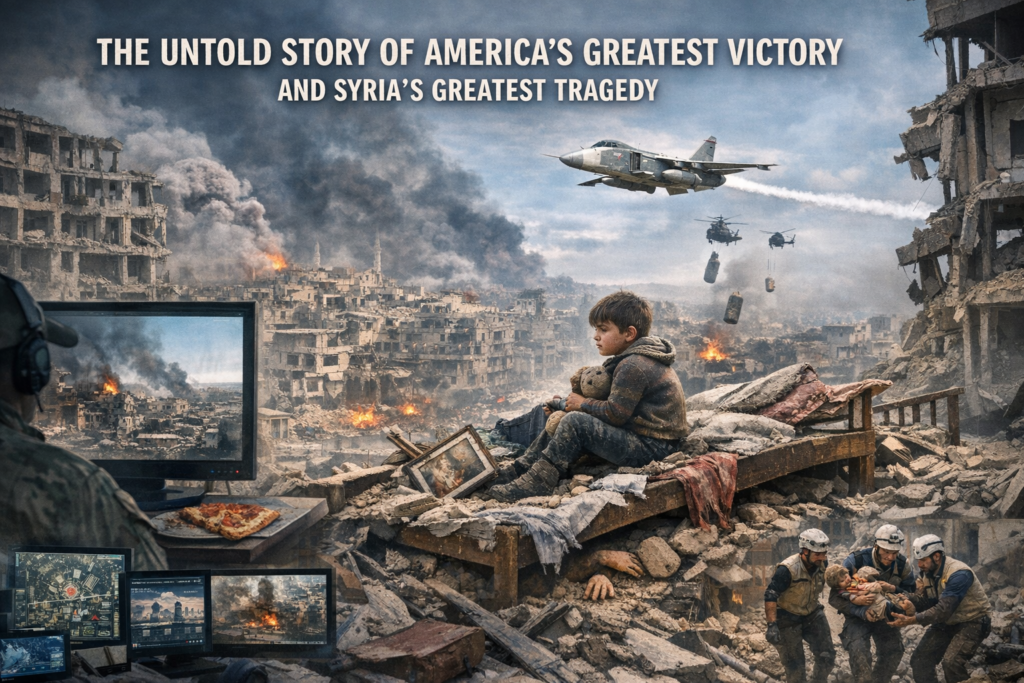
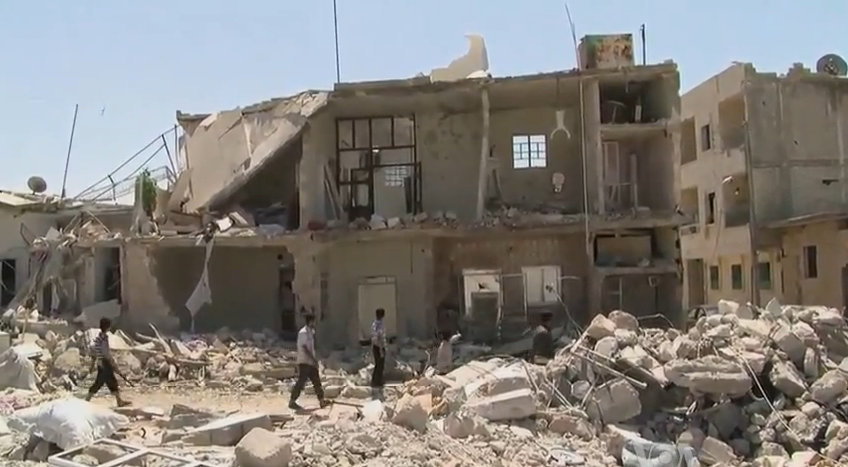
There is a situation you need to imagine. It shows a Syrian boy sitting alone in the rubble of what was once his bedroom. Around him, the skeleton of a twenty-story apartment building groans in the wind. Somewhere below, his family is dead. Above him, a Russian SU-24 streaks across the sky, trailing the white kiss of a contrail. Somewhere in Virginia, an American drone operator watches this entire scene unfold on a flatscreen monitor, 6,000 miles away, eating cold pizza. This is not Stalingrad. Stalingrad had no live stream. Stalingrad had no Twitter hashtags. Stalingrad had no geolocation analysts triangulating bomb craters from their basement apartments in Bethesda. And yet, between 2012 and 2016, Aleppo became Stalingrad; not in spite of these technologies, but because of them. Welcome to the 21st century’s most destructive ancient siege. Welcome to the paradox that will define every urban battle for the next fifty years. Welcome to Aleppo.
1. THE DEFINING PARADOX
“The 21st Century’s Most Destructive Ancient Siege”
Stalingrad and Aleppo are not twins separated by seventy years. They are something far more disturbing: the same ghost, haunting different centuries, dressed in radically different clothes. In 1942, the Red Army held Stalingrad because the Volga River froze solid enough to march supply convoys across the ice. In 2016, the Syrian Arab Army held Aleppo because the Castello Road; a six-lane highway became a kill zone where every tomato truck required an armor-plated escort and a prayer. The comparison that matters is not about technology. It is about totality. Stalingrad consumed an entire nation’s will. Hitler demanded it not because it held strategic value it did not, by late 1942 but because its very name carried the weight of his enemy’s ideology. Stalin ordered it held for the same reason. The city became an abstraction: two men wrestling over a word. Aleppo became the same thing. “He who controls Aleppo controls Syria,” Aris Roussinos observed during the siege. By 2015, the city had ceased to be a functional urban center. It was a theater of symbolic annihilation. Assad could not afford to lose it not because Aleppo contained anything of material value anymore, but because losing Aleppo meant proving that the rebellion could hold Syria’s largest city for four years and survive. The rebels could not afford to abandon it not because they could win there, but because surrendering Aleppo meant admitting that the revolution had failed.
This is the first paradox: the symbolic weight of cities in the 21st century has increased in inverse proportion to their economic utility. We bomb them precisely because they no longer matter as centers of commerce. They matter only as icons. But here is the deeper paradox, the one that should keep strategists awake at night: In 1942, the absence of precision weapons meant that destroying a city required enormous industrial effort. The Luftwaffe bombed Stalingrad for six weeks with thousands of sorties. In 2016, the Syrian Air Force achieved greater urban destruction with a single Mi-8 helicopter and a modified oil drum than Hitler’s entire Condor Legion achieved in Guernica. The technology that could have saved Aleppo precision guidance, real-time intelligence, drone surveillance was either withheld or actively weaponized against its population.
Consider this: The same satellites that Google Maps uses to help you find coffee shops were repurposed by the AAAS to document the systematic destruction of Aleppo’s UNESCO World Heritage sites . The same geolocation algorithms that power Uber were used by opposition activists to document war crimes and by regime intelligence to locate those activists and bomb their apartments. This is the central irony: We have invented technologies that make urban warfare more visible, more documented, more transparent than ever before in human history. And yet this visibility has produced not intervention, but spectatorship. The world watched Aleppo die on Instagram. And then it kept scrolling.
2. TACTICAL EVOLUTION
Aleppo was not one battle. It was three battles, fought simultaneously, on three distinct layers of existence. To understand why modern armies cannot solve the city fight, you must understand how these layers interacted and how they fundamentally broke the grammar of conventional warfare. Here is something the Wehrmacht never faced: the enemy livestreaming your artillery impacts to 50,000 followers. Social media in Aleppo was not an after-action report. It was a primary weapon system.
For the opposition: YouTube and Twitter served as their air force. Unable to contest the skies, they contested the narrative. Every barrel bomb strike was filmed, timestamped, geolocated, and uploaded within minutes. Civil defense volunteers the White Helmets built an entire operational doctrine around GoPro cameras. Their rescue footage became the single most effective propaganda weapon of the war, not because it was slickly produced, but because it was unbearably raw: a toddler pulled from concrete, still wearing the pajamas his mother dressed him in four hours earlier.
For the regime and its allies: This same ecosystem became a targeting grid.
This cannot be overstated: rebels and activists were killed because of the metadata in their own photographs. Geolocation analysts both Russian military intelligence and freelance open-source investigators triangulated positions from shadows, from building facades, from the curvature of window frames visible in background shots. A photograph posted at 2:47 PM showing damage from a morning strike often contained enough information to pinpoint the uploader’s location within five meters. Artillery strikes frequently followed within the hour.
The digital layer did not democratize warfare. It gamified targeting. The global narrative battleground was equally transformative and equally perverse. Both sides spoke directly to international audiences, bypassing traditional media gatekeepers. The regime’s information operations presented a city “liberated from terrorists.” The opposition presented a city “massacred by a tyrant.” Both were true. Both were incomplete. And the constant collision of these competing truths produced something unprecedented: a war fought simultaneously on physical terrain and on the screens of millions of people who would never visit Syria but developed passionate convictions about its fate.
This had a profoundly distorting effect. Military operations were now staged for cameras. The timing of offensives shifted to accommodate Western news cycles. The final evacuation of East Aleppo in December 2016; the “Green Buses” was as much a piece of visual propaganda as it was a tactical withdrawal. Both sides understood that the photographs of those buses would define the historical memory of the siege. Stalingrad had war correspondents. Aleppo had everyone.
Return of the Tunnel Rats
Now descend. Leave the screaming headlines and the retweet counts. Descend twenty meters, into the dark. Tunnel warfare in Aleppo was not an innovation. It was an exhumation. The rebels dug because they had no choice. Above ground, the Syrian Air Force owned the sky. Barrel bombs fell at will. Artillery destroyed anything that moved on the surface. The only way to move men, supplies, and weapons without being annihilated was to move beneath. The tunnels of Aleppo hand-dug with pickaxes and rented jackhammers extended for kilometers. Some were logistical arteries, connecting besieged neighborhoods to dwindling supply caches. Some were command bunkers, buried under forty feet of reinforced concrete, immune to all but the largest thermobaric bombs. And some were offensive weapons.
The Islamic Front’s tunnel engineers accomplished something that conventional military analysts had declared impossible: they negated airpower. Between 2014 and 2016, rebel sappers dug beneath regime-held positions, packed chambers with hundreds of tons of explosives, and detonated them with devastating effect. The July 2015 attack on the Air Force Intelligence HQ; a complex that had survived countless airstrikes collapsed into a crater the size of a city block when 400 tons of explosives detonated beneath it .
Was this antiquity or innovation?
It was both. The tactic itself is ancient; the Romans used tunnels to breach fortified cities. But the context was radically new. These tunnels were not dug to bypass stone walls. They were dug to bypass the entire technological apparatus of 21st-century air dominance. The regime had satellites, drones, attack helicopters, and precision-guided munitions. The rebels had shovels, patience, and the willingness to die in darkness.
This is the lesson of Aleppo’s subterranean layer: asymmetric warfare finds a way. No matter how complete your air superiority, you cannot bomb what you cannot see. And you cannot see what is twenty meters beneath the surface, moving silently through hand-carved passages that do not appear on any satellite imagery. The regime’s response thermobaric “bunker buster” bombs designed to suck oxygen from underground spaces was technically effective but strategically revealing. They needed weapons designed to kill tunnel fighters because conventional weapons could not reach them. The defender had forced the attacker to escalate, not to a higher technology, but to a different category of technology entirely.
The Barrel Bomb Economy
Now ascend. Return to the sky. Look down at the helicopter. It is a Mi-8 transport helicopter, circa 1983. It has no targeting computer. It has no precision guidance. It has no smart munitions. What it has is a crew chief standing in the open cargo door, shoving an oil drum filled with TNT and scrap metal into the slipstream. This is the most important weapon system of the Battle of Aleppo. The barrel bomb is not a weapon of precision. It is not even, strictly speaking, a weapon of war as defined by most international humanitarian law frameworks. It is an improvised explosive device, scaled up by three orders of magnitude, delivered from altitude.
Why barrel bombs? Why not precision-guided munitions? The answer reveals the regime’s entire operational doctrine.
Cost. A single US-made Paveway laser-guided bomb costs approximately $25,000. A barrel bomb costs approximately $300. The regime dropped an average of 107-barrel bombs per month on Aleppo between April and July 2014 alone. At Western precision munition prices, that tempo would have been financially impossible. At barrel bomb prices, it was merely industrial-scale murder.
Psychology. Precision weapons kill specific targets. Barrel bombs kill everyone. The whistle of an oil drum descending through 5,000 feet of air is distinctive, terrifying, and impossible to ignore. It does not matter if the bomb lands on your building or your neighbor’s; what matters is that you heard it, you froze, and you spent the next three minutes waiting for the explosion. This is not counterinsurgency. It is population clearance through terror.
Area denial. Precision weapons are surgical; they remove a target while preserving the surrounding environment. This is useful if you intend to govern the territory after the battle. The Assad regime did not intend to govern East Aleppo. It intended to depopulate East Aleppo. Barrel bombs do not remove enemy combatants; they remove the conditions under which human life can continue. They crater streets. They collapse apartment blocks. They shred water pipes and electrical lines. They make cities uninhabitable.
The contrast with Western precision doctrine could not be starker. When coalition forces fought in Mosul (2016-2017), they expended enormous resources on precision guidance to minimize civilian casualties. This was not purely humanitarian; it was also strategic. The Iraqi government needed to govern Mosul after its liberation. A city reduced to rubble cannot be governed. The Assad regime faced no such constraint. Its goal was not to win the allegiance of Aleppo’s population; its goal was to eliminate that population as a political and military factor. Barrel bombs were not a failure of capability. They were a doctrinal choice, a deliberate rejection of precision in favor of terror, area denial, and demographic transformation.
3. WEAPON INNOVATION AND THE REJECTION OF PRECISION
Thermobaric bombs. “Poor man’s nukes” . These weapons function by dispersing an aerosol cloud of fuel, which ignites and creates a sustained blast wave that propagates through enclosed spaces. They do not blow buildings apart; they suffocate everyone inside, then crush the structure with negative pressure. In a tunnel, a thermobaric detonation creates an overpressure wave that travels at supersonic speed, rounding corners, following ventilation shafts, killing people who never heard the explosion.
Cluster munitions. Prohibited by international convention. An air-dropped canister opens at altitude and releases hundreds of “bomblets” across a wide area. Some detonate on impact. Others up to 40 percent, in some variants fail to detonate and remain on the ground, indistinguishable from debris, waiting for a child to pick them up.
Incendiary weapons. White phosphorus. Napalm. Designed to start fires that cannot be extinguished. White phosphorus burns at 5,000 degrees Fahrenheit and adheres to skin and bone. It has a legitimate military use for generating smokescreens. In Aleppo, it was used against apartment buildings.
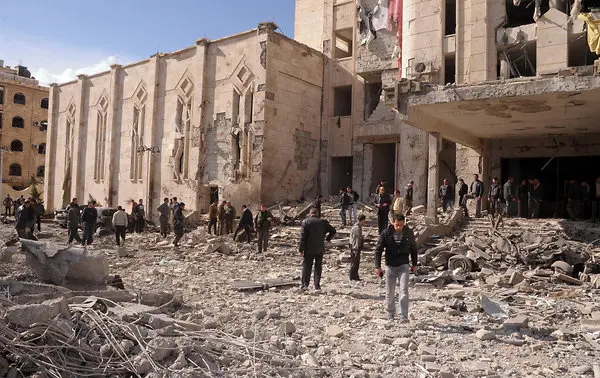
This is the uncomfortable truth that Western military doctrine refuses to confront. The regime “solved” the urban fight. It took four years, enormous casualties, and the systematic destruction of a UNESCO World Heritage city, but the Syrian Arab Army supported by Russian airpower and Iranian militias successfully recaptured Aleppo. The method was not subtle. It did not involve counter-insurgency theory or “clear, hold, build” operations. It involved artillery, airstrikes, and siege warfare. The regime did not “clear” East Aleppo; it annihilated East Aleppo. When the final evacuation occurred in December 2016, the departing rebels and civilians walked through corridors of complete devastation neighborhoods where not a single intact building remained standing. This is not a military failure. It is a political and moral choice.
Western armies have not adopted this approach because they are constrained by domestic legal systems, international treaties, and the expectations of their populations. They cannot drop barrel bombs on civilian neighborhoods and remain liberal democracies. They cannot use thermobaric weapons against urban apartment blocks and maintain the moral authority necessary to wage counter-insurgency campaigns.
But the question remains: If a decisive military “solution” to urban warfare exists witness Grozny (1999-2000), witness Aleppo (2016) and it simply requires the suspension of moral constraint, how long will Western democracies maintain that constraint when facing adversaries who do not share it?
4. THE HUMAN COST
Urban Warfare as Sociocide
We must move beyond casualty numbers. Not because the numbers are unimportant; they are not. The UN estimates that tens of thousands died in Aleppo. But numbers abstract suffering into statistics. To understand what urban warfare actually means for civilians, we must understand the systematic weaponization of everyday life. Consider the hospitals. Between 2012 and 2016, Aleppo’s health infrastructure was deliberately and repeatedly targeted. The regime bombed hospitals not because they contained military assets they did not but because destroying medical care accomplished two objectives simultaneously: it denied the enemy the ability to treat wounded fighters, and it convinced civilians that remaining in the city meant accepting death without medical recourse. The bombing of Al-Quds Hospital in 2016 was not a targeting error. It was a message: There is nowhere safe. There is no sanctuary. Even the place you go to die is not protected.
Consider the bakeries. Bread is life in Aleppo. The city’s eastern districts, under siege, depended on a network of neighborhood bakeries running on dwindling fuel supplies. These bakeries were systematically targeted by airstrikes and artillery. Not because they were command centers. Because hunger breaks populations faster than bombs. The siege protocol was medieval in its precision: control the Castello Road, the last supply route into East Aleppo. Allow enough food to prevent outright mass starvation that would trigger international intervention. But never enough. Always just below subsistence. A population slowly weakening, slowly despairing, slowly concluding that surrender is the only remaining option.
This is what urban warfare means for civilians. It means the city itself becomes a trap. You cannot leave because the exit roads are sniper alleys. You cannot stay because the bombs are falling faster. You cannot hide because the tunnels are crowded and collapsing. You cannot fight because you are a pediatrician, not a soldier, but the pediatrician in the next building was killed last week by shrapnel through his kitchen window, and someone needs to treat the children. By December 2016, when the final evacuation deal was negotiated, East Aleppo had been reduced from 250,000 residents to approximately 40,000. The rest had fled, been killed, or been trapped in the shrinking pocket of territory that the regime had not yet recaptured. The “Green Buses” that carried them out of the city were not rescue vehicles; they were deportation transports, removing a hostile population from territory the state intended to control. This is sociocide: the deliberate unmaking of a society through the destruction of the physical and institutional fabric that enables social life to continue.
5. THE ENDURING MILITARY LESSON
General Stephen Townsend, commander of coalition forces during the Battle of Mosul, stood before British military leaders in 2018 and said something extraordinary: “Future wars will be more Stalingrad than Star Wars.” He warned that advanced weapons are “largely useless” in urban battles. He described bunker-buster bombs shaking collapsed buildings without killing the fighters hidden in the basements. He asked coalition partners if any army still used flamethrowers, because conventional weapons could not reach ISIS fighters buried beneath fifty feet of rubble. This is the confession of a man who has seen the future of warfare and found it terrifying. Why do modern armies still “fail” to solve the city fight? Because the city fight is not a tactical problem. It is a political, moral, and demographic problem masquerading as a tactical problem.
Tactically, the solution is straightforward:
- Surround the city.
- Deny all supply routes.
- Bomb anything that moves.
- Continue until the enemy surrenders or dies.
This is the Grozny Doctrine. This is the Aleppo Model. It works. It has always worked. It will continue to work. But it works by destroying precisely what you are trying to save. A liberal democracy cannot adopt the Aleppo Model and remain a liberal democracy. An army that uses barrel bombs against civilian neighborhoods is not an army; it is an occupation force. A state that deliberately starves its own population to defeat an insurgency is not a state; it is a criminal enterprise. This is the insoluble dilemma of 21st-century urban warfare: The military solution exists, but it is politically and morally unacceptable. The politically acceptable solution precision warfare, minimal civilian casualties, counter-insurgency through population protection has not worked since Vietnam and shows no signs of beginning to work now. We are trapped between effectiveness and legitimacy, and we have not yet found a way out.
CONCLUSION
Let us end where we began: with a paradox.
The Aleppo Equation:
In a contested city where Side A possesses total air dominance and has rejected the principles of proportionality and distinction, and Side B is deeply embedded in the urban fabric and willing to absorb catastrophic casualties.
The possible outcomes are two:
1. Stalemate. The defender holds. The attacker cannot dislodge them without unacceptable casualties. The front line freezes. The city divides. This describes Aleppo from 2012-2015.
2. Annihilation. The attacker escalates to total warfare. The city is systematically destroyed. The defender is killed, captured, or expelled. The population flees or is deported. The attacker “wins” a city that no longer functions as a city. This describes Aleppo in 2016.
There is no third outcome. Precision warfare does not produce a third outcome. Counter-insurgency doctrine does not produce a third outcome. International law does not produce a third outcome. Humanitarian intervention does not produce a third outcome because humanitarian intervention did not occur.
What does this mean for future urban conflicts in megacities?
Consider this: By 2030, the world will have 60 megacities urban agglomerations of 10 million people or more. Two-thirds of the global population will live in urban areas. The density that defines these cities is the same density that makes them indefensible under the laws of war. A single thermobaric bomb detonated in a Mumbai high-rise would kill more people than died in the entire Battle of Aleppo. A barrel bomb campaign against Dhaka would produce refugees measured in millions, not thousands. The Aleppo Equation, scaled to megacity proportions, becomes not a humanitarian crisis but a civilizational catastrophe. We have not prepared for this. We have invested billions in drone technology, satellite surveillance, and precision guidance. We have neglected the basic tactical problems of urban combat: how to clear a room, how to distinguish combatants from civilians, how to fight in a city without destroying it. We have assumed that technology would solve the problems that technology itself has created.
Aleppo proves otherwise. The city is the ultimate defensive bastion. It is the ultimate political trap. It is the ultimate argument against the idea that war can be clean, precise, and humane. Four years of siege, 107 barrel bombs per month, 60 percent of the Old City severely damaged, 30 percent completely destroyed . And at the end of it, a “victory” that produced nothing except rubble, refugees, and the knowledge that we will do this again. The ghost of Stalingrad does not haunt us because we have forgotten the lessons of 1942. It haunts us because we have learned them all too well.
As of February 2026; the war in Syria has not ended. Aleppo has fallen again, this time to opposition forces, and the UN reports that 900,000 people in and around the city require urgent humanitarian assistance. The fighting continues. The barrel bombs have not stopped. The Aleppo Equation remains unsolved.