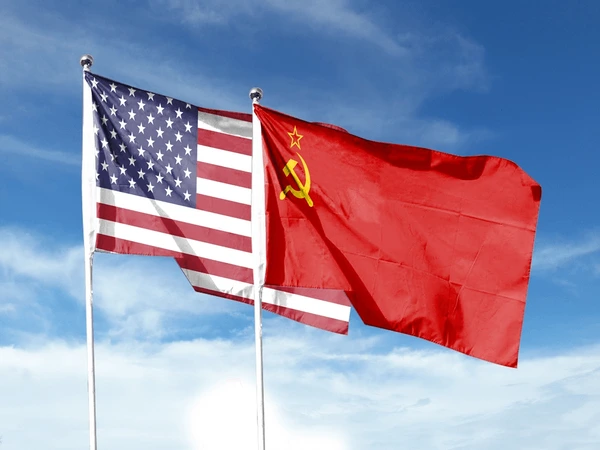
“Two superpowers. One planet. Zero room for compromise. Between 1947 and 1991, the world held its breath.”
Imagine waking up every morning knowing that two nations each armed with enough nuclear warheads to destroy civilization multiple times over were locked in a contest that could end all of human history with a single miscalculation. This was not a sci-fi thriller. This was Tuesday, circa 1962.
The Cold War was not a war in the conventional sense. No American soldier ever fired a bullet directly at a Soviet soldier in uniform on a declared battlefield. And yet, it was arguably the most consequential conflict the modern world has ever witnessed. It reshaped continents, birthed technologies we use every day, funded dictators, toppled democracies, launched humanity into space, built the internet, and ultimately cracked the Soviet Union apart like a glacier under its own impossible weight.
This is the story of that conflict told not just as history, but as the living architecture of the world we inhabit today. From nuclear arsenals to satellite espionage, from proxy wars in jungles to propaganda battles in living rooms, from financial warfare to the race to the moon the Cold War touched everything. And its echoes still thunder across geopolitics, military doctrine, cyberspace, and culture in the twenty-first century.
THE ORIGINS: HOW TWO ALLIES BECAME ARCH ENEMIES
The Post-War World Order and the Seeds of Rivalry
To understand the Cold War, you must first understand what the world looked like in the ashes of World War II. In 1945, the planet was exhausted, shattered, and desperately searching for order. Two nations emerged from that carnage as the undeniable victors the United States and the Soviet Union. Together, they had crushed Nazi Germany and Imperial Japan. Together, they had saved civilization. And within two years of that triumph, they were bitter enemies staring each other down across an ideological abyss.
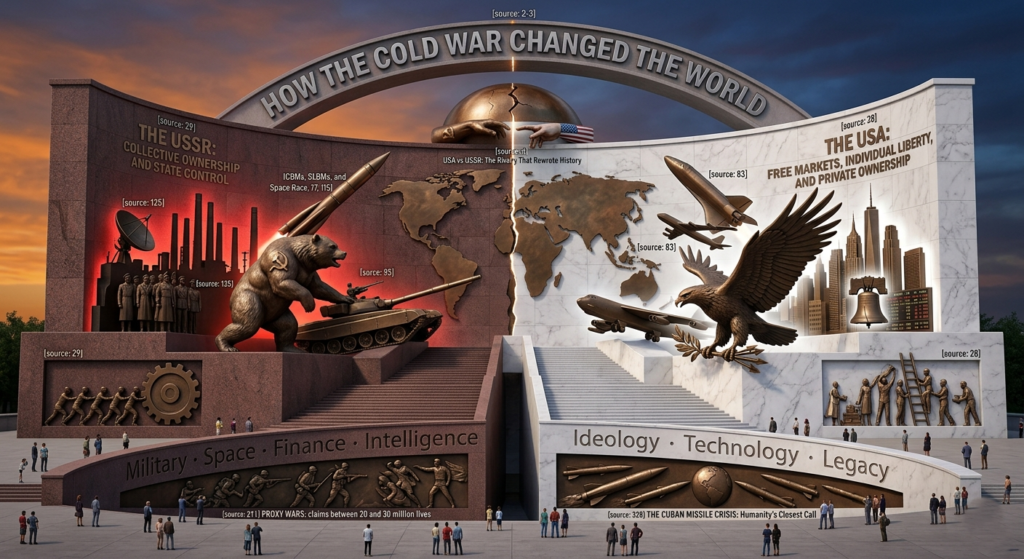
How does that happen? The short answer: it was always coming. The alliance of WWII was one of wartime convenience, not ideological kinship. The United States was the world’s foremost capitalist democracy; a system built on free markets, individual liberty, and private ownership. The Soviet Union was the world’s first and most powerful communist state; a system built on collective ownership, centralized planning, state control, and a rejection of everything capitalism represented. These weren’t just policy differences. They were civilizational worldviews and in a world suddenly carved into spheres of influence, every patch of land, every newly independent nation, every political election in every country suddenly became a battleground for which model would prevail.
Yalta, Potsdam, and the Division of Europe
The formal architecture of Cold War division was laid at two conferences: Yalta (February 1945) and Potsdam (July 1945). At Yalta, Roosevelt, Churchill, and Stalin carved up the post-war world with a combination of diplomatic niceties and raw power politics. Stalin secured Soviet influence over Eastern Europe in exchange for promises of free elections promises the Soviets never kept. By the time of Potsdam, Roosevelt was dead, replaced by the more suspicious Harry Truman, and the warm wartime partnership had already begun to cool. Germany was divided into occupation zones. Berlin, deep inside Soviet-controlled East Germany, was itself split four ways. The blueprints for a divided Europe and a divided world were being drafted with every handshake and every broken promise. Winston Churchill famously described it in March 1946 in his Fulton, Missouri speech: ‘From Stettin in the Baltic to Trieste in the Adriatic, an iron curtain has descended across the Continent. That phrase: Iron Curtain became the defining metaphor of an era.
The Truman Doctrine and the Marshall Plan: America’s First Moves
The United States wasted no time establishing its Cold War strategy. President Truman, alarmed by Soviet expansionism in Greece and Turkey, went before Congress in March 1947 and articulated what became known as the Truman Doctrine: The United States would support free peoples who were resisting subjugation by armed minorities or by outside pressures. This was an open ended commitment essentially a blank check for American intervention anywhere communism threatened to spread.
Paired with this was the Marshall Plan (1948), perhaps the most strategically brilliant act of American foreign policy in the twentieth century. The US offered approximately $13 billion (over $150 billion in today’s money) in economic aid to rebuild war-devastated Western Europe. The genius was dual: it rebuilt allies, and it made Western capitalism look enormously attractive compared to Soviet-style poverty. The Soviets furiously pressured their Eastern European satellites to reject Marshall Plan aid, and most did, at tremendous cost to their own populations. The ideological battle lines were now drawn. The contest had begun.
THE MILITARY DIMENSION
The Nuclear Arms Race: Counting Warheads Like Coins
Nothing defined Cold War military competition more viscerally than the nuclear arms race. It began on August 6, 1945, when the United States dropped ‘Little Boy’, a uranium bomb with a yield of approximately 15 kilotons on Hiroshima, Japan. Three days later, ‘Fat Man,’ a plutonium implosion device, leveled Nagasaki. In an instant, the nature of warfare was transformed forever.
The Soviets understood the implications immediately. Stalin accelerated their own nuclear program with ruthless urgency, pouring resources into it and benefiting enormously from espionage the Cambridge Five spy ring, the Rosenbergs, and numerous other intelligence assets gave Soviet scientists critical insights. On August 29, 1949, years ahead of American projections, the USSR detonated ‘First Lightning’ (RDS-1), their first nuclear bomb. The arms race that followed was one of the most terrifying escalatory spirals in human history:
1952: USA tests first thermonuclear (hydrogen) bomb: yield: 10.4 megatons (700x Hiroshima).
1953: USSR tests its first thermonuclear device (RDS-6s) just nine months later.
1961: USSR detonates Tsar Bomba: 50 megatons, the most powerful weapon ever detonated.
Peak US arsenal (1967): ~31,255 nuclear warheads.
Peak USSR arsenal (1986): ~45,000 nuclear warheads.
Combined peak: Over 70,000 nuclear weapons capable of destroying humanity dozens of times over.
The Tsar Bomba deserves special attention. Detonated on October 30, 1961, over Novaya Zemlya Island in the Arctic, this device released a blast equivalent to 50 million tons of TNT. The fireball was nearly 5 miles across. The shockwave circled the Earth three times. Windows were shattered 900 kilometers away. It was not a weapon of war; it was a geopolitical statement. A demonstration of Soviet power so overwhelming it defied rational military use. It was terror as policy.
Delivery Systems: The Nuclear Triad
Building bombs was only half the equation. Delivering them reliably, at intercontinental range, through any conceivable defense was the other half. Both superpowers developed what became known as the nuclear triad: three independent delivery systems ensuring that no first strike could eliminate the opponent’s ability to retaliate.
1. Intercontinental Ballistic Missiles (ICBMs)
Land-based ICBMs housed in hardened underground silos became the backbone of both arsenals. The US Minuteman III could deliver a 335-kiloton warhead to any point on Earth within 30 minutes of launch. The Soviet SS-18 ‘Satan’ perhaps the most feared weapon of the Cold War carried up to 10 independently targeted warheads (MIRV technology), each with a yield of 500-750 kilotons, and had the accuracy to target hardened missile silos. At its peak, the SS-18 threatened to make land-based US missiles obsolete in a first strike scenario.
2. Submarine-Launched Ballistic Missiles (SLBMs)
Nuclear-armed submarines prowling the world’s oceans provided the ultimate retaliatory capability. Virtually impossible to track and destroy simultaneously, ballistic missile submarines (SSBNs) guaranteed the horror of mutually assured destruction. The US Ohio-class submarine could carry 24 Trident II D5 missiles, each with up to 8 warheads a single submarine carrying more destructive power than was used in all of World War II. The Soviets’ Typhoon-class the largest submarine ever built was their equivalent, displacing 48,000 tons submerged.
3. Strategic Bombers
Long-range bombers completed the triad. The US B-52 Stratofortress, entering service in 1955 and still flying today, was designed to penetrate Soviet airspace and deliver nuclear bombs. The Soviets countered with the Tu-95 Bear, a turboprop-powered bomber that remains in service to this day. Later, both sides developed supersonic bombers, the US B-1 Lancer and the Soviet Tu-160 Blackjack capable of low-level supersonic dashes to evade radar.
Conventional Military Forces: NATO vs. the Warsaw Pact
While nuclear weapons grabbed headlines, both superpowers also assembled the largest conventional military forces in history, particularly focused on the Central European front where a potential Warsaw Pact invasion of Western Europe was the constant nightmare scenario for NATO planners.
The Warsaw Pact, formalized in 1955 in response to West Germany joining NATO, was the Soviet-led military alliance of Eastern European satellite states. On paper, its conventional military advantage over NATO was staggering: some estimates suggested Warsaw Pact forces had 2:1 or even 3:1 advantage in tanks, artillery, and troops in Central Europe. NATO strategists faced with the prospect of being overrun by Soviet armor in the Fulda Gap developed the doctrine of flexible response, which explicitly reserved the right to use tactical nuclear weapons to stop a conventional Soviet advance. This was the doctrine that made Europe itself a potential nuclear battlefield a prospect that haunted European governments and drove massive anti-nuclear protest movements throughout the 1980s.
Key Military Technologies That Defined the Cold War
- M1 Abrams vs. T-72/T-80: The tank rivalry that never met on a European battlefield but defined armored warfare doctrine.
- F-15/F-16 vs. MiG-29/Su-27: Air superiority fighters whose design philosophies diverged radically the US prioritizing air-to-air missiles, the Soviets raw maneuverability.
- Stealth technology: The F-117 Nighthawk and B-2 Spirit emerged from Cold War black programs, rendering conventional air defenses obsolete.
- Anti-ballistic missiles: Both sides attempted to build shields against nuclear attack the US Nike Hercules system, the Soviet Galosh ABM around Moscow.
- Precision-guided munitions: ‘Smart bombs’ emerged from Cold War research and transformed conventional warfare doctrine.
- Early warning systems: DEW Line, BMEWS, and eventually satellite-based detection systems designed to give 15-30 minutes warning of nuclear attack.
Doctrine of Mutually Assured Destruction (MAD)
“We may be likened to two scorpions in a bottle, each capable of killing the other, but only at the risk of his own life. — J. Robert Oppenheimer”
MAD was not just an acronym that happened to be appropriate. It was the foundational strategic doctrine that kept the Cold War from becoming a hot one. The logic was grimly elegant: if both sides possessed enough nuclear weapons to absorb a first strike and still destroy the attacker with retaliatory strikes, then launching a nuclear war meant guaranteed self-annihilation. Therefore, no rational actor would launch. Deterrence through terror.
The problem with MAD was that it depended on rationality and on accurate information. The closer we look at Cold War history, the more we realize how many times accidents, miscommunications, and technical failures nearly triggered the apocalypse by accident. In 1983, Soviet Lt. Col. Stanislav Petrov was on duty at a nuclear early warning center when his systems detected five US Minuteman missiles inbound. Protocol required him to report an attack immediately. Petrov hesitated. Something felt wrong — a real attack would involve hundreds of missiles, not five. He reported a system malfunction. He was right: it was a computer error caused by sunlight reflecting off clouds. His personal judgment may have prevented nuclear war.
In that same year, during the NATO exercise Able Archer 83, Soviet intelligence was so convinced the exercise was cover for an actual nuclear first strike that KGB agents in Western Europe were ordered to watch for last-minute indicators of real attack. Soviet nuclear forces were placed on elevated alert. The world was, according to some historians, genuinely close to accidental nuclear war.
THE SPACE RACE: COMPETING FOR THE HEAVENS
The Space Race was not primarily about scientific curiosity. It was about ballistic missiles, national prestige, and proving whose system, capitalism or communism was technologically superior. Space and missile technology were the same technology. A rocket that could launch a satellite could launch a nuclear warhead. The country that dominated space would dominate the military high ground of the future. The psychological dimension was equally critical. In the bipolar world of the Cold War, every technological achievement was propaganda. Every satellite launched, every astronaut spacewalked, every moon landing was a global advertisement for the superiority of one ideology over the other. The early Space Race was, to American dismay, dominated almost entirely by the Soviet Union. The list of Soviet firsts is genuinely staggering:
October 4, 1957: Sputnik 1; first artificial satellite in Earth orbit. The beeping radio signal heard worldwide shook American confidence to its core.
November 1957: Sputnik 2; first living creature in orbit (Laika the dog). Soviets had not yet developed re-entry technology; Laika did not survive.
April 12, 1961: Yuri Gagarin; first human in space, completing one orbit of Earth in Vostok 1.
June 1963: Valentina Tereshkova; first woman in space (US would not send a woman until 1983).
March 1965: Alexei Leonov; first spacewalk (18 minutes outside Voskhod 2).
1966: Luna 9; first spacecraft to achieve soft landing on the Moon.
The Sputnik moment was genuinely traumatic for the American public and government. If the Soviets could put a satellite in orbit, they could put a nuclear warhead anywhere on Earth. Congress panicked. The National Defense Education Act was rushed through, pouring funding into science and mathematics education. NASA was created from scratch in 1958. The space race was on with maximum urgency.
The American Response: Apollo and the Moon Landing
President Kennedy’s declaration before Congress in May 1961 committing the United States to landing a man on the Moon and returning him safely to Earth before the end of the decade was one of the most audacious public commitments any government had ever made. At the time it was made, America had approximately 15 minutes of manned spaceflight experience. What followed was arguably the greatest technological mobilization in human history. At its peak, the Apollo program employed over 400,000 engineers, scientists, and technicians. It consumed roughly 4% of the total US federal budget. It required solving problems that had never been solved before, in computing, materials science, life support, navigation, rocketry, and dozens of other fields.
On July 20, 1969, Neil Armstrong descended the ladder of the Lunar Module Eagle and set foot on the surface of the Moon. Watched by an estimated 600 million people worldwide roughly one in five humans alive at the time it was the ultimate Cold War statement. American capitalism, American technology, American ambition had planted a flag on another world while Soviet communism watched from Earth. The Soviets, who had their own secret Moon program (the N1 rocket), never publicly acknowledged the race. The N1 program was plagued by catastrophic failures all four launch attempts ended in explosions, including the largest non-nuclear explosion in history when an N1 launched with a full fuel load destroyed its own launch pad. The program was quietly cancelled in 1974.
The Space Race Legacy
The Cold War Space Race produced technologies whose civilian applications now underpin modern civilization. This is perhaps the most underappreciated dimension of Cold War competition:
- GPS (Global Positioning System): Developed by the US military for ballistic missile navigation and military positioning. Now used by billions of people daily for navigation, logistics, and timing systems.
- Satellite communications: Military communication satellites evolved into the global telecom infrastructure underpinning television, internet, and phone networks.
- Weather forecasting: Military reconnaissance satellites pioneered Earth observation. Today’s weather forecasting saving hundreds of thousands of lives annually traces directly to Cold War satellite programs.
- Miniaturized electronics: The demands of space and missile programs drove the development of integrated circuits and eventually microprocessors the foundation of all modern computing.
- Memory foam, scratch-resistant lenses, water filtration: NASA innovations transferred to consumer markets.
- Freeze-dried food: Developed for astronaut nutrition, now ubiquitous in emergency preparedness and camping.
- Velcro: While not strictly a NASA invention, its widespread adoption was driven by the space program’s needs.
The internet itself is the defining technology of the modern era traces directly to ARPANET, a US Defense Advanced Research Projects Agency (DARPA) project designed to create a communications network that could survive a nuclear attack. The Cold War, in its paranoid brilliance, accidentally built the information age.
INTELLIGENCE WARS: SHADOWS, SPIES, AND SECRETS
The CIA vs. KGB: The World’s Greatest Spy Rivalry
If the military was the hard power of the Cold War, intelligence agencies were its nervous system. The Central Intelligence Agency (CIA), established in 1947, and the Soviet Committee for State Security (KGB), established in 1954, became the instruments through which both superpowers waged war in the shadows recruiting agents, stealing secrets, conducting covert operations, running disinformation campaigns, and occasionally assassinating enemies.
The KGB at its peak employed an estimated 480,000 personnel; security, intelligence, and border guards combined with a global network of agents, informants, and influence operations spanning every continent. Its domestic function was equally significant: monitoring Soviet citizens, suppressing dissent, running the Gulag system, and maintaining the surveillance state that kept the Communist Party in power. The CIA, though smaller in domestic mandate, was granted extraordinary latitude for foreign operations including some that, in hindsight, were deeply troubling and counterproductive.
Major CIA Covert Operations
Operation AJAX (Iran, 1953)
The CIA and British MI6, alarmed by Iranian Prime Minister Mohammad Mosaddegh’s nationalization of the Anglo-Iranian Oil Company, orchestrated a coup that overthrew him and restored the Shah Mohammad Reza Pahlavi to power. The operation succeeded brilliantly in the short term. The long-term consequences; the 1979 Islamic Revolution, the hostage crisis, and decades of anti-American sentiment in Iran were catastrophic.
Operation PBSUCCESS (Guatemala, 1954)
When Guatemalan President Jacobo Arbenz Guzman moved to nationalize land owned by the United Fruit Company (in which CIA Director Allen Dulles held a personal financial interest, a scandal buried for decades), the CIA organized a paramilitary coup. Arbenz was overthrown. Guatemala descended into 36 years of civil war, killing over 200,000 people.
Bay of Pigs (Cuba, 1961)
One of the CIA’s most spectacular failures. An invasion by CIA-trained Cuban exiles intended to trigger a popular uprising against Fidel Castro collapsed within 72 hours. Kennedy refused to provide air cover, leaving the 1,400 invaders stranded on the beach. The humiliation directly contributed to Castro’s decision to invite Soviet nuclear missiles to Cuba, setting up the most dangerous crisis of the Cold War.
Operation Cyclone (Afghanistan, 1979-1989)
The CIA’s longest and most expensive covert operation funded, armed, and trained the Mujahideen fighters resisting the Soviet invasion of Afghanistan. At its peak, the program channeled over $630 million per year in weapons and support through Pakistani intelligence (ISI). It succeeded: the Soviets withdrew in 1989, having lost approximately 15,000 soldiers and billions in equipment in what became their Vietnam. The blowback was catastrophic: many of the CIA-trained and equipped fighters became the Taliban and Al-Qaeda.
KGB Operations and Influence Campaigns
The KGB’s operations were equally audacious. Their ACTIVE MEASURES program; dezinformatsiya, was perhaps the most sophisticated influence operation in history. The KGB planted forged documents, manipulated media narratives, funded and directed front organizations, and manufactured political chaos in target countries.
- Operation INFEKTION (1980s): A KGB disinformation campaign that successfully spread the narrative through African and Indian newspapers that AIDS was a US military biological weapon created at Fort Detrick, Maryland. The story circulated in over 80 countries.
- Recruitment of the Cambridge Five: Kim Philby, Guy Burgess, Donald Maclean, Anthony Blunt, and John Cairncross five British establishment figures recruited at Cambridge University who fed Soviet intelligence for decades, compromising numerous Western intelligence operations.
- Aldrich Ames and Robert Hanssen: Two catastrophic intelligence penetrations. CIA officer Ames spied for the KGB/SVR from 1985 to 1994, compromising over 100 operations and causing the deaths of at least 10 CIA sources in the Soviet Union. FBI agent Hanssen spied from 1979 to 2001. Both represent the KGB’s extraordinary success at long-term penetration of American intelligence.
Aerial and Technical Espionage: The U-2 and Satellites
Not all intelligence was gathered by human spies. The Cold War drove revolutionary advances in technical intelligence particularly aerial and satellite reconnaissance. The Lockheed U-2, a high-altitude reconnaissance aircraft developed under CIA contract in the 1950s, flew at 70,000 feet above the reach of Soviet fighters and missiles, or so the CIA believed. Its cameras could photograph a newspaper headline from 12 miles up. From 1956 to 1960, U-2 flights provided critical intelligence on Soviet military capabilities, missile programs, and nuclear facilities.
On May 1, 1960, that assumption was shattered when Soviet SA-2 surface-to-air missiles shot down a U-2 piloted by Francis Gary Powers over Sverdlovsk. Powers survived, was captured, and confessed. The Eisenhower administration initially denied the flights, then was forced into humiliating acknowledgment when the Soviets displayed both the wreckage and the pilot. The Paris Summit between Eisenhower and Khrushchev, scheduled for that week, collapsed.
In the aftermath, both superpowers accelerated satellite reconnaissance programs. The US CORONA program produced satellite imagery that superseded aerial reconnaissance, the first successful recovery of film from orbit, in August 1960, produced more imagery of the Soviet Union than all previous U-2 flights combined. Satellites became the primary intelligence-gathering platform of the Cold War, and their descendants; the NRO’s classified constellation of reconnaissance satellites remain among the most closely guarded secrets in American intelligence.
PROXY WARS
Direct military confrontation between the US and USSR risked nuclear escalation and both sides knew it. So instead, they fought each other through proxies: funding, arming, training, and advising local forces in conflicts around the world. The result was a global patchwork of wars that were, at their core, battles for superpower influence dressed in local clothes. The human cost was staggering. Estimates suggest Cold War proxy conflicts claimed between 20 and 30 million lives. Entire countries were destroyed, entire generations traumatized, entire regions destabilized for decades all in service of a rivalry between two superpowers whose soldiers rarely faced each other directly.
Korea (1950–1953): The First Hot War
When North Korean forces, equipped with Soviet weapons and acting with Soviet and Chinese encouragement, crossed the 38th parallel on June 25, 1950, the Cold War turned hot almost immediately. The United States, operating under UN authorization, committed ground forces. China intervened when US forces approached the Yalu River. The war lasted three years, claimed approximately 5 million lives (military and civilian combined), and ended essentially where it started; the 38th parallel.
Korea established the template for Cold War proxy conflict: local war, superpower involvement, no decisive resolution, enormous human cost. It also introduced the concept of limited war, the deliberate restraint of military power to avoid escalation to nuclear conflict. General Douglas MacArthur, who wanted to use nuclear weapons against China and even bomb Chinese territory directly, was relieved of command by Truman for precisely this reason.
Vietnam (1955–1975): America’s Defining Trauma
No proxy war damaged the United States more profoundly than Vietnam. What began as American support for the French colonial effort against the Viet Minh, escalated through covert operations, advisory missions, and ultimately the deployment of 543,000 US troops at peak commitment in 1969, all in service of preventing a communist takeover of South Vietnam.
The strategic logic; domino theory, the idea that if Vietnam fell to communism, neighboring countries would follow like dominoes was not entirely wrong as theory. But the application was catastrophically flawed. The US military, built and optimized for conventional warfare against Soviet forces in Europe, found itself fighting a patient, distributed, politically sophisticated insurgency that could absorb enormous punishment and remain undefeated.
The costs: 58,220 American dead. An estimated 1.1 to 3.5 million Vietnamese dead (military and civilian, both sides). Massive environmental destruction from Agent Orange defoliation campaigns. The psychological devastation of returning veterans, many suffering PTSD when the condition wasn’t even formally recognized. The collapse of American public trust in government, the ‘credibility gap’ between official optimism and battlefield reality, laid bare by the Pentagon Papers. The War Powers Act, limiting presidential authority to commit troops without congressional approval. Saigon fell to North Vietnamese forces on April 30, 1975. The US had spent approximately $843 billion (in 2021 dollars) and lost the war entirely.
Afghanistan (1979–1989): The Soviet Vietnam
The Soviet Union invaded Afghanistan in December 1979, seeking to prop up a failing communist government. They expected a swift operation. They got a 10-year nightmare. CIA-backed Mujahideen fighters, supplied with Stinger surface-to-air missiles (which neutralized Soviet air power), RPGs, mortars, and communications equipment channeled through Pakistani ISI, turned Afghanistan into a meat grinder for Soviet forces. The economic and human cost; approximately 15,000 Soviet soldiers killed, another 35,000 wounded, and billions in equipment destroyed, contributed materially to the strain that would eventually collapse the Soviet system.
Soviet General Boris Gromov’s symbolic solitary walk across the Friendship Bridge into Uzbekistan in February 1989, last Soviet soldier to leave Afghanistan, marked the end of an imperial overreach that echoed with terrible irony the American experience in Vietnam. The world noticed.
Other Proxy Conflicts
- Angola (1975–2002): Cuban troops backed the MPLA government; US and South Africa backed UNITA rebels. 500,000+ dead.
- Nicaragua (1979–1990): US funded and armed Contra rebels against the Sandinista government, leading to the Iran-Contra scandal that nearly destroyed the Reagan presidency.
- El Salvador, Guatemala, Honduras: US-backed military governments and death squads combated left-wing guerrillas, with tens of thousands of civilian casualties.
- Mozambique: Soviet-backed FRELIMO government vs. South African and Rhodesian-backed RENAMO rebels. Approximately 1 million dead.
- Ethiopia/Somalia (Ogaden War, 1977–78): The USSR switched sides mid-conflict from Somalia to Ethiopia, demonstrating the purely pragmatic nature of Soviet alliance politics.
- Congo, Laos, Cambodia, Greece, Turkey, Cyprus: Every continent, every decade, every crisis had a Cold War dimension.
THE ECONOMIC COLD WAR: CAPITALISM vs COMMUNISM
The Cold War was, at its deepest level, an argument about economics. Which system, free market capitalism or centrally planned communism could better organize human society, produce prosperity, and earn the loyalty of people around the world? The answer, ultimately delivered by history rather than ideology, was capitalism. But the path to that answer was long, contested, and bloody. The Soviet economic model’s early results were genuinely impressive. Under Stalin’s brutal five-year plans, the USSR transformed from an agricultural peasant society into an industrial superpower in roughly two decades; a process that took Britain 150 years and the United States 75. Soviet GDP grew at extraordinary rates through the 1950s. Khrushchev’s famous boast, ‘We will bury you’ reflected a genuine Soviet belief that their planned economy would overtake American capitalism by the 1980s.
The fundamental problems were structural and ultimately fatal. Central planning could not efficiently allocate resources across a complex modern economy. Price signals the mechanism by which free markets coordinate billions of economic decisions were absent. Innovation was stifled because bureaucratic planning rewarded meeting production quotas, not improving products. Consumer goods were chronically scarce, shoddy, or both. Soviet citizens famously stood in lines for basic necessities while American supermarkets stocked dozens of varieties of breakfast cereal.
Military spending made everything worse. At its peak, the USSR was devoting an estimated 15-20% of its GDP to defense (versus roughly 5-7% for the US), an impossible burden for an economy that was already approximately half the size of the American economy. The guns-versus-butter tradeoff was brutal, and Soviet citizens paid for it every day.
The Petrodollar System and Financial Warfare
One of the Cold War’s most consequential and least-discussed economic battlefields was the global financial system itself. The United States, emerging from WWII as the world’s dominant economy, shaped the post-war financial architecture entirely in its favor. The Bretton Woods system, established in 1944, made the US dollar the world’s reserve currency convertible to gold at $35 per ounce, with all other currencies pegged to the dollar.
This gave the United States what French Finance Minister Valéry Giscard d’Estaing famously called an ‘exorbitant privilege’ the ability to run trade deficits without the balance-of-payments crises that would cripple other countries. When Nixon ended dollar-gold convertibility in 1971 (the ‘Nixon Shock’), the US negotiated the petrodollar arrangement with Saudi Arabia, oil would be priced and traded globally in dollars, maintaining dollar demand and American financial dominance.
The Soviet Union, blocked from the dollar system and from international financial institutions like the IMF and World Bank, operated in its own parallel financial universe, the COMECON trading bloc that was chronically inefficient and ultimately unable to generate the hard currency needed to import Western technology.
Reagan’s Economic Warfare
When Ronald Reagan entered the White House in 1981, he inherited a Cold War that many believed the US was losing. He pursued a deliberate strategy of economic pressure on the Soviet Union that, in combination with other factors, accelerated Soviet collapse.
- Defense spending surge: Reagan increased defense spending from $158 billion in 1981 to $304 billion by 1989, forcing the Soviets with their smaller economy to either match the buildup and bankrupt themselves or fall behind militarily.
- Strategic Defense Initiative (Star Wars): Whether technically feasible or not, SDI terrified Soviet planners and forced enormous Soviet investment in potential countermeasures.
- Coordinating oil price collapse: The Reagan administration worked with Saudi Arabia to increase oil production and crash global oil prices in 1985-86. Oil revenue constituted roughly 60% of Soviet hard currency earnings. The price collapse was devastating.
- Technology denial: COCOM (Coordinating Committee for Multilateral Export Controls) restrictions on technology transfer to the Soviet bloc denied them access to critical Western advances.
Whether Reagan’s strategy ‘won’ the Cold War or simply accelerated a collapse already in progress is historically contested. What is clear is that by the mid-1980s, the Soviet economy was in structural crisis and Mikhail Gorbachev’s reform programs, intended to save the Soviet system, instead unraveled it.
SOFT POWER AND PROPAGANDA
Political scientist Joseph Nye coined the term ‘soft power’ to describe the ability to attract and persuade rather than coerce. In the Cold War, both superpowers understood intuitively before the academic concept was formalized that winning the loyalty of people around the world required more than tanks and missiles. It required cultural appeal, ideological attraction, and the projection of a compelling vision of the good life.
The United States had enormous natural advantages in soft power: Hollywood, jazz, rock and roll, blue jeans, Coca-Cola, and the genuine appeal of its political values; freedom of speech, freedom of the press, democratic elections. The Soviet Union countered with its own cultural apparatus: Bolshoi Ballet, Soviet cinema, international solidarity movements, and the appeal of anti-colonialism and social equality to populations in the developing world still raw from European imperialism.
American Cultural Cold War
The US government secretly funded an extraordinary array of cultural programs as part of the Cold War ideological struggle. The Congress for Cultural Freedom, secretly CIA-funded, sponsored intellectual journals, art exhibitions, and cultural events across Europe and the developing world. Abstract expressionist painting, Jackson Pollock, Willem de Kooning was actively promoted internationally as evidence of American creative freedom, in deliberate contrast to Soviet Socialist Realism’s state-mandated conformity.
The Voice of America and Radio Free Europe broadcast news, music, and ideological content behind the Iron Curtain to populations hungry for outside information. At its peak, Radio Free Europe had an estimated 35 million listeners in Eastern Europe. These broadcasts played a real role in keeping the flame of independent thought alive in Soviet satellite states and were actively jammed at enormous expense by Soviet authorities.
American popular culture required no government subsidy to spread globally. Elvis Presley, the Beatles (whose music was banned in the USSR but circulated on bootleg recordings cut onto hospital X-ray film ‘music on bones’), Hollywood films, and eventually Levi’s blue jeans became potent symbols of Western freedom to young people across the Soviet bloc. The USSR’s inability to provide its citizens with consumer goods of comparable quality to Western products was a constant propaganda problem that no amount of official messaging could overcome.
Soviet Propaganda and Active Measures
The Soviet propaganda apparatus was, in its time, formidably sophisticated. The Communist Party controlled all media entirely, newspapers, radio, television, film, literature, and the arts were all organs of the state and the party’s ideological mission. Pravda (‘Truth’) and Izvestia (‘News’) were global institutions, widely read and in the western joke containing neither truth nor news.
Internationally, Soviet propaganda successfully amplified genuine American failings: racial segregation, economic inequality, and later the Vietnam War provided enormously effective material. Soviet newspapers and state media gleefully covered the bombing of Vietnamese villages and the fire-hosing of civil rights marchers, a devastating contrast to American claims of freedom and democracy.
The KGB’s Active Measures went further, manufacturing false documents, planting fabricated stories, funding front organizations, and running agents of influence in foreign media and political movements. The sophistication and scale of these operations now revealed through declassified documents and defector testimony was remarkable, and they provide the historical context for understanding twenty-first-century Russian information operations.
THE DIGITAL BATTLEFIELD
The most consequential technology the Cold War produced was not the hydrogen bomb or the intercontinental missile. It was the internet. In 1969, the Advanced Research Projects Agency Network (ARPANET) connected four university computers in a distributed communications network designed to be resilient against nuclear attack if any node was destroyed, traffic would automatically reroute through surviving nodes.
This architectural principle decentralized, packet-switched, resilient became the foundation of the global internet that now connects over 5 billion people. Every email, every social media post, every streaming video, every financial transaction travels over a network whose fundamental design was shaped by Cold War nuclear strategy.
Electronic Warfare and Signals Intelligence
The Cold War drove the development of signals intelligence (SIGINT), the interception and analysis of electronic communications to an industrial scale. The NSA (National Security Agency), established in 1952 as a successor to wartime signals intelligence organizations, grew into the world’s largest intelligence organization, operating a global network of listening posts, undersea cable taps, and eventually satellite-based SIGINT collection systems.
ECHELON; the signals intelligence alliance between the US, UK, Canada, Australia, and New Zealand (the Five Eyes) was developed during the Cold War to monitor Soviet communications globally. Its existence remained classified until the 1990s. Its successor systems continue to operate today, representing perhaps the most extensive surveillance infrastructure ever constructed.
Operation Ivy Bells: Tapping Soviet Cables
One of the Cold War’s most extraordinary technical intelligence operations was Operation Ivy Bells, in which US Navy divers, at enormous risk and over multiple years, installed induction tap recording devices on Soviet undersea communication cables in the Sea of Okhotsk. The taps allowed the NSA to record Soviet naval communications in real time. The operation was eventually compromised by NSA employee Ronald Pelton, who sold the secret to the Soviets in 1980, one of many cases where human espionage undid technical triumphs.
The Digital Legacy: Cybersecurity in the Cold War’s Shadow
The cybersecurity challenges of the twenty-first century are direct descendants of Cold War intelligence competition. The same technical infrastructure, the same intelligence agencies, the same strategic logic gaining advantage by penetrating adversary communications and systems now plays out in cyberspace. When the NSA conducts cyberoperations against foreign governments, when Russian intelligence conducts influence operations through social media, when Chinese hackers steal industrial and military secrets, all of these are Cold War-era strategies executed through twenty-first-century technology. The 2016 US election interference operation, attributed to Russian intelligence services, bears striking resemblance in structure and objectives to Soviet Active Measures campaigns of the Cold War era. The tools changed; the strategic logic did not.
THIRTEEN DAYS AND CLOSER: NUCLEAR NEAR-MISSES
The Cuban Missile Crisis: Humanity’s Closest Call
October 1962. Thirteen days that nearly ended human civilization. The discovery of Soviet nuclear missiles being installed in Cuba; 90 miles from the American coast triggered the most acute crisis of the Cold War, and arguably the most dangerous moment in human history.
The backstory matters: Khrushchev made his decision to deploy missiles in Cuba for multiple reasons to deter a second US invasion attempt (after the Bay of Pigs), to close the missile gap (the Soviets had far fewer ICBMs than the US), and to gain a bargaining chip. The US response, a naval quarantine of Cuba and a demand for missile removal brought both superpowers to the brink.
For thirteen days, nuclear weapons were on hair-trigger alert on multiple continents. American U-2 aircraft were shot down over Cuba. Soviet submarines, unable to communicate with Moscow and depth-charged by US naval forces that didn’t know the submarines were carrying nuclear torpedoes, nearly launched. Only the decision of Soviet submarine commander Vasili Arkhipov one of three officers required to authorize launch to refuse to fire his nuclear torpedo prevented a nuclear exchange that could have escalated to full strategic war.
Arkhipov made that decision unilaterally, under enormous stress, with depth charges going off around his submarine, cut off from communication with Moscow. One man, making one decision, may have saved hundreds of millions of lives. The crisis was ultimately resolved through a secret deal: the Soviets would remove missiles from Cuba in exchange for a US pledge not to invade Cuba and the secret removal of US Jupiter missiles from Turkey (a concession Kennedy refused to make publicly, to protect NATO credibility). The hotline, a direct teletype communication link between the White House and the Kremlin was established in its aftermath, a direct response to the communication failures that had nearly caused catastrophe.
Other Nuclear Near-Misses
- 1961: A B-52 broke up over North Carolina, dropping two Mark 39 nuclear bombs. One bomb’s parachute deployed; it came within one safety switch of detonating a 3.8 megaton weapon over the American South.
- 1979: A training tape was accidentally inserted into NORAD’s missile warning system, generating a false alert of a massive Soviet nuclear strike. Fighters were scrambled before the error was discovered in six minutes.
- 1983: The Stanislav Petrov incident (described earlier) Soviet early warning satellites falsely detected five US Minuteman missiles. Petrov’s personal judgment prevented a potential nuclear response.
- 1983: Able Archer 83; NATO exercise so realistic that Soviet intelligence believed it might be cover for a real first strike. Soviet nuclear forces on elevated alert.
- 1995: Norwegian weather rocket briefly triggered Russian nuclear warning systems. President Yeltsin reportedly had the nuclear briefcase open and was minutes from authorizing response when the rocket’s trajectory was identified as non-threatening.
The lesson of these near-misses is chilling: the Cold War’s peace was not maintained solely by rational deterrence theory. It was maintained by rational deterrence theory PLUS a series of lucky accidents, courageous individual decisions, and technical failures that happened to fail safe rather than catastrophically. The world survived the Cold War partly through strategy and partly through extraordinary luck.
THE FALL: HOW THE SOVIET EMPIRE COLLAPSED
Gorbachev and the Reform That Unraveled an Empire
When Mikhail Gorbachev became General Secretary of the Communist Party in March 1985, the Soviet Union was economically stagnant, technologically backward relative to the West, militarily overstretched, and socially ossified. The catastrophic Chernobyl nuclear disaster in April 1986 and the transparent lies the Soviet state told about it; was a turning point, demonstrating not only the technical failures of Soviet industry but the fundamental inability of the Soviet system to tell its own people the truth about anything.
Gorbachev launched two interlocking reform programs: Glasnost (‘openness’) relaxing censorship and allowing freer public discussion and Perestroika (‘restructuring’) attempting to modernize the Soviet economic and political system. His intentions were to save and revitalize Soviet communism, not to destroy it. But once the Soviet system’s dysfunctions were exposed to public scrutiny, and once suppressed nationalisms and grievances were allowed to be voiced, the dam broke.
The Fall of the Berlin Wall and the Revolutions of 1989
In 1989, in a cascade that astonished the world with its speed, the Soviet satellite regimes of Eastern Europe collapsed one after another. Poland held free elections in June; Solidarity swept to power. Hungary opened its border with Austria, the first breach in the Iron Curtain. East Germans flooded through Hungary into the West. The East German government, paralyzed, attempted to manage the crisis by announcing border relaxations.
On November 9, 1989, an East German spokesman named Günter Schabowski, who had not been fully briefed on the new regulations, announced at a press conference that new travel regulations would take effect and when asked when, said ‘immediately, without delay.’ Within hours, hundreds of thousands of East Berliners crowded the checkpoints. Border guards, with no orders and overwhelmed, stood aside. The Berlin Wall: the most powerful symbol of Cold War division began to fall, not to military force, but to joyful crowds with hammers. By the end of 1989, communist governments had fallen in Poland, Hungary, Czechoslovakia, East Germany, Bulgaria, and Romania (the latter in a violent revolution). The Soviet empire in Eastern Europe, built at the cost of millions of lives and maintained for four decades, dissolved in months.
The Dissolution of the USSR (December 25, 1991)
The Soviet Union itself followed two years later. Failed coup attempts, declarations of independence by Baltic states and then other Soviet republics, and the political bankruptcy of the Communist Party all converged. On December 25, 1991, Mikhail Gorbachev resigned as President of the Soviet Union. The Soviet flag over the Kremlin was lowered and replaced by the Russian tricolor. The Union of Soviet Socialist Republics: the world’s first communist superpower, successor to the Russian Empire, one of history’s most consequential political entities ceased to exist.
“We are now experiencing a new world situation, a new epoch. — Mikhail Gorbachev, December 25, 1991”
Fifteen independent nations emerged from the Soviet collapse. The Cold War was over. The United States had won though ‘won’ is a word that requires enormous qualification, given the costs, the destruction, the near-apocalypses, and the unfinished business that the victory left behind.
THE LEGACY
The Unipolar Moment and Its Aftermath
American strategist Charles Krauthammer called the post-Cold War era the ‘unipolar moment’, a brief period of unchallenged American global dominance. The triumphalism was real. Francis Fukuyama’s ‘End of History’ thesis that liberal democracy had definitively won the ideological contest of the twentieth century captured the mood. NATO expanded eastward. The EU expanded eastward. Free trade and globalization expanded everywhere. American power and American values seemed to be the universal template. History, of course, had not ended. It had merely taken a breath.
Nuclear Weapons: Still Here, Still Deadly
The Cold War’s most dangerous legacy is the one we discuss least comfortably. Nine nations now possess nuclear weapons. The arsenals are smaller than Cold War peaks, but they are still sufficient to end civilization multiple times over. The US maintains approximately 5,500 nuclear warheads. Russia maintains approximately 6,200. Both countries still keep hundreds of warheads on launch-ready alert capable of being launched within minutes of a presidential order.
The arms control architecture built to manage Cold War arsenals; SALT, START, INF, ABM treaties have been progressively eroded. The INF Treaty, which eliminated an entire class of nuclear missiles, was abandoned by the Trump administration in 2019. New START (now extended under Biden) remained the last major bilateral arms control framework. Its future is uncertain.
Cold War Alliances: NATO’s Continued Relevance
NATO, created in 1949 to defend Western Europe against Soviet military power, outlasted its original rationale and expanded to include 32 members as of 2024 including former Warsaw Pact members and former Soviet republics. Russia’s 2022 invasion of Ukraine fundamentally a conflict over Ukrainian aspirations to join NATO and the EU demonstrated that Cold War geopolitical fault lines had never disappeared. They had merely been papered over. The Ukraine war has been described by many analysts as a second Cold War, or Cold War 2.0 featuring US and Western military and economic support for a country fighting Russian military power, on a scale not seen since the proxy conflicts of the original Cold War era.
China: The New Peer Competitor
Perhaps the most consequential long-term consequence of the Cold War was one neither superpower intended: the rise of China as the defining geopolitical challenge of the twenty-first century. During the Cold War, the US-China rapprochement (Nixon’s 1972 visit) was a strategic masterstroke splitting the Sino-Soviet bloc and adding a de facto partner against the USSR. The US supported China’s admission to the WTO, welcomed Chinese investment and manufacturing, and for decades operated on the theory that economic integration would produce political liberalization.
That bet has not paid off. China has become the world’s second-largest economy while remaining a Leninist one-party state. It has built the world’s largest navy, the world’s most extensive surveillance state, and a military explicitly designed to contest American dominance in the Pacific. The trade war, technology decoupling, and rising military tensions over Taiwan suggest a new long-term rivalry that may prove even more complex than the original Cold War between an economy of this size and sophistication competing with the US in domains the Cold War never imagined.
The Geopolitical Landscape: Cold War’s Enduring Imprint
- Korea: The Korean peninsula remains divided at the 38th parallel, frozen in the armistice of 1953. North Korea has developed nuclear weapons and ICBMs. The Cold War in Korea literally never ended.
- Vietnam: Reunified under communism in 1975, now a US partner and major trading nation, the ironies of history are rich.
- Cuba: The US embargo, established during the Cold War, remained in force for 60 years. Normalized relations under Obama; reversed under Trump; ambiguous under Biden.
- Afghanistan: Three generations of war since the Soviet invasion. The US spent 20 years and $2.3 trillion attempting to build a stable state, then withdrew in 2021 leaving the Taliban originally CIA-funded Mujahideen allies in power.
- Middle East: Cold War proxy dynamics, oil geopolitics, and the blowback from covert operations (Iran 1953, Iraq support in the 1980s) continue to shape the region’s instability.
- Nuclear proliferation: India, Pakistan, Israel, and North Korea all developed nuclear weapons in the Cold War’s shadow and with Cold War dynamics either enabling or failing to prevent their programs.
The Technological Inheritance
The civilian technologies produced by Cold War military competition are so deeply embedded in modern life that we have largely forgotten their origins. GPS guides every Uber and every warship. The internet carries every human communication. Satellite weather forecasting saves hundreds of thousands of lives annually. The microelectronics revolution that produced smartphones was driven by missile guidance requirements. Freeze-dried food, memory foam, water filtration, the smoke detector, all Cold War era technologies that migrated to consumer use.
More subtly, the Cold War created the institutional infrastructure of modern science. The National Science Foundation, DARPA, the national laboratory system, and massive federal investment in university research all trace to the Sputnik shock and the conviction that technological superiority was a national security necessity. American scientific and technological dominance through the late twentieth century was, in significant part, a product of Cold War investment.
CONCLUSION: WHAT THE COLD WAR TEACHES US
The Cold War was the defining crucible of the world we inhabit. Its military competition gave us nuclear deterrence theory, precision-guided weapons, stealth technology, and the perpetual shadow of nuclear annihilation. Its space competition gave us the internet, GPS, satellite communications, and the moon landing, humanity’s greatest single achievement. Its intelligence wars gave us the modern surveillance state, the doctrine of information operations, and the understanding that every conflict is fought as much in perception as in reality.
Its economic competition gave us the definitive twentieth-century test of capitalism versus communism, a test that capitalism passed, at enormous human cost, but that left behind profound questions about inequality, the role of the state, and the limits of markets that remain hotly contested today. Its proxy conflicts killed millions, destabilized regions that still suffer the consequences, and created the conditions for some of the worst humanitarian disasters of the modern era.
Its propaganda and soft power competition established the playbook for information warfare that Russia, China, and others continue to execute in the digital age and that democracies are still struggling to defend against. And its near-misses, Cuba, Able Archer, Petrov, the Norwegian rocket, the B-52 over North Carolina remind us that the Cold War’s peaceful conclusion was not inevitable. It was the product of deterrence theory, yes, but also of extraordinary luck, extraordinary individual courage and judgment, and the quiet heroism of people whose names most of us will never know.
What the Cold War ultimately teaches us is that ideology, fear, and the dynamics of great-power competition can push human civilization to the edge of self-destruction and that the institutions, agreements, and habits of mind that pull us back from that edge are fragile, precious, and worth fighting to preserve.
“The world is very different now. For man holds in his mortal hands the power to abolish all forms of human poverty and all forms of human life.“ (John F. Kennedy, Inaugural Address, 1961)