Redefining Modern Conflict in the 21st Century
In the summer of 2023, a column of armed vehicles belonging to the Wagner Group, a private Russian military company with no formal state identity briefly seized the southern Russian city of Rostov-on-Don and drove within 200 kilometers of Moscow before its leader, Yevgeny Prigozhin, abruptly stood down. For nearly twenty-four hours, a non-state actor had paralyzed a nuclear-armed great power from within. No formal declaration of war was issued, no international coalition convened and no chapter of the United Nations Charter was invoked.
The incident passed with bewildering speed, yet it illuminated something that defense establishments from Washington to Beijing had long understood intellectually but struggled to confront operationally: in the twenty-first century, the most consequential threats to international stability often wear no national uniform.
The Westphalian order, the framework of sovereign nation-states that has governed international relations since 1648 is under sustained pressure. Not from rival empires or competing great powers alone, but from entities that defy easy categorization: armed groups that govern territory, corporations that wage war, criminal networks that finance insurgencies, and hackers who bring down infrastructure without firing a single shot. Understanding who these actors are, why they are ascending, and what they mean for the future of warfare is no longer a niche academic exercise. It is a central requirement of modern strategic literacy.
Mapping the Landscape of Non-State Actors
The term “non-state actor” is a deliberately broad umbrella, and its breadth is both its strength and its analytical weakness. Lumping a Colombian drug cartel together with an Iranian-backed militia or a Silicon Valley cybersecurity contractor obscures more than it reveals. Clarity demands taxonomy.
Terrorist organizations are perhaps the most publicly visible category, groups that deliberately target civilians to generate psychological terror and coerce political outcomes. Al-Qaeda, ISIS, and Tehrik-i-Taliban Pakistan (TTP) fall here, though all three have demonstrated insurgent and quasi-state capabilities that complicate simple labeling. Insurgencies, by contrast, typically seek to control territory and populations, waging protracted campaigns to replace or reform existing governments. The Houthi movement in Yemen, which now controls the country’s most populous regions and a significant share of its coastline, exemplifies the insurgency that has evolved into a proto state.
Private Military Companies (PMCs) represent a distinct and rapidly growing category. Unlike mercenaries of old, modern PMCs operate with corporate structures, human resources departments, and, occasionally, state patronage. Before its formal absorption into Russian military structures following Prigozhin’s death, Wagner Group deployed tens of thousands of fighters across Syria, Libya, Mali, Sudan, and Ukraine projecting Russian strategic interests with plausible deniability. Transnational Criminal Organizations (TCOs) such as Mexico’s Sinaloa Cartel or Brazil’s Primeiro Commando da Capital (PCC) blend economic predation with political intimidation, and in failed or fragile states, effectively become the de facto governing authority.
Cyber actors form perhaps the most novel category. From state-sponsored Advanced Persistent Threat groups like Sandworm and Lazarus, to ideologically motivated hacktivist collectives like Anonymous, they operate in a domain where geography is irrelevant, attribution is contested, and the rules of engagement remain largely unwritten. Finally, proxy forces, armed groups sponsored, equipped, and directed by state patrons blur the line between state and non-state behavior entirely. Hezbollah’s relationship with Iran, the various armed factions supported by the United Arab Emirates and Saudi Arabia in Yemen, or Pakistan’s historically complex relationship with certain militant networks all represent this category, where a nominally non-state actor serves as the extended arm of a sovereign power.
“The most consequential threats to international stability today often wear no national uniform and that is precisely the point.”
From Liberation Movements to Global Networks
Non-state armed actors are as old as organized violence itself, but their modern form emerged from the wreckage of the Second World War. The collapse of European colonial empires unleashed a wave of national liberation movements, the Viet Minh in Indochina, the FLN in Algeria, EOKA in Cyprus, Irgun in Mandatory Palestine that challenged conventional military doctrines and forced strategic recalibration in London, Paris, and Washington. These were, in many senses, the prototype: disciplined, politically motivated, and willing to absorb disproportionate losses in exchange for strategic endurance.
Impact of Cold War
The Cold War transformed this landscape dramatically. Both superpowers discovered the utility of arming, financing, and training non-state proxies as an instrument of geopolitical competition short of direct confrontation. The CIA’s support for the Afghan Mujahideen against Soviet forces in the 1980s: Operation Cyclone is the paradigmatic case. Washington funneled billions of dollars and sophisticated weaponry, including shoulder-fired Stinger anti-aircraft missiles, through Pakistani intelligence to fighters who would later form the nucleus of both the Taliban and al-Qaeda. The Soviet Union, meanwhile, supported liberation movements and communist insurgencies from Angola to Nicaragua. The Cold War proxy ecosystem normalized the idea that non-state violence was a legitimate instrument of statecraft.
The decade in times of post-Cold War brought a brief and illusory optimism that state-centric order would prevail. Then came September 11, 2001. The attacks on New York and Washington executed by a non-state network operating from a failed state with a budget estimated at under $500,000 triggered the most extensive reorganization of Western security architecture in a generation.
Twenty years of counterterrorism operations in Afghanistan, Iraq, Syria, Somalia, and the Sahel followed. Yet the strategic ledger remains deeply ambiguous: the U.S. and its partners degraded al-Qaeda’s core leadership and eliminated the Islamic State’s territorial caliphate, but the underlying conditions enabling non-state violence state fragility, ungoverned space, ideological grievance proved stubbornly persistent.
Case Studies in Modern Non-State Power
Hezbollah
No survey of contemporary non-state actors can omit Hezbollah, arguably the most sophisticated non-state military force in existence. Founded in 1982 with Iranian support in the wake of Israel’s invasion of Lebanon, Hezbollah has evolved from a guerrilla movement into what analysts call a “state within a state.” It fields an estimated 100,000 fighters and a missile arsenal exceeding 150,000 rockets and precision-guided munitions more firepower than most NATO member states.
Its 2006 war with Israel demonstrated an ability to absorb sustained aerial bombardment, maintain operational coherence, and inflict meaningful casualties on a technologically superior adversary. Hezbollah’s involvement in the Syrian civil war from 2012 onward further expanded its battlefield experience and organizational sophistication. It remains the clearest example of a non-state actor that has achieved conventional military parity in certain operational domains.
ISIS
The Islamic State in Iraq and Syria (ISIS) represented a different and, in some respects, more alarming model. At its peak between 2013 and 2016, it governed a territory larger than the United Kingdom, administered taxation, operated a judicial system, ran schools, and generated revenues estimated at over a billion dollars annually from oil sales, extortion, and looting.
It recruited fighters from over ninety countries through a sophisticated social media apparatus and demonstrated an unprecedented ability to inspire distributed “lone wolf” attacks in Western cities without direct command-and-control. The military campaigns against ISIS, Operation Inherent Resolve and the parallel Russian and Syrian government operations eventually dismantled its territorial caliphate, but its ideology and its franchise model proved far more durable than its geography.
Houthis
The Houthis of Yemen, formally known as Ansar Allah, offer yet another archetype. Emerging from a Zaydi Shia revivalist movement in northern Yemen in the 1990s, they have progressively expanded their military capabilities with Iranian support to include ballistic missiles, anti-ship cruise missiles, and kamikaze drones.
Since late 2023, their sustained campaign of attacks on commercial shipping in the Red Sea framed as solidarity with Palestinians in Gaza has disrupted one of the world’s most critical maritime chokepoints, forcing major shipping companies to reroute around the Cape of Good Hope and raising global insurance premiums dramatically. The Houthi campaign demonstrates how a non-state actor with Iranian backing and access to relatively affordable precision strike technology can hold global commerce hostage.
Wagner Group
The Wagner Group, prior to its partial dissolution and reabsorption into Russian state structures following Prigozhin’s death in August 2023, represented the PMC model at its most ambitious and geopolitically consequential. Wagner operated simultaneously as a direct-action combat force in Ukraine, a regime-stabilization tool in Syria and Libya, and a strategic foothold-builder in Africa particularly in Mali, the Central African Republic, and Sudan.
Its business model blended military services with resource extraction concessions, making it simultaneously a security provider, a commercial enterprise, and an instrument of Russian foreign policy. The group’s implosion after the failed mutiny and its partial reconstitution under the GRU and Russian Africa Corps branding illustrates both the power and the fragility of the PMC model.
TTP
Tehrik-i-Taliban Pakistan, better known as the TTP, deserves sustained attention as an actor that directly threatens a nuclear-armed state. Distinct from the Afghan Taliban though closely affiliated the TTP has waged an insurgency against the Pakistani state since 2007. It is carrying out thousands of attacks that have killed tens of thousands of civilians, soldiers, and police. Following the Taliban’s return to power in Kabul in 2021, the TTP gained renewed sanctuary in Afghanistan as well as access to significant quantities of abandoned American military equipment, and a boost in morale and recruitment. Pakistan’s military, despite its conventional superiority, has found the TTP extraordinarily difficult to suppress, which is a testament to the enduring challenge of counterinsurgency in complex terrain with contested political support.
Armed Groups of Myanmar
Finally, in the East and Southeast Asian context, the constellation of armed groups operating in Myanmar following the 2021 military coup warrants attention. The People’s Defence Force and allied Ethnic Resistance Organizations have, by mid-2024, inflicted unprecedented territorial losses on the Tatmadaw, and demonstrating that a combination of popular mobilization, diaspora financing, social media coordination, and locally produced weapons can mount an existential challenge to a well-equipped conventional military. Myanmar has become an inadvertent laboratory for the future of distributed, decentralized insurgency.
The Enabling Environment: Why Non-State Actors Are Thriving
The proliferation of non-state military power is not accidental. It is the product of identifiable structural forces that show no sign of abating. State fragility is the most fundamental. According to the Fund for Peace’s Fragile States Index, over fifty countries score in the “alert” or higher category of state fragility. In these environments characterized by weak institutions, limited revenue extraction, porous borders, and low state legitimacy, non-state actors fill governance vacuums, providing services, security, and identity that the state cannot or will not supply.
The Sahel region, stretching from Mauritania to Sudan, has become the fastest-growing theater of non-state violence in the world partly because colonial-era borders cut across ethnic and cultural communities, and the states that inherited those borders lack the capacity to govern their peripheries.
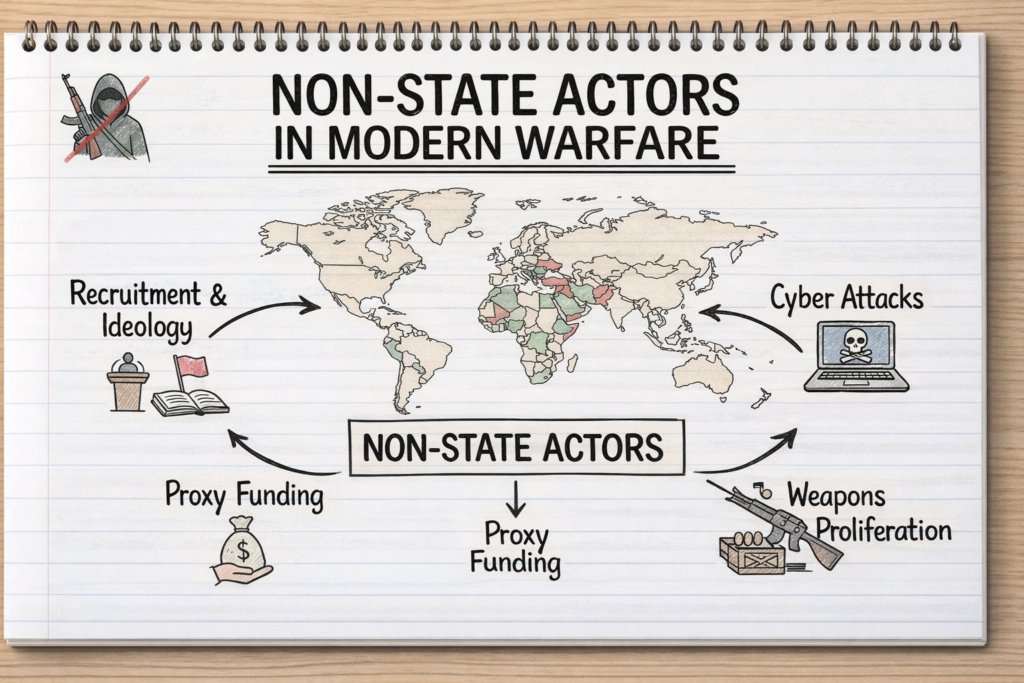
Globalization has proven to be a double-edged sword of extraordinary sharpness. The same infrastructure of global trade, finance, and communication that has lifted hundreds of millions out of poverty has also provided non-state actors with unprecedented resources. Cryptocurrency and informal hawala networks allow groups like ISIS and TTP to move money across borders with limited traceability.
Media Platforms and Sources
Dark web arms markets have lowered the cost and raised the accessibility of everything from small arms to precursor chemicals. The global commercial drone market driven by hobbyist and agricultural demand has provided insurgent groups with cheap, adaptable surveillance and strike platforms that previously required nation-state budgets.
Social media has transformed recruitment, radicalization, and operational coordination. ISIS’s media operation, al-Hayat Media Center produced multilingual, cinematically sophisticated content that reached millions of potential recruits worldwide. The TikTok and Telegram ecosystems have since become equally important vectors for ideological mobilization. And the smartphone has fundamentally altered battlefield dynamics: footage of attacks, testimony of atrocities, and operational information now flow in near-real time, shaping the information environment faster than any military public affairs apparatus can respond.
Arms proliferation completes the enabling picture. The collapse of the Libyan state in 2011 flooded the Sahel with weapons from Muammar Gaddafi’s vast arsenals. American and NATO weapons left in Afghanistan after the 2021 withdrawal have appeared in conflict zones as far afield as Kashmir and the Sahara. The global small arms trade remains chronically under-regulated. And the democratization of precision strike technology through commercially available GPS components, open-source flight controllers, and cheap munitions means that non-state actors can now threaten targets that once required sophisticated air forces.
Doctrine Under Pressure: How Militaries Are Adapting
The conventional military response to the rise of non-state actors has been characterized by painful, costly, and often incomplete adaptation. The initial American response to 9/11, overwhelming conventional force proved spectacularly effective at dismantling states and killing uniformed soldiers, but spectacularly ineffective at defeating dispersed networks and entrenched insurgencies.
The subsequent development of U.S. Army and Marine Corps counterinsurgency doctrine, codified in the 2006 Field Manual FM 3-24 authored in large part by General David Petraeus and Marine General James Amos, represented a genuine intellectual and operational shift. It emphasized population protection over enemy attrition, local governance over military control, and cultural competence over firepower. The “surge” in Iraq from 2007 to 2008 demonstrated its partial effectiveness. But FM 3-24 also required a level of political patience and resource commitment that democratic electorates proved unwilling to sustain over the long term.
Contemporary military doctrine has increasingly pivoted toward concepts of hybrid warfare and grey zone competition, the use of a calibrated mix of conventional, irregular, information, and cyber instruments below the threshold of declared war. Russia’s operations in Ukraine beginning in 2014 combining regular forces operating under ambiguous command, local proxy militias, disinformation campaigns, economic coercion, and cyberattacks provided the defining template, even as Russia’s subsequent conventional invasion in 2022 demonstrated the continued relevance of traditional military power. China’s grey zone operations in the South China Sea, combining civilian fishing fleets used as maritime militia, coast guard vessels, and information operations, represent a similar approach tailored to a different geographic and political context.
NATO’s adaptation has included greater investment in Special Operations Forces, which are inherently better suited to working with local partners, conducting direct action against high-value targets, and operating in ambiguous environments. The Combined Joint Task Force Operation Inherent Resolve employed an “advise, assist, and accompany” model in both Iraq and Syria that relied heavily on partnered indigenous forces the Kurdish Peshmerga and Syrian Democratic Forces to provide the ground combat mass that Western political constraints prevented direct American deployment from supplying. This model has significant limitations: partner forces have their own interests, loyalties, and red lines. But it reflects a realistic acknowledgment that external powers cannot indefinitely substitute for local will and local legitimacy.
The Legal and Ethical Labyrinth
The laws of armed conflict, developed over centuries and codified most comprehensively in the four Geneva Conventions of 1949 and their Additional Protocols of 1977, were designed with state-on-state warfare in mind. Non-state actors strain this framework in ways that remain genuinely unresolved.
International Humanitarian Law (IHL) grants combatant status and the protections that come with it to fighters who wear distinguishing insignia, carry arms openly, and operate under a responsible command structure. Most non-state actors meet none of these criteria, creating acute ambiguity about the legal standards that govern their targeting, detention, and treatment.
The use of PMCs raises acute accountability questions. When a Wagner Group contractor commits atrocities in Mali or the Central African Republic, under what legal framework is accountability pursued? Russian domestic law has historically declined to acknowledge the group’s existence. International Criminal Court jurisdiction requires either state referral or Security Council action both politically constrained in cases involving permanent members. The practical result is a significant accountability gap that emboldens actors operating in the grey zone between state and non-state violence.
Drone strikes against non-state actors outside of declared war zones the signature counterterrorism tactic of the Obama and Trump administrations raise equally thorny questions about sovereignty, proportionality, and the definition of imminence that have never been satisfactorily resolved in international law. The practice established precedents that adversaries and allies alike have cited to justify their own use of lethal force outside traditional battlefield constraints.
The Battlefield Ahead
The trajectory of non-state military power points in a consistent direction: upward in capability, outward in geographic reach, and increasingly inward toward the digital and cognitive domains. Several convergent trends merit close attention from strategists and policymakers.
Artificial intelligence is on the verge of transforming the operational capabilities of non-state actors in ways that are not yet fully appreciated. The barriers to AI-enabled autonomous weapons, swarm drones, autonomous targeting systems, AI-generated disinformation are eroding rapidly. Commercial off-the-shelf components, open-source AI frameworks, and declining hardware costs mean that capabilities once confined to the most advanced militaries are becoming accessible to well-resourced non-state groups.
The Houthis’ use of one-way attack drones is a preview, not an endpoint. The next generation of non-state military technology may involve coordinated swarms of autonomous platforms capable of saturating air defenses that no single drone could defeat.
The cyber domain has already become a primary arena for non-state competition. Groups like Sandworm nominally non-state but effectively Russian GRU have demonstrated the capacity to conduct attacks against critical infrastructure, including Ukraine’s power grid, with civilizational-level consequences. Ransomware gangs operating with Russian, Iranian, or North Korean tolerance represent a hybrid of criminal and state-strategic motivation. The distinction between a cybercriminal, a hacktivist, and a state-sponsored actor is now routinely blurred by design. As critical infrastructure becomes more networked and industrial control systems more accessible, the attack surface available to non-state cyber actors will expand dramatically.
Perhaps most fundamentally, the Westphalian state model itself the assumption that world politics consists primarily of interactions between territorially bounded, sovereign states faces its most serious structural challenge since the Thirty Years War gave birth to it. In an increasing number of regions, it is non-state actors rather than state governments that provide security, levy taxation, administer justice, and command the primary loyalty of local populations.
Hezbollah in southern Lebanon, the Taliban in Afghanistan, ISIS in its remnant territorial enclaves, and the Wagner-successor Russia Africa Corps in parts of the Sahel, all govern in ways that meaningfully compete with or replace formal state authority. The question is no longer whether non-state actors can challenge states. The question is whether the conceptual and legal architecture of international order, built around states as the primary unit of analysis, can adapt to a world where they increasingly cannot.
The strategic implications are profound and uncomfortable. Defense establishments that invest overwhelmingly in capabilities designed for peer-competitor warfare fifth-generation aircraft, carrier battle groups, hypersonic missiles risk building the military equivalent of the Maginot Line: formidable, expensive, and oriented toward a threat that is no longer the primary axis of danger. Counterinsurgency and counterterrorism, dismissed as “small wars” in the aftermath of Afghanistan and Iraq, cannot be discarded on the basis of political exhaustion.
The structural conditions that generate non-state violence are, if anything, intensifying: climate change is stressing agricultural systems and forcing population displacement that strains state capacity across the Global South; youth demographics in the Middle East and sub-Saharan Africa are creating large pools of unemployed men susceptible to recruitment; and the information environment makes ideological mobilization faster and cheaper than ever before.
“The most dangerous illusion in contemporary strategy is the belief that we can choose between peer-competitor deterrence and sub-state conflict management. The twenty-first century will demand both simultaneously, indefinitely, and with diminishing margin for error.”
Adapting to this reality requires more than doctrinal revision. It requires a fundamental reconceptualization of what security means, who provides it, and how state and non-state actors interact within the same competitive spaces. Moreover, It requires sustained investment in the intelligence capabilities, human networks, and partner-force relationships that are the indispensable prerequisites of effective grey zone competition. It also requires legal frameworks adequate to the complexity of hybrid conflict, rather than juridical structures designed for a world of clearly demarcated combatants. And it requires, above all, the strategic patience to engage in long-duration competition that cannot be resolved by any single battle, any single campaign, or any single administration’s term in office.
The state has not become irrelevant. Its monopoly on organized violence remains the foundation of political order in most of the world. But that monopoly is being contested with unprecedented tools, unprecedented reach, and unprecedented sophistication. The rise of non-state actors is not a temporary aberration that will resolve itself when the global order stabilizes. It is the new permanent condition of international security and the militaries, governments, and international institutions that recognize this earliest will be the ones best positioned to navigate what comes next.
The battlefield, in other words, no longer waits for a declaration of war. In many places, it has already arrived quietly, deniably, and without a flag.