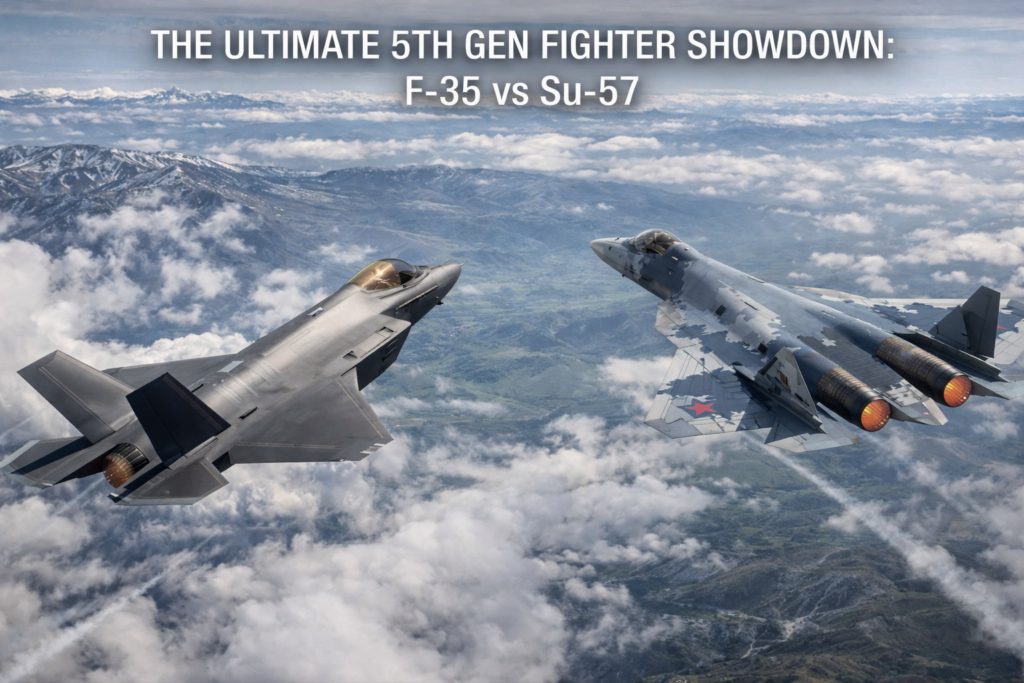
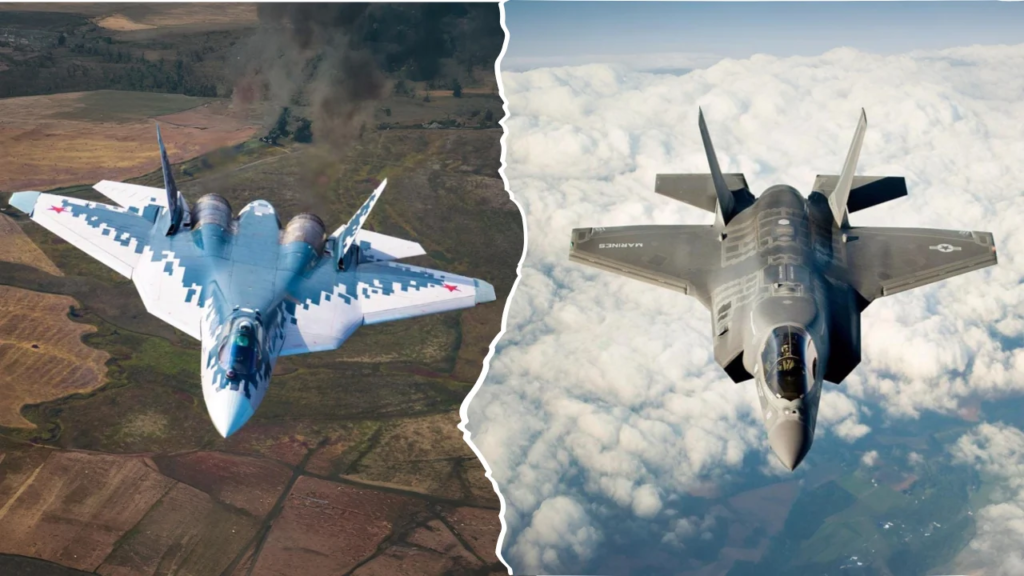
Two Jets. Two Doctrines. One Question: Who Rules the Skies? A rivalry of 5th gen fighters.
Somewhere above the clouds, a pilot in an advanced fifth-generation cockpit scans a threat-saturated sky. To his left, digital displays fuse together radar returns, infrared signatures, and data-linked intelligence from a dozen allied platforms. To his right somewhere, an adversary does the same, except his advantage lies not in invisibility but in raw speed, reach, and kinematic lethality. This is the fundamental tension of modern air combat: the F-35 Lightning II versus the Sukhoi Su-57 Felon.
This comparison is not just between two aircraft. It is a lens into the competing strategic philosophies of the world’s two most formidable military machines, the United States and Russia. The F-35 is America’s billion-dollar bet that information supremacy, coalition integration, and stealth are the decisive currencies of 21st-century warfare. The Su-57 is Russia’s counter-wager that raw performance, kinematic dominance, and lethal reach can still win the day.
This deep-dive analysis covers every critical dimension of this rivalry from engineering architecture and radar cross-sections to combat records, weapons payloads, geopolitical footprints, and the future trajectory of both programmes. Whether you are a defense analyst, aviation enthusiast, or simply someone who wants to understand the true balance of airpower in 2026, this is the definitive comparison you have been looking for.
ORIGINS AND DESIGN PHILOSOPHY
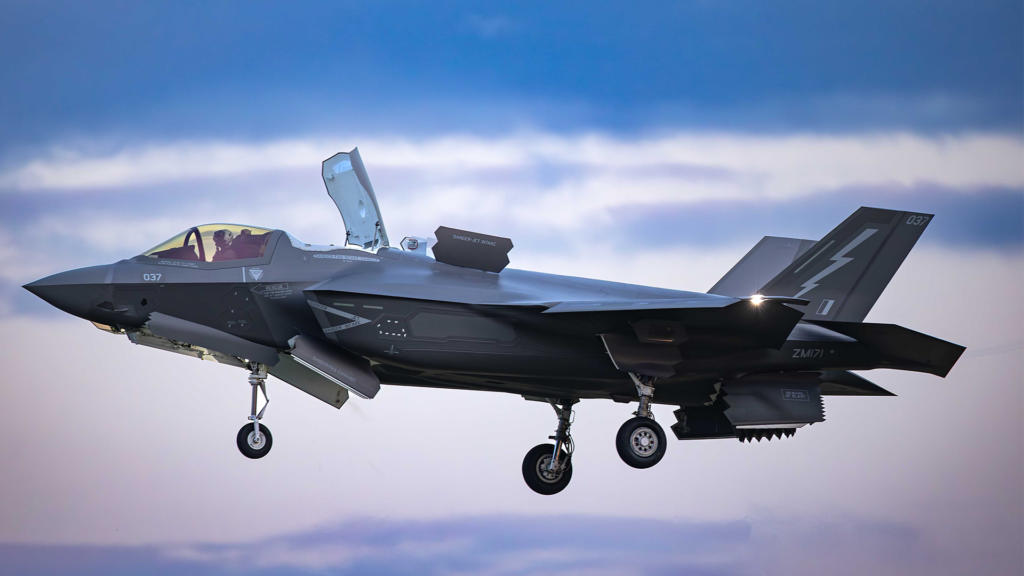
The F-35 Lightning II: America’s Flying Network Node
The F-35 programme was born from the Joint Strike Fighter (JSF) initiative of the 1990s which was an ambitious attempt to replace several ageing American and allied airframes with a single, affordable, stealthy multirole platform. Lockheed Martin won the contract in 2001, and what followed was one of the most complex, expensive, and consequential defense programmes in history. Today, the F-35 exists in three variants: the conventional take-off F-35A for the Air Force, the short take-off/vertical landing F-35B for the Marine Corps, and the carrier-variant F-35C for the Navy.
At its conceptual core, the F-35 was designed not as the fastest or most agile fighter ever built, but as the most situationally aware one. Lockheed Martin made a deliberate architectural decision: every compromised knot of speed or degree of maneuverability would be traded for sensor integration, low observability, and connectivity. The F-35 is less a standalone fighter and more a flying sensor node, that’s why it is a platform that sees first, shares that picture across the battlespace, and eliminates threats before they ever know it was there.
The Su-57 Felon: Russia’s Supersonic Power Projection
Russia’s fifth-generation aspirations crystallised around the PAK FA programme, which began in earnest in the early 2000s in response to the emergence of the F-22 Raptor and the JSF concept. Sukhoi, the legendary design bureau behind the Su-27 family, was tasked with creating an aircraft that could match or exceed Western fifth-generation performance. The T-50 prototype first flew in 2010, and after years of development and engine challenges, the aircraft formally entered service as the Su-57 in 2020.
Russia’s design philosophy reflected a different set of operational priorities. Russia needed a fighter capable of long-range patrols across its vast geography, air superiority in contested environments against superior numbers, and a platform that could carry heavy, long-range missiles to engage adversaries well beyond visual range. The result is a large, twin-engine, supercruise-capable aircraft with 3D thrust-vectoring nozzles and internal weapons bays, designed for kinematic dominance rather than pure stealth.
The F-35 is a systems integrator disguised as a fighter jet. The Su-57 is a kinematic predator with a stealth coating. Understanding this distinction explains every design decision made on both platforms.
TECHNICAL SPECIFICATIONS: HEAD-TO-HEAD
Before we dissect individual capabilities, here is a clean side-by-side look at the core specifications of both aircraft, drawing from the most current available data as of April 2026:
| Specification | F-35A Lightning II | Su-57 Felon |
| Primary Role | Multirole Strike / Stealth | Air Superiority / Multirole |
| Manufacturer | Lockheed Martin (USA) | Sukhoi / UAC (Russia) |
| First Flight | 2006 | 2010 |
| Service Entry | 2015 (USAF) | 2020 (Russian AF) |
| Length | 15.7 m (51.4 ft) | 20.1 m (65.9 ft) |
| Wingspan | 10.7 m (35 ft) | 14.1 m (46.3 ft) |
| Max Speed | Mach 1.6 (with afterburner) | Mach 2+ / Supercruise Mach 1.6+ |
| Service Ceiling | ~50,000 ft | ~66,000 ft |
| Combat Radius | ~1,100–1,200 km (internal fuel) | ~1,500+ km (internal fuel) |
| Ferry Range | ~2,220 km | ~5,000–5,500 km |
| Engines | 1× Pratt & Whitney F135 | 2× Saturn AL-41F1 (Izdeliye 30 planned) |
| Thrust (each) | 43,000 lbf (with AB) | 32,000 lbf per engine (×2) |
| Internal Payload | ~3,900 kg (stealth config) | ~4,000–6,000 kg (internal) |
| Max Payload (total) | ~8,160 kg | ~10,000 kg |
| RCS (estimated) | <0.001–0.005 m² | ~0.1–1 m² |
| Unit Cost | $80–100 million | $35–50 million |
| Fleet Size (2026) | 1,300+ delivered, 20+ nations | <35 in service, Russia only |
STEALTH: THE GREAT DIVIDE
How the F-35 Achieves Near-Invisibility
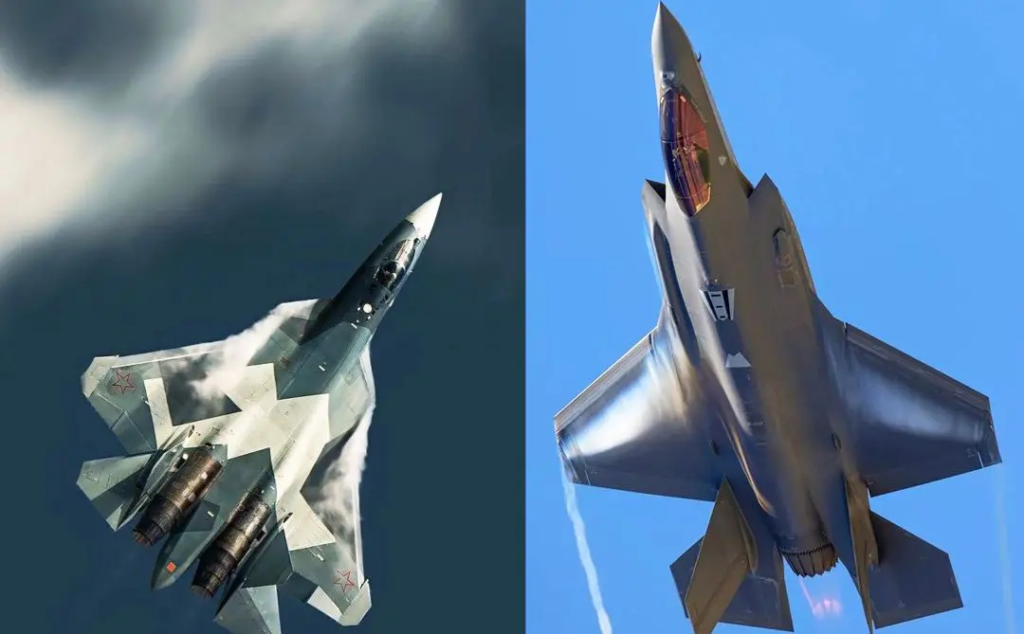
Stealth technology is where the F-35’s advantage is most decisive and most thoroughly engineered. The Lightning II achieves its remarkable radar cross-section through three interlocking disciplines: external shaping, radar-absorbent material (RAM) coatings, and internal weapons carriage. The airframe is sculpted to redirect radar energy away from the emitter rather than back to it. Diverterless supersonic inlet (DSI) geometry eliminates the radar-bright engine face from most angular perspectives. Every surface discontinuity, panel gaps, access hatches, antennas etc. is carefully serrated or treated to minimize radar return.
The result is an RCS estimated at somewhere between 0.001 and 0.005 square meters roughly comparable to a large bird or small metallic ball. At this level, even modern S-400-class radars would not detect an F-35 until it is dangerously close, dramatically compressing the adversary’s reaction window. Crucially, the F-35 is designed to maintain this stealth posture from all aspects whether it is frontal, lateral, and rear which is a significantly harder engineering problem than frontal-only signature reduction.
The Su-57’s Compromised Stealth Approach
Russia’s approach to stealth on the Su-57 is best characterized as ‘reduced observability’ rather than true low-observability. The aircraft incorporates radar-absorbent coatings and some degree of edge alignment in its airframe design, and it does carry weapons internally. However, the Su-57’s shaping makes significant concessions to aerodynamic performance whether it is the thrust-vectoring nozzles, large wing-body blending surfaces, and the physically large airframe all contribute to a radar cross-section estimated at roughly 0.1 to 1 square meters, anywhere from 20 to 200 times larger than the F-35 depending on frequency and aspect angle.
This is not necessarily an irrational design trade. Russia’s doctrine does not assume that its aircraft will be operating alone against a network of AWACS platforms and highly integrated air-defense systems the way US planners anticipate. Therefore, the Su-57’s electronic warfare suite which Russia claims is capable of suppressing adversary radar detection is meant to partially compensate for its stealth shortfall. Whether that claim is validated by real-world performance is another matter entirely.
In a world where modern S-400 radars can detect and engage targets at 400 km, the difference between a 0.001 m² RCS and a 0.5 m² RCS is not merely statistical. It could be the difference between surviving a mission and being detected, tracked, and killed before you ever reach your target.
AVIONICS AND SENSOR FUSION: THE INTELLIGENCE WAR
The F-35’s Unmatched Sensor Architecture
If stealth is the F-35’s shield, sensor fusion is its spear. The avionics architecture of the F-35 represents the most integrated fighter sensor suite ever built and fielded. At the center of this architecture sits the AN/APG-81 Active Electronically Scanned Array (AESA) radar which is a system capable of detecting and tracking 23 air targets within 100 miles in under nine seconds, while simultaneously mapping ground targets with synthetic-aperture resolution and jamming adversary emitters. The radar is so integrated into the aircraft’s electronic warfare system that it can both sense and suppress threats using the same antenna.
Surrounding the pilot in a 360-degree sphere are the six infrared cameras of the AN/AAQ-37 Distributed Aperture System (DAS), which feed a continuous, full-spherical infrared picture into the pilot’s helmet. Through the Helmet Mounted Display System, arguably the most advanced aviator interface ever created, the pilot can literally look through the floor of the aircraft and see threats below, without ever touching a sensor selection switch. The AAQ-40 Electro-Optical Targeting System (EOTS) embedded in the aircraft’s chin provides passive infrared and laser designation for precision engagement of both air and ground targets.
All of these sensor streams including radar, infrared, electronic warfare, and data-linked intelligence from allied platforms via the Multifunction Advanced Data Link (MADL) are merged by a central fusion engine into a single, prioritized tactical picture. The pilot does not manage sensors. The jet manages the sensors, and the pilot manages the battle.
The Su-57’s Distributed but Less Integrated Suite
The Su-57’s sensor architecture follows a different philosophy. Rather than funneling everything into a single fused picture, the Felon carries multiple discrete radar and sensor systems spread across the airframe. The main N036 Byelka AESA radar occupies the nose, while additional L-band radar arrays are embedded in the leading edges of the wings, a design choice that allows the aircraft to potentially detect stealth aircraft at certain frequency ranges where RAM coatings are less effective. The aircraft also carries an Infrared Search and Track (IRST) system for passive targeting without radar emissions.
On paper, the Su-57’s total number of radar transmit/receive modules and total sensor angular coverage, reportedly up to 270 degrees, rivals or exceeds the F-35’s hardware. The significant gap lies in integration; where the F-35’s sensor fusion engine distils all input streams into one coherent picture automatically, the Su-57’s systems are less comprehensively integrated, placing greater cognitive demand on the pilot to synthesise information from multiple displays and systems. In the compressed timelines of modern beyond-visual-range combat, this difference is operationally consequential.
PERFORMANCE AND KINEMATICS: SPEED VS STEALTH
The Speed and Manoeuvrability Case for the Su-57
In raw kinematic terms, the Su-57 is the more formidable aircraft. Its twin Saturn AL-41F1 engines each producing approximately 32,000 pounds of thrust give the Felon genuine supercruise capability, sustaining speeds above Mach 1.6 without afterburner. This is a strategically significant capability; supercruise allows the Su-57 to enter and exit engagement zones rapidly without the fuel and infrared signature penalty of sustained afterburner use. The aircraft’s top speed exceeds Mach 2 in clean configuration.
The three-dimensional thrust-vectoring nozzles of the Su-57 are its most spectacular feature. Inherited and evolved from the Su-35S, these systems allow the aircraft to execute maneuvers that defy conventional aerodynamics including the Pugachev’s Cobra and Kulbit movements by redirecting engine thrust independently of airflow. In within-visual-range combat scenarios, this gives the Su-57 a significant energy-management advantage: the ability to rapidly change the direction of weapons employment in a close-in fight in ways that a conventional control surface aircraft cannot match.
The F-35’s Deliberate Performance Compromise
The F-35 was never designed to be a kinematic champion, and its designers made no secret of this fact. The single Pratt & Whitney F135 engine despite being the most powerful fighter engine ever produced, generating approximately 43,000 pounds of thrust with afterburner is constrained by the single-engine configuration and the airframe’s aerodynamic priorities. The Lightning II tops out at Mach 1.6, lacks supercruise capability, and is widely acknowledged to be at a disadvantage in a traditional close-in dogfight against a more agile adversary.
Lockheed Martin and the US Air Force have consistently argued that this does not matter that fifth-generation air combat doctrine renders the close-in fight largely obsolete. If the F-35 can see an adversary at 150 km while remaining invisible at 15 km, the engagement will be decided long before the aircraft are close enough for kinematic performance to be relevant. This is a philosophically coherent position backed by decades of beyond-visual-range missile development.
The real question in any F-35 vs Su-57 engagement is not who wins a turning fight. It is whether the turning fight ever happens. The F-35’s bet is that it never does. The Su-57 is built to survive the scenario where it does.
WEAPONS: PAYLOAD, REACH AND LETHALITY
F-35 Armament: Precision and Integration
The F-35’s weapons philosophy centres on precision engagement from stealth configuration. In its primary stealth mode, the F-35A carries weapons exclusively in two internal bays, typically configured with AIM-120 AMRAAM beyond-visual-range air-to-air missiles. It also has a range of precision-guided air-to-ground munitions including the GBU-31 JDAM, GBU-39 Small Diameter Bomb, and AGM-158 JASSM cruise missiles. This internal configuration limits external radar signature but also limits payload diversity. Maximum internal payload stands at approximately 3,900 kg, expandable to 8,160 kg with external hardpoints though using external stations compromises stealth.
The F-35’s great armament advantage is not its payload tonnage but its targeting and fire-control integration. The AN/APG-81 provides mid-course guidance updates to AIM-120 missiles throughout their flight, while the sensor fusion architecture ensures that the pilot has clear, deconflicted firing solutions from any engagement aspect. Block 4 upgrades are progressively adding the longer-range AIM-260 JATM. This will significantly extend the F-35’s beyond-visual-range engagement envelope beyond the current AIM-120D’s approximately 160 km reach.
Su-57 Armament: Range and Heavy Payload
The Su-57’s weapons philosophy is built around reach and payload diversity. The aircraft carries up to 10,000 kg of ordnance across its internal bays and six external hardpoints, and it was designed from the outset to carry Russia’s most capable and lethal long-range air-to-air missiles. Chief among these is the R-37M; a massive hypersonic air-to-air weapon with a reported engagement range of up to 400 km. For context, this means that an Su-57 carrying R-37Ms could, in theory, engage airborne targets at ranges that exceed even the most advanced Western BVR missiles in service today.
Additionally, the Su-57 is being integrated with the R-77M (a more manoeuvrable evolution of the AA-12 Adder), the Kh-35U anti-ship missile, and reportedly the Kh-69 low-observable cruise missile for stand-off strike missions. The aircraft’s large internal volume also makes it a candidate platform for the integration of hypersonic air-launched weapons, an area where Russia has invested heavily in recent years. The catch, as always, is that this theoretical lethality depends on the Su-57 being able to detect and fix a target which, against an F-35, is far from guaranteed.
| Weapon | F-35 (Primary) | Su-57 (Primary) |
| BVR Air-to-Air | AIM-120C/D AMRAAM (~160 km) | R-37M (~400 km) / R-77M |
| WVR Air-to-Air | AIM-9X Sidewinder | R-74M (off-boresight) |
| Strike Weapon | GBU-31 JDAM, AGM-158 JASSM | Kh-69 cruise missile |
| Anti-Radiation | AGM-88E AARGM | Kh-31P |
| Cannon | 20mm M61A1 (internal) | 30mm GSh-30-1 |
| Max Total Payload | ~8,160 kg | ~10,000 kg |
| Internal Payload (stealth) | ~3,900 kg | ~4,000–6,000 kg |
COMBAT RECORD AND OPERATIONAL REALITY
The F-35’s Battle-Tested Credentials
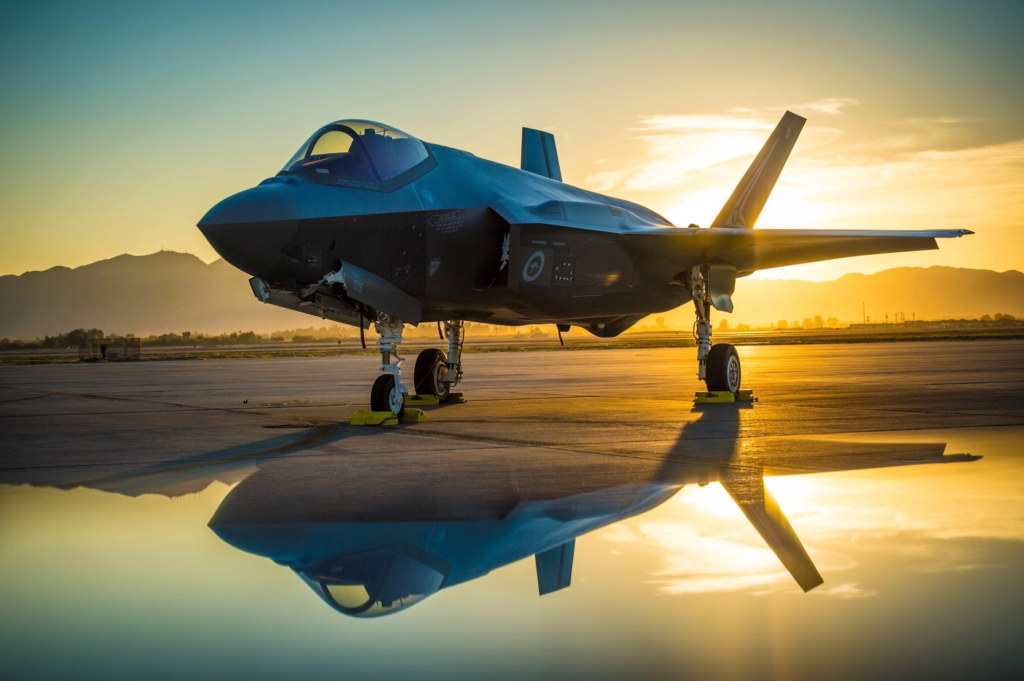
The F-35’s combat record in 2026 is perhaps its strongest argument in any comparison. This is no longer a theoretical platform rather it is a war-proven one. Israeli F-35I Adir jets have conducted hundreds of strike missions across the Middle East, including deep penetration strikes against Syrian air defence networks, Hezbollah infrastructure, and most significantly Iranian nuclear and military targets. These missions demonstrated the aircraft’s ability to penetrate some of the most capable air defence systems in the world, including S-300 and S-400 variants operated by adversaries and their proxies.
In early 2026, during the escalating military campaign against Iran, the F-35 achieved a landmark: its first confirmed air-to-air kill against a manned aircraft. An Israeli F-35I Adir shot down an Iranian Yak-130 over Tehran in a beyond-visual-range engagement which is a milestone that, while asymmetric in nature, validated the aircraft’s sensor-shooter kill chain in a live, contested environment. Simultaneously, during the United States strikes on Iranian nuclear sites, F-35s and F-22s were used to suppress Iranian integrated air defences, opening corridors for B-2 bombers to execute their strikes. In January 2026, F-35s also participated in US operations in Venezuela, where they were used to disable air defence systems ahead of special operations insertions.
Lockheed Martin delivered a record 191 F-35s in 2025 alone, with cumulative deliveries exceeding 1,300 units to more than 20 nations. This production pace and operational breadth have no parallel in fifth-generation aviation history.
The Su-57’s Limited and Opaque Operational Experience
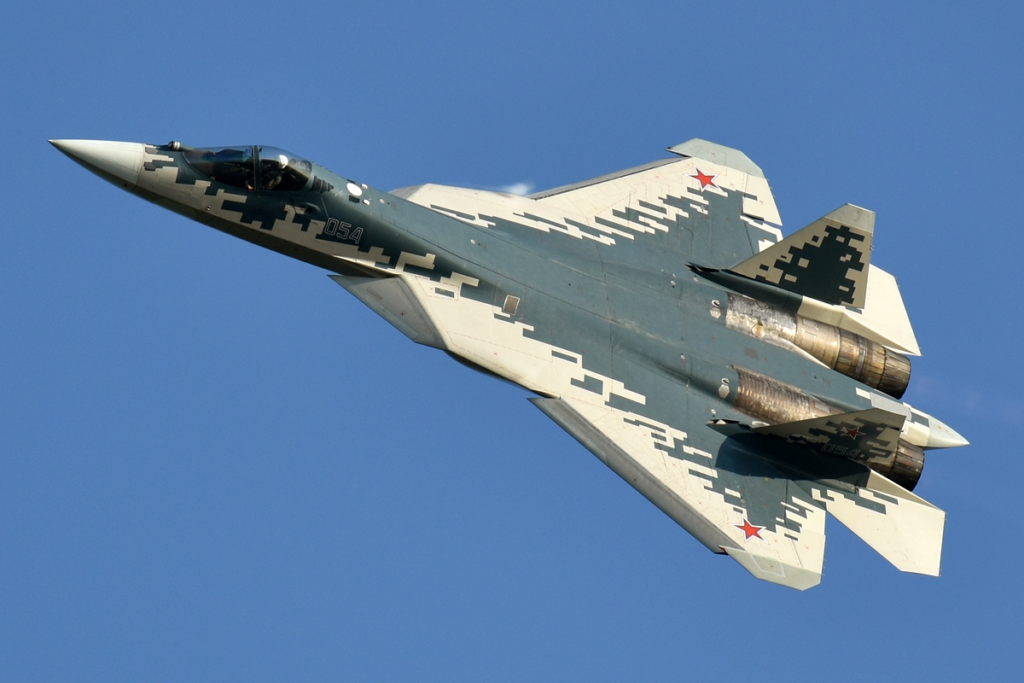
By contrast, the Su-57’s operational record is thin and largely opaque. The aircraft was reportedly tested in Syria in 2018, primarily for environmental and systems evaluation rather than sustained combat operations. In the Ukraine conflict, which has been the defining test of modern Russian military systems, the Su-57 has been conspicuously absent from front-line operations, a telling signal given the enormous resources invested in its development. Russian sources have reported limited deployments in a stand-off capacity, potentially using the aircraft to fire long-range cruise missiles from positions well inside Russian-controlled airspace, but confirmed details are scarce.
Fleet size is the Su-57 programme’s most glaring vulnerability. As of early 2026, fewer than 35 Su-57s are believed to be in operational service with the Russian Aerospace Forces a far cry from Russia’s original target of 76 by 2027. Western sanctions imposed following the Ukraine invasion have disrupted access to critical avionics components and manufacturing equipment, compounding pre-existing challenges in Russia’s defence industrial base. The planned Izdeliye 30 engine which would give the Su-57 significantly improved thrust, fuel efficiency, and stealth-optimized nozzle geometry remains in development and has not yet entered serial production.
Numbers matter profoundly in air warfare. An aircraft that exists in dozens is a statement of intent. An aircraft that exists in hundreds is a doctrine. The F-35 is a doctrine. The Su-57, for now, remains largely a statement.
ELECTRONIC WARFARE: THE INVISIBLE FIGHT
Both the F-35 and Su-57 are equipped with sophisticated electronic warfare (EW) suites, and this dimension of the comparison is one of the most significant and least publicly discussed. Electronic warfare in a fifth-generation context is no longer simply about jamming adversary radar. It encompasses active signal suppression, electronic intelligence gathering, spoofing of missile seekers, passive detection of adversary emitters, and the use of low-probability-of-intercept waveforms to communicate without being detected.
The F-35’s BAE Systems AN/ASQ-239 Barracuda EW suite is deeply integrated into the aircraft’s sensor fusion architecture. It means that EW detections are immediately correlated with radar and infrared data to build a comprehensive threat picture. The F-35’s AESA radar itself can serve as a jammer, focusing its beam energy to suppress adversary emitters. Unclassified assessments consistently rank the F-35’s EW suite among the world’s most capable, particularly in the context of suppressing and exploiting enemy Integrated Air Defense Systems (IADS).
Russia claims the Su-57’s Himalaya EW suite is comparably capable, with features including active jamming, radar warning, and missile approach warning. Some Russian proponents argue that the Su-57’s EW capability partially compensates for its stealth shortfall. This is essentially substituting electronic suppression for geometric signature reduction. This claim is difficult to independently assess, but it reflects a coherent strand of Russian strategic thinking that has driven significant investment in EW across all of its military platforms.
COST, PRODUCTION AND STRATEGIC SUSTAINABILITY
The F-35’s Cost and Scale
The F-35 programme carries the double-edged reputation of being the most capable and most expensive weapons programme in human history. The total lifecycle cost of the programme is estimated to exceed two trillion US dollars. Unit procurement cost for the F-35A has declined significantly from early production lots, now sitting at approximately $80–100 million per aircraft depending on variant and lot. While this remains far more expensive than fourth-generation alternatives, it is substantially cheaper than the F-22 Raptor and has continued to fall with production volume.
The programme’s scale has created a self-sustaining industrial ecosystem. Lockheed Martin’s Fort Worth, Texas assembly line, supplemented by final assembly facilities in Italy and Japan, has achieved production efficiencies that would be impossible at smaller volumes. The global logistics network supporting 20+ operator nations creates economies of scale in spare parts, maintenance training, and software development that no competitor can replicate. For partner nations, the F-35 also comes with the significant intangible value of integration into the most capable and interoperable coalition air warfare network ever assembled.
The Su-57’s Cost Advantage and Industrial Constraints
The Su-57’s unit cost estimated at $35–50 million represents a significant procurement price advantage over the F-35. For nations that cannot afford or are not eligible for F-35 sales, this lower sticker price is genuinely attractive. Russia has actively marketed the Su-57E export variant to potential customers including Algeria (which has reportedly ordered 14 aircraft), Vietnam, and the UAE, using price and the absence of Washington’s political conditions as primary selling points.
However, the Su-57’s true cost must be assessed in the context of its programme’s industrial reality. Western sanctions imposed after 2022 have disrupted access to semiconductor components, advanced manufacturing equipment, and microelectronics that underpin modern avionics. The Komsomolsk-on-Amur production facility has struggled to ramp output, and Russia’s limited ability to produce the most advanced components domestically has constrained both production rate and the sophistication of the avionics that can be installed in serial aircraft.
GEOPOLITICAL FOOTPRINT AND ALLIANCE DYNAMICS
The F-35 as a Western Alliance Cornerstone
The F-35 has become far more than an aircraft. It is a geopolitical instrument. Operating the F-35 means joining a closely integrated coalition of allied air forces that share tactics, intelligence, targeting data, and doctrine through interoperable systems. As of 2026, more than 20 nations operate or have ordered the F-35, including the United States, United Kingdom, Australia, Japan, South Korea, Israel, Norway, Denmark, Netherlands, Belgium, Poland, Finland, Germany, Italy, Greece, Singapore, Czech Republic, Romania, and Canada. The aircraft will also serve as the delivery platform for NATO’s nuclear sharing arrangements with Belgium, Italy, Germany, and the UK all transitioning to F-35As for this mission.
This network effect is the F-35’s most durable strategic advantage. In a contested scenario, 20 nations’ worth of F-35s sharing targeting data, sensor coverage, and coordinated electronic attack create an air combat environment that no adversary’s single-nation platform can match. Israel’s ability to penetrate Iranian air defenses was not simply a function of the F-35’s individual capabilities. It was enabled by the entire intelligence, surveillance, and reconnaissance architecture that the US and its allies had built around the aircraft.
The Su-57’s Isolation and the India Question
By contrast, the Su-57 operates within a drastically more constrained geopolitical context. Russia remains its sole operator, and the aircraft has attracted limited export interest despite sustained marketing efforts. India which is the most significant potential customer and Russia’s partner in the original FGFA fifth-generation fighter programme withdrew from joint development in 2018, citing concerns about stealth performance and engine maturity. Although Russia renewed its Su-57E pitch to India during Putin’s December 2025 state visit, New Delhi’s strategic calculus remains complicated by its desire to maintain operational independence from any single supplier and the practical difficulties of integrating an Su-57 fleet with India’s Russian-origin legacy platforms and American-origin systems.
Algeria’s reported order for 14 Su-57s represents the first export success but at a scale that barely moves the needle on programme economics or geopolitical significance. Without a major export customer willing to co-fund further development and production scaling, the Su-57 risks becoming a strategically marginalized platform, a technologically impressive but numerically irrelevant competitor to the F-35’s dominant network.
HYPOTHETICAL ENGAGEMENT: WHO WINS?
Any discussion of the F-35 vs Su-57 would be incomplete without examining the hypothetical combat encounter. The question that every reader ultimately wants answered. The honest answer is that it depends enormously on the scenario, the support environment, and the tactical conditions. But let us reason through it systematically.
Beyond Visual Range (BVR) Engagement
In a beyond-visual-range engagement in open airspace, with both aircraft flying without ground-based radar or airborne early warning support, the F-35 holds a significant and arguably decisive advantage. Its stealth signature means the Su-57’s N036 radar is unlikely to achieve a reliable targeting solution until the F-35 is already within lethal AIM-120 range. The F-35’s DAS and EOTS give it passive detection options that do not require it to radiate. In this scenario, the F-35 can engage and potentially defeat the Su-57 before the Russian aircraft’s pilot is certain he is being targeted.
Within Visual Range (WVR) Engagement
If the engagement transitions to within-visual-range perhaps because of a BVR shot failure, terrain masking, or radar jamming from the Su-57’s EW suite, the dynamic shifts. The Su-57’s 3D thrust vectoring, super cruise capability, and superior sustained turn rate give it a meaningful kinematic advantage. The off-boresight capability of the R-74M, combined with the Su-57’s helmet-cued targeting, make it dangerous at close range. The F-35 community acknowledges this vulnerability. The aircraft is not built for a turning fight and would ideally never find itself in one.
The Supported Scenario
In a real-world operational environment, neither aircraft fights alone. The F-35 is embedded in a layered network of AWACS platforms, linked satellites, ground radar, allied F-35s sharing sensor data, and electronic attack aircraft. This support architecture multiplies the F-35’s individual advantages enormously. The Su-57, operating in a degraded Russian C4ISR environment as evidenced by the chronic shortcomings of Russia’s networked warfare in Ukraine would face those advantages without equivalent support. This is perhaps the most underappreciated dimension of the real-world competition between these two platforms.
The F-35 is optimized for the war that America actually expects to fight. A networked, coalition, information-dominant campaign where stealth and connectivity are the decisive advantages. The Su-57 is optimized for a different war, one that may be increasingly rare in the era of integrated air defense systems and over-the-horizon sensing.
FUTURE TRAJECTORY AND SIXTH-GENERATION CONTEXT
Perhaps the most strategically significant context for understanding the F-35 vs Su-57 competition is where each platform fits in the longer arc of fighter development. The F-35 is a mature, combat-proven, continuously upgraded platform. Block 4 upgrades despite delays are progressively adding new weapons, enhanced electronic warfare, and the TR-3 mission computer that triples processing power. The F-35 will serve as the backbone of Western airpower through the 2040s and likely beyond.
The Su-57 faces a more uncertain future. Russia’s defense industrial base is under severe strain from the Ukraine conflict, Western sanctions, and the economic consequences of sustained military expenditure. The Izdeliye 30 engine which would transform the Su-57’s performance and stealth characteristics remains on the horizon without a confirmed in-service date. Production rates of two to four aircraft per year are insufficient to build a strategically significant fleet within any near-term planning horizon.
Meanwhile, the next generation of air combat systems is already under development on both sides. The United States is advancing its Next Generation Air Dominance (NGAD) program which is a classified platform designed to complement and eventually succeed the F-22, with collaborative combat aircraft and autonomous wingman concepts that will further multiply the lethality of the F-35 network. Russia has conceptually proposed the Su-75 Checkmate as a lighter, cheaper, potentially export-oriented fifth-generation platform, though the program faces severe funding and development challenges. China’s J-35 and J-20, increasingly capable in their own right, add a third dimension to this competition that neither the F-35 nor the Su-57 can afford to ignore.
FINAL COMPARISON: THE SCORECARD
| Category | Dominant | Margin |
| All-Aspect Stealth | F-35 Lightning II | Decisive |
| Sensor Fusion & Avionics | F-35 Lightning II | Significant |
| BVR Missile Range | Su-57 Felon | Significant |
| Raw Speed & Manoeuvrability | Su-57 Felon | Significant |
| Combat Radius | Su-57 Felon | Decisive |
| Total Payload Capacity | Su-57 Felon | Moderate |
| Combat Record | F-35 Lightning II | Decisive |
| Fleet Size & Global Deployment | F-35 Lightning II | Decisive |
| Alliance Network Value | F-35 Lightning II | Decisive |
| Unit Procurement Cost | Su-57 Felon | Significant |
| Electronic Warfare | Contested / Unclear | — |
| Production & Industrial Maturity | F-35 Lightning II | Decisive |
| Overall Combat Effectiveness (2026) | F-35 Lightning II | Significant |
The Su-57 Felon is not a paper tiger. In specific contexts particularly long-range engagements leveraging the R-37M, or close-in kinematic fights where its thrust vectoring and agility can be exploited, it is a formidable platform that no adversary pilot would dismiss. Its payload capacity, range, and speed represent genuine operational capabilities that the F-35 cannot match on those individual dimensions.
But warfare is not a collection of individual dimension contests. It is a system-of-systems competition in which platform capability, fleet size, industrial sustainability, alliance integration, and combat experience all determine outcomes. On that holistic measure, the F-35 Lightning II is, in 2026, the superior instrument of airpower, not because it is the fastest, or the longest-ranged, or the most heavily armed, but because it is the most effectively integrated, most widely deployed, most combat-proven, and most continuously improving fifth-generation fighter in operational service today.
WHAT CAN MAKE SU-57 SUPERIOR?
Strip away the production bottlenecks, the sanctions, the underfunded timelines, and the chronic industrial constraints and what you are left with is an aircraft of genuinely fearsome potential. The Su-57 Felon, at its engineering core, is built around a design philosophy that the F-35’s most honest critics acknowledge; raw combat power, when fully realized, is not so easily neutralized by sensor fusion alone. If Russia were to successfully field the Izdeliye 30 engines which promise dramatically higher thrust, improved fuel efficiency, and stealth-optimized nozzle geometry, the Su-57 would achieve true all-domain super cruise capability at speeds the F-35 cannot approach, radically compressing the reaction time of any adversary.
Pair that with the R-37M hypersonic air-to-air missile, which can reach out to 400 kilometres, and the Su-57 becomes an aircraft that could engage F-35s before those pilots even receive a warning tone because the kill chain does not require the Su-57 to see the F-35 clearly; it requires only that a ground radar, an AWACS-equivalent, or a networked early-warning system hands off a targeting solution, and the R-37M does the rest.
The Su-57’s 3D thrust vectoring, twin-engine redundancy, and superior combat radius mean it can reach contested airspace faster, linger longer, carry more, and maneuver out of trouble more aggressively than anything the F-35 can do in a kinematic fight. Its L-band wing-embedded radars, operating at frequencies where RAM coatings lose effectiveness give it a passive detection avenue against stealth aircraft that most Western jets simply do not possess.
And if the Himalaya electronic warfare suite matures to the level Russia claims, the Su-57 could suppress and deceive adversary radar networks while remaining a genuinely difficult targeting problem itself. The cruel irony of the Su-57 story is that the aircraft’s greatest enemy has never been the F-35, it has been Russia’s own economy, sanctions regime, and institutional dysfunction. The bones of a dominant fighter are all there. The question history will debate is whether Russia ever had the industrial and financial resolve to let those bones become the weapon they were designed to be.
CONCLUSION: TWO PHILOSOPHIES, ONE CONTESTED SKY
The F-35 vs Su-57 debate ultimately resolves into something more profound than a technical comparison. It is a debate about what air combat in the 21st century is, and what it will become. America answered that question by building the most capable sensor node and network warfare platform ever placed in the sky, accepting performance compromises in service of information dominance. Russia answered by building a kinematic powerhouse that values independence, reach, and lethal force, accepting signature compromises in service of raw fighting power.
History will eventually render a verdict on which philosophy was correct or whether, as is often the case, the answer depends entirely on the specific conflict, geography, and adversary. What we can say with confidence in April 2026 is that the F-35 has proven its philosophy in operational conditions, from the skies over Syria to the airspace above Tehran. The Su-57 has yet to face that test.
Until the day these two platforms meet in contested airspace, something that every serious defense planner hopes will never happen; the debate between them will continue to illuminate the deepest questions in modern military strategy: what is air power for, how should it be built, and what price are nations willing to pay for supremacy in the sky?
About Armorexa
Armorexa is a dedicated military intelligence and defence analysis platform covering weapons systems, warfare technology, military history, and strategic doctrine. Our editorial team is committed to delivering in-depth, credible, and rigorously researched analysis for defence professionals, students, and military enthusiasts worldwide.