What Is an Anti-Tank Guided Missile?
An Anti-Tank Guided Missile (ATGM) also called a guided anti-armor weapon or anti-tank missile system is a precision munition engineered specifically to defeat armored vehicles, chiefly main battle tanks (MBTs). Unlike unguided rockets or recoilless rifle rounds, ATGMs employ onboard or operator-directed guidance systems that actively steer the warhead toward the target throughout its flight, achieving hit probabilities at ranges impossible for unguided weapons.
Modern ATGMs are arguably the most operationally consequential infantry weapons of the past 70 years. They have restructured armored doctrine across every major military, enabled non-state actors to engage professional armored forces on near-equal terms, and repeatedly invalidated conventional assumptions about tank survivability. The 2022 Russian invasion of Ukraine where Ukrainian infantry armed with FGM-148 Javelins and NLAWs destroyed hundreds of armored vehicles in the opening weeks made those realities globally visible.
This guide traces the complete technological and doctrinal lineage of the ATGM: from World War II shaped-charge breakthroughs, through three distinct guidance generations, into the engineering physics of warhead defeat mechanisms and seeker electronics, and forward to the AI-enabled, network-integrated systems now in development.
The Armored Problem: Origins of Anti-Tank Warfare
When the Tank Appeared Unstoppable
When German Panzer divisions completed their conquest of France in 46 days in May–June 1940, the psychological impact of massed, fast-moving armor was seismic. The tank had transformed from the lumbering infantry-support machine of 1918 into a weapon of operational maneuver, fast, armored, capable of bypassing fixed defenses, and terrifyingly resistant to the small-arms fire that constituted the bulk of infantry anti-personnel capability.
Infantry anti-tank doctrine in 1940 was primitive. Anti-tank rifles typified by the British Boys .55-caliber rifle were already losing the race against German armor that was steadily thickening its plate. Anti-tank guns required crew, towing vehicles, emplacement time, and an unobstructed direct line of fire. Neither approach gave the dismounted soldier an organic, man-portable means to defeat armor reliably at ranges beyond a few hundred meters.
The Shaped Charge Breakthrough: HEAT Warhead Physics
The scientific foundation for all modern ATGMs emerged from a laboratory curiosity first documented in 1888: the Monroe Effect, or shaped charge effect. When a high explosive with a hollow, metal-lined cavity typically a copper cone is detonated, the explosive energy collapses the metal liner inward and forward, forming a coherent metallic jet traveling at approximately 8,000 to 10,000 meters per second. At these velocities, the jet doesn’t mechanically pierce armor; it hydrodynamically penetrates it and the target metal momentarily yields to the penetrating pressure as a quasi-fluid.
Critically, this penetration mechanism is entirely velocity-independent of the delivery vehicle. A rocket traveling at 150 m/s can carry a HEAT warhead that defeats armor no less effectively than a cannon shell at 1,500 m/s. This physical reality enabled lightweight, infantry-portable, rocket-propelled anti-armor weapons. The manufacturing challenge shifted from gun-barrel metallurgy to warhead chemistry and rocket propulsion.
| Key WWII-Era Unguided Anti-Tank Systems: Context for ATGM Development |
| M1 Bazooka (USA, 1942): 60mm HEAT rocket, 83mm RHA penetration, effective range ~90 m |
| Panzerfaust (Germany, 1943): Disposable single-shot launcher, 30-150 m effective range; over 9 million produced |
| Panzerschreck (Germany, 1943): Crew-served 88mm rocket launcher, 160mm RHA penetration |
| PIAT (Britain, 1943): Spring-actuated anti-tank projector; ungainly but effective at Arnhem (1944) |
| RPG-2 (USSR, 1947): Post-war Soviet development; direct parent of the ubiquitous RPG-7 family (1961) |
What these weapons fundamentally lacked was range. The Panzerfaust was effective to 60 meters in its original form; a tank’s co-axial machine gun was lethal to 800 meters. The shaped charge had cracked the physics of armor defeat, but extending that capability to tactically survivable ranges required guidance. Without it, the anti-tank operator had to close to within the tank’s own self-defense envelope to fire.
First Generation MCLOS: The Wire Era (1955-1973)
Manual Command to Line of Sight: How It Worked
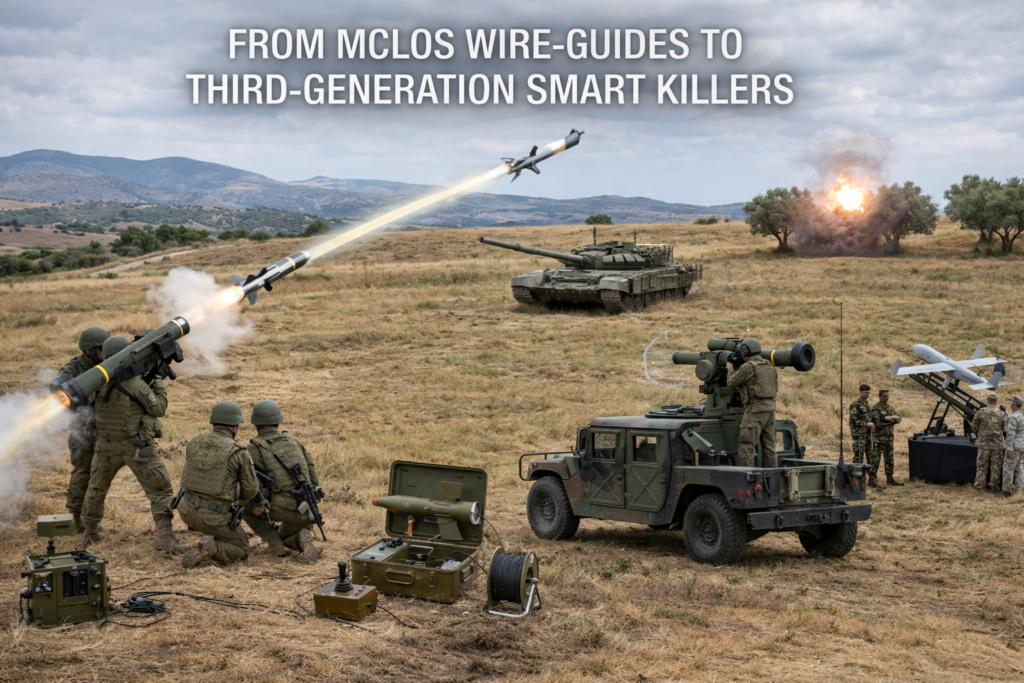
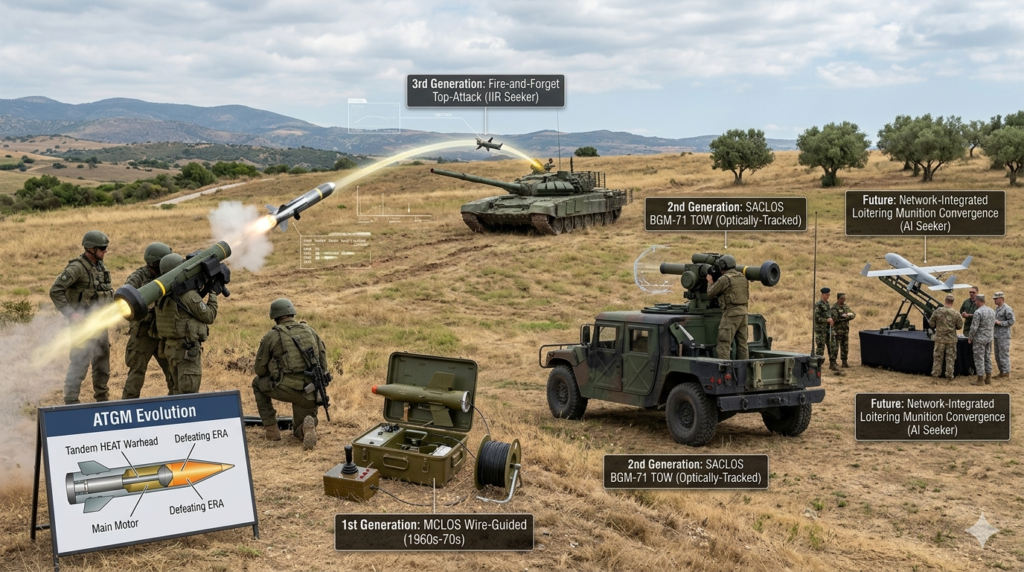
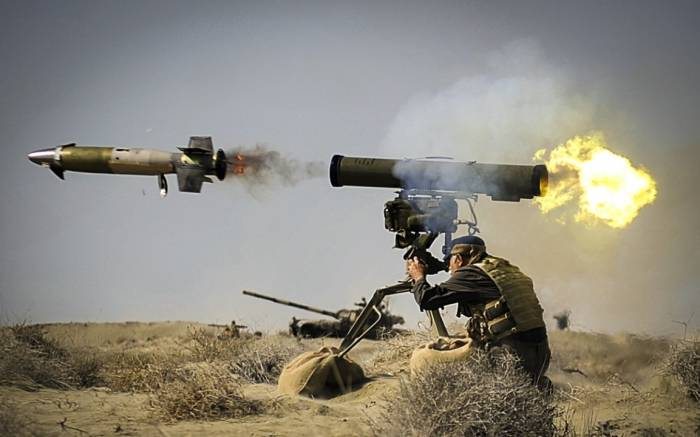
The first generation of guided anti-tank missiles operated on a principle called Manual Command to Line of Sight (MCLOS). The missile was launched toward the target and trailed a thin copper wire behind it. The operator observed both the missile identified by a flare or tracer on its tail and the target simultaneously through an optical sight and issued manual course corrections via a joystick or thumb controller. These commands traveled as electrical signals down the wire to the missile’s aerodynamic control surfaces.
The operator-burden was extreme. Simultaneously tracking a fast-moving missile flare and the target, while issuing smooth corrections to null their angular deviation, all while remaining stationary and exposed under fire required training measured in hundreds of hours. Hit probability under test conditions with expert operators reached 70-80%. Under actual combat conditions like suppressive fire, smoke, stress, poor visibility, these figures dropped markedly.
A further limitation was the minimum engagement range. The initial seconds of flight were required simply to bring the missile onto the operator’s line of sight to the target. Targets within 300-400 meters were often impossible to engage the missile would reach them before guidance could be established. This gave tanks a relative sanctuary at close range.
Key MCLOS Systems
| System | Nation / Date | Key Specifications |
| Nord SS.10 | France, 1955 | Range: 1,600 m | Speed: ~80 m/s | First operational MCLOS ATGM; combat-used in Algeria |
| Nord SS.11 | France/NATO, 1956 | Range: 3,000 m | Over 179,000 produced; widely exported; also air-launched from Alouette II helicopters |
| AT-3 Sagger (9M14 Malyutka) | USSR, 1963 | Range: 3,000 m | HEAT: 400mm RHA | 500,000+ produced; suitcase-portable container; most numerous MCLOS missile in history |
| Cobra (MAMBA) | West Germany, 1960 | Range: 1,600 m | NATO standard ATGM through the 1960s; replaced by Milan |
| Swingfire | UK, 1969 | Range: 4,000 m | 90-degree post-launch turn enabled hull-down firing from defilade positions |
Combat Debut: 1973 Yom Kippur War
The October 1973 Arab Israeli War delivered the MCLOS generation’s defining combat test. Egyptian infantry units, equipped with thousands of AT-3 Saggers and RPG-7s, executed a defense-in-depth across the Suez crossing points. When Israeli armored brigades launched unsupported counterattacks in the Sinai without adequate infantry screening, they drove into prepared Sagger killing grounds, and the initial Israeli armored losses were severe.
| The 1973 war initially appeared to prove the tank obsolete. The more complete analysis showed otherwise: when Israeli infantry learned to suppress Sagger operators with machine gun fire forcing them to break sight contact, ATGM effectiveness plummeted. The vulnerability of MCLOS was structural: a stationary, exposed operator needed for 8-12 seconds per engagement. |
As the battle evolved and Israeli forces adapted their tactics, smoke, suppression, and combined arms ATGM effectiveness declined sharply. The lesson was not that the tank was obsolete, but that armor operating without infantry screens was highly vulnerable to ATGM ambush. It was a lesson that would be learned, forgotten, and relearned in every subsequent major conflict.
Second Generation SACLOS: The Semi-Automatic Revolution
Semi-Automatic Command to Line of Sight: The Engineering Shift
The core insight of Semi-Automatic Command to Line of Sight (SACLOS) guidance was to remove the operator from the missile-tracking loop entirely. Rather than requiring the operator to simultaneously track missile and target, the system’s electronics would track the missile automatically, compute the deviation from the operator’s line of sight, and generate correction commands without manual input. The operator’s only task: keep the crosshairs on the target.
The implementation: a rearward-facing infrared emitter on the missile’s tail generates a coded thermal signature. The optical sight unit contains a photoelectric sensor that tracks this IR signal. A guidance computer calculates the angular deviation between missile position and operator line-of-sight, and transmits corrections via wire, radio frequency, or laser beamriding to the missile’s control fins.
The operational result was transformative. Operator training time dropped substantially. Hit probability with average-trained operators rose to 85-95% in controlled conditions. The exposure vulnerability persisted and the operator still had to remain on target during flight but the cognitive and physical coordination demand was radically reduced. SACLOS made ATGMs viable for mass issue to standard infantry units.
BGM-71 TOW: The West’s Workhorse
The BGM-71 TOW (Tube-launched, Optically tracked, Wire-guided) entered U.S. Army service in 1970 and has remained continuously relevant through six decades; a testament to an aggressive warhead upgrade program that has matched successive armor improvements:
- TOW (1970): Original HEAT warhead, 430mm RHA penetration. Effective against T-54/55 and T-62.
- TOW-2 (1983): Improved warhead geometry, 900mm+ RHA penetration. Designed for T-64/72/80 baseline armor.
- TOW-2A (1987): Tandem precursor charge defeats first-generation Explosive Reactive Armor (ERA).
- TOW-2B (1992): Top-attack mode: flies over target, fires two EFP probes downward through thin roof armor.
- TOW-2B Aero Extended Range (2009): RF command link extends range to 4,500 m, eliminates wire spool limitation.
- TOW Bunker Buster (2002): Thermobaric warhead for fortifications, caves, and light vehicles.
The TOW-2B’s top-attack profile represents a significant doctrinal innovation: engaging the tank’s thinnest armor face typically 30-50mm on the roof versus 500-800mm effective armor on the glacis front via a plunging EFP attack from directly above. This profile also defeated most first-generation Active Protection Systems oriented toward the frontal arc.
MILAN: Man-Portable SACLOS for Dismounted Infantry
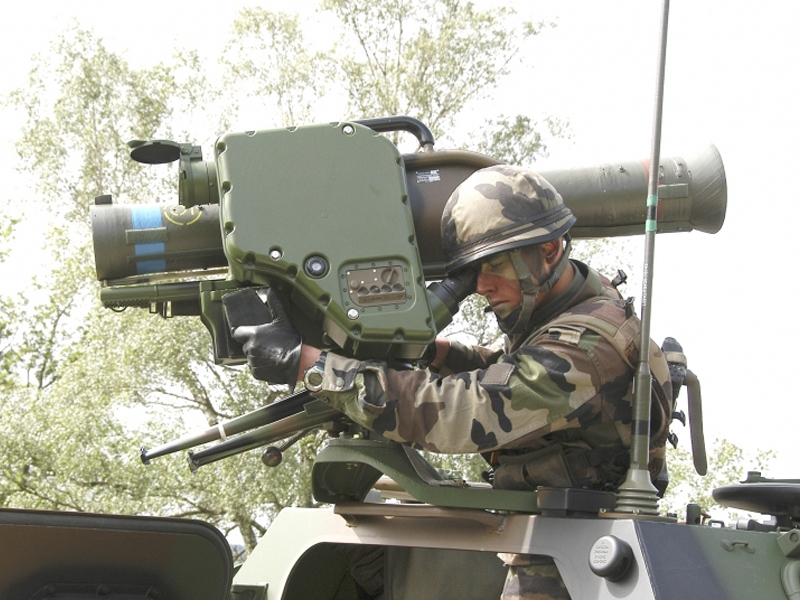
The Franco-German MILAN (Missile d’Infanterie Leger Anti-Char) brought SACLOS capability to two-man dismounted infantry teams from 1972, weighing approximately 16 kg in firing configuration and requiring under two minutes to establish a firing position. It provided organic anti-armor capability to infantry units without requiring specialized vehicles or crew.
MILAN saw combat across four decades: the Falklands (1982), the Chad-Libya conflict (1986-87), the Gulf War (1991), former Yugoslavia, and numerous African conflicts. The Milan 3 (1996) introduced a tandem HEAT warhead to defeat ERA-equipped armor. Over 40 nations still operate MILAN variants, and it will remain in active conflict zones through the 2030s despite progressive replacement by Spike and MMP in frontline NATO service.
Soviet SACLOS: Fagot, Konkurs, and Their Global Legacy
The AT-4 Spigot (9M111 Fagot) and AT-5 Spandrel (9M113 Konkurs) provided the Warsaw Pact with SACLOS equivalents to the Milan and TOW respectively. The Konkurs became the standard Soviet vehicle-mounted ATGM, fitted to BMP-1P, BMP-2, and wheeled carriers, with a 4,000-meter range and tandem warhead variants developed post-Cold War.
Their strategic significance today is that they remain the most operationally active ATGMs in global conflict zones. Exported to every Soviet client state, manufactured under license in multiple countries including Iran and Syria, Konkurs and Fagot missiles appear regularly in conflict footage from Ukraine, Syria, and Yemen on multiple sides of each engagement. Understanding these systems is essential for analyzing any contemporary conflict involving ex-Soviet equipment.
Third Generation Fire-and-Forget & Top-Attack Systems
The Core Breakthrough: Autonomous Terminal Guidance
MCLOS and SACLOS both required the operator to remain stationary and exposed for the full missile flight time up to 12 seconds at 3,000+ meter range. An alert tank crew with a co-axial machine gun, a supporting artillery battery, or an air-burst grenade could suppress or kill the operator before the missile arrived.
Third-generation ATGMs broke this constraint by moving all guidance intelligence onto the missile itself. A fire-and-forget system uses an onboard seeker to lock onto the target before launch. Once fired, the operator has zero further guidance responsibility. They can immediately move to covered positions, engage a different target, or withdraw. The missile navigates autonomously to the locked target, using its onboard sensor to correct for wind drift and target movement.
FGM-148 Javelin: System Architecture and Employment
The FGM-148 Javelin, entering U.S. Army service in 1996 after a 15-year development program, is the definitive third-generation ATGM and the system most associated with the Ukraine conflict in public discourse. The system comprises:
- Command Launch Unit (CLU): Reusable sight and processor, approximately 6.4 kg. Contains second-generation FLIR camera (3-5 micron mid-wave IR), digital targeting display, and pre-launch seeker-cueing electronics.
- Launch Tube Assembly (LTA): Expendable missile round, approximately 15.9 kg. Total ready-to-fire weight: ~22.3 kg across both components.
Pre-launch, the operator frames the target in the CLU’s thermal display and places an acquisition box over the target’s heat signature. The missile’s own cooled focal-plane array seeker is activated and locks to the target. On firing, a soft-launch gas generator ejects the missile from the tube at ~20 m/s generating minimal backblast that allows indoor and urban firing. The main dual-stage flight motor ignites at a safe standoff distance.
In top-attack mode, the Javelin climbs to approximately 150 meters altitude before pitching into a near-vertical dive onto the tank’s roof. The tandem HEAT warhead precursor charge to defeat ERA, main charge following milliseconds later achieves 600-750mm+ RHA penetration behind ERA. In direct-attack mode, the missile flies a depressed trajectory for engagement of helicopters, bunkers, and lighter vehicles.
| At approximately USD 178,000 per round, the Javelin draws cost criticism. Against a T-72B3 worth USD 2-3 million, or a T-90M at USD 4.5 million, the exchange ratio is geometrically favorable to the defender. The fundamental economics of ATGM warfare reliably favor the guided missile over the armored vehicle which is a strategic asymmetry that reshapes procurement decisions globally. |
Rafael Spike: The Multi-Mode Family
| Spike Variant | Range & Key Capability |
| Spike SR | 800 m | Man-portable F&F; squad-level anti-armor, replaces RPG in Israeli infantry |
| Spike MR | 2,500 m | Standard infantry F&F; dual IIR/CCD seeker; 45+ export countries |
| Spike LR / LR2 | 4,000 / 5,500 m | Fiber-optic data link; man-in-the-loop abort capability mid-flight |
| Spike ER / ER2 | 8,000 m | Helicopter/vehicle platform; multi-spectral seeker |
| Spike NLOS | 30 km | Non-line-of-sight via coordinate or image-based guidance; used on MQ-8 Fire Scout UAV |
The Spike LR and NLOS variants introduce a capability the Javelin lacks: mid-flight operator intervention via a fiber-optic data link that transmits live video from the missile’s seeker. The operator can steer to a different aim point, switch targets, or command abort that is a critical advantage in populated environments where civilian and military vehicles may be difficult to distinguish at target acquisition ranges. This ‘fire, observe, and update’ mode represents a different philosophical approach to the man-machine interface in precision strike.
Russian and Chinese Third-Generation Development
Russia’s 9M133 Kornet (AT-14) uses laser beam riding guidance, technically a SACLOS variant requiring operator laser-hold throughout flight but delivers exceptional performance specifications: 5,500 m range, 1,200mm+ RHA penetration behind ERA, and a thermobaric variant. Critically, the Kornet’s laser guidance produces no IR signature detectable by Missile Approach Warning Systems fitted to most Western and Israeli vehicles, giving Kornet operators a significant survivability advantage.
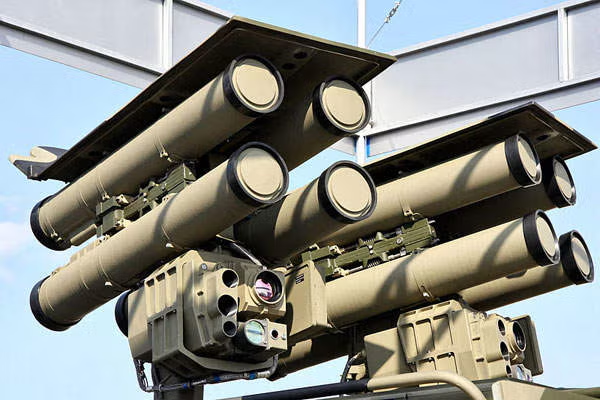
Hezbollah’s dual-Kornet simultaneous engagement technique of two launchers firing at the same target within milliseconds to simultaneously defeat ERA and penetrate base armor which demonstrated sophisticated doctrinal adaptation of the weapon’s capabilities. This tactic directly drove Israel’s Trophy (Windbreaker) APS development program.
Warhead Defeat Mechanisms
HEAT Warhead: Foundation of Anti-Armor Guided Weapons
High-Explosive Anti-Tank warheads exploit the Monroe Effect: a copper or ductile-metal cone backed by main explosive charge. On detonation, the liner collapses at ~8,000-10,000 m/s, forming a coherent penetrating jet. The jet defeats armor hydrodynamically as the armor metal briefly flows around the penetrating column rather than stopping it mechanically. Penetration is expressed in millimeters of Rolled Homogeneous Armor (RHA) equivalent; a 100mm-diameter HEAT warhead typically achieves 400-500mm RHA penetration. Primary defeat: Explosive Reactive Armor (ERA), which disrupts the jet geometry by detonating outward on contact.
Tandem HEAT: ERA Defeat Architecture
Tandem warheads were engineered specifically to defeat ERA. A small precursor charge positioned ahead of the main warhead on a standoff probe detonates the ERA tile first. A millisecond delay allows the ERA’s explosive reaction to complete. The main, larger HEAT charge then fires its jet through the disrupted tile into the base armor beneath. Multi-layer ERA systems (Russian Relikt, Israeli ASPRO-A) attempt to defeat tandem warheads with larger or layered explosive tiles, creating a continuing engineering race between warhead and armor designers. The Javelin, Spike MR, and TOW-2A represent the current state of tandem warhead development.
EFP: Explosively Formed Penetrator
The EFP warhead uses a convex metal disk typically copper or tantalum backed by explosive. On detonation, the disk is shaped into a high-velocity slug traveling at approximately 1,500-2,500 m/s. Unlike a HEAT jet, which requires close standoff to maintain coherence, an EFP retains penetrating capability across hundreds of meters making it ideal for top-attack submunitions like the TOW-2B’s downward-firing probes. EFP penetration (typically 100-200mm RHA) is sufficient against tank roof armor while the high kinetic energy delivers catastrophic lethality against the interior crew and systems.
Guidance Electronics: From Analog Wire to Digital IIR Seekers
First-generation guidance was purely analog and mechanical: rate gyroscopes for roll stabilization, analog voltages transmitted down copper wire to aerodynamic control surfaces.
SACLOS systems introduced dedicated guidance computers initially analog, later hybrid digital that sampled the IR tracker output multiple times per second and applied proportional navigation algorithms to generate guidance commands frequency-modulated onto the transmission link.
Third-generation IIR seekers represent a fundamentally different engineering category. A focal plane array (FPA) typically Indium Antimonide (InSb) or Indium Gallium Arsenide (InGaAs) contains thousands of individual detector elements operating in the mid-wave infrared band (3-5 microns), where armored vehicle heat signatures provide strong contrast against terrain backgrounds. The detector must be cooled to approximately 77 Kelvin to reduce thermal noise that was achieved via miniature Joule-Thomson or Stirling-cycle micro-compressors built into the seeker housing. A radiation-hardened digital signal processor applies centroid tracking, template matching, or convolutional neural network classifiers to maintain lock through smoke, dust, and partial obscuration. The seeker’s two-axis inertially stabilized gimbal keeps the detector aimed at the tracked target regardless of the missile’s own attitude changes during flight.
Propulsion: Soft-Launch Architecture and Dual-Stage Motors
ATGM propulsion must balance forward performance against the immediate backblast hazard to the operator. Most modern systems use a two-stage architecture: a low-impulse soft-launch gas generator ejects the missile from the tube at 20-30 m/s using cool, low-pressure combustion products dramatically reducing backblast versus direct ignition. The missile coasts for 10-20 meters before the main composite solid-fuel sustainer motor ignites, accelerating to cruise velocity (150-250 m/s) within the first 200-400 meters. After burnout, the missile coasts aerodynamically to target, controlled by spring-deployed tail fins. The Javelin’s soft-launch requirement was driven by urban warfare doctrine enabling firing from enclosed rooms, from behind walls, and from rooftops.
Modern Deployment Doctrine: How Global Armies Use ATGMs Today
NATO Combined Arms Anti-Armor Framework
Contemporary NATO doctrine treats ATGMs as components of a layered anti-armor framework rather than standalone systems. Effective anti-armor defense integrates mines, indirect fire (artillery and mortars), aviation (attack helicopters with Hellfire or Brimstone), and dismounted ATGM teams in mutually supporting, depth-structured positions. ATGMs occupy the 500-4,000 meter engagement band: beyond the RPG’s reliable effective range, within the horizon where artillery response time is too slow for fleeting vehicle targets.
U.S. Army organization places Javelin CLU/LTA sets at infantry company level (2-4 per company), with vehicle-mounted TOW at battalion and brigade. Armored attacks must survive successive engagement bands: long-range Javelin teams, medium-range TOW systems, close-range RPG teams, and mines throughout depth. The doctrinal intent is to force the attacker to disperse, screen, and slow enabling detection and engagement before mass can concentrate.
Russia: Vehicle Integration and the Kornet-D Doctrine
Russian and Chinese doctrine integrates ATGMs directly into IFV armament, making every BMP-2, BMP-3, and export variant an organic ATGM carrier alongside its 30mm autocannon. Russia’s Kornet-D system mounts two Kornet launchers on an automated turret capable of simultaneously engaging two separate targets addressing the rate-of-fire limitation inherent in single-tube ATGM systems against multiple simultaneous armored threats.
Non-State and Proxy Warfare: The ATGM Proliferation Challenge
The most strategically significant doctrinal development of the past two decades is ATGM capability proliferating below the nation-state threshold. Hezbollah, Hamas, Houthi forces, and multiple Syrian factions have demonstrated sophisticated ATGM employment that imposed significant attrition on professional military forces. Non-state ATGM employment typically exploits prepared positions with overhead cover, terrain channelization that constrains armored movement, and post-shot dispersal exploiting the missile’s 8-12 second flight time to break contact before armored counter-fire can respond.
| ATGM Proliferation: Documented Non-State Employment Data |
| Hezbollah, 2006 Lebanon War: ~1,000 ATGM engagements; 14 Merkava tanks penetrated, 5 destroyed |
| Syrian FSA, 2013-2017: BGM-71 TOW-2A supplied via Saudi/Qatar pipeline; video-documented kills of T-72, T-55, BMP-2 |
| Houthi forces, Yemen 2015-present: AT-3, Toophan (Iranian Kornet derivative), HJ-8; multiple M1A2S Abrams defeated |
| Hamas, Gaza 2021/2023: Kornet engagements against Merkava Mk.4; Trophy APS intercepts documented on multiple videos |
| Strategic asymmetry: Toophan missile cost (~$50,000) vs. M1A2S Abrams ($6-8 million) = 1:120 cost exchange ratio |
Real-World Combat Case Studies
Ukraine (2022-Present): The Defining ATGM War of the Century
The Russian invasion of Ukraine that began February 24, 2022 generated the most data-rich conventional ATGM combat environment since the 1973 Yom Kippur War. Ukrainian forces received over 8,500 Javelins (by mid-2022), approximately 10,000 NLAWs, RBS-56 BILLs from Sweden, MILANs from France and Germany, and retained substantial stocks of Soviet-legacy Stugna-P, Konkurs, and Fagot systems.
The initial Russian armored advance toward Kyiv characterized by road-bound columns with inadequate infantry screening in restrictive wooded and urban terrain was catastrophically vulnerable to ATGM ambush. Ukrainian territorial defense forces executed classic fire-and-maneuver anti-armor tactics: engage the lead and trail vehicles of a column to block forward and rearward movement, then systematically destroy the trapped vehicles from flanking positions. Open-source analysis by Oryx documented over 1,700 Russian armored fighting vehicle losses in the first 90 days, a substantial fraction attributable to ATGM fire.
Drone footage and ground photography of destroyed vehicles provided unprecedented technical data on ATGM-versus-armor defeat mechanisms. Circular entry holes through hull roofs with internal fires consistent with top-attack Javelin strikes were documented extensively. Active protection system installations on T-90M and T-80BVM tanks were observed both failing and in a smaller number of documented cases successfully intercepting incoming missiles. The conflict also documented Russian adaptation: overhead ‘cope cage’ slat armor (of limited effectiveness against top-attack munitions), increased APS deployment, and drone-guided counter-ATGM artillery targeting.
Perhaps most significantly for doctrine, Ukrainian forces operationalized drone-ATGM integration as standard practice: a commercial UAS provides overhead observation and target designation, ATGM teams engage from positions behind cover without ever directly observing the target through the weapon sight. This employment model already informally adopted by multiple armies will likely define formal doctrine in next-generation ATGM employment manuals.
Lebanon 2006: Hezbollah’s Kornet Doctrine
The 34-day 2006 Lebanon War provided the first large-scale test of a sophisticated non-state actor employing advanced ATGMs against a modern armored force with emerging active protection. Hezbollah’s arsenal centered on Russian-supplied 9M133 Kornet missiles with AT-3 Saggers and RPG-29s in supporting roles.
Hezbollah’s approach was technically sophisticated: pre-surveyed firing positions with range cards to likely tank approach routes; simultaneous dual-Kornet engagements of single targets (precursor defeats ERA, main warhead penetrates base armor milliseconds later); anti-tank teams sited in reinforced building positions enabling cover between engagements; and disciplined fire-and-withdraw sequences exploiting the 5-second Kornet flight time at maximum range to enable withdrawal before counter-fire arrived.
Fourteen Merkava Tanks were penetrated; five were destroyed outright; four soldiers were killed inside vehicles. The Kornet’s laser guidance produced no IR signature detectable by the missile approach warning systems fitted to Israeli vehicles at the time. The IDF’s post-war analysis drove accelerated development and full-fleet deployment of the Trophy (Windbreaker) Active Protection System, which reached operational status by 2011 and has since documented multiple successful ATGM intercepts in Gaza operations.
Yemen (2015-Present): Asymmetric Armor Attrition Economics
The Yemen conflict has become an extended operational test of ATGM employment across multiple weapon systems and non-state operators. Houthi forces deploy Iranian-supplied Toophan missiles, 9M14 Saggers from Yemeni Army stockpiles, Chinese HJ-8s obtained through various supply chains, and BGM-71 TOWs captured from Saudi coalition forces; a diverse, multi-source arsenal typical of prolonged proxy conflicts.
Documented defeats of Saudi-operated M1A2S Abrams tanks have drawn significant analytical attention, given the system’s reputation as among the world’s most survivable MBTs. Analysis of defeat mechanisms suggests most Abrams losses were achieved through side and rear arc flanking ambushes where frontal ERA coverage is absent, through multiple sequential ATGM strikes that degraded protection before a lethal hit, or through vehicles with APS disabled or improperly operated.
The strategic implication is the consistent lesson of every ATGM conflict: the exchange economics are structurally adverse for the armored force. When a guided missile costing under USD 100,000 destroys a vehicle worth USD 6-8 million, the attritional calculus creates sustained strategic pressure regardless of battlefield outcomes. Houthi forces have degraded Saudi coalition armor capability not through decisive engagements but through consistent attrition that imposes economically unsustainable replacement costs. This asymmetry will only worsen as ATGM systems become cheaper and more accurate.
The Future of ATGM Technology
Six Emerging Technology and Doctrine Trajectories
1. AI-Enabled Autonomous Target Recognition
Defense development programs in the United States (DARPA EXACTO follow-on), Israel (Rafael Spike Block 4), and France (MBDA MMP evolution) are actively integrating convolutional neural network (CNN) classifiers into seeker processing. These systems identify and distinguish target types; MBT, IFV, wheeled APC, civilian truck from the seeker’s thermal imagery in real-time without operator input, enabling selective autonomous engagement. The technical barriers are shrinking rapidly as commercial AI inference hardware miniaturizes.
2. Multi-Mode Guidance Fusion
Single-mode seekers are increasingly vulnerable to countermeasures: IR jamming against IIR seekers, smoke obscuration, laser warning systems against beamriders. Next-generation seekers integrate multiple guidance modes; imaging infrared, semi-active laser, millimeter-wave radar and switch between them mid-flight based on detected countermeasure activity. Raytheon’s advanced Javelin Block II program and Rafael’s Spike LR2 multi-spectral seeker represent the early operational steps in this direction.
3. Network-Integrated Fire Control and Drone-ATGM Teams
Ukraine operationally validated what defense analysts had theorized: organic UAS integration with ATGM teams enables effective engagement of targets beyond the operator’s direct line of sight. Future formal doctrine will standardize UAS assignment to ATGM sections, datalink-compatible missile seekers that accept off-board target coordinate handoff, and network-enabled fire coordination across dispersed ATGM teams. This transforms the ATGM from a point-and-shoot weapon into a node in a sensor-shooter network.
4. Loitering Munition Convergence
The doctrinal boundary between ATGM and loitering munition is dissolving. Systems like the Israeli Hero-120, the American Switchblade 600, and the Ukrainian Punisher occupy the same tactical space as a long-range ATGM infantry-portable, guided, anti-armor but with loiter capability measured in minutes rather than seconds of flight time. This enables optimal engagement geometry selection, target verification, and man-in-the-loop abort that wire-guided systems never achieved. The ATGM of 2035 may be functionally indistinguishable from today’s loitering munition.
5. Active Protection System Counter-Development Race
Trophy, Arena-M, Iron Fist, AMAP-ADS, and their successors are forcing ATGM engineers to develop systematic counter-APS approaches: higher missile acceleration to compress the APS intercept time window; salvo tactics that saturate APS engagement capacity; top-attack and bottom-attack profiles that exploit radar coverage gaps; and EMP precursor warheads intended to disable APS electronics before the main missile arrives. This is the fastest-evolving technical dimension in the ATGM-armor competition.
6. Miniaturization and Squad-Level F&F Proliferation
The Spike SR demonstrates that genuine fire-and-forget capability now fits in a 9 kg man-portable package where the weight class of the MCLOS systems of the 1960s. As focal plane array manufacturing scales, driven primarily by commercial thermal camera and automotive LiDAR demand, seeker unit costs are declining toward levels enabling integration into light anti-armor rockets previously limited to unguided HEAT. True fire-and-forget guidance at squad level, in sub-USD 10,000 systems, appears achievable within a decade. The democratization of precision guided anti-armor fire down to the individual rifleman’s section will have profound implications for armored doctrine.
| The tank is not obsolete rather it remains essential for breakthrough, exploitation, and protected maneuver that no light infantry system can replicate. But the cost of armored advance, measured in money, vehicles, and lives, has risen dramatically with each ATGM generation. Every armored thrust now occurs under the arc of guided fire from opponents who may be invisible, miles away, and increasingly assisted by artificial intelligence in finding, identifying, and targeting armored vehicles. |
KEY TERMS TO UNDERSTAND
Difference between an anti-tank missile and an anti-tank rocket
A rocket is unguided and it travels on a fixed ballistic trajectory after launch and cannot correct its course. A missile is guided and it uses onboard or operator-directed guidance to steer toward the target. All ATGMs are missiles. RPGs are rockets. The practical distinction is hit probability at range: a Milan or Javelin achieves 85-95% hit probability at 2,000 meters; an RPG-7 has perhaps 10-15% against a moving target at the same range.
Can modern tanks survive a Javelin hit?
Against unprotected T-72B and T-80 variants, a Javelin top-attack strike is typically lethal. Against tanks with active protection systems particularly Israeli Trophy, there is a documented probability of intercept; Trophy has successfully defeated top-attack threats in operational Gaza engagements. Against Russia’s T-90M with Relikt ERA, Shtora soft-kill, and Arena-M hard-kill APS, the outcome is highly geometry- and system-status-dependent. No current MBT is reliably immune to Javelin in all engagement scenarios.
What does fire-and-forget mean in ATGM systems?
Fire-and-forget means the missile locks onto the target before launch using its own onboard seeker, then guides itself to impact without any operator input after firing. The operator can immediately move, take cover, or engage a different target. This contrasts with SACLOS guidance, where the operator must hold the sight on target for the full missile flight time of up to 12 seconds. Third-generation systems like Javelin, Spike MR/LR, Brimstone all use fire and forget.
Why are tanks still used if ATGMs are so lethal?
ATGMs are most effective in the defensive, dismounted, prepared-position role. Tanks remain essential for offensive operations against defended positions, direct fire support of infantry in built-up areas, protection against other armored vehicles in fluid mobile engagements, and rapid exploitation following breached defenses. The correct military response to ATGM proliferation is combined arms using tanks with adequate infantry screens, active protection systems, suppression of ATGM teams, and aerial reconnaissance.
What is the most capable ATGM in service in 2026?
Depends on the mission requirement. For dismounted infantry fire-and-forget performance, the Javelin Block I/II remains the proven benchmark. For longest-range precision with man-in-the-loop abort, the Spike NLOS (30 km) is unmatched. For maximum armor penetration, the Kornet-EM’s declared 1,300mm+ RHA behind ERA specification is among the highest published. For versatility across target types and platforms, the Spike family’s range from SR to NLOS provides the broadest capability envelope of any single missile family.
How much does an ATGM cost?
Costs vary widely by type and contract: an RPG-7 round costs approximately USD 100-300; a Fagot (AT-4) missile approximately USD 3,000-8,000; a MILAN round approximately USD 20,000-40,000; a Javelin round approximately USD 178,000-200,000 (FY2022 unit cost); a Spike NLOS round approximately USD 300,000+. The Javelin’s cost has attracted public attention in the Ukraine context, but against a T-72B3 at USD 2-3 million, the cost-exchange ratio remains strongly favorable to the guided missile.
Conclusion: Seven Decades, One Direction
The evolution from the Nord SS.10’s joystick-flown copper wire to the Javelin’s cryogenically cooled focal plane array and autonomous flight represents one of the most sustained engineering progressions in military technology history. Each generation addressed the structural vulnerability of the previous one: SACLOS removed the missile-tracking burden; fire-and-forget removed flight-time operator exposure; top-attack removed frontal armor immunity; and the emerging generation is progressively removing the human operator from the terminal engagement loop entirely.
The consequences for armored warfare doctrine have been equally profound. Armor that once advanced with relative freedom of action under most non-peer conditions now operates within a persistent threat envelope extending across the full depth of the battlefield from dismounted Javelin teams at 2,500 meters to Spike NLOS at 30 kilometers, to loitering munitions with indefinite persistence. The tank’s operational utility has not ended, but its costs, constraints, and required enablers have multiplied with every ATGM generation.
The next chapter: AI seekers that identify targets without operator classification, network-integrated fire control that enables beyond-line-of-sight engagement, loitering munitions that blur the missile-drone boundary is already being written in development laboratories and field tests across the world’s major defense establishments. The story of the anti-tank guided missile is the story of infantry steadily, technologically, methodically clawing back from the armor dominance that once made the tank appear invincible. That story is far from its final chapter.