
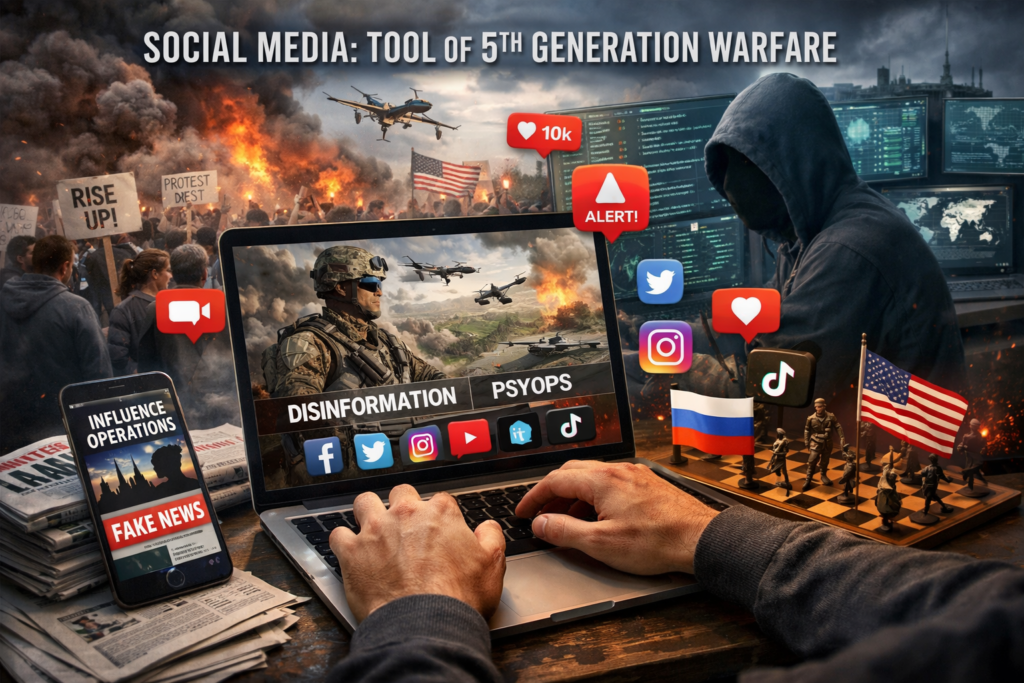
“Whoever controls the media, controls the mind.”
— Jim Morrison
The year is 2016. A war room not in the Pentagon, not in the Kremlin, but in a nondescript office block in St. Petersburg, Russia is running three shifts, around the clock, seven days a week. Its workers are not soldiers. They carry no weapons. They sit at laptops, sipping coffee, typing in fluent American English. By the time their operation is exposed, they will have reached 126 million Americans on Facebook alone without a single bullet being fired, a single border crossed, or a single law of war being invoked.
Now consider this: that was Phase Rudimentary, Exploratory and a prototype. What is being deployed against populations today with generative AI, with psychographic micro-targeting, with deepfake video indistinguishable from live news footage makes 2016 look like a rehearsal for a war that has since gone fully operational. “The most dangerous weapon in the world today does not detonate. It does not require launch codes or military doctrine. It requires only a smartphone, a platform, and the precise knowledge of what makes you angry.”
Here is what most people still do not understand about 5th Generation Warfare: the battlefield is not a place. It is a mental state. The territory being fought over is not land, not sea, not airspace, it is your perception of reality. Your trust in institutions. Your sense of who the enemy is. Your willingness to act, to resist, or to simply disengage and stop caring. And the primary infrastructure through which that battle is now fought; the delivery system, the amplification network, the targeting mechanism, and the detonator all in one is the same application you opened this morning before you got out of bed.
This article is not about social media being ‘bad for you’ in the wellness-influencer sense. It is about something far more specific, far more documented, and far more dangerous: the deliberate, state-level, strategically coordinated weaponisation of social platforms as instruments of 21st-century warfare. Every claim in this piece is sourced. Every operation described is real. And all of it is ongoing.
The Architecture of a Perfect Weapon
WHAT IS 5TH GENERATION, HYBRID & AI WARFARE?
Why Social Media Was Always Vulnerable
Social media was not designed to be a battlefield. It was designed to maximise engagement. But in the world of 5GW, those two things turned out to be inseparable.
The business model of every major platform, Facebook, X (formerly Twitter), TikTok, Instagram, YouTube rests on a single principle: keep users engaged for as long as possible. Longer engagement means more advertising revenue. The algorithms that govern what you see are, at their core, engagement-maximization engines.
And what maximizes engagement? Research consistently shows the answer: emotionally charged content. Specifically, content that generates outrage, fear, disgust, and tribal indignation spreads faster and wider than content that is calm, nuanced, or factually balanced. A 2018 MIT study found that false news spreads up to 70 percent faster than true news on social platforms, because fabricated stories tend to carry stronger emotional novelty.
| Key Finding: The MIT Falsehood Study A landmark study published in the journal Science (Vosoughi, Roy & Aral, 2018) analyzed 126,000 stories shared on Twitter over eleven years. False news was 70% more likely to be retweeted than true news and this was driven by humans, not bots. People, not algorithms alone, chose to spread falsehoods because they were more emotionally novel and surprising. |
This creates a devastating structural vulnerability. A hostile actor does not need to hack a platform, pay for advertising, or even have a sophisticated operation. They simply need to produce content that is emotionally manipulative enough to be amplified by the platform’s own algorithms and by its own users. The weapon was handed to 5GW operators by the platform architects themselves, wrapped in the promise of free speech and human connection.
The Four Platform Features That Enable 5GW
Understanding how social media was weaponised requires understanding four specific platform features that make it uniquely suited to information warfare:
- Algorithmic amplification of emotionally charged content. Platforms are designed to surface content that generates strong reactions which is precisely the content that hostile influence operations are engineered to produce.
- Anonymity and pseudonymity. Operators can create thousands of fake personas, sock-puppet accounts, and automated bots with minimal barriers to entry, making the source of coordinated campaigns nearly impossible to trace in real time.
- Network virality. A single piece of fabricated content can reach millions through organic sharing within hours, at zero cost to the originator. The economics of disinformation are almost perfectly asymmetric, the cost of creating a lie is trivial; the cost of correcting it is enormous.
- Personalization and filter bubbles. Recommendation algorithms segment users into ideological silos, ensuring that targeted content reaches psychologically pre-conditioned audiences who are already primed to believe it.
The Weapons Arsenal: Tactics of Social Media Warfare
Disinformation Campaigns: Engineering Perception
Disinformation is not mere misinformation, the accidental sharing of false information. Disinformation is the deliberate, strategic deployment of false or misleading content to achieve a political, social, or military objective. In 5GW, disinformation is a kinetic act, it is designed to produce real-world effects.
The Russian Internet Research Agency (IRA) operation during the 2016 United States presidential election remains the most thoroughly documented example of state-sponsored social media disinformation at industrial scale. According to the bipartisan Senate Intelligence Committee Report, the IRA’s operation, codenamed Project Lakhta involved the creation of thousands of fake American social media personas across Facebook, Twitter, YouTube, and Instagram. These personas were organized into communities that targeted specific demographic fault lines: race, gun rights, immigration, and religious identity.
The IRA did not simply post pro-Trump content. Its strategy was more sophisticated and more dangerous: it sought to deepen every existing fracture in American society simultaneously. It ran pro-Black Lives Matter pages and anti-Black Lives Matter pages. It ran pro-Muslim and anti-Muslim accounts. The objective was not to elect one candidate, it was to make Americans more divided, more distrustful of institutions, and more susceptible to future manipulation. This is the essence of 5GW: not destruction, but destabilization.
| Documented Scale of the IRA Operation: The Senate Intelligence Committee found that IRA content reached an estimated 126 million users on Facebook alone between 2015 and 2017. On Instagram, IRA accounts had approximately 187 million user interactions. Twitter identified 3,841 accounts linked to the IRA. The operation spent approximately $100,000 on targeted Facebook advertising a fraction of the billions spent by the campaigns themselves, yet arguably far more strategically precise. |
Bot Networks and Coordinated Inauthentic Behaviour
Bots, automated accounts programmed to post, like, retweet, and amplify content are the artillery of social media warfare. They manufacture the appearance of organic consensus where none exists. When a fabricated narrative is amplified by thousands of bot accounts simultaneously, it creates the illusion that a fringe view is actually a mainstream one. This is the illusory truth effect in action: the more a claim is repeated, and the more people appear to believe it, the more likely real humans are to accept it as true.
Researchers at Oxford University’s Computational Propaganda Project documented the use of computational propaganda, the use of automated accounts and algorithms to distribute political messaging, in at least 81 countries by 2020. What began as an experimental tool of a few state actors has become a globalized industry, with commercial troll farms offering disinformation-as-a-service to governments, political parties, and even corporations.
| Real-World Impact: India-Pakistan Digital War 2025 During the escalating India-Pakistan tensions following Operation Sindoor in 2025, social media became a parallel battlefield. Both sides deployed massive waves of disinformation. Fake videos of non-existent military victories, digitally manipulated footage, and fabricated casualty figures flooded X, Facebook, and YouTube. Video game simulations were passed off as real strike footage. According to Stratheia’s analysis of the conflict, ‘X and Facebook became fertile ground for the spread of war narratives, hate speech, and emotionally manipulative disinformation.’ Meta acknowledged taking ‘significant steps’ to remove false content but by the time corrections were issued, the original falsehoods had already reached tens of millions of users. |
Deepfakes: When Seeing No Longer Means Believing
If disinformation is the infantry of social media warfare, deepfakes are its air power capable of striking at scale, with devastating psychological precision, from a position of apparent legitimacy.
Deepfakes are synthetic media; video, audio, or images generated or manipulated using artificial intelligence to portray events or statements that never occurred. The technology has advanced at a pace that has outstripped both detection capability and public awareness. As recently as March 2026, a viral video showing missiles striking Tel Aviv circulated widely across social media. The footage appeared to document a real attack. The captions were credible. The quality was high. It was, according to subsequent investigations, a deepfake one of what the New York Times described as a ‘cascade of AI fakes about war with Iran’ that proliferated following the US-Israel military actions beginning in February 2026.
The deeper danger of deepfakes in 5GW is not merely that they spread lies. It is that their existence and public awareness of their existence erodes the foundational trust that makes factual information possible at all. When people know that any video could be fabricated, they begin to dismiss authentic evidence as fake. NBC News documented this precisely: video footage of starving Gazans waiting for food aid in May 2025 was comprehensively authenticated yet was reflexively dismissed by large numbers of social media users as a deepfake. Genuine suffering became dismissible as simulation. This is perhaps the most insidious strategic outcome of deepfake proliferation: not that people believe false things, but that they cease to believe anything.
| The Liar’s Dividend Researchers have coined the term ‘liar’s dividend’ to describe the secondary effect of deepfake proliferation: even real, authenticated evidence can be rejected by audiences who cite the existence of deepfakes as a justification for disbelief. This gives bad actors a double advantage; they can spread fabrications that are believed, and they can point to the existence of fabrications to cast doubt on truth. |
ISIS and the Weaponisation of Narrative
The Islamic State (ISIS) demonstrated, between 2013 and 2017, that social media warfare was not the exclusive domain of nation-states. ISIS built one of the most sophisticated digital propaganda operations in the history of non-state conflict. Through platforms including Twitter, Telegram, and YouTube, it disseminated high-production-value videos, multilingual publications, and precisely targeted recruitment content across global networks.
ISIS was distinguished from Al-Qaeda not primarily by its military capabilities, but by its mastery of narrative warfare. It understood that social media algorithms reward content that generates strong emotional responses, and it produced content of extraordinary emotional intensity: executions, battlefield victories, the promise of belonging to a global movement, the appeal of purpose and identity to radicalised young men in Western countries. Researchers estimate that at its peak, ISIS-affiliated accounts were generating up to 90,000 social media posts per day.
The ISIS example established a template that has since been adopted, refined, and scaled by actors ranging from far-right domestic terror cells to state-sponsored influence operations: identify your target audience’s psychological vulnerabilities, produce content engineered to exploit them, and let the platform’s own algorithms do the distribution work.
The Algorithm as Co-Conspirator
Echo Chambers, Filter Bubbles, and Epistemic Siege
Perhaps the most strategically consequential feature of social media in the context of 5GW is not any single tactic but the structural environment that platforms have constructed an environment that pre-conditions populations for manipulation long before a specific disinformation campaign is ever launched.
Filter bubbles; a term coined by digital activist Eli Pariser refer to the algorithmic creation of personalized information environments in which users are shown content that aligns with their existing beliefs and preferences. This is not a side effect of personalization; it is its intended outcome. The algorithm does not want to challenge you. It wants to confirm you, because confirmation keeps you engaged.
A systematic review of 30 peer-reviewed studies published in the journal Societies (2025) found consistent evidence that algorithmic systems structurally amplify ideological homogeneity across platforms including Facebook, YouTube, Twitter, Instagram, and TikTok reducing exposure to diverse perspectives and creating the conditions for political polarization and, in extreme cases, radicalization.
The implications for 5GW are profound. A state actor or non-state operator running an influence operation does not need to convert people from one worldview to another. It simply needs to find populations that already hold extreme or divisive views, identify the algorithms that are already feeding them polarising content, and add its own disinformation into that stream. The platform does the heavy lifting.
| TikTok Radicalization in Under 3 Hours A study examining TikTok’s recommendation algorithm found that a user could be exposed to a pathway from mild political content to white supremacist ideology, anti-Semitic content, and violent extremist material within approximately 2.5 hours of engagement without ever explicitly seeking such content. The algorithm, optimizing purely for engagement, treated extremist content identically to any other high-engagement category. The study also found that a 2021 Facebook internal report admitted its AI ‘played a major role in radicalizing’ users who joined extremist groups; 64% of all extremist group joins resulted from the platform’s own recommendation tools. |
Cognitive Contagion: When Disinformation Becomes Ideology
Recent research from the US Special Operations Forces Command has introduced the concept of cognitive contagion; a more sophisticated understanding of how disinformation operates at scale. Unlike simple falsehoods, cognitive contagions do not merely transmit incorrect information. They embed patterns of thinking: logical fallacies, emotionally charged heuristics, and cognitive shortcuts that self-propagate within communities.
A cognitive contagion does not say ‘X is false.’ It says ‘the kind of person you are believes X.’ It ties belief to identity. When disinformation becomes identity-linked, it becomes almost immune to factual correction because correcting the fact feels, to the believer, like an attack on who they are. This is why factchecking alone, while important, is insufficient as a counter to 5GW influence operations. The target is not just the belief; it is the cognitive framework within which beliefs are formed and evaluated.
This dynamic explains the persistence and resilience of conspiracy theories, election fraud narratives, and anti-vaccination movements across social media despite comprehensive factual debunking. The information has been corrected. The cognitive contagion has not.
The Current Battlefield: 5GW in Action (2024–2026)
Russia’s Ongoing Information Operations in Europe
Russia’s social media warfare operations did not end with the exposure of the IRA. They evolved. According to the EU DisinfoLab’s December 2025 update, Russia is running a coordinated foreign information manipulation campaign in Armenia ahead of the 2026 elections, using bots, deepfakes, and impersonation sites to portray the Armenian government as corrupt and Moscow as its only credible protector. In the Democratic Republic of Congo, Russian state actors have amplified false claims about US bioweapon laboratories alongside Ebola outbreaks; a calculated operation to discourage communities from seeking medical care, weaponising a public health crisis as a vector for destabilisation.
The EU DisinfoLab’s analysis of the current landscape notes that ‘Russian and Chinese state actors are refining their playbooks’ and that ‘algorithmic incentives, lax oversight, and shrinking transparency mechanisms are deepening existing vulnerabilities.’ This is not a static threat. It is an actively developing one.
China and the Architecture of ‘Unrestricted Warfare’
China’s strategic doctrine articulated in the 1999 military treatise Unrestricted Warfare by Qiao Liang and Wang Xiangsui explicitly envisions the use of non-military instruments including law, finance, information, psychology, and media as integrated elements of conflict. Chinese influence operations on social media reflect this doctrine.
The most significant Chinese social media operation documented to date is what researchers have called the Spamouflage network; a large-scale, coordinated campaign of fake accounts across multiple platforms that amplified pro-Beijing narratives, criticised dissident voices, and spread disinformation about issues including Hong Kong, Taiwan, and the origins of COVID-19. Meta reported removing over 4,800 Facebook accounts linked to Spamouflage in a single enforcement action in 2023.
What distinguishes China’s approach from Russia’s is its longer strategic horizon. Where Russian operations tend to be tactically focused disrupting specific elections or escalating specific conflicts, Chinese information operations appear oriented toward the slow, patient reshaping of global perception of China’s geopolitical legitimacy.
Iran’s Expanding Digital Influence Apparatus
Israel issued a rare public warning in late 2025 that Iran is intensifying cyber and disinformation operations targeting both civilians and critical infrastructure, describing a trajectory toward cyber-based warfare. Iran’s operations have historically targeted regional adversaries; Israel, Saudi Arabia, and the Gulf states but have increasingly expanded into Western information environments, including the United States and Europe. Iranian-linked operations have used social media to amplify sectarian divisions, spread anti-Israel content, and influence the perceived legitimacy of armed groups in the Middle East.
The Pop-Fascism Pipeline: Memes as Radicalisation Tools
One of the most underappreciated dynamics in contemporary social media warfare is the use of humor, meme culture, and pop-culture aesthetics as delivery mechanisms for extremist content. The EU DisinfoLab’s analysis, drawing on a cross-border investigation, documented how fascist symbols and historical authoritarian figures are being introduced into mainstream digital culture through memes, music, football fandom, and AI-generated videos. The pattern follows a three-stage progression: normalization (making extremist imagery seem harmless), acceptance (framing it as edgy but legitimate), and idolization (reframing historical atrocities as admirable).
This is a sophisticated 5GW operation that exploits the viral mechanics of platform culture. It requires no bot networks, no troll farms, and no state budget. It requires only an understanding of how algorithmic amplification works and the patience to let the content propagate organically.
Who Is Targeted and How
Demographic Precision: The Targeting Matrix
One of the defining features of social media warfare, as distinguished from traditional propaganda, is its capacity for demographic precision. Cold War propaganda was broadcast — it was fired at whole populations indiscriminately. Social media disinformation is narrowcast — it is surgically delivered to specific psychological profiles, demographic groups, and ideological communities.
The IRA’s Facebook operations, for example, did not present the same content to all Americans. They created distinct content ecosystems for different target communities: African Americans received content designed to suppress voter participation; gun rights activists received content designed to heighten fear and mobilize around Second Amendment grievances; evangelical Christians received content linking Hillary Clinton to anti-religious agendas. Each community was targeted with content precisely calibrated to its specific fears, identities, and emotional triggers, all derived from the same platform data that advertisers use to sell products.
Youth: The Primary Theatre of Operations
Young people are disproportionately targeted in social media warfare for several structural reasons. They spend more time on social platforms. They are statistically more likely to encounter and share political content online. Their political identities are still forming making them more susceptible to identity-linked cognitive contagions. And they are, by virtue of growing up in digital environments, often overconfident in their ability to assess digital content, a confidence that adversaries systematically exploit.
The systematic review of filter bubble and echo chamber research (2025) found that YouTube is particularly strongly linked to radicalisation among young users, with platform-specific algorithmic features amplifying fringe content with particular intensity on that platform. TikTok and Instagram remain under-researched but are assessed as carrying strong youth-radicalisation risk given their algorithm design and demographic profile.
Marginalised Communities: Amplifying Existing Grievances
5GW operators consistently target marginalized communities ethnic minorities, religious groups, communities with historical grievances against the state because they carry pre-existing vulnerabilities that require less effort to exploit. The goal is never to create grievances from scratch. It is to find genuine grievances, amplify them beyond their natural dimensions, direct them against targeted institutions or groups, and convert discontent into destabilizing action.
Pakistan’s experience in Baluchistan, documented in multiple defense analyses, illustrates this dynamic. Adversaries have used social media platforms to amplify separatist narratives, spread fabricated accounts of state abuses, and recruit youth into anti-state causes all while operating through proxy accounts and foreign-funded media organizations that provide plausible deniability.
The Structural Failures
The obvious question, given the scale and documentation of social media warfare operations, is: why have platforms not stopped them? The answer is structural, not incidental.
The engagement-maximization model that makes platforms profitable is the same model that makes them vulnerable. Disinformation and emotionally manipulative content perform better on engagement metrics than accurate, balanced content. Any algorithmic intervention that reduces the viral spread of manipulative content will, by definition, reduce engagement and therefore advertising revenue. This is not a problem that platforms can solve without restructuring their core business model.
A second structural failure is transparency. Platforms have historically resisted external scrutiny of their algorithms, their content moderation decisions, and their advertising systems. The Facebook Files, internal documents leaked by whistleblower Frances Haugen in 2021 revealed that Facebook’s own researchers had documented the platform’s role in amplifying extremism and undermining democratic discourse, and that this research had been systematically suppressed internally to protect commercial interests.
A third failure is speed asymmetry. Disinformation spreads at the speed of a share button. Correction, verification, and moderation operate at the speed of human review — which is orders of magnitude slower. By the time a false narrative is fact-checked and labelled, it has typically already reached its maximum audience.
| Challenge | Why It Has Not Been Solved |
| Algorithmic amplification of disinformation | Fixing it reduces engagement and revenue platforms face a direct commercial disincentive |
| Bot networks and fake accounts | Detection constantly lags behind creation; new bots are generated faster than they are removed |
| Deepfake content | Detection technology is advancing but remains behind generation capability |
| Echo chamber dynamics | Breaking filter bubbles requires reducing personalization also reduces engagement |
| Cross-platform coordination | Disinformation campaigns pivot across platforms; no single platform can address the network |
| Jurisdictional complexity | Influence operations originate across multiple countries; no single legal framework applies |
Solutions, Strategies, and What Actually Works
State-Level Responses
The first and most essential layer of defence against social media warfare operates at the state level. Effective state responses to 5GW information operations require a combination of institutional capability, legal frameworks, and international cooperation.
- Institutional capacity: Dedicated Counter-Disinformation Architecture: The United States established the Global Engagement Center (GEC) in 2016, specifically to lead, synchronise, and coordinate federal efforts to recognise, expose, and counter foreign disinformation. The European Union has implemented the Digital Services Act (DSA), which introduces mandatory transparency requirements, content moderation obligations, and risk assessment requirements for large platforms operating in EU territory.
- Early warning and attribution: Mapping disinformation operations before they reach operational scale, identifying patterns of coordinated inauthentic behaviour, and attributing campaigns to state or non-state actors are essential capabilities. The EU DisinfoLab, Oxford Internet Institute, and Stanford Internet Observatory have pioneered methodologies for this work.
- International legal frameworks: Disinformation operations exploit legal grey zones between countries. Establishing international frameworks for information security analogous to arms control treaties is a long-term strategic imperative that has yet to be seriously pursued at the multilateral level.
Platform-Level Interventions
While platforms face structural commercial incentives against comprehensive reform, a number of specific interventions have demonstrated measurable effectiveness when implemented:
- Friction-based interventions: Slowing the spread of potentially false content by adding friction to sharing prompting users to read before they share reduces the viral amplification of disinformation without censoring content. Twitter’s 2020 experiment with read-before-retweet prompts reduced article-sharing without reading by 40 percent.
- Content labelling and context: Labelling content from state-affiliated media, flagging claims that have been disputed by fact-checkers, and providing contextual information about viral content all demonstrate measurable reductions in the credibility users assign to false information.
- Transparency in political advertising: Requiring verified human identity for accounts that engage in political advertising, and making political ad targeting criteria publicly searchable, reduces the effectiveness of micro-targeted disinformation campaigns.
- External researcher access: Allowing credible academic researchers and civil society organizations to access platform data under appropriate privacy frameworks enables the independent study of influence operations and holds platforms accountable for the effectiveness of their own moderation.
The Cognitive Firewall: Individual and Community-Level Defence
Ultimately, the most durable defense against social media warfare is not technological, it is cognitive. But even without AI assistance, there are individual practices that constitute meaningful defense:
| The SIFT Method: A Practical Framework for Digital Literacy SIFT is a four-step approach developed by information literacy researchers: STOP Before sharing or reacting, pause. Notice your emotional response. High emotional intensity is a warning sign, not a validation. INVESTIGATE THE SOURCE: Who produced this? What is their track record? Are they credible on this subject? FIND BETTER COVERAGE, Is this claim reported by multiple independent, credible sources? If only fringe or partisan outlets are covering it, treat it with extreme caution. TRACE CLAIMS, Go upstream. Find the original source of the claim, not just the most emotionally compelling version of it. |
- Digital literacy as civic infrastructure: States, civil society organizations, and educational institutions must invest in systematic digital and media literacy education. This is not simply a matter of teaching people to fact-check, it is about developing the cognitive habits that resist manipulation.
- Community resilience: 5GW operators exploit social isolation and the absence of trusted intermediaries. Communities with strong social bonds, trusted local media, and robust civic institutions are more resistant to information warfare than atomised, high-distrust societies.
- Responsible journalism: Journalists should investigate and expose disinformation operations when discovered, rather than amplifying the original false content. Understanding the structural mechanics of influence operations should be a core journalistic competency.
The Future Trajectory
The dynamics described in this article are not static. They are evolving at a pace that outstrips institutional response capacity, and several near-term developments are likely to significantly intensify the challenge.
- Generative AI at scale: AI-generated content, text, images, audio, and video is becoming indistinguishable from human-produced content at scale. This will dramatically lower the cost and increase the volume of synthetic disinformation, enabling influence operations to be run at previously impossible scale with minimal human involvement.
- Psychographic micro-targeting: As neuroscience and behavioural science research advances, influence operations will become more precisely calibrated to individual psychological profiles. The shift from demographic targeting to individual psychographic targeting is already underway; AI-driven profiling will accelerate it.
- Platform migration: Emerging platforms particularly messaging applications like Telegram, WhatsApp, and Discord operate with even less transparency and content moderation than established social media companies. Disinformation operations are already migrating to these environments.
- AI-integrated platforms: The integration of AI into social media recommendation systems, content moderation, and user interaction will create new attack surfaces. AI systems can be manipulated through adversarial inputs, prompt injection, and training data poisoning opening entirely new vectors for 5GW operations.
“In a world where biological warfare is outlawed, the selective control of information has replaced mass destruction with slow, calculated epistemic suffocation.”
(Global Security Review, 2025)
CONCLUSION: The War That Never Ends
The weaponization of social media in 5th Generation Warfare represents one of the most significant strategic challenges of the 21st century precisely because it does not look like a strategic challenge. It looks like your morning scroll.
The battlefield is the attention of populations. The ammunition is emotion specifically the emotions of outrage, fear, disgust, and tribal loyalty that social media algorithms have been optimized to produce and amplify. The combatants are states, non-state actors, corporations, and networks whose identities are deliberately obscured. And the victims are, as Daniel Abbott observed, often unaware they are under attack.
The defense is not simple, and there is no single solution. It requires state capacity to detect and counter influence operations. It requires platforms to restructure their incentive systems in ways that reduce their commercial appeal. It requires communities to invest in the social bonds and trusted institutions that provide resistance to manipulation. And it requires individuals to cultivate the cognitive habits that make them less vulnerable to the emotional exploitation that 5GW depends upon.
Jim Morrison was right that whoever controls the media controls the mind. But the inverse is also true: whoever controls their own mind, who can pause before the outrage reflex, question the source before the share, and recognize the emotional manipulation in the content designed to enrage them has already won a significant battle in the war they did not know they were fighting.
“The first casualty of 5GW is not a soldier. It is a citizen’s ability to distinguish truth from engineered reality.”