”Not to have an adequate air force in the present state of the world is to compromise the foundations of national freedom and independence.” (Winston Churchill)
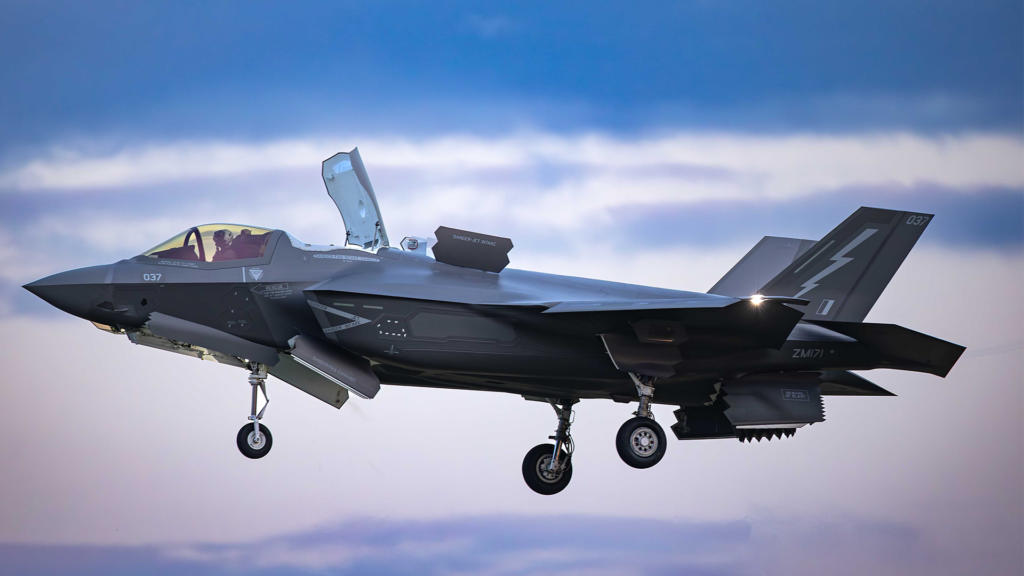
The Lockheed Martin F-35 Lightning II stands as the cornerstone of modern Western air superiority and the most expensive military weapons system in history. It is a fifth-generation, single-seat, single-engine, all-weather stealth multirole combat aircraft designed to perform ground attack and air superiority missions. Originating from the Joint Strike Fighter (JSF) program initiated in the 1990s, the F-35 was developed to replace a wide range of aging fighter, strike, and ground-attack aircraft for the United States Air Force, Navy, and Marine Corps, as well as allied nations. The program’s primary goal was to create a versatile, common platform that combined advanced stealth capabilities with unprecedented situational awareness through sensor fusion, net-centric operations, and agile logistics, thereby reducing overall development and sustainment costs compared to fielding multiple specialized aircraft.
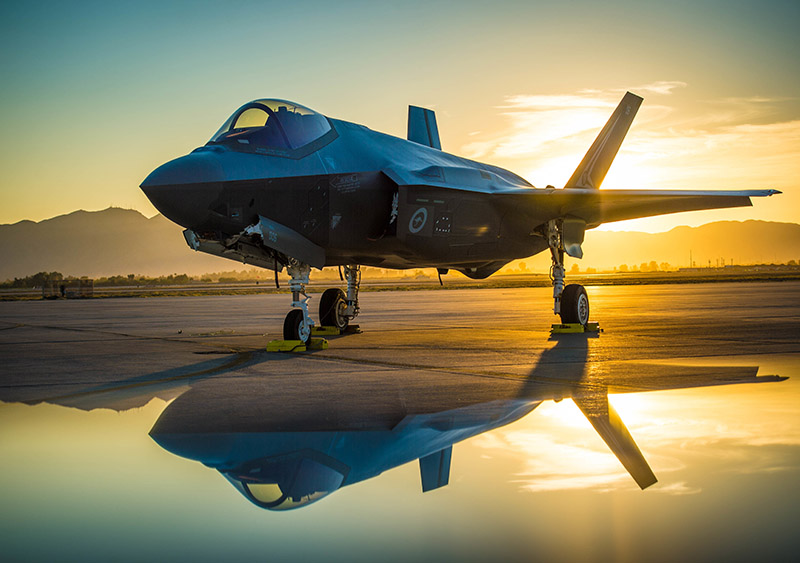
The defining characteristic of the F-35 is its “fifth-generation” status, a classification that goes beyond mere performance metrics like speed and maneuverability. While the F-35 is capable of supersonic flight (Mach 1.6) and high-g maneuvers, its true power lies in Very Low Observable (VLO) stealth technology combined with advanced avionics. The aircraft’s shape is rigorously designed to deflect radar energy, and its surfaces are coated with radar-absorbent materials. Furthermore, to maintain its stealth profile, the F-35 carries its primary armament in internal weapons bays, eliminating the significant radar cross-section created by external pylons and munitions. This stealth capability allows the F-35 to penetrate sophisticated enemy integrated air defense systems (IADS) that would detect and engage non-stealth aircraft at long ranges, enabling it to operate with relative impunity in contested airspace.
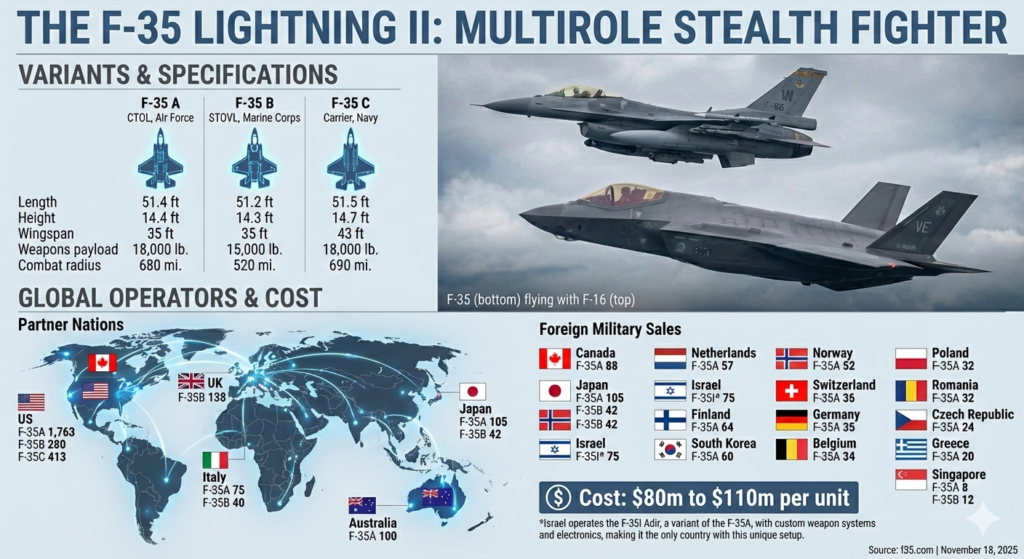
The F-35 is unique because it is a single design refined into three distinct “makes” to serve different branches of the military.
- The F-35A (CTOL): The “Conventional Take-Off and Landing” variant is the fastest and most agile, designed for the Air Force. It is the only model with an internal 25mm GAU-22/A cannon and is built to withstand 9g maneuvers.
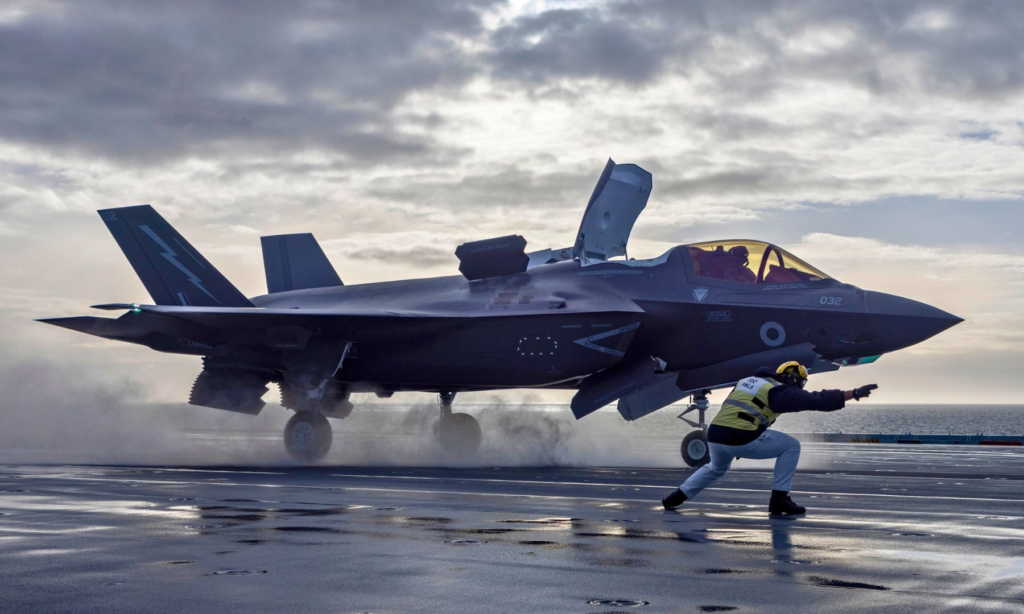
- The F-35B (STOVL): Perhaps the most engineering-intensive aircraft ever built, the “Short Take-Off and Vertical Landing” variant uses a massive Rolls-Royce LiftFan to hover and land like a helicopter. This allows it to operate from small amphibious ships or damaged runways where traditional jets cannot.
- The F-35C (CV): Built for the U.S. Navy’s supercarriers, the “Carrier Variant” features larger wings and robust landing gear to handle the violent stress of catapult launches and arrested landings. Its folding wingtips are a masterpiece of mechanical design, saving precious space on a crowded flight deck.
In terms of armament, the F-35 offers mission flexibility through two distinct configurations. In its “stealth” configuration, weapons are carried solely in two internal bays to maintain maximum radar evasion. Typical internal loads include two medium-range air-to-air missiles (like the AIM-120 AMRAAM) and two heavy air-to-ground ordnance (such as 2,000 lb GBU-31 JDAMs for the A/C models or smaller 1,000 lb munitions for the B model due to bay size constraints). When operating in permissive environments where enemy air defenses have been neutralized, the F-35 can utilize external pylons in what is informally known as “Beast Mode.” This sacrifices stealth for massive firepower, increasing the total ordnance payload to over 18,000 pounds (depending on variant) across internal bays and six external hardpoints.
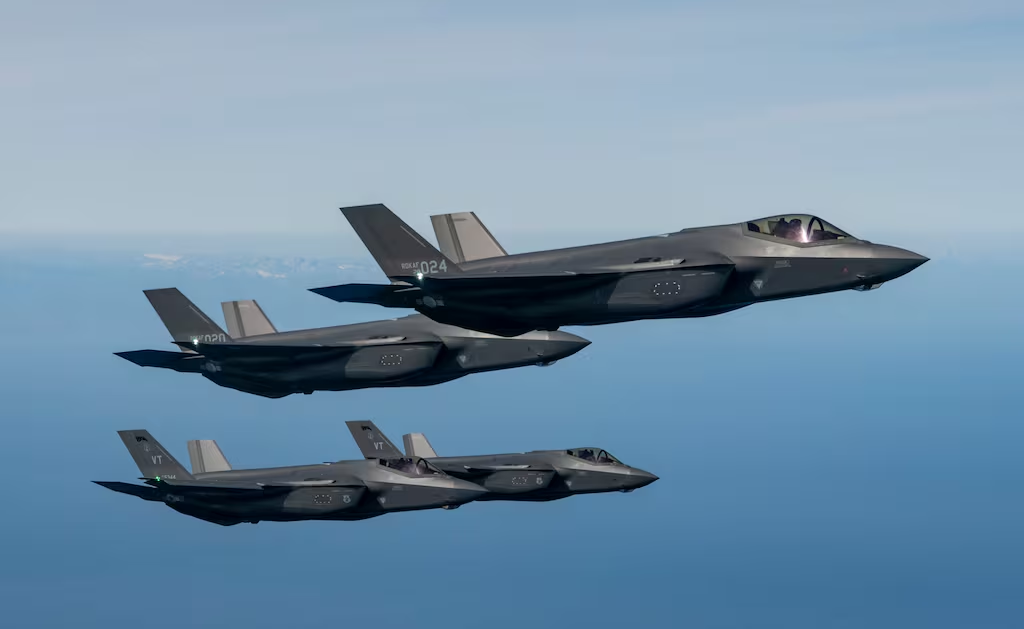
The F-35 program is a truly global enterprise with profound strategic implications. While led by the United States, the program includes eight original international partners—the United Kingdom, Italy, the Netherlands, Australia, Canada, Denmark, Norway, and Turkey (though Turkey was subsequently removed from the program)—along with numerous Foreign Military Sales (FMS) customers, including Israel, Japan, South Korea, Belgium, Poland, Singapore, Finland, Switzerland, Germany, and the Czech Republic. Despite early program criticism regarding significant cost overruns and development delays, the F-35 has matured into a highly capable operational platform. With over 990 aircraft delivered globally as of early 2024, the F-35 is rapidly becoming the backbone of NATO and allied air power, fundamentally reshaping aerial warfare doctrine by prioritizing information dominance, stealth, and interoperability over traditional kinematic performance.
The Digital Nervous System: Sensor Fusion and TR-3
What truly sets the F-35 apart is its “brain.” With the 2026 rollout of Technology Refresh 3 (TR-3), the aircraft has received a massive computing boost—featuring 25 times the computing power of previous models. This hardware supports the Block 4 upgrade, which introduces over 75 major capability enhancements. The pilot doesn’t just look at a screen; they wear a Gen III Helmet Mounted Display System (HMDS). This $400,000 piece of technology uses the Distributed Aperture System (DAS)—six infrared cameras around the jet—to project a 360-degree view directly onto the pilot’s visor. If a pilot looks down at their feet, they don’t see the cockpit floor; they see the ground below the plane in high-definition infrared.
However, the most revolutionary aspect of the F-35 is not its airframe or engine, but its “sensor fusion.” The aircraft acts as a flying data hub, collecting immense amounts of information from its onboard sensors and presenting it to the pilot as a single, integrated tactical picture. Key sensors include the Northrop Grumman AN/APG-81 Active Electronically Scanned Array (AESA) radar, which provides long-range air-to-air and air-to-ground targeting along with electronic warfare capabilities. Under the nose sits the Lockheed Martin AN/AAQ-40 Electro-Optical Targeting System (EOTS), providing precision air-to-ground targeting and long-range infrared search and track (IRST) functionality without compromising stealth. Perhaps the most unique sensor is the Northrop Grumman AN/AAQ-37 Distributed Aperture System (DAS), comprised of six high-resolution infrared cameras mounted around the airframe. DAS provides spherical, 360-degree situational awareness, warning of incoming missiles, detecting aircraft, and even allowing the pilot to look “through” the floor of the cockpit via their helmet.
Stealth as a Science: Materials and Survivability
The F-35’s stealth is not just paint; it is baked into the very structure of the airframe. The jet is constructed from a sophisticated blend of carbon-fiber composites, titanium, and aluminum. Its “Very Low Observable” (VLO) characteristics come from its highly aligned edges and a radar-absorbent material (RAM) that is now more durable than ever. By 2026, a new advanced coating has been implemented to combat the “discoloration” and corrosion issues seen in early maritime deployments. Unlike older stealth jets that required hours of delicate maintenance after every flight, the F-35’s skin is designed for the rugged reality of front-line combat, maintaining its radar-evading profile even in high-humidity and salty environments.
The Heart of the Beast: F135 Engine and the ECU
Powering this 70,000-pound machine is the Pratt & Whitney F135, the world’s most powerful fighter engine, producing over 43,000 lbs of thrust. To keep up with the power-hungry sensors of the Block 4 era, the engine is currently undergoing an Engine Core Upgrade (ECU). This upgrade isn’t just about speed; it’s about “thermal management.” Modern electronics generate immense heat; the ECU and the new Power and Thermal Management System (PTMS) provide up to 80 kW of cooling, ensuring the jet’s “digital brain” doesn’t overheat during high-intensity electronic warfare (EW) missions using the AN/ASQ-239 suite.
Technical Fact Sheet & Performance Data
| Feature | Specification (F-35A) |
| Max Speed | Mach 1.6 (~1,200 mph) |
| Combat Radius | > 590 nautical miles (Internal Fuel) |
| Internal Weapons | 4–6 Missiles (AIM-120) or 2 JDAMs + 2 Missiles |
| “Beast Mode” Payload | 18,000+ lbs (Internal + External) |
| Service Ceiling | 50,000+ feet |
| Radar | AN/APG-81 AESA (Multi-function) |
The Future: Collaborative Combat Aircraft (CCA)
Looking forward, the F-35 is evolving into a “mothership.” In 2026, testing has intensified for the F-35 to lead “Loyal Wingman” drones—autonomous aircraft that fly ahead of the jet to jam radars or strike targets. This Manned-Unmanned Teaming (MUM-T) ensures that the pilot remains out of harm’s way while the drones do the “dirty work” in highly contested airspace. The F-35 is no longer just a weapon; it is the command center of a robotic fleet, ensuring air superiority for decades to come.
2025: The Year the F-35 Redefined the Global Order
For the Lockheed Martin F-35 program, 2025 was the year the “jet of the future” became the definitive “jet of the present.” While the program’s early years were marked by development hurdles, the data from January 2026 confirms an unprecedented industrial and operational surge. In a staggering show of manufacturing might, Lockheed Martin delivered 191 aircraft in 2025 alone, shattering its previous record of 142 and outpacing the production of any other allied fighter by a factor of five. With the global fleet now swelling toward 1,300 units, the Lightning II is no longer a niche stealth asset; it is the standardized backbone of democratic airpower.
Trial by Fire: Combat Validation and NATO’s Shield
The most compelling narrative of 2025 wasn’t found on the assembly line, but in contested airspace. The F-35 moved beyond training exercises into high-stakes kinetic operations that proved its fifth-generation worth.
- Operation Midnight Hammer: The F-35 played the “lead” role in neutralizing sophisticated Iranian air defenses, demonstrating its ability to dismantle Integrated Air Defense Systems (IADS) that 4th-generation jets simply cannot survive.
- The Polish Frontier: In a historic first, NATO F-35s successfully engaged and eliminated Russian drones encroaching on allied airspace over Poland. This marked the first time the Lightning II was used to enforce NATO’s “red lines,” proving its utility in direct high-intensity European defense.
- Reliability Under Pressure: Amidst these combat sorties, the U.S. Marine Corps’ F-35B fleet logged 5,000 flight hours without a single mishap, a testament to the platform’s maturing maintenance cycle and the success of the vertical-lift propulsion system.
The Silicon Heart: TR-3 and the Million-Hour Milestone
Technically, 2025 was defined by the completion of Technology Refresh 3 (TR-3). This wasn’t just a software patch; it was a fundamental “brain transplant” for the fleet. TR-3 provides the massive processing power required to run the Block 4 capability suite, which includes advanced electronic jamming and enhanced sensor ranges. This milestone coincided with the program surpassing one million cumulative flight hours, a gold-standard metric of platform maturity that signals the F-35 has moved out of its “learning phase” and into its “dominance phase.”
Global Confidence and the $24 Billion Agreement
The international appetite for the F-35 reached a fever pitch in 2025. Nations are no longer just buying the jet; they are doubling down on it. Italy and Denmark significantly expanded their original orders, adding 25 and 16 jets respectively. Meanwhile, the industrial map of Europe shifted as Finland rolled out its first airframe and Norway achieved the monumental feat of completing its entire planned fleet delivery.
Securing the program’s financial future, the F-35 Joint Program Office (JPO) finalized the Lots 18-19 contract—a $24 billion deal for nearly 300 additional aircraft. This contract, alongside a new annualized sustainment agreement, ensures that the F-35 enterprise has the “long-term fuel” to keep costs down while keeping the technology ahead of peer adversaries like the Su-57 or J-20.
The Paradigm Shift: How the F-35 Redefined the Philosophy of Aerial Combat
The “Paradigm Shift” triggered by the F-35 represents the most significant evolution in air warfare since the introduction of the jet engine. It moves the metric of victory away from kinematics (how fast a plane flies or how tightly it turns) and toward cognition (who sees, understands, and acts first). This shift is built on three factual pillars: information dominance, stealth as a “time-generator,” and the role of the pilot as a strategic battle manager.
In legacy 4th-generation fighters like the F-16 or Su-27, pilots spent roughly 80% of their cognitive energy simply flying the aircraft and managing individual sensors—manually tuning radar, checking fuel, and cross-referencing maps. The F-35’s Sensor Fusion flips this ratio. Its computers take data from the AN/APG-81 radar, the 360-degree DAS cameras, and electronic warfare suites, merging them into a single, intuitive tactical picture. In 2025, the TR-3 (Technology Refresh 3) upgrade increased the F-35’s computing power by 25 times, allowing the jet to process millions of lines of code per second to identify and prioritize targets automatically. The pilot no longer “searches” for the enemy; the aircraft presents the enemy as a solved mathematical problem.
Common misconceptions view stealth as “invisibility,” but in the new philosophy of combat, stealth is actually a time-management tool. By having a radar cross-section (RCS) similar to a metal marble, the F-35 forces enemy radar to get significantly closer before achieving a “track.” This creates a “Detection Gap.” An F-35 can detect a 4th-generation threat at over 100 miles, while the enemy may not detect the F-35 until it is within 20 miles. This 80-mile “buffer zone” allows the F-35 to position itself perfectly, choose the angle of attack, or even bypass the fight entirely to strike a higher-value target.
The F-35 is designed to be a “node” in a network, not a “lone wolf.” Its Multifunction Advanced Data Link (MADL) is a narrow-beam, low-probability-of-intercept signal that shares its entire “fused” view with other F-35s instantly and securely. This was demonstrated during Operation Midnight Hammer (June 2025). F-35s penetrated Iranian airspace undetected and used their sensors to provide real-time targeting coordinates to B-2 bombers and Tomahawk missiles. The F-35s didn’t just carry bombs; they acted as the eyes and ears for the entire 125-aircraft strike package, ensuring no allied aircraft were fired upon during the suppression of air defenses.+2
In previous decades, “Wild Weasel” missions involved specialized jets baiting enemy radars into firing so they could be targeted. The F-35 has redefined this as a Passive Electronic Attack. During 2025 operations, F-35s utilized their AN/ASQ-239 Electronic Warfare suite to geolocate and jam enemy emitters without ever turning on their own radar. By staying “silent” and “dark,” they “obliterated” integrated air defenses in minutes (as seen in the Midnight Hammer reports) by feeding precise coordinates to standoff weapons while remaining undetected.
As of 2026, the philosophy has extended to Collaborative Combat Aircraft (CCA). The F-35 is now being tested as the “mother ship” for autonomous drones. Recent simulations and flight tests have shown a single F-35 pilot commanding a “swarm” of four to six drones. The drones fly ahead to draw fire or act as extra missile magazines, while the F-35 pilot stays in the “stealth bubble,” making high-level strategic decisions.
The “Invisible” Eye: Stealth and Sensory Fusion
The aircraft’s reputation for air superiority isn’t built on a single feature, but on a “triad” of integrated technologies: stealth airframe design, advanced sensors, and high-speed edge computing. * Low Observability: The F-35 is engineered to be nearly “invisible” to enemy radar, allowing it to slip through the most sophisticated defenses.
- 360-Degree Vision: Using the Distributed Aperture System (DAS), the jet feeds a seamless, spherical view of the environment directly into the pilot’s helmet. This means the pilot isn’t just looking at a screen; they are “merged” with the aircraft, seeing every threat—from a ground-based missile launch to a distant enemy jet—in real-time.
Beyond Speed: The “First Look, First Kill” Advantage
For decades, the measure of a great fighter was its Mach number. The F-35 changes that equation. It operates on a simple but deadly principle: identify the threat before the threat knows you exist. By prioritizing data collection over pure velocity, the F-35 acts as a stealthy “vacuum” for information. It gathers massive amounts of intelligence from its surroundings, processes it via onboard AI-driven computers, and presents the pilot with a curated, actionable “God’s-eye view” of the battlefield. This allows the F-35 to engage targets at extreme ranges, often neutralizing an adversary before they even see a blip on their radar.
The Force Multiplier: A Connected Command Center
The F-35 represents a seismic shift in how modern militaries employ air power. It is no longer a “lone wolf” fighter; it is a Force Multiplier. * Collaborative Strikes: The jet’s ability to share its high-fidelity data across the entire force—to naval destroyers, ground units, and 4th-generation jets like the F-16 or F-15—is its true “secret weapon.”
- Coordinated Lethality: An F-35 can identify a target but remain “silent” (not firing its own weapons to maintain stealth), instead passing the targeting data to a distant ship or another aircraft to execute the strike.
In short, the F-35 has transformed the role of the fighter pilot from a “driver” to a “battle manager.” It has shifted the focus of aerial warfare from the physical realm of “who is faster” to the cognitive realm of “who knows more,” ensuring that the F-35 remains an indispensable, invisible hand in global security.
References and Sources:
- Lockheed Martin Official Website (F-35 Page): Primary source for general specifications, variant differences, and program status.
- U.S. Air Force Official Fact Sheets: Source for F-35A-specific capabilities, armament, and mission roles.
- U.S. Navy Official Fact File: Source for F-35B and F-35C maritime operational details and specifications.
- Pratt & Whitney Official Website: Primary source for F135 engine thrust data and technical specifications.
- Congressional Research Service (CRS) Reports: “F-35 Joint Strike Fighter (JSF) Program.” These reports provide objective, detailed analysis of program costs, quantities, and legislative history.
- Northrop Grumman Capabilities Reports: Information regarding the AN/APG-81 radar and AN/AAQ-37 DAS sensor systems.