“Let your plans be dark and impenetrable as night, and when you move, fall like a thunderbolt.” – (Sun Tzu)
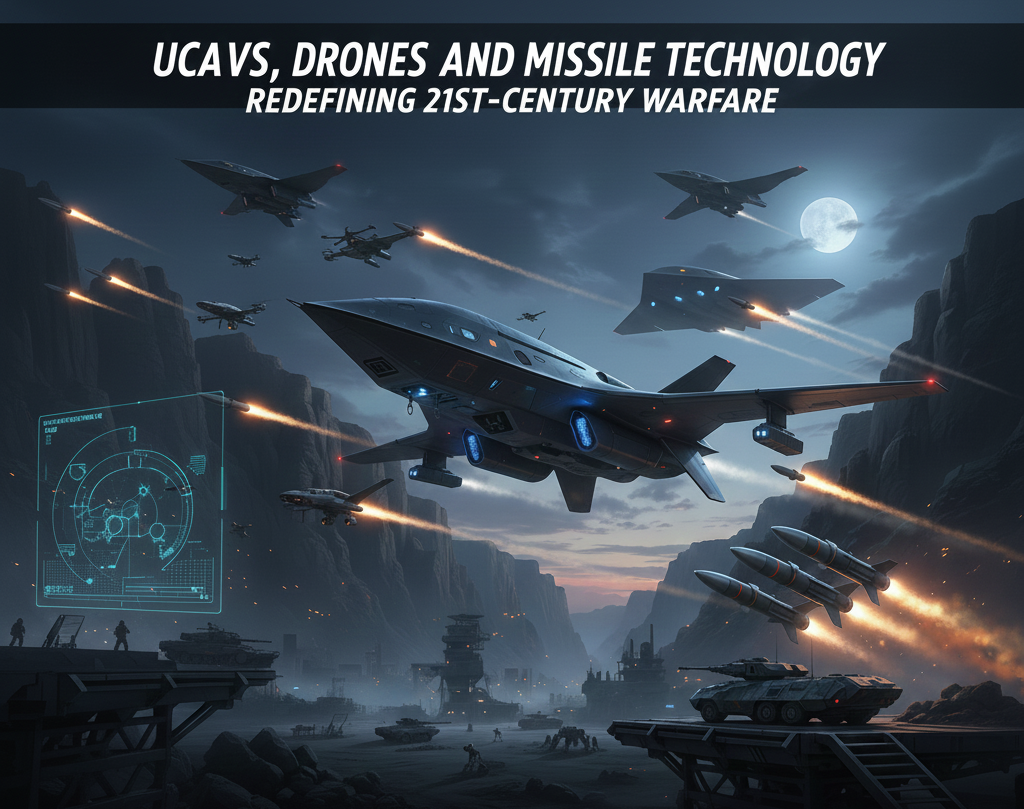
The character of modern warfare is undergoing a profound transformation, driven by the convergence of three interrelated technological domains: stealth, unmanned aerial systems (UAVs/UCAVs), and precision missile technology. These innovations are not merely new tools but are fundamentally altering strategic calculations, force structures, and the very experience of conflict, blurring the lines between traditional and asymmetric warfare.
The Evolution of the Unmanned Aerial System: From Sensor to Swarm
The role of UAVs has evolved exponentially since their early days as remote-controlled targets. Their operational history is a chronicle of technological ascent:
- 1991 Gulf War: Primarily used as naval gunfire spotters and limited reconnaissance assets.
- 1999 Kosovo War: Marked a leap with the integration of real-time satellite relay, providing commanders with persistent surveillance feeds.
- Post-9/11 Conflicts (Afghanistan, Iraq, Yemen, Syria): The MQ-1 Predator’s evolution from a “sensor” to a “shooter” platform inaugurated the era of the armed drone, enabling persistent tracking and kinetic engagement of non-state actors like Al-Qaeda and ISIS with minimal risk to operators.
- 2020s Conflicts: The Nagorno-Karabakh war (2020) and the Russo-Ukrainian War (2022-present) have served as stark demonstrations of a new paradigm. The large-scale, innovative use of relatively inexpensive, commercially-sourced drones and loitering munitions (e.g., Turkish Bayraktar TB2, American Switchblade, Iranian Shaheds) by state and non-state actors alike has proven devastating against multi-billion-dollar conventional armor and artillery systems. The use of drone swarms, as seen in conflicts from Ethiopia to Ukraine, hints at a future where saturation attacks overwhelm even the most advanced air defenses.
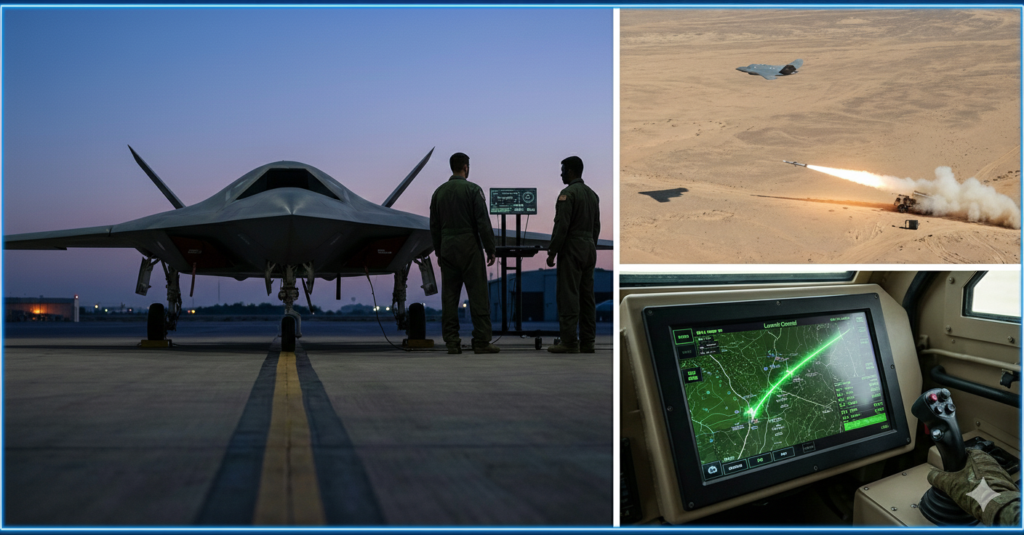
This trajectory underscores a strategic shift. The ultimate consideration is no longer solely the protection of a pilot’s life—a primary driver for centuries of aviation design—but has expanded to include mission persistence, cost-exchange ratios, and political deniability. A $20 million UCAV can be risked in airspace deemed too dangerous for a $100 million manned fighter and its pilot. This calculus empowers both advanced militaries and smaller states or non-state actors, democratizing access to potent aerial capabilities.
The Science of Invisibility: Deconstructing Stealth Technology
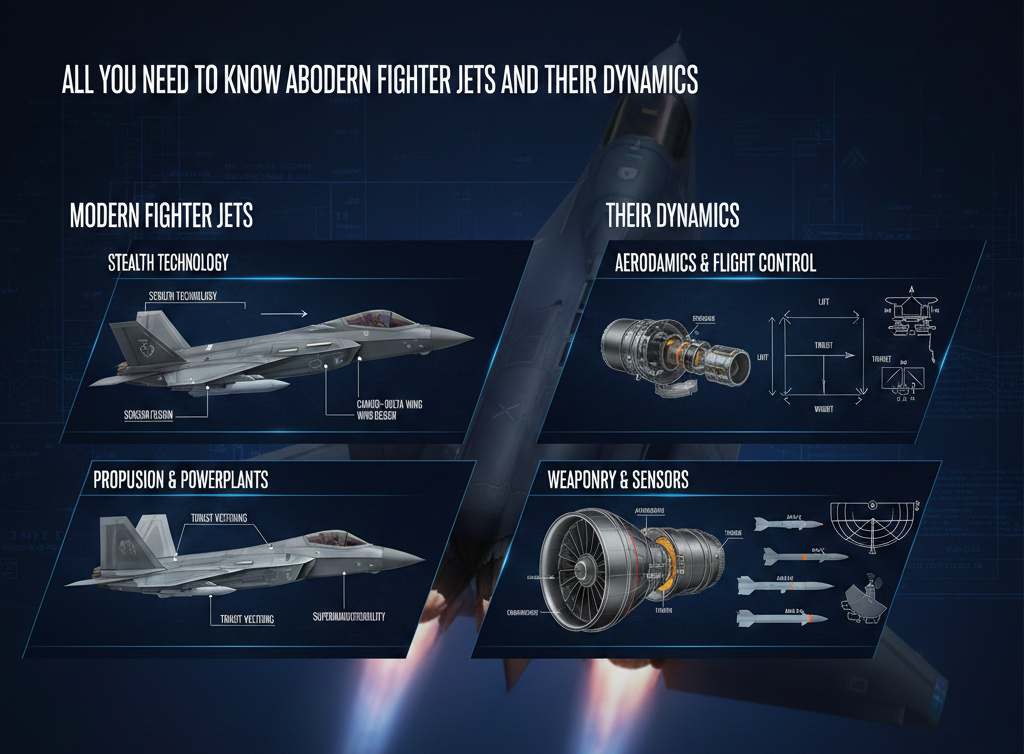
Popularized by the angular F-117 Nighthawk in the late 1980s, Low Observable (LO) or “stealth” technology is a multidisciplinary suite of passive electronic countermeasures designed to make platforms less detectable across the electromagnetic and acoustic spectra.
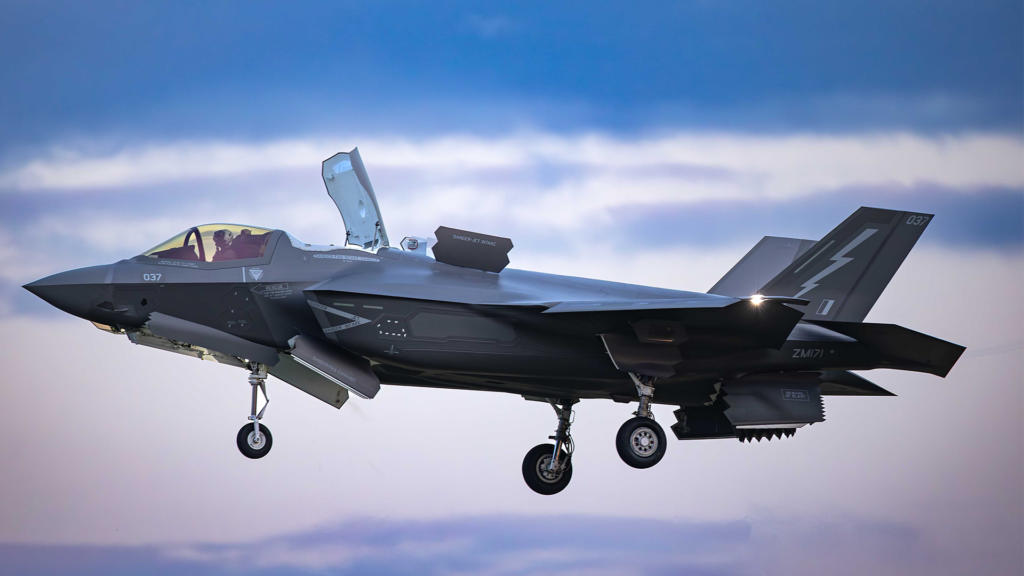
- Radar Cross-Section (RCS) Reduction: The cornerstone of stealth. This is achieved through faceting and shaping (like the F-117) or continuous curvature (like the B-2 Spirit and F-35 Lightning II) to deflect radar energy away from the source. Internal weapon bays and covered engine intakes are critical, as protruding ordnance and turbine faces are major radar reflectors.
- Radar-Absorbent Materials (RAM): Specialized paints and structural composites containing ferrite particles or carbon nanotubes are applied to absorb radar wave energy and dissipate it as heat, rather than reflecting it. The exact composition and application of these materials remain among the most closely guarded secrets in defense technology.
- Infrared (IR) Signature Suppression: Hot engine exhaust is a beacon for IR seekers. Techniques include non-circular, flattened exhaust nozzles (F-22, F-35) to maximize the mixing of hot gases with cooler ambient air, and shielding engine parts from direct view.
- Acoustic and Visual Stealth: While secondary for high-speed aircraft, acoustic quieting is paramount for submarines and low-altitude UAVs. Visual camouflage, matte paints, and nocturnal operations remain simple yet effective tactics, especially for tactical UAVs.
- Low Probability of Intercept (LPI) Systems: Modern stealth platforms like the F-22 employ advanced radars and datalinks that transmit signals in brief, frequency-hopping bursts that are difficult for enemy sensors to distinguish from background noise.
However, stealth is not absolute invisibility. It is a reduction of detection ranges. Counter-stealth technologies are advancing in parallel, including:
- Low-Frequency/ Bi-static and Multi-static Radars: Older, longer-wavelength radars (VHF/UHF bands) can detect large stealth platforms at longer ranges, though with poor precision. Bi-static systems, where the transmitter and receiver are separated, can catch deflected radar energy.
- Passive Sensing: Systems that detect an aircraft’s unintended emissions (like RF leakage from onboard electronics) or its perturbations in ambient signals, such as cellular or TV/radio waves, offer a potent detection method without broadcasting their own location.
Defining the Unmanned Fleet: RPV, UAV, and UCAV
While often used interchangeably, key distinctions exist:
- Remotely Piloted Vehicle (RPV): Emphasizes real-time, line-of-sight human control. The operator “flies” the aircraft as if in the cockpit. Many smaller tactical drones fit this category.
- Unmanned Aerial Vehicle (UAV): A broader term encompassing all aircraft without an onboard human pilot. It implies a higher degree of autonomy in navigation and flight control, though missions are overseen by humans.
- Unmanned Combat Aerial Vehicle (UCAV): A subset of UAVs designed specifically for offensive strike, air-to-air combat, or electronic warfare missions. They are characterized by integrated weapons bays, survivability features (often including stealth), and sophisticated sensor-suites for target identification and engagement (e.g., Northrop Grumman X-47B, General Atomics Avenger, Turkish Bayraktar Akıncı).
Classification remains fluid but is often based on altitude, endurance, and mission:
- Small/Tactical: (e.g., RQ-11 Raven, AeroVironment Switchblade). Range: <200 km. Used for platoon/company-level reconnaissance and direct attack.
- Medium-Altitude Long-Endurance (MALE): (e.g., MQ-9 Reaper). Operates at ~25,000 ft for 24+ hours. The workhorse for persistent ISR and targeted strikes.
- High-Altitude Long-Endurance (HALE): (e.g., RQ-4 Global Hawk). Operates at 60,000+ ft for over 30 hours, providing strategic-level reconnaissance over continents.
The UCAV: A New Pillar of Military Power
The UCAV represents the logical fusion of stealth, unmanned autonomy, and precision strike.
Strategic Drivers:
- Penetration of Denied Airspace: UCAVs with very-low-observable (VLO) features are envisaged as the leading edge to degrade or destroy integrated air defense systems (IADS), paving the way for manned aircraft.
- Persistence and Endurance: Freed from human physiological limits, UCAVs can loiter over a battlefield or high-value target for dozens of hours, creating persistent pressure and enabling rapid strike when a target is identified.
- Affordable Mass and Attrition Tolerance: Advanced militaries see UCAVs as force multipliers that can be procured in larger numbers than manned fighters, creating a more resilient and distributable force structure. The concept of “Loyal Wingman” (e.g., Kratos XQ-58 Valkyrie) envisions UCAVs operating alongside manned fighters, acting as sensor nodes, weapons magazines, and shields.
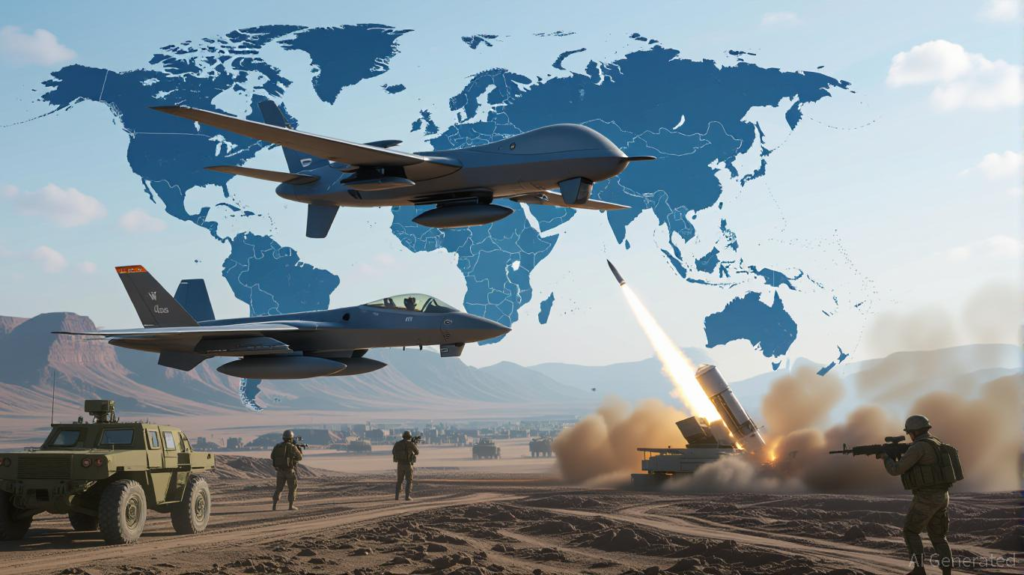
Expanded Military Applications:
Beyond strike and ISR, UCAVs are envisioned for:
- Networked Electronic Warfare: Acting as mobile, survivable nodes to jam or spoof enemy communications and radars.
- Air-to-Air Combat: Developing concepts for autonomous “dogfighting” and long-range intercepts, though the rules of engagement and required level of autonomy remain intensely debated.
- Combat Search and Rescue (CSAR): Providing overwatch and suppressing enemy fire in high-risk rescue zones.
- Under-sea Warfare: Deploying sonobuoys or acting as communications relays for submarine fleets.
The Missile Technology Nexus: Proliferation and Precision
The impact of UAVs and stealth is amplified by parallel revolutions in missile technology:
- Proliferation of Precision: Advanced seekers (imaging infrared, millimeter-wave radar) are now miniaturized and affordable, enabling even non-state actors to field precision-guided munitions (PGMs) via drones.
- Anti-Access/Area Denial (A2/AD): Long-range, stealthy cruise and ballistic missiles (e.g., Chinese DF-21D “carrier-killer”) threaten to keep traditional force-projection platforms like aircraft carriers at bay, increasing the value of stealthy, penetrating UAVs and UCAVs.
- Hypersonic Weapons: The emergence of hypersonic glide vehicles and cruise missiles (traveling at Mach 5+) drastically compresses decision-making timelines for defenders, demanding automated, sensor-to-shooter networks where UCAVs could serve as critical forward nodes for targeting.
The Cognitive and Informational Domain: The True Battlefield
While much focus is on physical platforms, the decisive advantage lies in the C4ISR (Command, Control, Communications, Computers, Intelligence, Surveillance, and Reconnaissance) architecture that enables them. This is the “central nervous system” of modern warfare.
- The Data Tsunami and AI Trilemma: A single HALE UAV like the Global Hawk can generate over 7 terabytes of sensor data per day. The core challenge is no longer collection, but processing, exploitation, and dissemination (PED). Militaries face a trilemma: Volume (handling the data), Velocity (making decisions fast enough), and Veracity (ensuring AI/ML algorithms are not fooled by adversarial spoofing). The side with superior AI-enabled battle management systems that can translate sensor data into actionable targeting solutions within minutes—the “OODA loop compression“—will dominate.
- The Rise of the “Digital Constellation”: Future battles will be fought not by individual stealth fighters or drones, but by integrated “constellations” of assets. This includes:
- Low-Earth Orbit (LEO) Satellites (e.g., Starlink, Blackjack) providing resilient, low-latency global comms.
- High-Altitude Pseudo-Satellites (HAPS) – solar-powered UAVs like Airbus Zephyr, acting as persistent, repositionable communication and sensing nodes.
- Undersea and Surface Nodes – unmanned vessels feeding data into the network.
- The Adversarial Counter: This creates vulnerability. The 2022 sinking of the Russian cruiser Moskva was enabled by a Ukrainian TB2 drone acting as a sensor node to cue shore-based anti-ship missiles. The kill chain was distributed and resilient.
The Stealth vs. Counter-Stealth Dialectic: An Enduring Race
The narrative often pits stealth against new detection methods. The reality is more fluid—a constant cycle of measure and countermeasure.
- Advanced Sensor Fusion: The most significant threat to stealth is not a single “silver bullet” radar, but the AI-driven fusion of multiple, disparate sensors. This could combine data from:
- Passive RF Sensors: Tracking unintentional emissions.
- Bi-static Radar: Using civilian radio/TV signals as illuminators.
- Infrared Search and Track (IRST): Advanced systems on fighters like the Su-35 can detect stealth aircraft at tactically relevant ranges by their skin friction heat, especially from certain aspects.
- Wide-Area Airborne Surveillance: Systems like the E-7 Wedgetail’s Multi-Role Electronically Scanned Array (MESA) radar can perform agile, non-traditional scans that are harder for stealth aircraft to predict and counter.
- The “Stealth is a Spectrum” Reality: Platforms are not simply “stealth” or “not stealth.” The B-2 bomber has a radar cross-section (RCS) comparable to a large bird (~0.0001 m²), while a 5th-gen fighter like the F-35 is around a golf ball (~0.001 m²). Future 6th-generation platforms (e.g., B-21 Raider, NGAD) focus on “all-aspect, broadband stealth,” meaning reduced signatures across a wider spectrum of radio frequencies and from all angles, not just the frontal aspect.
The UCAV Autonomy Threshold: The “Human-On-The-Loop” Imperative
The most critical and ethically charged evolution is in the level of autonomy granted to lethal systems.
- Beyond Remote Control: Autonomous Behaviors: Modern UCAVs are not merely remotely flown. They employ highly autonomous functions:
- Adaptive Route Planning: Re-routing in real-time to avoid threats or weather.
- Automated Sensor Management: Prioritizing which target to image based on pre-programmed rules.
- Collaborative Engagement (Swarm AI): Drones in a swarm communicating to allocate targets, maintain formation, and execute coordinated attacks without direct human piloting for each unit. Israel’s Harop loitering munition already embodies a high degree of autonomous target selection within parameters.
- The Critical Line: The “Fire” Decision: The international legal and normative red line remains Meaningful Human Control (MHC) over the final lethal decision. Current systems are “human-in-the-loop” (requiring direct command to strike) or “human-on-the-loop” (able to strike designated target types autonomously unless a human vetoes). The feared future is “human-out-of-the-loop”—fully autonomous hunting and engagement. The ongoing UN discussions on Lethal Autonomous Weapons Systems (LAWS) grapple with this threshold. The strategic risk is not just ethical but practical: an autonomous system could be hacked, spoofed, or escalate a conflict based on faulty logic.
The Asymmetric and Economic Re-Correction: The Cheap vs. Expensive Paradox
The Russo-Ukrainian War has delivered a stark lesson: expensive platforms can be neutralized by cheap, attritable systems. A $100,000 Turkish Bayraktar TB2 or a $10,000 commercial quadcopter modified to drop grenades has destroyed multi-million dollar tanks, artillery pieces, and even air defense systems. This inverts traditional military economics. Defense budgets optimized for a few exquisite platforms are now forced to invest in large numbers of attritable drones, layered air defenses (including anti-drone systems like Rheinmetall’s Skynex), and electronic warfare at the tactical level. The ability to rapidly produce, replace, and innovate with commercial-off-the-shelf (COTS) drone technology has become a strategic advantage. Ukraine’s ability to field and adapt thousands of first-person view (FPV) drones has been a key factor. This shifts the center of gravity from protected production facilities to global semiconductor and precision engineering supply chains.
The New Triad: Hypersonics, UCAVs, and Decision-Dominance
Missile technology is not just an adjunct but a central pillar of this new era, creating a potent synergy with unmanned systems. The future lies in systems that combine the long-range persistence of a UAV with the decisive kinetic effect of a missile. Loitering Munitions (e.g., IAI Harop, AeroVironment Switchblade) are precisely this: kamikaze drones that blur the line between sensor and weapon, capable of waiting for hours before striking a time-sensitive target. Weapons like Russia’s Kh-47M2 Kinzhal or China’s DF-17 glide vehicle compress the decision-making window from hours to minutes. To target these fleeting, high-value assets, militaries will rely on a persistent, survivable sensor grid — a role for which stealthy, penetrating UCAVs and unmanned space-based sensors are ideally suited. This creates a new strategic triad: Hypersonic Strike, Resilient Sensing (UAV/UCAV/Satellite Constellations), and AI-Enabled Command.
Conclusion: The Integrated Impact on Warfare
The convergence of these technologies is creating a new “kill web”—a highly networked, distributed, and resilient battlespace where sensors, shooters, and command nodes are rapidly and flexibly connected. The implications are profound:
- Lowered Thresholds for Conflict: The perceived low risk and cost of drone strikes may encourage more frequent uses of force below the level of traditional war.
- New Forms of Deterrence and Coercion: Persistent drone surveillance and the threat of swarms create constant psychological and operational pressure.
- Erosion of the Monopoly of Force: State and non-state actors can now project power and inflict significant costs with systems that are orders of magnitude cheaper than traditional platforms, challenging established military hierarchies.
- Ethical and Legal Challenges: The “faceless” nature of remote warfare, the delegation of lethal functions to algorithms, and the use of AI in target identification raise urgent questions about accountability, proportionality, and the laws of armed conflict.
In conclusion, stealth, UAV/UCAV, and missile technologies are not merely incremental improvements but are collectively driving a revolution in military affairs. They are redefining frontlines, altering cost-benefit analyses of war, and forcing a fundamental reassessment of aerial dominance, platform design, and the very meaning of military power in the 21st century. The future of conflict will be shaped by those who can most effectively integrate these invisible, autonomous, and precise capabilities into a coherent, adaptive, and ethically governed warfighting doctrine.
Sources & References:
- Department of Defense (U.S.), Unmanned Aircraft Systems Roadmap & Airborne Threat Recognition and Engagement reports.
- RAND Corporation analyses on Stealth Technology, Drone Proliferation, and The Future of Air Warfare.
- The International Institute for Strategic Studies (IISS), The Military Balance annual reports and Armed Conflict Survey.
- Brimley, S., et al. (2013). Game Changers: Disruptive Technology and U.S. Defense Strategy. Center for a New American Security (CNAS).
- Journal of Strategic Studies, Air & Space Power Journal – Peer-reviewed articles on UCAV autonomy, counter-stealth tactics, and drone swarm warfare.
- Congressional Research Service (CRS) Reports: “U.S. Unmanned Aerial Systems” and “Hypersonic Weapons: Background and Issues for Congress.”