“America does not merely lead the world. It is the world’s operating system and everyone else, whether they know it or not, is running on American code.”
Why is America so powerful? How does a country that was barely a footnote on global maps in 1776. How does a country that was barely a footnote on global maps in 1776; a loose collection of 13 coastal colonies with no standing army, no central bank, no navy, no industry, and no internationally recognized sovereignty become, within 250 years, the most comprehensively powerful nation in the recorded history of human civilization? Not the most powerful in one domain.
Not merely the richest, or the strongest militarily, or the most culturally influential. All three. Simultaneously, across every dimension of national power, all at once and that too for decades. That is not a political opinion. That is a fact of geopolitical architecture, and it demands an explanation that is more serious, more honest, and more intellectually rigorous than the usual slogans from either its admirers or its critics.
America is not just a country. It is an idea, an institution, and a machine of power unlike anything history has ever produced. It does not merely lead the world; it architects it. The very nation stands as an invincible power in the world because of combination of various assets and powers it possesses.
The Question That Refuses to Die
In every corner of the planet from Beijing’s strategic planning corridors to Karachi’s university seminar rooms, from Moscow’s war rooms to Brussels’ diplomatic chambers, from Tehran’s military headquarters to New Delhi’s think tanks, one question resurfaces again and again with increasing urgency: Why is America still so powerful? And what would it realistically take for that to change? It is tempting, particularly from the vantage point of nations that have suffered under American foreign policy, to attribute U.S. dominance to brute force, historical luck, or the post-World War II accident of being the only large economy left standing in the rubble. That explanation is both seductive and dangerously incomplete.
The closer you look, the more data you examine, the more systems you analyze, the more history you absorb, the more you realize that American power is not accidental. It is not fragile. It is not the product of one good century or one fortunate geography. American power is structural, layered, self-reinforcing, and compounding. It rests not on one pillar but on a dozen and the genius of the architecture is that each pillar holds up and amplifies the others. Remove one and the others compensate. That is not luck. That is design.
This is not a work of uncritical admiration. Great powers are never morally clean and America is no exception. This is a clinical, evidence-grounded, analytically honest examination of why, despite a national debt approaching $37 trillion, internal political fractures, two exhausting land wars in Asia, and the rise of a genuinely formidable rival in China, the United States remains the singular defining superpower of the 21st century. Understanding this is not about worship. It is about strategic literacy because this one nation shapes the value of your currency, the security of your skies, the content of your children’s entertainment, the architecture of the internet you are reading this on, and the invisible rules by which the entire international system operates.
The Military: Greatest War Machine in Human History
The conversation about American military dominance must begin with numbers, because the numbers alone are sufficient to produce awe. In 2024, according to the Stockholm International Peace Research Institute (SIPRI); the world’s most authoritative tracker of military expenditure, the United States spent $997 billion on defense, a figure that represents approximately 37% of all global military expenditure and 66% of total NATO spending combined. To place that in perspective, America outspent the entire 32-nation North Atlantic Alliance, the most powerful collective defense organization in human history, by a ratio of roughly 2:1, and it simultaneously dwarfed every nation on the planet individually by an extraordinary margin.
China, the most frequently cited strategic rival and the world’s second-largest military spender, committed approximately $314 billion less than one-third of the American total. Russia, waging a full-scale land war in Europe that has consumed enormous material, spent an estimated $149 billion. India, the world’s fourth-largest military spender, allocated around $86 billion. The United Kingdom, $74 billion. Even adding China, Russia, India, and the United Kingdom together you still fall short of the American figure.
The FY2025 base defense budget stood at $849.8 billion, with the Army receiving $185.9 billion, the Navy 30% of the total and the Air Force 31%. The Defense Department’s Research, Development, Test and Evaluation (RDT&E) allocation alone money spent on creating the next generation of weapons exceeded $145 billion, a figure that itself surpasses the entire defense budgets of most nations on Earth.
President Trump’s proposed FY2026 defense blueprint pushes toward a $1 trillion annual defense budget, institutionalizing American spending dominance for the foreseeable future. No other nation comes close to matching this spending, and no other nation can match the cumulative advantage of decades of spending at this scale. The weapons America fields today were funded by budgets from ten and twenty years ago. That compounding is invisible to most observers, but it is the invisible flywheel of American military dominance.
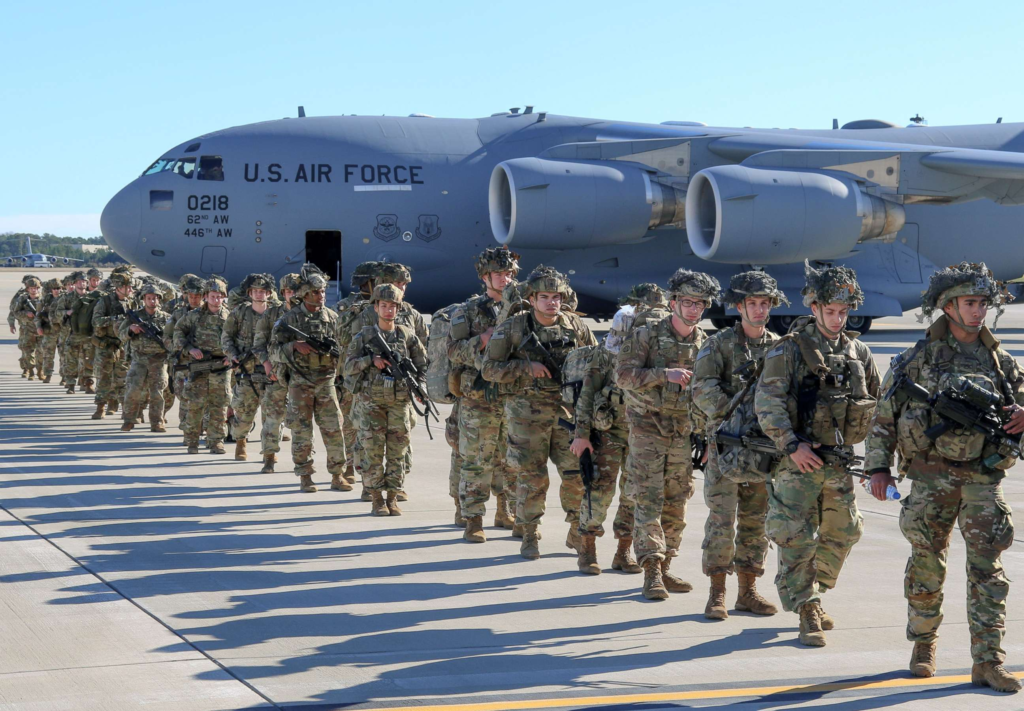
The Nuclear Triad: The Architecture of Ultimate Deterrence
The most consequential component of American military power is one the world hopes never to see deployed. The United States maintains approximately 3,708 nuclear warheads in its total stockpile, of which roughly 1,770 are deployed and operationally ready sitting in silos, on submarines, and on bomber bases around the clock, every day of the year. This arsenal is structured around what strategic planners call the nuclear triad three independent delivery systems, each survivable and independently devastating.
Pillar One; The Land Leg (ICBMs): The United States deploys 400 Minuteman III Intercontinental Ballistic Missiles (ICBMs) in hardened underground launch facilities, known as silos, spread across three wings: the 90th Missile Wing at F.E. Warren Air Force Base in Wyoming, the 341st Missile Wing at Malmstrom Air Force Base in Montana, and the 91st Missile Wing at Minot Air Force Base in North Dakota. Each Minuteman III carries up to three independently targetable nuclear warheads and can reach anywhere on Earth in approximately 30 minutes after launch.
The missiles sit in silos hardened to withstand overpressure from nearby nuclear detonations, maintained on continuous alert by Air Force missileers who stand 24-hour watches in underground launch control facilities. The Minuteman III is now being replaced by the LGM-35A Sentinel ICBM, a next-generation ballistic missile program already in active development. The Sentinel program is expected to reach initial operational capability in the early 2030s, replacing all 400 Minuteman IIIs with a more capable, more survivable, and more modern system designed to remain in service through 2075. The estimated cost: over $96 billion.
Pillar Two; The Sea Leg (SSBNs): This is the most feared, most survivable, and strategically most significant component of the American nuclear triad. The United States operates 14 Ohio-class ballistic missile submarines (SSBNs), known informally as “boomers.” They are arguably the most powerful weapons ever built by human hands. Eight are homeported at Naval Submarine Base Bangor, Washington, and six at Naval Submarine Base Kings Bay, Georgia, ensuring continuous Atlantic and Pacific presence. At any given time, a substantial number of these submarines are on “deterrent patrol” silent, submerged, invisible in the deepest waters of the ocean, beyond the reach of any known adversary anti-submarine capability. Each Ohio-class submarine carries up to 24 Trident II D5 submarine-launched ballistic missiles (SLBMs).
The Trident II D5 is a masterpiece of engineering: it has a range of over 7,000 miles, can carry up to eight independently targetable warheads, and achieves extraordinary accuracy, reportedly within 300 feet of its target from half a world away. A single Ohio-class submarine on patrol represents a nuclear force more powerful than everything used in World War II combined, many times over. The nuclear-powered Ohio-class submarines can remain submerged for months at a time, invisible to adversaries, refueling only when the crew is rotated, the equivalent of putting an invincible fortress in the deepest oceans of the world and leaving it there, perpetually, as the silent guarantor of American survival.
The Ohio-class is now being supplemented and will eventually be replaced by the Columbia-class SSBN, a new generation of nuclear-powered ballistic missile submarines currently under construction. The lead boat, USS District of Columbia (SSBN-826), is under construction at Newport News Shipbuilding. The Columbia class will carry 16 Trident II D5 missiles each and is designed to remain in service into the 2080s, guaranteeing the continuity of the sea leg of the triad for generations to come.
Pillar Three; The Air Leg (Strategic Bombers): The United States Air Force maintains 19 B-2A Spirit stealth strategic bombers at Whiteman Air Force Base, Missouri. The B-2 is one of the most extraordinary machines ever constructed a flying wing with a radar cross-section no larger than a small bird, capable of penetrating the most advanced air defense networks on Earth and delivering either conventional or nuclear weapons with precision. Its range exceeds 6,000 miles without refueling, and with aerial refueling from KC-135 or KC-46 tankers,
it can reach any point on Earth from American soil. It can carry the B61-12 nuclear gravity bomb a precision-guided nuclear weapon as well as the massive MOAB, and conventional bombs in quantities sufficient to level entire districts.
Complementing the B-2 are 76 B-52H Stratofortresses, of which approximately 46 are nuclear-capable. The B-52H, despite first flying in 1955, has been continuously modernized and remains a formidable strike platform, capable of launching nuclear-tipped cruise missiles from standoff distances that keep the aircraft and crew well outside adversary air defenses.
The most transformative development in the air leg is the emergence of the B-21 Raider, Northrop Grumman’s next-generation stealth bomber, currently in-flight testing and entering production. The B-21 is designed to be the most survivable bomber ever built with stealth characteristics believed to be more advanced than the B-2, a design prepared for autonomous as well as crewed operations, and a nuclear certification that includes both the B61-12 and the new Long-Range Standoff Weapon (LRSO) nuclear cruise missile.
The Air Force plans to acquire at least 100 B-21 Raiders, with some analyses suggesting the final fleet could reach 145 or more. The B-21 is intended to serve into the 2080s, replacing both the B-1B Lancer and potentially supplementing or replacing B-2s. The LRSO itself, a new nuclear-armed air-launched cruise missile being developed to replace the aging AGM-86B ALCM is expected to enter service in the late 2020s, giving the air leg a standoff nuclear strike capability that no adversary defense system can currently intercept.
The logic of the triad is devastatingly simple: even if an adversary launched a perfect, all-out first strike on every identifiable American military asset simultaneously destroying ICBM silos, bombing air bases, sinking every ship in port, the submarines at sea would survive, and those submarines carry enough nuclear warheads to reduce every major city of the attacker to radioactive ash. This is the architecture of Mutually Assured Destruction, the strategic logic that has kept great-power war from occurring for eight decades. America has invested in all three legs to ensure this logic remains inviolable, permanently, regardless of what any adversary does.
Hypersonic Weapons: The New Strategic Frontier
The post-Cold War era has introduced a new category of weapons that challenges every existing system of missile defense: hypersonic weapons missiles that travel at speeds above Mach 5 (five times the speed of sound), maneuver unpredictably during flight, and can reach targets thousands of miles away in roughly 15 to 30 minutes. The United States is developing three parallel hypersonic weapons programs across the Army, Navy, and Air Force.
The Army’s Long-Range Hypersonic Weapon (LRHW), also known as Dark Eagle uses the Common Hypersonic Glide Body (C-HGB) and has a projected range exceeding 1,725 miles. It is designed to strike time-sensitive, high-value targets, enemy command centers, air defense radars and missile launchers before they can be relocated or activated. The Army intends to field two additional batteries of LRHW by FY2027, following successful end-to-end tests of the AUR (All-Up Round) in June and December 2024 and April 2025.
The Navy’s Conventional Prompt Strike (CPS) program is developing a sea-launched hypersonic weapon based on the same C-HGB, designed to be launched from Zumwalt-class destroyers beginning in 2025 and from Virginia-class submarines in 2028. This gives the Navy a prompt global strike capability the ability to hit any target anywhere in the world within 30 minutes, from a submarine or destroyer that can be positioned at strategic locations before a crisis even begins.
The Air Force’s Hypersonic Attack Cruise Missile (HACM) formerly built on the HAWC demonstrator program is a scramjet-powered hypersonic cruise missile being developed by RTX Raytheon and Northrop Grumman under a $985.3 million contract. HACM plans to conduct several flight tests in the 2025–2027 timeframe, with a potential production decision after 2027. The Air Force is also developing the MAKO missile a new air-launched hypersonic weapon revealed at the Sea Air Space symposium in 2024 which is compatible with the F-22, F-35, and P-8 aircraft, dramatically expanding the platforms that can deliver hypersonic strikes.
The Pentagon’s 2025 hypersonic research budget request was $6.9 billion, up from $4.7 billion in 2023, and the Defense Department has committed approximately $1 billion to hypersonic facility modernization from FY2015 to FY2024 alone. America is racing not just to field hypersonic weapons but to simultaneously develop defenses against them including the Glide Phase Interceptor (GPI), developed by Northrop Grumman in partnership with Japan, and the Glide Breaker program by DARPA, designed to defeat hypersonic glide vehicles at very long range. The Hypersonic and Ballistic Tracking Space Sensor (HBTSS) is simultaneously under development to provide the persistent space-based surveillance needed to track hypersonic threats a critical enabler of any defense.
The U.S. Navy: Masters of the Seas
At the heart of American conventional military power is the United States Navy, the most powerful maritime force in human history. As of 2024–2025, the U.S. Navy fields 296 battle force ships with an active goal of building toward a 381-ship fleet. The fleet’s displacement, the measure of its total tonnage stands at approximately 4.5 million tons, exceeding any other navy on Earth by a margin that is nearly impossible to overstate.
But the headline number that dominates all strategic analysis is this: the United States operates 11 nuclear-powered aircraft carriers more than all other nations on Earth combined. Most nations operate zero or one. China, the most rapidly growing naval power, currently operates three. The U.S. runs eleven, with two more under construction.
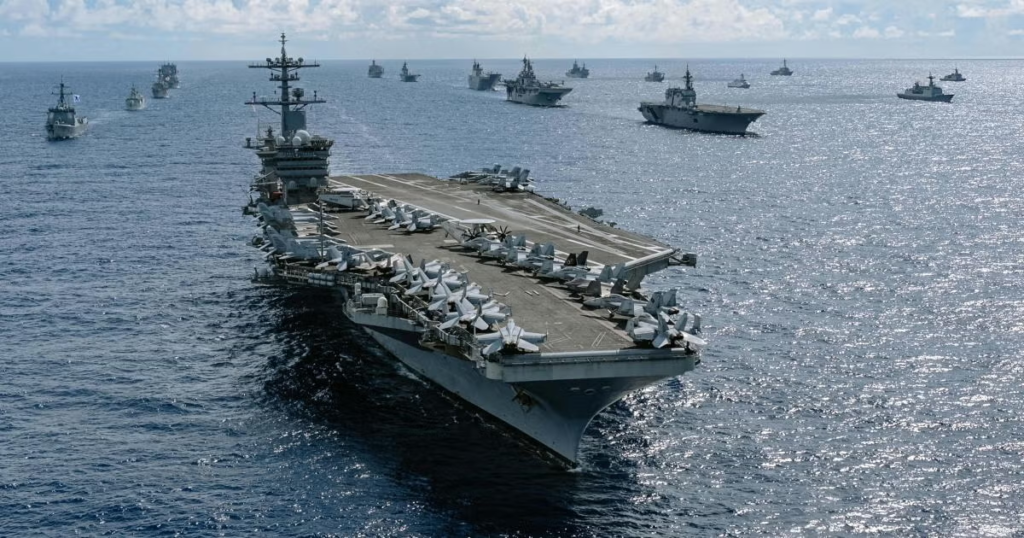
Each American aircraft carrier is not simply a ship. It is a floating sovereign air base, a city at sea. The latest in the fleet, the Gerald R. Ford-class carriers, displace approximately 100,000 tons each, are powered by two nuclear reactors that can generate 600,000 shaft horsepower, and feature an Electromagnetic Aircraft Launch System (EALS) that can launch aircraft more rapidly and with greater flexibility than conventional steam catapults. Each Ford-class carrier can operate an air wing of over 75 aircraft including F/A-18 Super Hornets, F-35C Lightning IIs, E-2D Advanced Hawkeyes, EA-18G Growlers, and helicopters creating a tactical air force that would rank among the top air forces of many nations, from the deck of a single ship.
Each carrier is deployed as the centerpiece of a Carrier Strike Group (CSG); typically comprising the carrier, a guided-missile cruiser, four to six Arleigh Burke-class guided-missile destroyers, two attack submarines, and logistics ships. This formation is capable of defeating almost any combination of forces it could realistically encounter, projecting air power 500 miles in every direction, conducting anti-submarine warfare in a massive ocean area, launching Tomahawk cruise missiles against land targets thousands of miles inland, and defending itself against air, missile, and underwater attack simultaneously. America maintains multiple CSGs deployed at sea simultaneously, enabling it to be present at every strategically important ocean simultaneously, a capability no other nation can approximate.
The surface fleet includes 75 Arleigh Burke-class guided-missile destroyers, the most numerous and arguably most capable class of surface combatant in the world. Armed with the Aegis Combat System and the SPY-1 or SPY-6 radar, these destroyers can simultaneously track and engage hundreds of air targets, launch Tomahawk cruise missiles at land targets 1,500 miles away, conduct anti-submarine operations, and perform ballistic missile defense missions. Three Zumwalt-class destroyers represent the cutting edge of surface warfare: stealthy hull shapes, a new radar system, and designed to receive new weapons including the Conventional Prompt Strike hypersonic missile system. The Navy is also introducing the new Constellation-class frigates (FFG-62); a multi-mission warship designed for anti-submarine warfare and distributed maritime operations in contested environments.
Below the surface, the American submarine force is unmatched. In addition to 14 Ohio-class SSBNs, the Navy operates 48 nuclear-powered attack submarines (SSNs): 22 Los Angeles-class, 3 Seawolf-class, and 23 Virginia-class. All are nuclear-powered, meaning they can operate indefinitely without surfacing, limited only by food supplies and crew endurance.
The Virginia-class submarines represent the current gold standard of attack submarine design: they combine exceptional quieting technology, advanced sensors, and a modular design that can be upgraded for new missions. They are equipped with the Virginia Payload Module (VPM) in newer blocks, adding a large-diameter payload tubes that can carry dozens of additional Tomahawk cruise missiles. The Navy has stated its intent to build 2 Virginia-class submarines per year by 2028, and the Columbia-class SSBN program is producing the next generation of strategic ballistic missile submarines.
Air Power: Dominating the Skies
The United States Air Force, Navy, and Marine Corps collectively operate approximately 13,000 military aircraft; the largest and most technologically sophisticated aerial fleet on the planet. The F-22 Raptor remains the world’s preeminent air superiority fighter. Its combination of stealth, super cruise capability (supersonic flight without afterburner), supermaneuvrability, and integrated avionics make it capable of defeating any known or projected adversary fighter without ever being detected on radar. Only 186 F-22s were built; a decision that many analysts have criticized as a strategic error but each one represents a qualitative leap over anything China or Russia has fielded or can field in the near future.
The F-35 Lightning II now fielded in three variants by the Air Force (F-35A), Marine Corps (F-35B), and Navy (F-35C) is the world’s most advanced multirole combat aircraft. It combines stealth, advanced sensor fusion, electronic warfare capabilities, and network-centric warfare architecture in a single platform. The F-35 is not just an aircraft it is a flying intelligence platform, processing data from its own sensors and from other platforms in its network to provide the pilot with a comprehensive, real-time picture of the battlespace that no other aircraft in any air force can match.
The F-35C has been certified to carry the B61-12 nuclear gravity bomb, making it a dual-capable aircraft with both conventional strike and nuclear deterrence missions. Sixteen allied nations now operate or are acquiring the F-35, giving American-led coalitions an interoperability advantage in coalition air operations that no adversary can replicate.
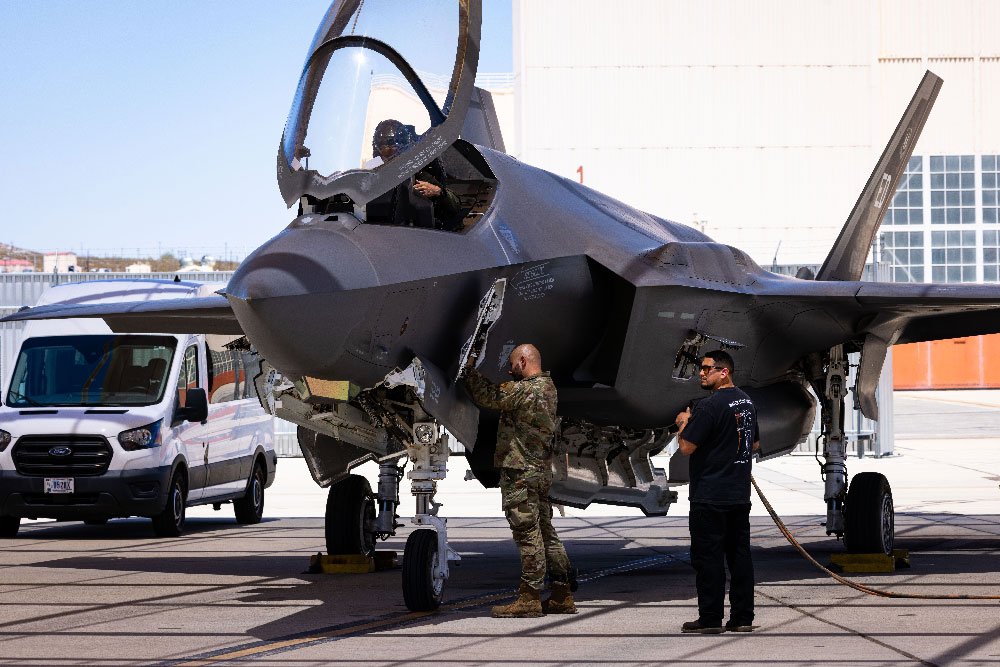
The Air Force is simultaneously developing the Next Generation Air Dominance (NGAD) sixth-generation fighter to replace the F-22, and Collaborative Combat Aircraft (CCA) loyal wingman drones that will fly alongside crewed fighters, multiplying combat power. DARPA is also pursuing a Next RS (Next Reconnaissance and Strike) hypersonic aircraft concept, eyeing prototype development by 2030, that would function as a reusable hypersonic strike and intelligence-gathering platform.
The supporting architecture of American air power is equally formidable: a fleet of KC-46A Pegasus aerial refueling tankers replacing the aging KC-135 fleet; E-3 Sentry AWACS and E-8C J-STARS surveillance and battle management aircraft; and the RQ-4 Global Hawk and MQ-9 Reaper unmanned aerial systems for intelligence and strike missions. JSTARS, U-2, and RC-135 reconnaissance platforms provide persistent surveillance that informs the entire military machine.
Special Operations: The World’s Sharpest Knife
Beyond conventional forces, the United States fields the world’s most capable and best-funded Special Operations Forces (SOF). U.S. Special Operations Command (SOCOM) is a unified command that brings together elements from all military branches under a single operational framework. The primary units include Delta Force (1st Special Forces Operational Detachment-Delta) America’s premier direct action and counterterrorism unit, capable of hostage rescue, the neutralization of high-value targets, and sensitive site exploitation worldwide.
Delta operates with a level of secrecy that means its operations rarely become public. SEAL Team Six (Naval Special Warfare Development Group, or DEVGRU), the naval equivalent, equally capable in maritime and land environments. It was DEVGRU operators who carried out the raid that killed Osama bin Laden in Abbottabad, Pakistan, in 2011. Army Special Forces (Green Berets) specialized in unconventional warfare, foreign internal defense, and working alongside allied and partner forces. Army Rangers raid specialists capable of rapid, large-scale, direct-action operations. Air Force Combat Controllers and Pararescuemen, the specialists who call in air strikes in the most contested environments and rescue downed aircrew under fire.
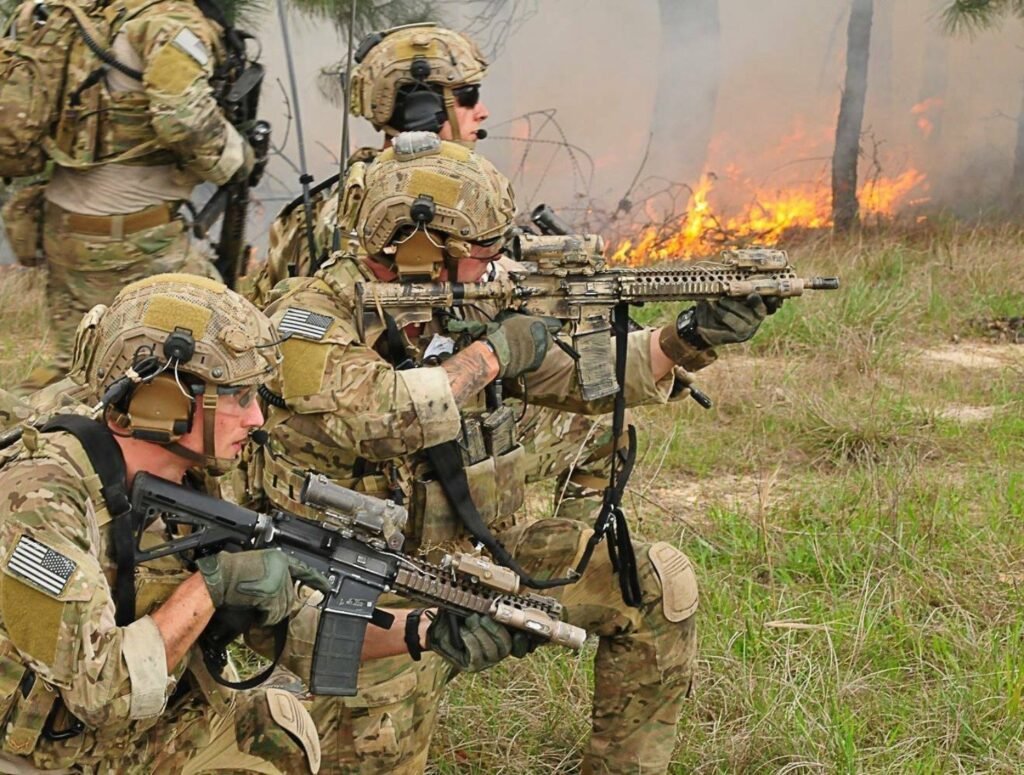
Together, these forces operate in dozens of countries simultaneously often without public disclosure. They conduct counterterrorism raids, train partner forces, gather intelligence, conduct psychological operations, and shape security environments across the globe in ways that conventional forces never could. SOCOM has an annual budget exceeding $13 billion and a total force of approximately 70,000 personnel, making it larger than the entire militaries of many significant nations.
THE ECONOMY: The World’s Engine
The Largest Economy in Human History
Military power, as every serious strategist has recognized since Thucydides, is ultimately downstream of economic power. A nation with a productive, innovative, well-capitalized economy can afford military dominance. One without it cannot sustain the spending. By nominal GDP in 2024, the United States produced approximately $29.2 trillion in economic output growing to an estimated $30.6 trillion in 2025.
This represents roughly 26.2% of total global GDP, meaning that one nation, with 4.2% of the world’s population, generates more than a quarter of everything humanity produces. The American economy alone is larger than the combined output of Japan ($4.28 trillion), Germany ($5 trillion), India ($3.7 trillion), the United Kingdom ($3.1 trillion), and France ($3 trillion) the world’s third, fourth, fifth, sixth, and seventh largest economies.
The composition of the American economy is as important as its size. Approximately 70% of U.S. GDP is driven by consumer spending, a reflection of the deepest and most liquid domestic market in the world. American consumers buy more goods and services than the entire populations of most countries on Earth, creating a gravitational pull on the global economy that makes American economic health a matter of vital concern to every export-dependent nation. When America contracts, the world feels it. When America expands, it creates demand that sustains economies from Seoul to São Paulo. The U.S. capital markets are the world’s deepest and most liquid.
The New York Stock Exchange and NASDAQ together represent a combined market capitalization exceeding $50 trillion roughly 44% of global equity market capitalization. This depth of capital markets means American companies can raise investment at lower cost and in larger quantities than virtually any rival. It also means global investors continuously send money to the United States in search of liquid, safe, high-return assets, an inflow of capital that sustains American prosperity and finances American deficits.
The Innovation Economy: Silicon Valley and Beyond
The great competitive advantage of the American economy is not its size alone but its capacity for innovation and technological disruption. The United States is home to the most productive innovation ecosystem in human history. Apple, Microsoft, NVIDIA, Alphabet (Google), Amazon, and Meta collectively represent trillions of dollars in market capitalization. NVIDIA, whose graphics processing units (GPUs) have become the essential infrastructure of the AI revolution, briefly crossed a $5 trillion valuation in 2025, the first company in history to reach that milestone. This is not accidental. These companies are products of the American environment: venture capital, world-class universities, immigration of talent, entrepreneurial culture, and legal infrastructure that protects intellectual property and enables risk-taking at scale.
The defense-technology nexus is increasingly powerful. Venture funding for U.S.-based defense technology startups reached approximately $38 billion through the first half of 2025 alone on pace to surpass the 2021 peak. Companies like Anduril Industries (valued at $30.5 billion after its latest funding round), Palantir Technologies, Shield AI, and Hermeus represent a new category of defense-technology firm: software-first, AI-driven, and capable of developing and deploying advanced military capabilities at a fraction of the cost and time of traditional defense primes like Lockheed Martin, Northrop Grumman, and Raytheon.
The Pentagon oversees more than 685 AI-related projects at any given time, and the FY2025 defense budget included $1.8 billion specifically for AI programs. The Project Stargate initiative backed by $500 billion in committed AI infrastructure investment over five years reinforces America’s determination to own the foundational compute infrastructure of the AI era.
DARPA: The Defense Advanced Research Projects Agency deserves special mention as perhaps the most productive applied research agency in history. DARPA’s budget of roughly $4 billion annually has produced, over its 67-year history, technologies including the internet (ARPANET), GPS, stealth aircraft, drone warfare, voice recognition, the computer mouse, modern night-vision systems, and now contributions to mRNA vaccine technology, quantum computing, and autonomous vehicles. DARPA represents the institutional marriage of military purpose and technological ambition that has given America an R&D advantage no rival can easily replicate.
THE DOLLAR: The World’s Most Powerful Financial Weapon
The Reserve Currency: Exorbitant Privilege
Perhaps the single most underappreciated and consequential source of American global power is something invisible: the U.S. dollar’s status as the world’s primary reserve currency. This status described by French economist Valéry Giscard d’Estaing as giving the United States an “exorbitant privilege” provides Washington with leverage over the global economy that no other nation possesses or can easily replicate. According to the Federal Reserve’s comprehensive 2025 review, the U.S. dollar is bought or sold in approximately 89% of all global foreign exchange (FX) transactions. The euro, the second-most-traded currency, appears in approximately 31% of transactions.
The dollar’s dominance means that when a Thai company buys goods from Brazil, the transaction is typically conducted in dollars neither country’s currency. When a Korean company borrows in international capital markets, it usually does so in dollars. When central banks around the world accumulate foreign exchange reserves, the dollar is the primary asset they hold. As of Q1 2025, the dollar comprised approximately 57.8% of all disclosed global foreign exchange reserves far surpassing the euro (20%), the Japanese yen (6%), the British pound (5%), and the Chinese renminbi (a mere 2%).
The total stock of dollar-denominated foreign exchange reserves stood at approximately $7.4 trillion held by the world’s central banks. Put differently: central banks from Beijing to Riyadh to Nairobi hold trillions of dollars in U.S. government debt as the foundation of their own financial systems, an involuntary, structural vote of confidence in American financial governance. About 55% of all cross-border bank loans are denominated in dollars, and approximately 54% of global exports are invoiced in dollars even when the United States is not a party to the transaction.
The Petrodollar System: Oil, Dollars, and Geopolitical Leverage
One of the foundational mechanisms sustaining dollar dominance is the petrodollar system established in the 1970s through U.S.-Saudi agreements that denominated global oil sales in dollars. Since oil is the world’s most strategically important commodity the feedstock of industrial economies, military machines, and transportation systems globally requiring oil transactions to be settled in dollars creates permanent, structural global demand for the currency. Nations must hold dollars to buy oil. Dollars earned from oil sales are reinvested in U.S.
Treasury securities. This “petrodollar recycling” mechanism has financed American deficits, kept interest rates lower than they otherwise would be, and given Washington extraordinary influence over global financial flows for five decades. The petrodollar system is under pressure from the rise of electric vehicles and China’s growing attempts to settle oil trade in yuan but it remains predominantly intact, and no viable alternative architecture for global oil settlement has yet materialized at scale.
The SWIFT Weapon: Economic War Without Armies
The dollar’s global role gives the United States a financial coercive power that is qualitatively different from anything any previous empire possessed. The SWIFT (Society for Worldwide Interbank Financial Telecommunication) messaging system through which virtually all international financial transactions are routed has become a tool of geopolitical warfare. When the U.S. and its allies chose to partially exclude Russia from SWIFT following the invasion of Ukraine in February 2022, it represented the deployment of financial power at a scale and speed that military action could not have achieved. Russian banks were suddenly cut off from the plumbing of global finance unable to process international payments, access dollar reserves held abroad, or conduct normal commerce with the outside world.
The ruble collapsed, Russian companies were shut out of capital markets, and the cost of Russia’s military adventure increased dramatically. America accomplished all of this without moving a single soldier or firing a single shot. The ability to wield this kind of financial power to effectively place an adversary outside the global economy is a form of dominance unique to the nation that issues the world’s reserve currency and exercises influence over global financial infrastructure.
SPACE: The Strategic High Ground of the Century
Whoever controls space controls the future of military, economic, and technological competition. Space provides the infrastructure for communications, navigation, surveillance, missile warning, and increasingly, direct combat operations and USA leads in every dimension.
The U.S. Space Force and its Mandate
The U.S. Space Force (USSF), established in December 2019 as the world’s first independent military branch dedicated exclusively to space operations, has grown rapidly into a force of approximately 15,000 “Guardians.” Its mission: organize, train, equip, and operate space forces in defense of national interests; protect U.S. and allied assets in space; and conduct operations to ensure freedom of action in the space domain. The Space Force commands a sprawling constellation of military satellites performing every function critical to modern warfare: communications, missile warning, imagery intelligence, signals intelligence, weather monitoring, and navigation.
The Global Positioning System (GPS) is perhaps the most consequential military technology of the late 20th century that civilians use daily without a second thought. The United States currently operates 31 GPS satellites in orbital constellation, providing positioning, navigation, and timing (PNT) signals to every GPS receiver on Earth military and civilian alike. The latest generation, GPS III, built by Lockheed Martin, delivers three times greater accuracy than previous satellites, dramatically improved anti-jamming capabilities through a new military-specific M-Code signal, and a new L1C civil signal compatible with other global navigation systems.
In a remarkable demonstration of agility, the Space Force conducted “rapid-response” GPS satellite launches in December 2024 and May 2025 compressing a process that traditionally takes two years into just three to five months, using SpaceX Falcon 9 rockets to rapidly augment the constellation. The GPS IIIF series, beginning launch in 2027, will add nuclear detection capabilities, upgrade search-and-rescue payloads, and further enhanced anti-jamming protections.
The United States is also developing Resilient GPS (R-GPS); a program to augment the existing constellation with smaller, cheaper, more proliferated commercial satellites capable of making the navigation system more survivable in a contested environment. GPS underpins the entire modern military: every precision-guided munition, every drone strike, every naval operation, every troop movement all rely on the signal from American satellites orbiting 12,550 miles above the Earth. No other nation provides this service to the world. China’s BeiDou, Russia’s GLONASS, and the EU’s Galileo all exist but GPS remains the global standard, embedded in billions of devices, trusted by the world’s aviation, shipping, financial, and agricultural systems in ways that cannot be quickly displaced.
Starlink and the Commercialization of Space Power
One of the most strategically significant developments of the past five years has been the emergence of SpaceX’s Starlink satellite constellation as a de facto military and geopolitical asset. With over 6,000 operational satellites in low Earth orbit (LEO) and growing, Starlink is the world’s largest satellite constellation by an enormous margin, providing high-speed internet connectivity globally. The strategic implications became vivid in Ukraine: when Russian military operations disabled conventional Ukrainian communications infrastructure,
Starlink terminals provided the Ukrainian military and government with resilient, high-bandwidth connectivity that sustained their ability to coordinate operations, share intelligence, and communicate with the outside world. Starlink demonstrated that commercial space infrastructure can be a decisive military enabler in modern warfare. The United States is the only nation where such a private-sector space capability exists at this scale and is available to support national security objectives, and where the government and private sector are integrated in this way. The Stargate initiative commits $500 billion in AI and compute infrastructure investment over five years, further cementing American leadership in the technologies that will define the next era of space and computing power.
CYBERSPACE: The Invisible Battlefield
Modern great-power competition is fought as much in cyberspace as in any physical domain. In this invisible theater, the United States holds formidable and largely unchallenged advantages in both offensive and defensive cyber capability.
The NSA and U.S. Cyber Command
The National Security Agency (NSA) co-located with U.S. Cyber Command at Fort Meade, Maryland commands a workforce estimated at approximately 40,000 personnel, with roughly 60% dedicated to signals intelligence and cyber defense and the remainder to offensive cyber operations. The NSA’s Tailored Access Operations (TAO) unit responsible for elite offensive cyber hacking and network penetration sustains an annual budget estimated at approximately $2.8 billion, maintaining a permanent capability to infiltrate adversary networks, exploit zero-day vulnerabilities, and conduct operations that range from intelligence collection to active disruption of enemy systems.
U.S. Cyber Command (USCYBERCOM) established in 2009 and elevated to a full Unified Combatant Command in 2018 has a FY2025 budget of approximately $1.7 billion at the headquarters level and commands the Cyber Mission Force (CMF) 147 specialized cyber teams, expanded from the original 133, covering offensive, defensive, and intelligence cyber missions. For FY2026, the Department of Defense’s total cyberspace activities budget request reached approximately $15.1 billion; a 4.1% increase over the prior year. This encompasses $9.1 billion for cybersecurity, $2.6 billion for CYBERCOM resources, and $611.9 million for cyber R&D. The full national cyber budget including classified programs is substantially larger.
The strategic doctrine of “Defend Forward” codified in the 2018 USCYBERCOM vision and the 2023 DoD Cyber Strategy authorizes American cyber warriors to engage adversaries in their own networks, disrupting malicious activity before it can reach American systems. This is an aggressive, forward-deployed cyber posture conceptually similar to positioning forces near adversary borders to deter and disrupt attack preparation. Hunt Forward Operations (HFO) deploy American cyber teams to allied nations at invitation, hunting for adversary malware on allied networks, disrupting adversary cyber operations, and sharing threat intelligence that strengthens collective defense. USCYBERCOM has conducted HFO missions in dozens of countries, making it a genuinely global cyber presence.
The most famous historical demonstration of American offensive cyber power was Stuxnet; a joint U.S.-Israeli operation that deployed a meticulously engineered cyberweapon to infiltrate the air-gapped industrial control systems of Iran’s uranium enrichment plant at Natanz and physically destroy approximately 1,000 centrifuges by causing them to spin at destructive speeds while displaying normal readings to Iranian operators.
Stuxnet set the Iranian nuclear program back by an estimated two years without a single bomb being dropped, a single missile being launched, or a single soldier crossing a border. It demonstrated that cyber operations can achieve kinetic, physical effects on adversary infrastructure in ways that leave no fingerprints and create no international incident. That capability has only grown more sophisticated in the decade since.
The Private Sector Advantage
The United States also benefits from a uniquely American advantage in the cyber domain: its private sector. Companies like Palantir Technologies (which processes battlefield intelligence for the U.S. military and intelligence community), CrowdStrike (whose Falcon platform provides the gold standard of endpoint cybersecurity across government and industry), Booz Allen Hamilton (the largest private employer of intelligence professionals in the world), Raytheon’s Cyber division, and dozens of others create a talent and innovation ecosystem that state-run programs in China, Russia, or any other adversary cannot replicate.
The relationship between Silicon Valley’s talent base and national security missions increasingly formalized through the Defense Innovation Unit (DIU) and venture-backed defense tech programs creates a feedback loop of capability development that is uniquely and powerfully American.
ALLIANCE NETWORKS: The Power Nobody Counts
One of the most persistently undervalued components of American power is something that doesn’t appear on any balance sheet or order of battle: its alliance architecture. No other power in the history of the world has voluntarily assembled a network of formal partnerships of comparable depth, geographic reach, and military capability.
NATO: The World’s Largest Military Alliance
The North Atlantic Treaty Organization (NATO) currently binds 32 nations including some of the world’s most capable militaries under the collective defense guarantee of Article 5: an attack on one member is an attack on all. NATO’s European members include the United Kingdom, France, Germany, Italy, Poland, the Netherlands, and Norway all nations with modern, well-equipped armed forces, advanced fighter fleets, sophisticated intelligence services, and substantial defense industries.
The combined defense spending of the NATO alliance exceeded $1.3 trillion in 2024. America’s European allies field hundreds of modern combat aircraft (primarily F-35s and Eurofighters), thousands of modern tanks and armored vehicles, advanced naval vessels, and nuclear capabilities (in the case of the UK and France). When the United States goes to war within the NATO framework, it does not fight alone it fights with partners who bring additional aircraft, ships, special forces, basing rights, and logistics that multiply effective combat power exponentially. Russia, fighting in Ukraine against Ukrainian forces equipped largely by NATO, has discovered at terrible cost the power of this alliance and the endurance of its material support.
The Indo-Pacific Architecture
In Asia, the United States has constructed a complementary network of bilateral defense treaties and security arrangements. Formal defense treaties bind the United States to Japan, South Korea, Australia, the Philippines, and Thailand. The treaty with Japan is particularly significant: Japan hosts nearly 55,000 U.S. military personnel across dozens of bases, including Carrier Strike Group homeports, Marine Corps installations, and Air Force bases from which American aircraft can reach every major strategic target in East Asia. The U.S.-Korea alliance places 28,500 American troops on the Korean Peninsula, providing a tripwire that deters North Korean aggression and anchors U.S. presence on the Asian mainland.
AUKUS: the security partnership established in 2021 between Australia, the United Kingdom, and the United States represents one of the most significant alliance developments in decades. The agreement is transferring nuclear-powered submarine technology to Australia, enabling Canberra to acquire and operate SSN-class submarines beginning in the early 2030s. This extends American undersea warfare capability into the Indo-Pacific through a trusted ally, complicating Chinese naval planning in ways that bilateral U.S. deployments alone could not achieve. The Quad; the Quadrilateral Security Dialogue between the U.S., Japan, India, and Australia functions as an informal strategic alignment that presents China with a potential coalition of democratic Indo-Pacific powers that together represent enormous, combined military and economic weight.
Five Eyes: The World’s Most Powerful Intelligence Network consisting of the United States, United Kingdom, Canada, Australia, and New Zealand represents the most comprehensive and integrated intelligence-sharing arrangement in history. Five Eyes nations share signals intelligence (SIGINT) collected from satellite intercepts, undersea cable taps, electronic eavesdropping, and human agents in real time, creating a global surveillance network that no adversary can individually match.
NSA collects from the Americas and globally; GCHQ covers Europe and Middle East; the Australian Signals Directorate covers Asia and the Pacific; Canada’s CSE focuses on specific corridors; and New Zealand’s GCSB covers the Pacific. Together, they provide American decision-makers with an informational picture of adversary intentions and capabilities that is simply unavailable to any power operating alone.
On the other hand, China has no equivalent network. Russia’s remnants of the Soviet intelligence network are geographically limited and politically constrained. The alliance advantage in both military capability and intelligence is one of the most durable and irreplaceable dimensions of American power.
SOFT POWER
Soft power is the ability to shape the preferences, aspirations, and behaviors of others through attraction rather than coercion. It was first theorized by Harvard’s Joseph Nye specifically to describe an American capacity that was qualitatively different from anything previously seen in international relations. In the 2024 Brand Finance Global Soft Power Index, the United States ranked first in the world for the third consecutive year, achieving an all-time high score of 78.8 out of 100. It topped rankings in arts and entertainment, scientific leadership, influential media, and global admiration.
Hollywood: Weaponized Storytelling
Hollywood is the world’s most powerful, most profitable, and most globally penetrating storytelling machine in history. American films and television productions reach billions of viewers across every continent, in virtually every language, through theatrical release, streaming platforms, and broadcast networks. The combined reach of Netflix, Disney+, HBO Max, Amazon Prime, and Apple TV+ all American-origin platforms give the United States an asymmetric ability to project cultural narrative globally that no state-funded propaganda apparatus can compete with. But the power of Hollywood is not in its propaganda value it is subtler and more durable than that.
By producing the stories, the world chooses to consume for entertainment, America normalizes its values: individualism, personal freedom, entrepreneurial ambition, romantic love as personal choice, democratic accountability, rule of law, social mobility. These values are absorbed through entertainment in ways that feel like pleasure, not indoctrination. A child who grows up watching Marvel films is absorbing a worldview. A teenager who dreams of attending an American university after watching a film set in one is demonstrating soft power at work. Taylor Swift, Beyoncé, Jay-Z, and Kendrick Lamar are America’s cultural ambassadors to the world more effective than any embassy or foreign ministry, and self-funding.
American Universities: Manufacturing the World’s Leaders
No soft power asset is more durable or more strategically significant than American universities. The United States hosts the world’s highest-ranked cluster of research institutions. In the 2024 QS World University Rankings and Academic Ranking of World Universities, American institutions dominate the top tiers of MIT, Stanford, Harvard, Caltech, and the University of Chicago regularly occupying positions 1 through 10. American universities attract approximately one million international students annually more than any other country paying full tuition and absorbing American educational culture, values, professional networks, and worldview.
Many return to their home countries to lead governments, corporations, NGOs, and academic institutions with professional identities and worldviews fundamentally shaped by the American experience. The alumni of American universities form an invisible empire of influence, one that persists for decades after graduation and shapes policy decisions, business partnerships, and strategic alignments in ways that are impossible to quantify but undeniably consequential.
American Brands: The Daily Reinforcement of Power
American brands are the most globally recognized commercial entities on Earth. Coca-Cola is available in 200 countries, more than the membership of the United Nations. McDonald’s serves approximately 69 million customers daily across more than 100 nations. Google processes 8.5 billion search queries per day shaping what information billions of people encounter and how they understand the world. Apple’s iPhone is the aspirational status symbol of the global middle and upper class, from Dubai to Seoul to Lagos.
Amazon dominates e-commerce on multiple continents. Facebook and Instagram connect 4 billion people monthly. These are not merely commercial presences they are daily, repeated reinforcements of American cultural footprint in the lives of billions who have never visited the United States and may hold ambivalent or even hostile views of American foreign policy, yet whose daily lives are shaped by American-built platforms, products, and services.
The “American Dream” Narrative: The World’s Most Powerful Value Proposition
For all its complications and contradictions, the narrative of the “American Dream”, the proposition that individual effort, talent, and ambition can produce success regardless of origin continues to function as the world’s most powerful recruitment pitch for human capital. America attracts the world’s most talented engineers, scientists, entrepreneurs, artists, and thinkers, not primarily through coercion but through aspiration.
The United States is a nation that has repeatedly produced transformative figures who arrived with little and built empires: Andrew Carnegie (Scottish immigrant), Sergey Brin (Russian immigrant, co-founded Google), Elon Musk (South African immigrant), Jensen Huang (Taiwanese immigrant, founded NVIDIA), and thousands of less famous but equally productive contributors at every level of the economy. This attraction of talent functions as a permanent transfusion of human capital into the American system enriching it intellectually, economically, and culturally in ways that sustain its innovative edge generation after generation.
INTELLIGENCE: Seeing the Entire Board
The U.S. Intelligence Community (IC) comprises 18 agencies including the CIA, NSA, DIA (Defense Intelligence Agency), NRO (National Reconnaissance Office), NGA (National Geospatial-Intelligence Agency), FBI’s intelligence division, the intelligence arms of the State Department, Treasury, Energy Department, and all military branches coordinated under the Office of the Director of National Intelligence (ODNI). The combined annual intelligence budget is classified but estimated to exceed $85 billion. The total workforce of intelligence professionals’ government employees, military intelligence personnel, and contractors’ numbers in the hundreds of thousands.
The CIA is responsible for human intelligence (HUMINT); the recruitment and running of human agents inside foreign governments, militaries, terrorist organizations, and criminal networks. Decades of operations have produced networks of human sources that provide insight into adversary decision-making that technical collection cannot replicate. The NSA provides signals intelligence (SIGINT) through the interception of electronic communications, from phone calls and emails to encrypted diplomatic traffic at a global scale.
The National Reconnaissance Office (NRO) operates the classified constellation of reconnaissance satellites that provide imagery and signals intelligence from orbit. The National Geospatial-Intelligence Agency (NGA) processes satellite imagery to produce actionable intelligence about physical locations, movements of forces, infrastructure development, and dozens of other indicators. These are not independent capabilities they work together in an integrated architecture that provides American decision-makers with an informational picture of the world that no adversary can match.
An adversary deploys a new weapons system, American intelligence typically knows before it enters service. When a terrorist network shifts its communications methods, the NSA adapts its collection. When a foreign government deliberates a major strategic decision, American intelligence agencies are frequently reading the cables. This persistent informational advantage translates directly into strategic decision-making superiority, the ability to anticipate adversary actions, preempt threats, and position forces before crises escalate.
The CIA’s AI governance council established to integrate artificial intelligence into intelligence operations while maintaining human oversight represents the next phase of intelligence modernization: machine-speed processing of data volumes that human analysts alone could never handle, identifying patterns and connections that reveal adversary intentions in ways previously impossible.
ARTIFICIAL INTELLIGENCE: The New Decisive Battleground
The race for artificial intelligence dominance is increasingly recognized as the defining competition of the 21st century and the United States currently holds the leading position, though the race with China is intensifying. America’s AI dominance is built on several mutually reinforcing foundations.
First, compute dominance: NVIDIA’s GPU chips the essential hardware infrastructure of AI training is American-designed and American-produced in partnership with TSMC, and the United States has used export controls to restrict China’s access to the most advanced chips. NVIDIA’s market capitalization crossing $5 trillion in 2025 reflects the world’s assessment of the strategic value of this position.
Second, talent concentration: America’s universities and research institutions attract the world’s best AI researchers, and Silicon Valley’s compensation structures retain them.
Third, private sector velocity: OpenAI, Google DeepMind, Anthropic, Meta AI, and dozens of other American companies are advancing AI capabilities at a pace that state-directed research programs struggle to match.
Fourth, military integration: the DoD’s FY2025 AI budget of $1.8 billion funds 685+ active AI projects across the military, with applications ranging from autonomous logistics to intelligence analysis to autonomous weapon systems and decision-support for commanders.
The concept of agentic warfare in which AI systems capable of autonomous decision-making and multi-step task execution are integrated into military decision cycles is emerging as the next frontier. The United States is pursuing this capability through programs at DARPA, JAIC (Joint AI Center), and through partnerships with companies like Palantir and Anduril. The AI-enabled JADC2 (Joint All-Domain Command and Control) architecture designed to network every sensor, every weapon, every platform, and every decision-maker across all domains simultaneously represents the most ambitious attempt in history to create an AI-augmented military decision-making system. If successful, it would give American commanders an information processing advantage over adversaries that would be, in military terms, overwhelming.
ENERGY INDEPENDENCE: From Vulnerability to Dominance
A generation ago, American dependence on Middle Eastern oil was considered one of the nation’s most significant strategic vulnerabilities, the reason for decades of costly entanglement in the politics of the Persian Gulf. The shale revolution changed that calculus entirely. Today, the United States is the world’s largest producer of both petroleum and natural gas, surpassing Saudi Arabia and Russia.
Fracking technology unlocked massive reserves of shale oil and gas beneath American territory, transforming the country from a net energy importer to a net energy exporter in the space of a decade. American LNG (Liquefied Natural Gas) exports have become a geopolitical instrument: when Russia weaponized its gas exports to Europe after the Ukraine invasion, American LNG stepped in to supply European allies, reducing Russian leverage and strengthening the Western coalition at a critical moment. The United States also possesses the world’s largest coal reserves and massive renewable energy resources wind across the Great Plains, solar across the Southwest, hydroelectric across the Northwest giving it an energy endowment of extraordinary breadth and depth.
Energy independence has several profound strategic consequences. which eliminates the vulnerability of supply disruption by adversaries. It removes the strategic necessity of protecting distant oil fields with military force. It provides an export commodity LNG that can be deployed as a tool of alliance management and adversary pressure. And it keeps domestic energy prices lower than they otherwise would be, sustaining the consumer spending engine that drives the American economic machine.
DEMOGRAPHY AND IMMIGRATION: America’s Permanent Competitive Advantage
The great powers of the 21st century face a common demographic challenge: aging populations, declining birth rates, and shrinking workforces that constrain economic dynamism. China faces a demographic crisis of historic proportions the legacy of the One Child Policy combined with rapid industrialization has produced a population that is aging faster than any large nation in history. Japan is shrinking. South Korea has one of the lowest birth rates ever recorded. Russia’s population trends are among the most adverse in the developed world.
The United States faces some of the same pressures, but it has an answer that no authoritarian rival can replicate immigration. America has absorbed and integrated successive waves of immigrants from every corner of the world for two and a half centuries and continues to do so. The approximately 45 million foreign-born residents in the United States include some of the most talented scientists, engineers, physicians, entrepreneurs, and artists on the planet. Roughly 45% of Fortune 500 companies were founded by first- or second-generation immigrants, including Apple (Steve Jobs, son of a Syrian immigrant), Google (Sergey Brin), Yahoo (Jerry Yang), eBay (Pierre Omidyar), and Tesla (Elon Musk).
Immigration not only sustains America’s demographic profile keeping it younger than its rivals, but it also continuously renews the talent base that drives innovation and economic growth. This is not an accident of culture. It is a structural competitive advantage that flows from a free, open, and aspirational society, one that authoritarian rivals like China and Russia are constitutionally and politically incapable of replicating.
INSTITUTIONS AND THE RULES BASED ORDER
The post-World War II international order was not some neutral creation of global consensus. It was designed primarily by the United States, in American image, to serve American interests while simultaneously providing genuine benefits to partner nations in ways that made the system worth sustaining. The United Nations, World Bank, International Monetary Fund, World Trade Organization, GATT, Bank for International Settlements, and dozens of other international institutions were architected by American diplomats and economists in the years following 1945 and reflect American values: free trade, rule of law, sovereign equality (in principle), and dollar-centric financial governance. The United States is not merely a participant in this system; it is the system’s author and ultimate enforcer.
This institutional architecture provides America with leverage that no military force alone could provide. Washington imposes sanctions, the dollar-centric global financial system amplifies their effect exponentially banks in third countries comply not because of American law but because the cost of being cut off from dollar-clearing exceeds the benefit of any alternative relationship. When the U.S. invokes international law, it speaks from the position of a nation that helped write the rules. When the WTO rules on a trade dispute, it operates under frameworks that reflect American commercial norms and interests. This is not invisible power, it is structural power, baked into the architecture of the global system itself.
CHALLENGES
An analytically honest assessment of American power must acknowledge the genuine vulnerabilities and challenges that could, over time, erode structural advantages. It must encompass the prevailing threats and challenges to the existence and status of a superpower. Some of these are mentioned below.
The Fiscal Question: The U.S. national debt has exceeded $36 trillion, with an annual interest payment burden now exceeding $1 trillion larger than the entire defense budget of China. The debt-to-GDP ratio has surpassed 120%. If unchecked, the compounding of debt service costs could crowd out defense spending, research investment, and infrastructure development, the material foundations of future power. The Congressional Budget Office projects that under current trajectories, debt service will consume an ever-larger share of federal revenue, leaving less for the investments that sustain dominance.
Domestic Polarization: American democracy; the ideological foundation of soft power has never been more internally contested in the post-Cold War era. Contested election results, extreme political polarization, social divisions over race, guns, and economic inequality, and the dysfunction of legislative processes all undermine the image of the functioning democracy that once made the “American model” globally aspirational. This erosion of soft power at its source is not a short-term problem it is structural, and its effects compound over time as other nations point to American dysfunction to argue that liberal democracy is not a model worth emulating.
The China Challenge: The People’s Republic of China is engaged in the most ambitious and sustained military modernization in history. China’s defense budget, estimated at $314 billion in 2024, grows at 7-10% annually. Its nuclear arsenal is expanding rapidly from approximately 350 warheads in 2020 to over 600 now, with the U.S. Defense Department projecting 1,000+ by 2030.
The People’s Liberation Army Navy is building ships at a rate that exceeds American shipbuilding capacity by a factor of roughly 5:1, driven by the largest shipbuilding industry on Earth. China’s AI investment is enormous, its semiconductor ambitions are relentless despite export controls, and its Belt and Road initiative has built infrastructure relationships across 140+ countries that extend Chinese influence into regions where America has limited presence. China is the first peer competitor the United States has faced since the Soviet Union and unlike the USSR, China has a dynamic, productive economy that sustains its military modernization without requiring the kind of systemic overextension that brought the Soviet state down.
The Dollar’s Slow Erosion: The dollar’s share of global foreign exchange reserves has declined from a peak of 72% in 2001 to approximately 57% in 2025. While still dominant by an enormous margin and while the pace of decline has been gradual; the trend reflects growing deliberate efforts by BRICS nations, particularly China and Russia, to reduce dollar dependence and develop alternative payment systems.
China’s CIPS (Cross-Border Interbank Payment System) is growing slowly as an alternative to SWIFT. Saudi Arabia has sold some oil to China in yuan. The long-term erosion of petrodollar architecture accelerated by the global transition to electric vehicles, which reduces structural oil demand poses a structural challenge to the dollar’s reserve currency status over a multi-decade horizon.
Shipbuilding Capacity: The U.S. Navy aspires to a 381-ship fleet but is actually shrinking toward approximately 296 ships in the near term, constrained by insufficient industrial base capacity. American shipyards are producing submarines and destroyers at well below the rates needed to sustain, while China’s shipyards are producing naval vessels at a staggering pace. This industrial capacity gap is one of the most concrete and concerning military vulnerabilities America faces heading into mid-century.
Yet the Foundation Holds: All these challenges are real. None of them has yet translated into a fundamental revision of global power dynamics. The structural advantages explored in this study the nuclear triad, the carrier fleet, the dollar’s financial architecture, the alliance network, the soft power depth, the technological innovation engine, the energy independence were built over decades and cannot be eroded in years. The United States retains, across every dimension of national power, advantages that no rival nation can match across all dimensions simultaneously. And that is the irreducible reality of American dominance.
Conclusion: The Anatomy of an Invincible Power
American power is not a single thing. It never has been. It is a system of systems: an interlocking, mutually reinforcing architecture in which military supremacy funds diplomatic leverage, economic dominance sustains military capacity, soft power multiplies hard power, intelligence illuminates every decision, alliances extend the effective reach of all dimensions, and the dollar’s global role finances the entire enterprise at advantageous terms that no other nation enjoys.
The nuclear triad makes America undefeatable by force of arms. The carrier fleet makes it present everywhere on the world’s oceans simultaneously. The dollar makes the global economy an American instrument. Silicon Valley keeps the technology edge compounding. Hollywood and American universities shape the world’s aspirations. The Five Eyes and CIA illuminate adversary intentions. The alliance network gives America partners no authoritarian state can match. Energy independence removes a former vulnerability. Immigration keeps the talent engine running when rivals are aging and contracting.
No other nation can match the United States across all of these dimensions simultaneously. China is formidable economically and militarily but lacks America’s alliance networks, reserve currency dominance, and soft power depth. Russia has nuclear parity on paper but fields an economy the size of Italy and a military severely degraded by its Ukrainian adventure. No other state is in the conversation.
The United States is a deeply imperfect nation. founding ideals and its historical reality have often been in painful, violent contradiction. Its foreign policy has sometimes produced disasters of historic proportions. Its domestic politics are currently a spectacle of dysfunction. But imperfection and invincibility, history shows us again and again, are not mutually exclusive.
What makes America not merely a great power but the singular, irreplaceable, definitional superpower of our era is not that it has solved all its problems. It is that it has built structures of power so deep, so layered, and so mutually reinforcing that eroding them requires not competing with one dimension of American capability; it requires competing with all twelve, simultaneously, across decades, while America continues to innovate. That is an almost unimaginably difficult thing to do. And that is what makes America invincible.