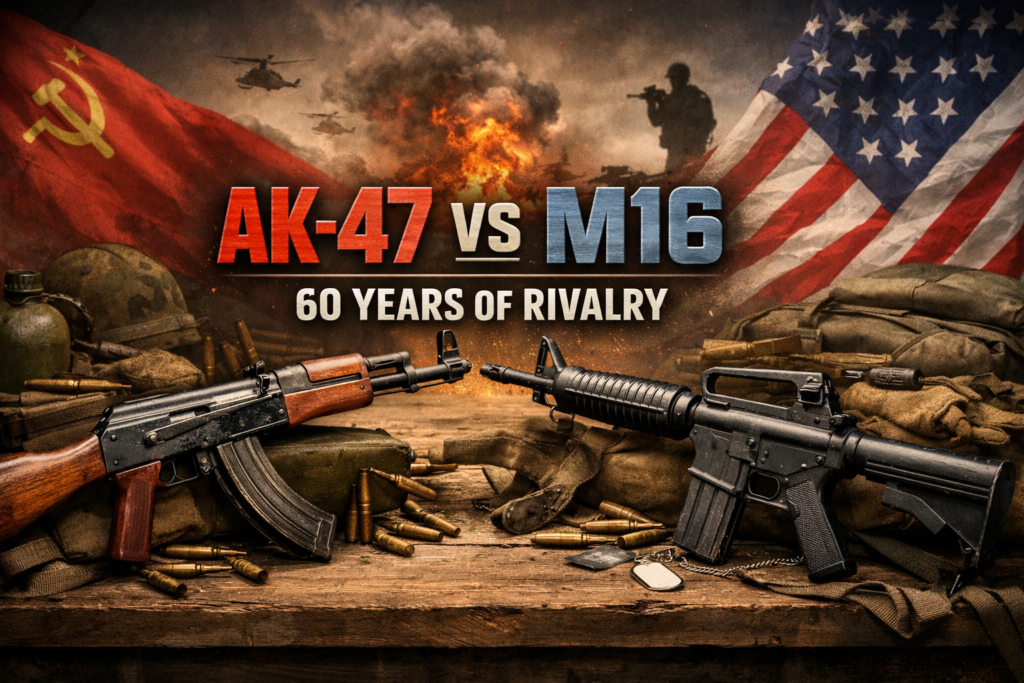
In the Debate from a Soviet Tank Sergeant’s Workshop to the Jungles of Vietnam, the Streets of Fallujah and the Trenches of Ukraine, the AK-47 vs M16 debate is the most argued, most analyzed, most emotionally charged weapons comparison in modern military history. It is also the one debate where the answer genuinely depends on the question you are asking because these two rifles were never truly designed to compete with each other. They were designed to answer two different versions of the same problem, produced by two different civilizations, shaped by two different experiences of war, and deployed by two different visions of what the individual soldier is and what he is worth.
The AK-47 vs M16 rivalry has spanned sixty years and every major conflict since the early 1960s. It was born in the jungles of Vietnam, where American soldiers famously threw down their early M16s to pick up enemy AK-47s from dead North Vietnamese soldiers, and where the AK’s legendary reliability in mud and monsoon made it the weapon of choice for a generation of guerrilla fighters from Southeast Asia to sub-Saharan Africa, from Central America to the Middle East.
It evolved through the Cold War proxy conflicts, through the Soviet-Afghan War where CIA-supplied Kalashnikovs transformed the Mujahideen, through Iraq and Afghanistan where the M16 family dominated the most technologically sophisticated military campaigns in history, and it continues today in the rubble of Ukrainian cities and across the conflict zones of a fractured world order.
This analysis examines every dimension of this rivalry without bias or mythology. We cover the history of both rifles from their conceptual origins through every major variant, the engineering philosophy that produced each, their performance in the environments that tested both to destruction, the doctrinal traditions each represents, the global proliferation that has given both weapons a presence in virtually every armed conflict on Earth, and the question that matters most in 2026: in an era of modular platforms, polymer composites, and sub-MOA 5.56 ammunition, which tradition ultimately prevailed and what comes next?
ORIGINS: HOW TWO WARS PRODUCED TWO RIFLES
Assault Rifle Concept: Germany’s Accidental Gift to the World
Neither the AK-47 nor the M16 could have existed without a conceptual breakthrough achieved by Nazi Germany in the final years of the Second World War. German military analysts, studying engagement data from the Eastern Front, reached a conclusion that upended a century of infantry rifle doctrine: most firefights occur at ranges under 400 meters, and the full-power rifle cartridges of the era; the 7.92x57mm Mauser, the .30-06 Springfield were dramatically overpowered for the distances at which soldiers actually fought.
The solution was an intermediate cartridge: one less powerful than a battle rifle round but more powerful than a pistol cartridge, capable of effective fire to 300-400 metres from a weapon compact enough for a single soldier to carry and controllable enough to fire in automatic mode. The result was the Sturmgewehr 44, the world’s first true assault rifle. Firing the 7.92x33mm Kurz intermediate cartridge, the StG44 combined automatic fire capability with genuine rifle accuracy at combat distances, in a weapon light enough to carry continuously in the field.
It entered service too late and in insufficient numbers to change the outcome of the war, but its conceptual impact was profound. Both Mikhail Kalashnikov and Eugene Stoner, the designers of the AK-47 and AR-15 respectively, were aware of and influenced by the StG44. The assault rifle era that the Sturmgewehr inaugurated has not yet ended.
Mikhail Kalashnikov and the Birth of the AK-47
Mikhail Timofeyevich Kalashnikov was born in 1919 in the Altai region of Siberia, the seventeenth of eighteen children in a peasant family exiled during Stalin’s collectivisation campaign. He became a tank commander in the Red Army and was seriously wounded at the Battle of Bryansk in 1941. Recovering in hospital, he overheard soldiers complaining about the inferiority of Soviet small arms compared to German weapons, a conversation that reportedly catalyzed his determination to design a better weapon for his countrymen. He had no formal engineering training.
What he had was a mechanic’s intuition, a willingness to learn from anyone with relevant knowledge, and a single-minded focus on creating a weapon that the average Soviet conscript could use, maintain, and rely upon in the harshest conditions imaginable. The weapon that emerged from years of development and testing was the Avtomat Kalashnikova 1947, or AK-47. It was not entirely original. Historians and engineers have identified influences from the Sturmgewehr 44, the American M1 Garand’s gas system, and the Remington Model 8. Kalashnikov himself acknowledged drawing on available sources.
What was original was the synthesis: a long-stroke gas-operated, rotating bolt design with deliberately loose manufacturing tolerances that allowed the action to function reliably even when fouled with mud, sand, or carbon deposits that would lock up a more precisely fitted weapon. The AK-47’s loose tolerances sacrifice some inherent accuracy but deliver operational reliability under conditions that defeat competitors. The Soviet Army formally adopted it in 1949, and its mass production began in earnest through the early 1950s.
Eugene Stoner and the Birth of the AR-15 / M16
Eugene Morrison Stoner was a Marine Corps veteran and self-taught engineer who joined ArmaLite in 1954. Where Kalashnikov’s design philosophy was shaped by necessity, field experience, and the constraints of Soviet manufacturing capacity, Stoner’s approach was shaped by the emerging American tradition of aerospace-grade engineering applied to small arms. He understood materials science, his designs used aluminum alloys and fiberglass composites at a time when most rifle designers still thought exclusively in steel and wood. He understood ballistics deeply, and he was willing to challenge the orthodoxy that bigger was inherently better in military rifle cartridges.
The AR-15, which became the M16, was chambered in the then-experimental .223 Remington (later standardised as 5.56x45mm NATO), a dramatically smaller and lighter cartridge than the 7.62x51mm NATO round the US Army had just standardised. Stoner’s case for the smaller cartridge rested on empirical evidence: tests showed that the high-velocity .223 round, despite its smaller diameter, produced wound ballistics in tissue comparable to larger calibres at typical combat distances, while allowing soldiers to carry significantly more ammunition for the same weight. The M16 entered limited service in 1963 and was formally adopted as the standard US service rifle in 1969, replacing the M14.
Kalashnikov was a wounded tank sergeant who wanted to give ordinary Soviet soldiers something that would not let them down. Stoner was an aerospace engineer who wanted to give American soldiers something no rifle had previously been. Both men succeeded. Both men changed the world.
ENGINEERING PHILOSOPHY: AK-47 vs M16
The AK-47’s Design Principles
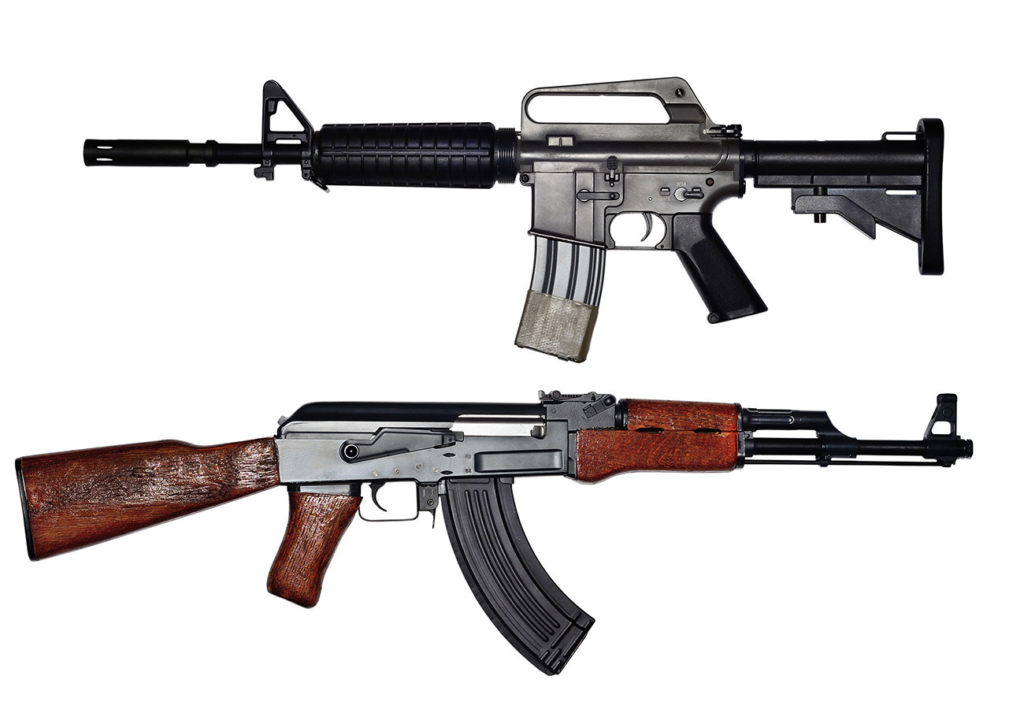
The AK-47’s engineering genius is not complexity but controlled simplicity. The long-stroke gas-operated action, in which the gas piston and bolt carrier move together as a single assembly through the full length of the operating cycle, is inherently more reliable than shorter-stroke systems under fouled conditions, because the greater momentum of the combined assembly provides more energy to overcome resistance from carbon deposits, dirt, or damaged cartridge cases. The rotating bolt provides secure lockup for the high-pressure firing cycle. The loose manufacturing tolerances, gaps that would be considered unacceptable in a precision instrument allow the action to cycle reliably even when grit, sand, or debris has entered the mechanism.
The 7.62x39mm cartridge the AK-47 fires were itself an engineering choice that shaped the rifle’s character. Producing more recoil than the M16’s 5.56mm round, it is more difficult to control in fully automatic fire but delivers significantly greater energy at close and medium range, an advantage in the kind of ambush-range combat for which Soviet doctrine expected the weapon to be used.
The curved 30-round banana magazine, necessitated by the tapered geometry of the 7.62x39mm cartridge, became one of the most recognizable visual symbols of the 20th century. The AK-47 is, in total, a weapon that asks very little of its operator and delivers accordingly: not the last word in precision, but absolute confidence in the one capability that matters most, it will fire when required.
The M16’s Design Principles
The M16’s engineering philosophy begins from the opposite premise: that the soldier can and should be trained to maintain his weapon, and that a rifle optimized for precision and controllability accepting a higher maintenance requirement in exchange for better performance per round fired. This represents the right set of trade-offs for a professional military. The direct gas impingement system, in which combustion gases are tapped from the barrel and directed rearward into the bolt carrier to cycle the action, is more mechanically elegant and produces less heat at the bolt carrier than piston systems, but it also deposits carbon directly into the action, making regular cleaning more critical for reliable function.
The M16’s aluminum and fiberglass construction, considered radical at its introduction, reduced the weapon’s weight dramatically compared to its steel-and-wood predecessors. The straight-line stock geometry designed so that the recoil impulse travels directly backward along the axis of the bore rather than rising into the muzzle reduces muzzle climb during automatic fire compared to the AK’s conventional pistol-grip-and-stock geometry. The tight manufacturing tolerances that make the M16 more accurate than the AK also make it more sensitive to maintenance, a characteristic that proved catastrophically consequential in the early years of Vietnam service.
The 5.56x45mm cartridge was simultaneously the M16’s greatest tactical advantage and the source of its most enduring controversy. Its high velocity at typical combat ranges produced wound ballistics that were, for a period, dramatically effective: the early M193 55-grain projectile was unstable enough at close range to yaw and fragment in tissue, producing wounds out of proportion to the round’s small calibre. At longer ranges or after the adoption of the heavier M855 bullet (the NATO-standardised “SS109”), this fragmentation behaviour became less reliable, and concerns about terminal effectiveness have driven ongoing US ammunition development including the current Mk 318 Mod 1 and M855A1 Enhanced Performance Round.
HEAD-TO-HEAD TECHNICAL COMPARISON
| Specification | AK-47 (Original) | M16A1 (Vietnam Era) | AKM (Modernised) | M16A4 (Current) |
| Calibre | 7.62x39mm | 5.56x45mm (.223) | 7.62x39mm | 5.56x45mm NATO |
| Action | Long-stroke gas piston | Direct gas impingement | Long-stroke gas piston | Direct gas impingement |
| Barrel Length | 415 mm (16.3 in) | 508 mm (20 in) | 415 mm | 508 mm (20 in) |
| Overall Length | 880 mm (34.6 in) | 986 mm (38.8 in) | 880 mm | 1,003 mm (39.5 in) |
| Weight (unloaded) | 3.47 kg (7.7 lb) | 2.89 kg (6.37 lb) | 3.1 kg (6.8 lb) | 2.89 kg (6.37 lb) |
| Effective Range | ~350 m | ~550 m | ~350 m | ~600 m |
| Rate of Fire | 600 rpm (cyclic) | 750–900 rpm | 600 rpm | 800 rpm |
| Muzzle Velocity | ~710 m/s | ~960 m/s | ~715 m/s | ~948 m/s |
| Magazine | 30 rd curved box | 20 or 30 rd box | 30 rd curved box | 30 rd STANAG box |
| Fire Modes | Semi / Full Auto | Semi / Full Auto | Semi / Full Auto | Semi / Full Auto (USMC: 3-rd burst) |
| Manufacturing Tolerance | Loose (reliability-optimised) | Tight (accuracy-optimised) | Loose | Tight |
| Nations Using | 106+ countries | 15+ NATO / allied | Wide AK family | USA + many allies |
| Approximate Units Made | ~100 million (all variants) | ~8 million | See AK family | ~8 million M16 family total |
THE VIETNAM CRUCIBLE: WHERE THE RIVALRY WAS BORN IN BLOOD
The AK-47 in Vietnam: The Weapon That Humiliated America
When North Vietnamese regular forces and Viet Cong guerrillas began deploying the AK-47 in significant numbers in the mid-1960s, American soldiers encountered something they were not prepared for: a rifle that was, in the immediate operational environment of the Vietnamese jungle, arguably better than the weapon they carried. The AK-47’s 7.62x39mm round hit harder at jungle ambush ranges. Its reliability in the heat, humidity, mud, and monsoon rain of Southeast Asia was, in early encounters, demonstrably superior to the rifle the Americans were fielding. And its simplicity of operation meant that Viet Cong guerrillas with minimal training could employ it effectively, maintain it minimally, and depend on it absolutely.
The psychological impact of facing the AK-47 was amplified by stories, widely circulated among American troops, of soldiers throwing down their jamming M16s to pick up enemy Kalashnikovs from fallen adversaries. These stories were not universally accurate many were embellished or apocryphal, but they reflected a real operational problem: the early M16 in Vietnam had a catastrophic reliability record that owed more to Pentagon procurement decisions and logistical failures than to any fundamental flaw in Stoner’s design.
The M16’s Vietnam Disaster: Political Failure Disguised as Mechanical Failure
The M16’s catastrophic early performance in Vietnam is one of the most instructive case studies in the history of weapons procurement. The rifle that Eugene Stoner designed and that early tests validated was not the rifle that American soldiers received in Vietnam. The Colt company, which held the manufacturing contract, had been told by the Army to change the rifle’s powder specification from the fast-burning ball powder originally specified to slower-burning IMR powder, reportedly to satisfy a competing ammunition supplier.
This change dramatically increased the rifle’s cyclic rate from approximately 750 rounds per minute to over 900, causing failures to extract the fired case and catastrophic fouling of the action far more rapidly than the original design. Simultaneously, the Army decided to market the M16 to troops as ‘self-cleaning’, an absurd claim for any gas-operated firearm and initially deployed it without cleaning kits. Soldiers in the field who understood the importance of maintenance had nothing with which to perform it.
The result was rifles jamming in firefights at rates that American soldiers found both life-threatening and inexplicable after decades of confidence in the M1 Garand and M14. Congressional investigations and a 1967 report by Representative James Ichord of Missouri documented the extent of the failures in devastating detail: soldiers found dead in combat with their rifles disassembled beside them, killed while attempting to clear a jam under fire.
The fixes were relatively straightforward reversion to the original powder specification, a chrome-lined chamber and bore to reduce fouling sensitivity, a forward assist and dust cover to exclude contamination, and the issuance of proper cleaning kits with basic instruction in maintenance. The M16A1 that resulted from these modifications was a fundamentally different weapon in operational terms from the rifle that had failed so visibly. But the damage to the M16’s reputation, and the elevation of the AK-47’s mystique, had been accomplished. The myth of the invincible Kalashnikov and the fragile American rifle persisted for decades beyond the specific failure conditions that produced it.
What Vietnam Actually Proved
When the M16A1’s problems were corrected, Vietnam provided a genuine head-to-head comparison between the two rifles in identical operational conditions. American soldiers armed with properly maintained M16A1s found that the rifle’s accuracy advantage at ranges beyond 200 meters was operationally significant, that its lighter ammunition allowed them to carry significantly more rounds into the field, and that its controllability in fully automatic fire gave them a capability the heavier-recoiling AK could not match.
Special Forces operators who used both weapons and who had the training and discipline to maintain the M16 rigorously generally concluded that the M16A1 was the superior weapon in the hands of a properly trained and equipped soldier. The AK-47 remained superior in the hands of a lightly trained soldier who could not be relied upon to maintain his equipment.
Vietnam did not prove the AK-47 was better than the M16. It proved that a properly designed rifle deployed with the wrong ammunition, without cleaning equipment, without maintenance training, and described as self-cleaning to soldiers who needed cleaning kits, would fail. That is a procurement failure, not a design failure. It took decades for the distinction to fully enter the public narrative.
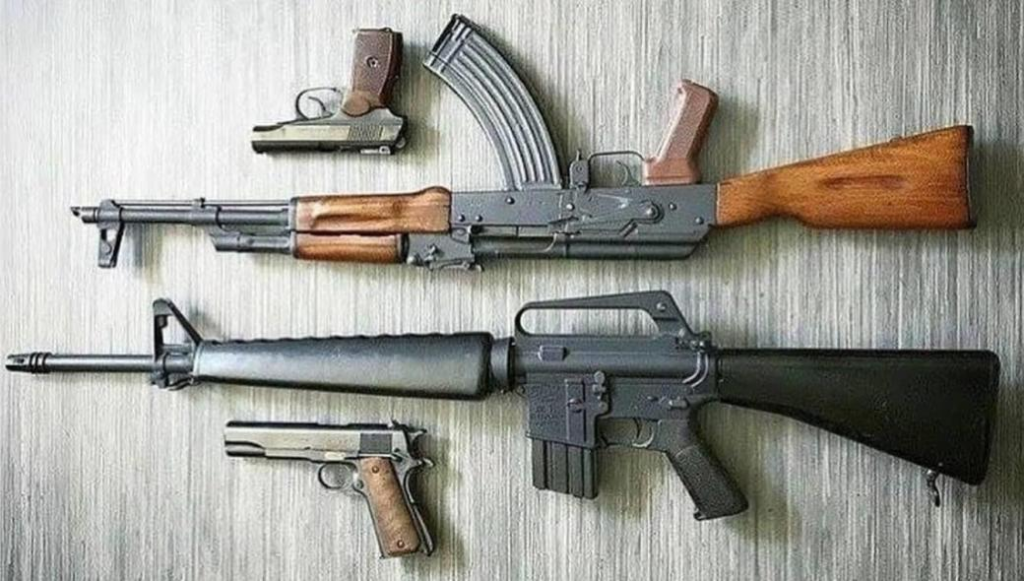
THE GLOBAL SPREAD
The AK-47’s Proliferation: The Rifle That Went Everywhere
No weapon in the history of modern warfare has achieved the geographic distribution of the Kalashnikov family. More AK-type weapons have been produced than all other assault rifles combined estimates range from 75 million to 100 million units, manufactured in the Soviet Union, Russia, China, East Germany, Poland, Romania, Bulgaria, Yugoslavia, Hungary, North Korea, Egypt, India, Finland, and numerous other countries under license or by unlicensed copying. Over 106 countries’ military or police forces have used the AK family. It has appeared on the flags of Mozambique and Hezbollah’s insignia. It has been the weapon of liberation movements and terrorist organizations, of state armies and criminal gangs, of child soldiers and Olympic-level competitive shooters.
The Soviet policy of providing the AK-47 to allied states and liberation movements at minimal or no cost was one of the most consequential decisions in Cold War geopolitical history. By arming proxy forces across Asia, Africa, and Latin America with weapons that were simple to operate, cheap to produce, and essentially impossible to destroy through neglect, the Soviet Union created a global base of armed actors whose dependence on Moscow for ammunition, spare parts, and training created lasting influence in regions that American conventional diplomacy could not penetrate. The AK-47 was not merely a weapon. It was an instrument of geopolitical architecture.
The M16’s Proliferation: Alliance, Training, and Export
The M16 family spread through a fundamentally different mechanism: US military alliance structures, foreign military sales programmes, and the gradual adoption of the 5.56x45mm NATO standard cartridge by the alliance. By standardizing on the 5.56mm cartridge across NATO forces, the US ensured that the M16 platform and its descendants would become the default weapon of the Western military alliance, a decision with enormous logistical advantages in coalition operations but one that also generated genuine debate, particularly among European nations who found the cartridge’s terminal performance at longer ranges insufficient for their operational environments.
The M16’s civilian derivative, the AR-15, became the bestselling rifle platform in American history, with an estimated 20 to 25 million units in civilian circulation in the United States alone. This civilian base created a private aftermarket ecosystem of extraordinary depth and sophistication: every optic, handguard, trigger group, barrel, suppressor, and accessory designed for the AR-15 platform is compatible with the military M16/M4 family, creating a modularity and customisation capability that no other service rifle platform in history has approached.
Cold War Proxy Conflicts: The Two Rifles at War with Each Other
The Cold War produced a series of proxy conflicts in which the AK-47 and M16 family were directly opposed, providing operational data that no laboratory test could replicate. In the Soviet-Afghan War, CIA-supplied AK-47s and AKMs in the hands of Mujahideen fighters proved devastatingly effective against Soviet forces also carrying Kalashnikovs. This was a conflict that was ultimately decided not by the rifle but by the Stinger missile and the strategic decision to bleed Soviet will to continue. In Angola, Mozambique, Nicaragua, El Salvador, and a dozen other Cold War battlegrounds, the two rifles faced each other across ideological lines that were also, simultaneously, manufacturing and logistical lines.
The consistent lesson from these conflicts was the one that Vietnam had already suggested: the AK-47’s advantage was most pronounced when the operator was lightly trained and operating in conditions of minimal logistical support. The M16’s advantage was most pronounced when the operator was well-trained, properly equipped, and operating within a logistics chain that kept the rifle clean, lubricated, and supplied with quality ammunition. These conditions of training, logistics, ammunition quality are ultimately political and economic conditions as much as military ones, which is why the debate about which rifle is ‘better’ has never resolved itself into a simple answer.
RELIABILITY: THE QUESTION EVERY SOLDIER ASKS FIRST
The AK-47’s Legendary Reliability: Fact, Myth, and Context
The AK-47’s reputation for indestructible reliability is the most widely understood fact about the weapon and it is, with appropriate context, substantially true. The long-stroke gas system’s higher operating mass and greater momentum provides genuine tolerance for contamination that shorter-stroke or direct-impingement systems lack. The loose manufacturing tolerances that allow the action to cycle through grit, mud, and fouling that would lock up a tighter mechanism are a real operational advantage in the operational environment’s jungle, desert, Arctic cold where the AK-47 has most often been employed.
Tests conducted by the US military and independent evaluators have consistently confirmed that the AK-47 performs more reliably than the M16 family when both weapons are deliberately subjected to contamination without cleaning. The context that qualifies this advantage is equally important. The reliability differential between a properly maintained M16 and a properly maintained AK-47 in controlled conditions is small. The differential widens significantly when maintenance is absent, cleaning impossible, or ammunition quality compromised conditions that disproportionately characterize irregular, under-resourced, or poorly trained forces.
For a professional military with access to quality ammunition, adequate cleaning supplies, and a training culture that emphasizes weapon maintenance, the AK-47’s reliability advantage over the M16 family is present but not operationally decisive. For a guerrilla fighter with a Chinese-manufactured AK who buried it in the ground for three months, the reliability advantage is the difference between a weapon and an expensive club.
The M16’s Reliability: The Post-Vietnam Recovery
The M16A1 that replaced the original, problematic M16 was a fundamentally different weapon in reliability terms. The chrome-lined bore and chamber, the revised ammunition specification, the addition of the forward assist and dust cover, and the comprehensive maintenance culture that the US military belatedly built around the platform produced a rifle that, in the hands of properly trained soldiers with good ammunition and cleaning kits, was genuinely reliable under combat conditions.
The subsequent M16A2, M16A4, and M4 carbine have continued this evolution, and the M4’s service record across two decades of continuous combat operations in Iraq and Afghanistan where American forces fired more rounds in training and combat than any previous generation has substantially rehabilitated the platform’s reliability reputation.
The adoption of improved bolt carrier group lubrication requirements, enhanced bolt materials, and the gradual transition to piston-operated variants among some special operations units have further narrowed the reliability gap. The HK416, which replaces the direct-impingement system with a short-stroke piston, was adopted by Delta Force and DEVGRU precisely to address the M4’s sensitivity to the extreme fouling conditions of sustained combat and was subsequently adopted as the new standard service rifle by Germany, Norway, France, and several other nations.
ACCURACY AND EFFECTIVE RANGE
The accuracy debate between the AK-47 and M16 is one area where the technical literature provides relatively consistent findings: the M16 family is more accurate, and the gap is not trivial. The M16’s tighter manufacturing tolerances, the superior ballistic performance of the 5.56mm projectile at extended ranges, the rifle’s straight-line stock geometry reducing muzzle flip, and the superior optics ecosystem that the AR-15 platform supports combine to make the M16 family genuinely more precise at ranges beyond 200 meters. Military accuracy standards for the M16A2 specify performance to 550 meters against point targets; the AK-47’s effective point-target range is generally accepted at approximately 350 meters, with area fire remaining effective to perhaps 500 meters.
This accuracy differential is operationally significant in specific contexts and operationally irrelevant in others. Approximately 80 percent of combat engagements occur at ranges under 300 meters, a statistic that echoes the German analysis from 1944 that produced the assault rifle concept in the first place, and that has been consistently confirmed across every conflict from Vietnam to Afghanistan. At ranges under 300 meters, the practical accuracy difference between a well-maintained AK-47 and an M16, in the hands of soldiers whose training is similar, is modest.
At ranges of 400-600 meters, the M16’s advantage becomes operationally meaningful, particularly in the open terrain environments of Afghanistan’s Korengal Valley, where Taliban fighters regularly engaged American positions at ranges that rendered their AK-47s and PKM machine guns ineffective against targets that the American M4s and M16s could engage with confidence.
The Afghanistan experience drove the US military’s recognition of a genuine capability gap: the M4’s 14.5-inch barrel reduced muzzle velocity below the threshold required for reliable fragmentation of the M855 round at extended ranges, producing a carbine that was less effective at the long distances that Afghan terrain imposed than the full-length M16 it had largely replaced. The result was the adoption of the M855A1 Enhanced Performance Round, specifically engineered to maintain effective terminal performance from shorter barrels, and the accelerated procurement of the M110 Semi-Automatic Sniper System and Mk 17 SCAR-H to fill capability gaps at the upper end of engagement range.
VARIANTS AND EVOLUTION: SIXTY YEARS OF DEVELOPMENT
The AK Family Tree
The AK-47’s most commercially successful feature may be its evolutionary fertility. The original AK-47 was followed by the AKM, a manufacturing-refined version with a stamped steel receiver replacing the original’s milled receiver, lighter and cheaper to produce. It became the most widely produced Kalashnikov variant. In 1974, the Soviet Union introduced the AK-74, chambered in the new 5.45x39mm cartridge, a deliberate response to the ballistic advantages the Americans had demonstrated with their 5.56mm round.
The AK-74 was a genuine improvement in accuracy and controllability, its smaller, faster projectile producing a flatter trajectory and reducing muzzle climb in automatic fire, while the cartridge’s terminal ballistics in tissue proved, if anything, more dramatic than the 5.56mm at close range. The AKS-74U (nicknamed the ‘Krinkov’ in the West) provided a compact carbine version suited to vehicle crews, paratroopers, and special operations personnel. The AK-100 series introduced polymer furniture, improved ergonomics, and calibre flexibility across the AK-74, 7.62x39mm, and 5.56x45mm NATO configurations.
The AK-12, adopted as the Russian military’s current standard service rifle, represents a comprehensive modernisation: an improved trigger mechanism, a Picatinny top rail for optic mounting, an adjustable stock, ambidextrous controls, and improved accuracy specification. The AK-12 is arguably the most significant departure from the original Kalashnikov design philosophy since the AKM, retaining the long-stroke piston reliability while substantially closing the ergonomic and modularity gap with the M16 platform.
The M16 Family Tree
The M16’s evolutionary path has been, if anything, even more diverse than the AK family’s. The original M16 spawned the corrected M16A1, the improved M16A2 with its heavier barrel and 3-round burst mechanism, the flattop M16A4 with Picatinny rail and removable carrying handle that became the USMC’s standard service rifle, and most significantly the M4 carbine with its collapsible stock, 14.5-inch barrel, and compact configuration that became the US Army’s principal service rifle from the 1990s onward. The M4A1, with its full-auto capability and enhanced lower receiver, became the preferred configuration for special operations forces and has since spread to conventional Army units.
Beyond the military variants, the civilian AR-15 ecosystem has produced a platform of extraordinary diversity. Barrel lengths from 7 inches to 24 inches, calibers from the diminutive .22 LR through 5.56mm, 6.5 Grendel, 6.8 SPC, 7.62x39mm (using AK magazines), .300 Blackout, .458 SOCOM, and .50 Beowulf, configurations from micro-pistols to precision target rifles, and a modular lower-receiver architecture that allows any combination of components to be assembled into a legal firearm in most US jurisdictions, the AR-15 is less a single weapon than an entire weapon development platform. The US military has exploited this by procuring the Mk 12 Special Purpose Rifle, the HK416 (M27 Infantry Automatic Rifle for the USMC), and multiple other specialized variants from the same basic architecture.
The US Army’s SIG XM7: Superseding the M16 Legacy
In April 2022, the US Army announced the selection of the SIG Sauer XM5 (now M7) rifle and XM250 (M250) automatic rifle as the replacements for the M4A1 and M249 SAW under the Next Generation Squad Weapon programme. Chambered in the new 6.8x51mm cartridge, a round specifically engineered to defeat enemy body armour at extended ranges, motivated by the proliferation of Level III+ plate armour systems among peer and near-peer adversaries, the M7 represents the most significant change in US service rifle doctrine since the original adoption of the M16.
The 6.8x51mm round operates at higher pressures than any previous service cartridge, requiring a hybrid steel-and-brass case construction, and delivers terminal performance against protected targets that the 5.56mm M855A1 cannot match. Full fielding to Army units is projected through the late 2020s.
MAJOR CONFLICTS: THE TWO RIFLES IN ACTION
The Soviet-Afghan War (1979–1989): Kalashnikov vs Kalashnikov
The Soviet-Afghan War presents one of history’s most instructive case studies in the AK-47’s geopolitical dimensions. Soviet forces equipped with AK-74s, the then-current Kalashnikov variant, faced CIA-supplied Mujahideen armed principally with AKM and Chinese Type 56 rifles. Both sides carried essentially the same weapon philosophy. The conflict’s outcome was determined less by the rifle than by the Stinger missile, by geography and logistics, and by the asymmetric will to sustain casualties. The AK-74’s 5.45mm round gained a particular reputation among Mujahideen and later American military observers for severe wounding effects, earning the informal designation ‘the poison bullet’ which is a characteristic attributed to the projectile’s tendency to tumble violently in tissue.
Iraq and Afghanistan: The M4/M16 System at Full Stretch
The post-2001 operations in Afghanistan and Iraq provided the most sustained and operationally diverse evaluation of the M16 family in combat since Vietnam, and the verdict was considerably more favorable. American forces operating the M4 and M16A4 in Iraq’s urban environment found the weapons’ accuracy and modularity the ability to mount Trijicon ACOG optics, SureFire lights, AN/PEQ-2 laser designators, and M203 grenade launchers on the same Picatinny-railed platform provided genuine operational advantages over the AKs, AKMs, and PKMs carried by insurgent forces.
The M4’s compact configuration proved well-suited to the vehicle-mounted and room-clearing operations that characterized the Iraq campaign. Afghanistan presented different challenges. The Korengal Valley and Kunar Province engagements repeatedly placed American soldiers at a disadvantage when Taliban fighters fired from ridgelines at ranges of 500-800 metres with PKMs, SVDs, and even bolt-action rifles, while the M4’s effective range and the M855 round’s terminal performance at those distances left something to be desired.
The Army’s response included the wider issuance of the M16A4 over the M4 for specific units, the procurement of Mk 14 Enhanced Battle Rifles in 7.62mm for designated marksmen, and ultimately the ammunition improvements mentioned above. Afghanistan confirmed the M16’s precision and modularity advantages while also confirming that 5.56mm from a 14.5-inch barrel at 600 metres was at the edge of its operational effectiveness envelope.
Ukraine: Both Rifles in a Peer-on-Peer Conflict
The war in Ukraine has provided the most current evaluation of both platforms in high-intensity peer conflict. Russian forces have operated predominantly with AK-74M, AK-12, and RPK variants. Ukrainian forces have fielded a mix of legacy AKs, Ukrainian-manufactured Malyuk bullpup rifles, and increasingly, Western-supplied weapons including M16A4s, M4A1s, and HK416s provided under military assistance programmes. The operational evidence from Ukraine reinforces several established conclusions: Russian-doctrine AK operations prioritise volume of fire and suppression; Western-influenced Ukrainian operations using M4/M16 family weapons tend to prioritise target discrimination and single-shot accuracy supported by optics, a capability facilitated by the Picatinny rail ecosystem that the AK-12 is only beginning to approach.
Ukraine has also validated a lesson that the infantry weapons community has understood theoretically for decades: in a peer conflict with widespread use of drone surveillance and precise artillery, the individual rifleman’s ability to accurately engage targets at 400-600 meters with first-round hits is strategically significant. Volume of automatic fire that reveals your position to drone-assisted observers and draws artillery response is a liability as much as an asset. This tactical reality favors the M16 family’s precision orientation over the AK family’s volume-fire heritage though the AK-12’s improved accuracy specification narrows this gap compared to the original 1949 design.
In Ukraine, both rifles are under fire in the most literal sense. And both are proving the same thing they proved in Vietnam, in Afghanistan, and in every conflict between: a rifle is ultimately only as good as the soldier behind it, the logistics supplying it, and the doctrine directing it. The metal has never been the decisive variable.
CULTURAL AND SYMBOLIC DIMENSIONS
The AK-47 as Cultural Icon
No weapon in history has achieved the symbolic status of the AK-47 outside the purely military domain. Its silhouette, the distinctive curved magazine, the wooden stock, the long gas tube above the barrel is among the most recognizable shapes in the world, carrying associations as varied as African liberation movements, Cold War revolution, street crime, and the technical artistry of one of the 20th century’s most consequential mechanical minds.
The AK-47 appears on the flag of Mozambique, on the arms of Hezbollah and Hamas, in the hands of every fictional terrorist from Hollywood to Bollywood, and in the rifle sling of every major insurgency since the 1960s. When Mikhail Kalashnikov died in 2013 at the age of 94, he was mourned as a national hero in Russia. He had reportedly expressed deep regret in his final years at the role his invention had played in violence worldwide, writing to the Russian Orthodox Patriarch to ask whether he bore moral responsibility for all those deaths.
The M16/AR-15 in American Culture
The M16’s civilian derivative, the AR-15, has acquired a cultural significance in the United States that far exceeds its military dimensions. With an estimated 20 to 25 million units in civilian ownership, the AR-15 platform has become simultaneously the symbol of American gun rights culture and the most contested weapon in the American domestic political debate. Its appearance in multiple high-profile mass shootings has driven calls for legal prohibition, while its defenders and there are tens of millions of them argue that the platform’s modularity, ergonomics, and the breadth of its legitimate sporting, hunting, and home-defence applications make it the 21st century’s definitive civilian firearm. This debate, which has no direct parallel in the AK-47’s cultural trajectory, illustrates how profoundly a weapon’s meaning is shaped by the society in which it is embedded.
HEAD-TO-HEAD VERDICT: THE SIXTY-YEAR SCORECARD
| Category | AK-47 / AK Family | M16 / M4 Family | Winner |
| Reliability (unmaintained) | Outstanding | Adequate | AK-47 |
| Reliability (maintained) | Excellent | Excellent | Draw |
| Accuracy (point targets, <300m) | Good | Very Good | M16 (slight) |
| Accuracy (point targets, 300-600m) | Marginal | Good | M16 (decisive) |
| Controllability (full auto) | Good | Very Good | M16 |
| Terminal Effectiveness | Good (larger calibre) | Good (high velocity) | Contextual |
| Weight (rifle unloaded) | Heavier (3.47 kg) | Lighter (2.89 kg) | M16 |
| Ammunition Weight | Heavier (7.62mm) | Lighter (5.56mm) | M16 |
| Modularity / Accessories | Limited (improving w/ AK-12) | Exceptional (Picatinny ecosystem) | M16 (decisive) |
| Manufacturing Cost | Lower | Higher | AK-47 |
| Global Proliferation | 100M+ units, 106+ nations | ~15M units, 30+ nations | AK-47 (decisive) |
| Training Requirements | Low (accessible to all) | Higher (maintenance critical) | AK-47 |
| Modern Variant Capability | AK-12 closes gap | M7 (6.8mm) leaps ahead | M16 family |
| Cultural / Symbolic Status | Global insurgency symbol | Western alliance standard | Draw |
| Overall (professional military) | Excellent | Superior | M16 family |
| Overall (irregular forces) | Superior | Good | AK-47 |
The sixty-year verdict is: both rifles won. They won in the contexts they were designed for, against the adversaries they were built to face, in the hands of the soldiers they were intended to arm. The AK-47 armed more people, reached more countries, appeared in more conflicts, and proved more useful in the hands of soldiers who could not be relied upon to maintain it than any weapon in history.
The M16 family equipped the most powerful military alliance in history, drove weapons technology forward through continuous improvement, produced the most capable and modular service rifle platform ever fielded, and is now evolving into a new generation, the M7 in 6.8mm that is a deliberate generational leap beyond anything the Kalashnikov family currently offers.
CONCLUSION: THE RIFLES THAT DEFINED AN ERA
The AK-47 vs M16 debate will never fully resolve, because it was never really a debate about which rifle is better. It was a debate about which world you live in. In a world of conscript armies, poor logistics, tropical climates, and political urgency, the AK-47 is not merely adequate, it is optimal. In a world of professional soldiers, sophisticated logistics, precision doctrine, and an industrial base capable of producing world-class optics, ammunition, and accessories in unlimited quantities, the M16 family is not merely adequate, it is transformative.
The sixty years of this rivalry has produced something neither Kalashnikov nor Stoner could have fully anticipated: the convergence of both philosophies into every serious modern rifle design. The AK-12 has Picatinny rails and an adjustable stock. The M4 has piston-operated variants that improve its reliability in fouled conditions. The HK416 combines Stoner’s calibre and architecture with a gas system that approaches the Kalashnikov’s reliability heritage. Every modern service rifle is, to some degree, trying to be both rifles simultaneously.
What replaces both of them; the US Army’s M7, firing 6.8mm through a hybrid steel-brass case at pressures no previous service cartridge has sustained is a recognition that the threat environment has changed again. Enemy body armour, once a rarity on the battlefield, is now standard issue for peer adversaries. The intermediate cartridges that both the AK-47 and the M16 were built around, calibers chosen specifically to reduce the weight of a soldier’s ammunition load are no longer adequate against a protected adversary at 500 meters.
The next sixty years of infantry weapons development will be shaped by a new equation, just as the sixty years from 1947 were shaped by the German analysts who sat down with engagement data from the Eastern Front and concluded that most firefights happen at under 400 meters.
Mikhail Kalashnikov and Eugene Stoner both understood something that every military planner since has been forced to relearn: the rifle in the soldier’s hands is not merely metal and wood and polymer. It is an expression of what that soldier’s society believes warfare is, what it believes soldiers are worth, and what it believes victory requires. As long as those beliefs differ between nations, the rifles those nations build will differ too. And the debate about which is better will never end. It shouldn’t. That argument, sustained across sixty years of blood and ingenuity, is how the next rifle gets designed.
FREQUENTLY ASKED QUESTIONS: AK-47 VS M16
Q1. Which is better, the AK-47 or the M16?
Neither rifle is universally better. The AK-47 is superior in the hands of lightly trained soldiers operating without reliable logistics, in harsh environments where weapon maintenance is impossible. The M16 is superior in the hands of professional, well-trained soldiers with access to quality ammunition, optics, and maintenance equipment. The AK-47 wins on reliability under neglect and global affordability. The M16 wins on accuracy, modularity, controllability, and precision at ranges beyond 300 metres. The correct answer depends entirely on who is carrying the rifle and under what conditions.
Q2. Why did American soldiers prefer the AK-47 over the M16 in Vietnam?
Some American soldiers picked up enemy AK-47s during the early years of the Vietnam War because the original M16 issued to US troops was plagued with reliability failures, not because of any fundamental design flaw, but because the Army changed the rifle’s powder specification without updating the chamber design, deployed it without cleaning kits, and falsely marketed it as “self-cleaning.” The resulting jamming failures were catastrophic and preventable. Once the M16A1 incorporated a chrome-lined chamber, correct ammunition, and proper maintenance training, the preference for captured AKs largely disappeared among trained American units
Q3. How many AK-47s have been produced worldwide?
Estimates vary, but between 75 million and 100 million AK-type rifles of all variants have been produced since the original AK-47 entered Soviet service in 1949. This makes the Kalashnikov family the most manufactured firearms platform in history, more AK-type weapons have been produced than all other assault rifles in history combined. They are currently in military or police service in over 106 countries.
Q4. What is the effective range of the AK-47 compared to the M16?
The AK-47 has an effective range of approximately 300–350 meters against point targets. The M16 has an effective range of approximately 500–600 meters. This difference is due to the superior ballistic performance of the 5.56x45mm NATO cartridge, the M16’s tighter manufacturing tolerances, and its longer barrel providing higher muzzle velocity. In practical combat, where approximately 80 percent of engagements occur under 300 meters, this difference is modest. In open terrain environments such as Afghanistan, it proved operationally decisive.
Q5. Is the AK-47 more reliable than the M16?
Yes, when both rifles are subjected to contamination without cleaning, the AK-47 is significantly more reliable than the standard M16/M4. The AK’s long-stroke gas piston system and deliberately loose manufacturing tolerances allow it to cycle through mud, sand, and carbon fouling that will lock up the M16’s tighter direct-impingement action. However, when both rifles are properly maintained with quality ammunition, the reliability gap narrows considerably. Piston-operated variants of the M16 platform such as the HK416 largely close the gap even under dirty conditions.
Q6. Which rifle is more accurate, the AK-47 or the M16?
The M16 is more accurate than the AK-47. The M16’s tighter manufacturing tolerances, superior 5.56mm ballistics, straight-line stock geometry, and the exceptional optics ecosystem of the AR-15/M16 platform combine to make it a more precise weapon at all ranges particularly beyond 200 meters. The AK-47 is a good combat rifle but was never engineered for precision; its loose tolerances that deliver reliability come at a cost to inherent mechanical accuracy. Modern variants such as the AK-12 have improved on the original’s accuracy, but the M16 family retains a meaningful advantage.
Q7. What replaced the M16 in the US Army?
The US Army selected the SIG Sauer XM5 (designated M7) rifle as the replacement for the M4A1 carbine under the Next Generation Squad Weapon (NGSW) programme, announced in April 2022. The M7 is chambered in the new 6.8x51mm cartridge, specifically designed to defeat modern body armour at extended ranges, a capability the 5.56mm M855A1 cannot reliably provide against peer adversaries equipped with Level III+ ceramic plate carriers. Full Army fielding is projected through the late 2020s, though the M4A1 will remain in service across many units for years to come.
Q8. What replaced the AK-47 in the Russian military?
The AK-47 was replaced in Soviet and subsequently Russian service through a series of upgrades. The AKM replaced the original AK-47 in the 1950s with a lighter stamped-steel receiver. The AK-74, chambered in the smaller 5.45x39mm cartridge, replaced the AKM in 1974. The AK-74M became the standard post-Soviet service rifle. The current Russian Army standard service rifle is the AK-12, adopted in 2018, which adds Picatinny rail optics mounting, an adjustable folding stock, improved ergonomics, and enhanced accuracy compared to its predecessors while retaining the long-stroke piston reliability that defines the Kalashnikov family.
Q9. Which rifle has been used in more conflicts, the AK-47 or the M16?
The AK-47 family has been used in significantly more conflicts and by a greater number of armed actors than the M16. Its presence in over 106 countries, its use by both state militaries and non-state armed groups, and its appearance in virtually every major armed conflict since the 1960s from Vietnam, Angola, Mozambique, and Nicaragua through to the Syrian civil war, the wars in Iraq and Afghanistan, and the current conflict in Ukraine make it the most combat-deployed rifle in history. The M16 family’s combat deployment is primarily through US and NATO forces and allied militaries, a smaller but extraordinarily well-documented operational record.
Q10. Can you use AK-47 magazines in an M16?
Standard AK-47 magazines, which use 7.62x39mm cartridges, are not compatible with standard M16 or M4 rifles chambered in 5.56x45mm NATO. However, there are AR-15/M16-pattern rifles specifically manufactured in 7.62x39mm calibre that are designed to accept AK-47 magazines. These are niche configurations and not standard military issue. The M16 family uses STANAG-specification box magazines, a standard adopted across NATO that ensures interoperability among the alliance’s forces.
Q11. Why is the AK-47 on the flag of Mozambique?
The AK-47 appears on the national flag of Mozambique because of the central role the Kalashnikov rifle played in the country’s independence struggle against Portuguese colonial rule, conducted by the FRELIMO liberation movement between 1964 and 1974. The AK-47 became the symbol of armed liberation for FRELIMO, as it did for numerous African independence movements of the Cold War era that were supplied with Soviet-manufactured Kalashnikovs. When Mozambique adopted a new national flag after independence in 1975, the AK-47 was included alongside a hoe (representing agriculture) and an open book (representing education) as one of three symbols of the new nation.
Q12. Which is heavier, the AK-47 or the M16?
The original AK-47 weighs approximately 3.47 kg (7.7 lb) unloaded, compared to the M16A1’s approximately 2.89 kg (6.37 lb) unloaded. The M16 is lighter by roughly 580 grams. This weight difference is compounded by ammunition weight: the 7.62x39mm cartridges the AK fires are heavier than the 5.56x45mm rounds the M16 fires, meaning a soldier carrying the same number of rounds will carry significantly more total weight with an AK than with an M16. Over a full combat load, this difference can exceed two kilograms, a meaningful factor in sustained operations.
About Armorexa
Armorexa is a dedicated military intelligence and defense analysis platform covering weapons systems, warfare technology, military history, and strategic doctrine. Our editorial team delivers in-depth, credible, and rigorously researched analysis for defense professionals, students, and military enthusiasts worldwide.