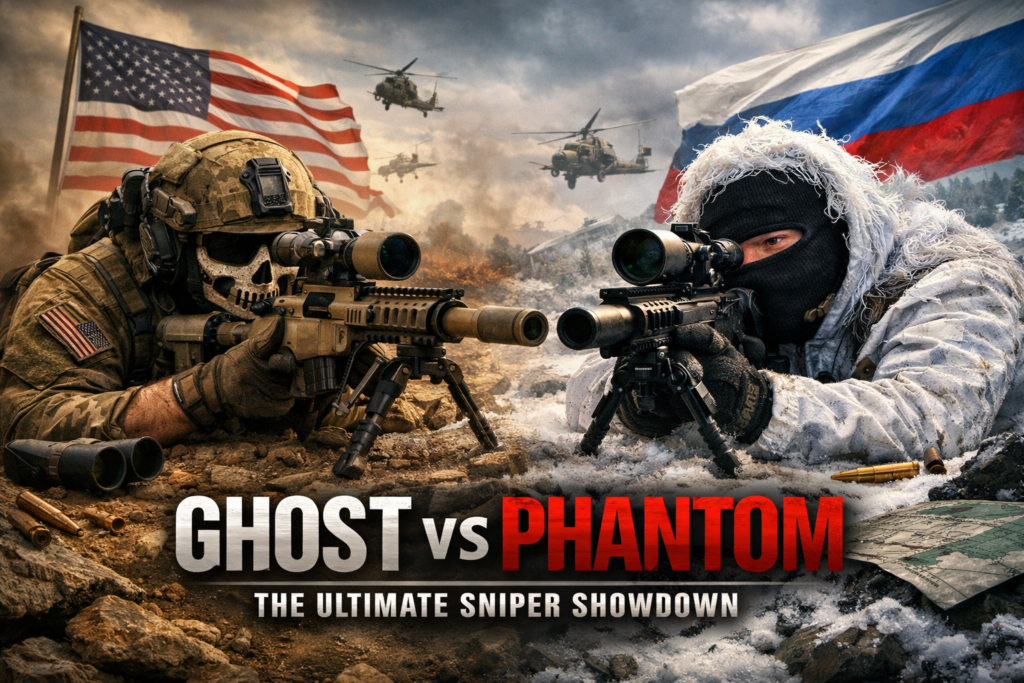
America’s Elite Marksmen Against Russia’s Silent Hunters
Rifles, Records, Doctrine and the Art of the Long Kill: A Complete Tactical, Historical and Strategic Comparison of Snipers
In the calculus of modern warfare, no figure is more psychologically potent than the sniper. Invisible, patient, lethal at distances that defy comprehension, the marksman has haunted the battlefield imagination of every army since the first rifled barrel sent a ball spinning across an 18th-century tree line. Today, as the United States and Russia engage in an intensifying competition for military dominance across every domain of warfare, the question of whose sniper tradition is superior; the American or the Russian, sits at the intersection of human skill, engineering precision, strategic doctrine, and centuries of accumulated combat experience.
The US sniper vs Russian sniper debate is not simply a contest between two rifles or two kill counts. It is a collision between two fundamentally different philosophies of what a sniper is for, how one should be trained, how one should be equipped, and what role the individual marksman plays in the larger architecture of military power. America built its sniper tradition around the concept of the patient, independent operator, a ghost who moves alone through enemy territory, selecting targets with surgical precision before vanishing without trace. Russia built its tradition around mass: thousands of trained marksmen deployed at platoon level, creating a pervasive psychological freeze across the entire battlefield through sheer numerical ubiquity.
This analysis examines both traditions in full. From the swamps of Vietnam where Carlos Hathcock earned a $30,000 bounty on his head, to the rubble of Stalingrad where Vasily Zaitsev stalked a Nazi super sniper through a city burning around him. Also from the .50 BMG round that Hathcock fired through an enemy sniper’s own scope to the Barrett M82 and ORSIS T-5000 comparison.
This is the definitive account of the world’s two greatest sniper traditions, the men who built them, the rifles that armed them, and the doctrine that directed them. It is also a guide to where this rivalry stands in 2026, as drone detection, counter-sniper radar, and AI-assisted targeting are forcing the most ancient of military arts to reinvent itself or die.
THE SNIPER IN MILITARY HISTORY: THE WORLD’S MOST FEARED INDIVIDUAL
From Sharpshooter to Strategic Asset
The sniper’s story begins wherever the first skilled rifleman realised that patience and precision could accomplish what mass and firepower could not. The American Revolutionary War produced the first systematic use of targeted long-range fire against command figures, with colonial marksmen deliberately selecting British officers as targets. This was a tactics so psychologically devastating that the British considered it a violation of the gentlemen’s rules of war. The Napoleonic Wars formalized the concept of the specialist marksman, with the British 95th Rifles and French Voltigeurs deploying skirmishers whose primary purpose was the suppression and disruption of enemy command and communication.
The American Civil War transformed the sniper from a battlefield expedient into a studied military capability. Berdan’s Sharpshooters on the Union side, equipped with Sharps rifles capable of consistent accuracy at 800 yards, established the principle that a small number of skilled marksmen could anchor defensive lines, disrupt enemy advances, and kill commanders at ranges that made retaliation nearly impossible. Confederate snipers using Whitworth rifles, the finest precision weapons of the era achieved kills at ranges exceeding 1,000 yards, a performance that would not be routinely surpassed for decades.
The First World War reduced the sniper’s operational environment to the claustrophobic confines of the trench system but did nothing to reduce the profession’s lethality or psychological impact. German snipers, equipped with pre-war hunting rifles and telescopic sights superior to anything the British initially possessed, inflicted casualties far disproportionate to their numbers in the early years of the war. The British response was systematic: they developed sniper schools, fielded the Pattern 14 rifle with telescope, and trained dedicated counter-sniper teams. By the war’s end, the sniper had been institutionalized as a permanent element of military structure in every major army.
Why One Sniper Is Worth a Hundred Soldiers
The disproportionate impact of the sniper on military operations has never been purely about the number of enemy killed. A single effective sniper operates at an entirely different level of strategic effect. When a sniper is active in a sector, the entire opposing force must change its behaviour: soldiers no longer stand exposed even briefly, officers cannot be identified by their actions or insignia, vehicle commanders button up and lose situational awareness, and resupply operations become high-risk undertakings that consume far more resources than the actual distance traversed would normally require. One sniper with 500 metres of coverage can hold down a force of thousands.
The psychological dimension compounds this physical effect. Unlike artillery or air strike, which kills indiscriminately and at intervals, the sniper kills selectively and silently. A soldier near a body that shows no visible wound and produced no audible shot experiences a quality of fear that no amount of conventional fire produces. The sniper’s victim simply falls. There is no warning, no shelter to run to, no direction in which to return fire. This is the terror that gave Vasily Zaitsev his power at Stalingrad, that made Carlos Hathcock worth a $30,000 bounty to the North Vietnamese, and that makes the sniper role as relevant in 2026 as it was in 1942.
A good sniper does not merely kill. He freezes an entire army. He makes every soldier in his range ask the same question with every step they take: ‘Is this the step that ends me?’ That question, multiplied across thousands of men, is worth more than any artillery barrage.
AMERICAN SNIPER LEGENDS: THE GHOSTS OF AMERICA’S WARS
Carlos Hathcock: The White Feather
If you want to understand the American sniper tradition, you begin with Gunnery Sergeant Carlos Norman Hathcock II, born in Little Rock, Arkansas, in 1942. Hathcock learned to shoot out of necessity, hunting with a .22 rifle in rural Mississippi to help feed his family. He enlisted in the Marine Corps at seventeen, won the Wimbledon Cup shooting championship in 1965, and deployed to Vietnam in 1966 as a military policeman. Within weeks, his extraordinary natural talent had been recognized, and he was transferred to the 1st Marine Division Sniper Platoon at Hill 55, south of Da Nang. The legend of the White Feather had begun.
Hathcock wore a single white feather in the band of his bush hat on every mission, not as carelessness but as a deliberate provocation. This was a challenge, almost a taunt, to the enemy who came increasingly to fear him. The North Vietnamese and Viet Cong named him Long Trang, meaning White Feather. They placed a bounty on his head that eventually reached $30,000, vastly higher than the $1,000 to $2,000 typically offered for American snipers, and a sum that in contemporary value exceeds $250,000.
They sent platoons of counter-snipers to hunt him. None succeeded. When the threat became known, fellow Marines across the area of operations began donning white feathers themselves to dilute the target, one of the most remarkable acts of collective military solidarity in the history of the Vietnam War.
Hathcock accumulated 93 confirmed kills, and this was a figure that significantly undercounts his actual impact, since Vietnam’s confirmation requirements demanded a third-party officer witness, a standard rarely achievable in the conditions under which Hathcock operated. He himself estimated his actual tally at between 300 and 400. The missions that define his legend, however, are not measured in numbers. His most celebrated kill came when he shot an enemy counter-sniper known only as the Cobra, the best marksman in the North Vietnamese Army.
He was sent specifically to kill Hathcock, through the man’s own rifle scope, the bullet entering through the scope and killing him through the eye. The optical alignment required for this shot means that at the moment Hathcock fired, the Cobra was looking directly at him through his scope and was a fraction of a second from firing first.
His most arduous mission was a solo infiltration to assassinate a North Vietnamese general. Hathcock removed his white feather for the only time in his combat career, a symbolic acknowledgement of the mission’s exceptional danger. He crawled 1,500 yards across open ground over three days and nights without sleep, at times within feet of enemy patrols, before taking a single shot that killed the general at 700 yards. He then crawled back through enemy lines before anyone knew what had happened. This mission, and the institutional knowledge Hathcock brought back from Vietnam, directly shaped the establishment of the Marine Corps Scout Sniper School at Quantico, which he helped found and whose curriculum he helped write, arguably his most enduring legacy.
Chuck Mawhinney: The Silent Record Holder
While Hathcock’s story became legend in his lifetime, the Marine Corps’ actual confirmed-kill record holder was unknown to the public for decades. Charles Benjamin Mawhinney served 16 months in Vietnam between 1968 and 1969, accumulating 103 confirmed kills and 216 probable kills, numbers that surpassed Hathcock’s confirmed count but were only publicly revealed in 1991 through a fellow Marine’s memoir. Mawhinney was a hunter from rural Oregon who chose the Marines specifically because they allowed him to delay enlistment until after deer season.
His battlefield record reflects this background: clinical, efficient, and utterly without showmanship. Where Hathcock wore the white feather as a challenge, Mawhinney operated in complete anonymity, by choice, for decades after the war. His most celebrated single engagement saw him kill 16 North Vietnamese soldiers in a single night engagement near the An Hoa Basin, each with a head shot, using night observation equipment. “It was the ultimate hunting trip,” he later said, “a man hunting another man who was hunting me.”
Chris Kyle: The Devil of Ramadi
The most decorated and most publicly recognized American sniper of the modern era is Navy SEAL Chief Petty Officer Chris Kyle, whose four tours in Iraq between 2003 and 2009 produced 160 confirmed kills with the Pentagon acknowledging more than 150 and Kyle’s own account citing a higher tally of approximately 255. Kyle operated under a fundamentally different set of conditions from his Vietnam-era predecessors: the urban environment of Fallujah, Ramadi, and Baghdad’s Sadr City, where engagements typically occurred at ranges of 600 to 1,000 yards across rooftops and through rubble, demanded different skills from the jungle craft of the Vietnam tradition, but the fundamental sniper virtues of patience, observation, and absolute trigger discipline remained unchanged.
Iraqi insurgents called him al-Shaitan ar-Ramadi, the Devil of Ramadi. His bounty escalated from $20,000 to $80,000 as his confirmed kills mounted. His longest confirmed shot, at approximately 2,100 yards in 2008 near Sadr City, was taken against an insurgent preparing to fire a rocket-propelled grenade at an American convoy. The shot, fired with a McMillan TAC-338, required an elevation correction of over 100 minutes-of-angle, a calculation that leaves essentially no margin for error at that range. Kyle was shot twice during his four tours and survived six IED explosions.
His 2012 memoir American Sniper became an international bestseller, and the 2014 film adaptation starring Bradley Cooper became the highest-grossing domestic film of that year. Kyle was murdered at a Texas shooting range in February 2013, aged 38.
Carlos Hathcock wore the white feather and dared the enemy to find him. Chris Kyle earned an $80,000 bounty and kept going back. The American sniper tradition has always been built on this: the man who goes where others cannot, stays where others will not, and shoots what others cannot see.
RUSSIAN AND SOVIET SNIPER LEGENDS: THE PHANTOMS OF THE EASTERN FRONT
Vasily Zaitsev: The Hare of Stalingrad
No sniper in history has been more completely immortalised in the cultural memory of his nation than Vasily Grigoryevich Zaitsev. Born in 1915 in the Ural village of Yelenovsk, Zaitsev learned marksmanship the same way Hathcock did, through necessity and subsistence hunting, taught by his grandfather in the forests and snow of the Urals. His grandfather’s lesson was absolute: bullets are precious, so each one must count. One animal, one bullet. This philosophy, instilled in a child, would later shape the most celebrated sniping career of the Second World War.
Zaitsev reached Stalingrad as a naval clerk and immediately volunteered for front-line combat. His commanding officer, observing an early engagement, noticed that Zaitsev killed a German officer at 800 meters with an unsighted standard-issue Mosin-Nagant, a shot that most trained riflemen could not make with a scoped weapon. Zaitsev was immediately given a sniper rifle and turned loose on the ruins of what had been a city. Between 10 October and 17 December 1942, in a period of just 68 days, he killed 225 enemy soldiers, including 11 enemy snipers. His total confirmed tally for the war exceeded 300.
His tactical innovations were as significant as his marksmanship. He developed and refined the “sixes” formation, three two-man sniper-scout teams positioned to cover overlapping fields of fire across a single area, creating interlocking zones in which no position was safe for an enemy observer. He understood, and taught his students to understand, that the sniper’s greatest weapon is not the rifle but the mind of the enemy: the fear of being watched, the paralysis of uncertainty, the terrible calculation that exposure for a single second may be the last decision you ever make. The tactics Zaitsev codified at Stalingrad are still studied in Russian military schools today.
His most famous duel against the German counter-sniper variously identified as Major Erwin König or SS-Standartenfuhrer Heinz Thorwald, said to be the head of the Berlin sniper school has the quality of mythology, partly because its historical documentation is contested. What is not contested is the psychological reality: the German high command, sufficiently alarmed by Zaitsev’s impact on the morale of their forces at Stalingrad, sent their best marksman to hunt him. The duel lasted days. Zaitsev won. Whether or not every detail of the account is precisely accurate, the strategic truth it captures is not: a single sniper had become so significant that the most powerful army in the world considered his elimination a strategic priority.
Lyudmila Pavlichenko: Lady Death
The Soviet Union’s sniper tradition produced something no other major military has matched: a female sniper who became one of the most effective marksmen in the history of warfare. Lyudmila Pavlichenko accumulated 309 confirmed kills on the Eastern Front, including 36 enemy snipers making her the most successful female sniper in recorded military history, and a kill count that exceeds every American military sniper except Chris Kyle.
She fought near Odessa and Sevastopol, was wounded four times, and in 1942 was sent to Washington DC as a goodwill ambassador, where she became the first Soviet citizen ever received by a sitting US President at the White House. Eleanor Roosevelt befriended her and later visited her in Moscow in 1957. She died in 1974.
Pavlichenko’s record is not merely remarkable as an achievement by a woman in a male-dominated environment. It is remarkable, full stop. Her tally of 309 confirmed kills, achieved in conditions of extreme violence against an armed and skilled adversary, places her among the greatest snipers who ever lived, from any nation, of any gender. The Soviet willingness to deploy women in front-line combat roles, including sniping, was itself a doctrinal expression of the mass-deployment philosophy: the Soviet military treated sniping as a skill that could and should be trained into any individual with sufficient aptitude, regardless of background or gender.
Ivan Sidorenko and the Soviet Record Books
While Zaitsev and Pavlichenko are the most famous names in Soviet sniper history, the sheer scale of the Soviet sniper programme produced multiple marksmen whose confirmed kill counts dwarf even the most celebrated American records. Ivan Sidorenko is credited with over 500 confirmed kills, a figure that exceeds any American sniper’s confirmed tally by a factor of more than three. Mikhail Surkov is credited with 702 confirmed kills.
At least five additional Soviet snipers recorded over 400 confirmed kills each. These numbers reflect not only individual skill but the institutional structures of the Soviet sniper programme, which trained 428,335 individuals in sniping skills during the Second World War, of whom 9,534 achieved higher-level qualifications. The Soviet Union treated the sniper not as a rare specialist but as a production-line capability.
The Soviets trained over 428,000 snipers in World War II. The United States trained hundreds. This is not a comment on individual skill rather it is the clearest possible statement of two completely different answers to the question: what is a sniper for?
THE RIFLES: ENGINEERING PHILOSOPHY IN STEEL AND GLASS
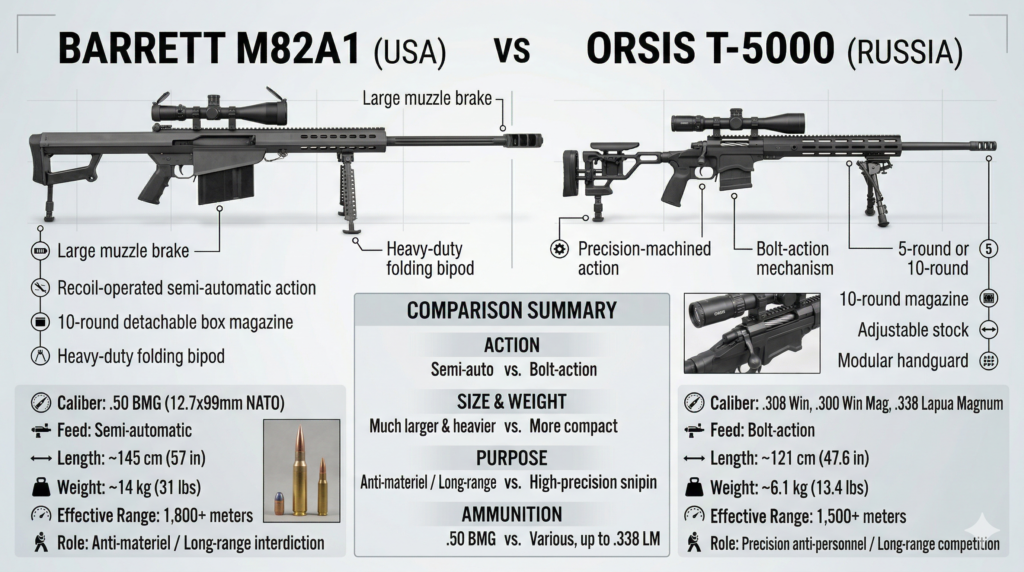
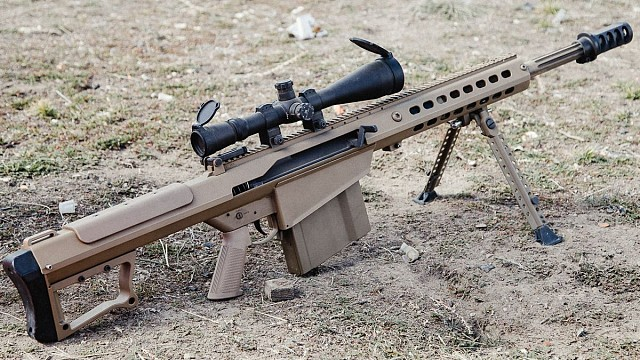
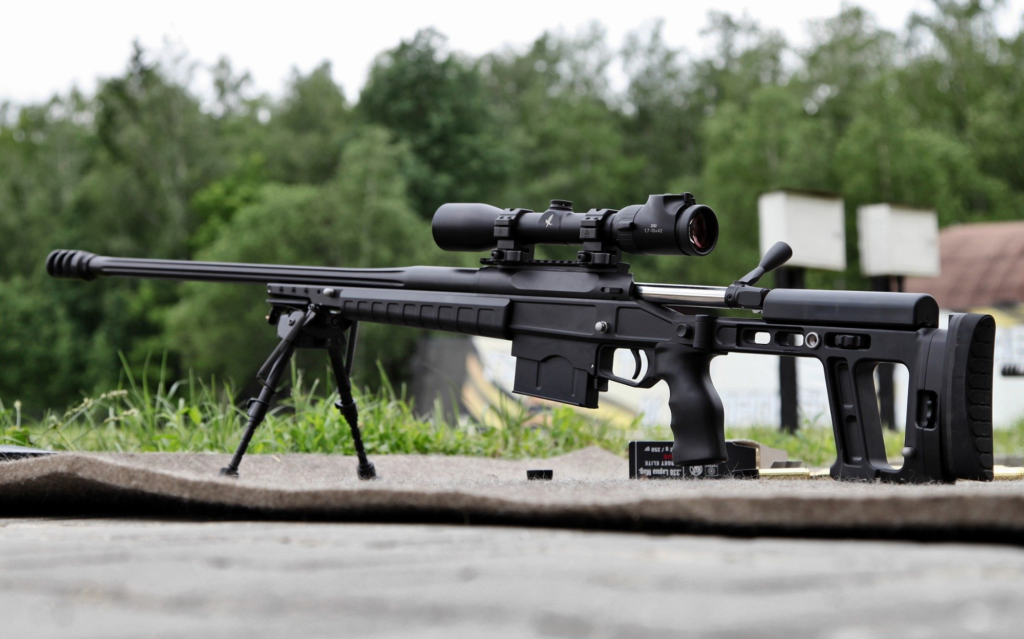
The rifles fielded by each nation’s snipers are not mere tools. They are physical expressions of the doctrinal philosophy that produced them. As illustrated above showing the Barrett M82 alongside the ORSIS T-5000, the contrast between American and Russian precision rifle design tells the story of two different answers to the same question: what must a sniper rifle do?
The American Arsenal: Precision, Modularity, and Anti-Materiel Power
Barrett M82A1 / M107 (.50 BMG)
The Barrett M82 is perhaps the most recognisable sniper rifle in the world, and its specifications are as uncompromising as its appearance. Chambered in the .50 BMG (12.7x99mm) cartridge, it is originally designed for machine-gun use against aircraft and light armour, the M82 is classified as an anti-materiel rifle: a system designed to destroy equipment, not merely personnel. Its effective range against point targets exceeds 1,800 metres, and its 736mm barrel drives a 660-grain projectile to a muzzle velocity of approximately 853 metres per second.
This makes it deliver a terminal energy that will defeat light armoured vehicles, radar installations, communication equipment, parked aircraft, and IED triggering devices at ranges that place the operator entirely outside most adversary defensive fire. Hathcock’s use of the .50 calibre machine gun at 2,286 metres in 1967 directly inspired the M82’s development, and the Barrett family of rifles has since appeared in conflicts from the Gulf War through to contemporary operations in Ukraine.
Mk 13 Mod 7 (.300 Winchester Magnum)
Where the M82 is the blunt instrument of American sniper capability, the Mk 13 Mod 7 is its surgical scalpel. Chambered in .300 Winchester Magnum, it is the current primary sniper weapon of US Navy SEAL sniper teams and has been the workhorse of SOCOM precision operations in the post-2001 era. The .300 Win Mag cartridge delivers a highly favourable balance between range, energy retention, and trajectory flatness. It remains effective to beyond 1,100 metres, retains sufficient energy for reliable terminal performance at that distance, and produces a flatter trajectory than 7.62x51mm NATO reducing the holdover calculation required at extreme range.
Chris Kyle used the .300 Win Mag during significant portions of his Iraq deployments. The Mk 13 platform’s modular design allows rapid barrel changes for calibre conversion, and it accepts suppressors without modification, a capability that has become operationally essential in modern special operations environments.
Mk 22 MRAD: The New Standard
The Barrett Mk 22 Multi-Role Adaptive Design rifle, adopted by US Army Special Operations Command in 2019 and now expanding across service branches, represents the next generation of American precision rifle capability. Fully modular, the Mk 22 can be reconfigured in the field between .300 Norma Magnum, .338 Norma Magnum, and .308 Winchester simply by swapping the barrel, bolt head, and magazine allowing a single platform to serve in roles ranging from standard sniper operations to extended-range anti-personnel and light anti-materiel missions.
This modularity reflects a mature understanding of operational flexibility: the sniper who deploys with one rifle that can adapt to the mission’s range and terminal requirements is more effective than one who must carry multiple systems.
The Russian Arsenal: Volume, Reliability, and Doctrinal Purpose
SVD Dragunov: The Soviet Doctrine Made Metal
The Dragunov SVD is the single most consequential sniper rifle of the Cold War era, and to understand it is to understand the fundamental difference between Soviet and American sniping doctrine. Introduced in 1963 to replace the Mosin-Nagant, the SVD was designed not as a true long-range precision sniper rifle in the American sense, but as a designated marksman rifle, a semi-automatic, squad-support weapon intended to extend the effective fire range of the basic infantry unit from 300 metres to 600-800 metres. It fires the 7.62x54mmR cartridge, effective to approximately 800-1,000 metres, from a 10-round detachable magazine.
The semi-automatic action, which Western precision doctrine would consider a compromise of accuracy, was entirely intentional: the SVD sniper was expected to deliver rapid, accurate fire to support infantry movement, not to make one surgical shot from concealment before relocating. This doctrinal clarity is visible in every design decision the rugged operating system, the relatively modest scope, the lack of the heavy precision barrel that characterises Western sniper rifles.
ORSIS T-5000: Russia’s Precision Awakening
The ORSIS T-5000, as clearly shown in the comparison image above, represents a fundamentally different Russian approach to precision rifle design. Founded by a group of precision shooting enthusiasts in Moscow in 2010, ORSIS is Russia’s first privately-owned small arms manufacturer capable of mass-producing precision-grade weapons, built the T-5000 as a direct competitor to Western precision platforms.
Chambered in 7.62x51mm NATO and .338 Lapua Magnum, it employs a bolt-action rotating bolt design with a glass-fiber-bedded aluminium chassis, a fluted stainless-steel barrel in 698mm length, a folding adjustable stock, and a Picatinny rail accepting any modern optic. As the image shows, the .338 LM variant achieves an effective range exceeding 1,500 metres, with a muzzle velocity of 900 metres per second, a genuine long-range precision instrument that competes directly with the best Western systems.
The T-5000 has been adopted by Russia’s FSB (Federal Security Service), FSO (Federal Protective Service), and Rosgvardia (National Guard), and has been observed in the hands of Spetsnaz operators in Ukraine. At sub-MOA accuracy from the factory and with a trigger that experienced shooters describe as among the best they have ever used, the T-5000 represents Russia’s belated but serious entry into the world of true precision long-range rifle design. The platform’s willingness to chamber Western calibres .300 Winchester Magnum, 7.62x51mm NATO, .338 Lapua Magnum is itself a doctrinal statement: Russia’s elite sniper units have concluded that for long-range precision work, Western cartridge ballistics are superior to the traditional Soviet calibre ecosystem.
Chukavin SVCh: The Dragunov’s Successor
The SVCh (Chukavin sniper rifle), currently entering Russian Army service as the designated replacement for the Dragunov, represents an attempt to bridge the gap between the SVD’s mass-deployment practicality and the precision capability of the T-5000. Available in 7.62x51mm NATO and 7.62x54mmR, with a maximum effective range exceeding 1,600 metres, the SVCh is a more modern and versatile platform than the Dragunov while remaining suitable for the volume deployment that Russian doctrine demands.
Its appearance signals that Russia has absorbed the lessons of Ukraine, where the precision and extended range of Western sniper systems have created a consistent asymmetric disadvantage for Russian marksmen armed with the older generation SVD.
| Specification | Barrett M82A1 (USA) | Mk 13 Mod 7 (USA) | SVD Dragunov (Russia) | ORSIS T-5000 (Russia) |
| Type | Semi-Auto Anti-Materiel | Bolt-Action Precision | Semi-Auto Marksman | Bolt-Action Precision |
| Calibre | .50 BMG (12.7x99mm) | .300 Win Mag | 7.62x54mmR | 7.62 NATO / .338 LM |
| Barrel Length | 736 mm | 610 mm | 565 mm | 698 mm (.338 LM) |
| Effective Range | ~1,800 m | ~1,200 m | ~800–1,000 m | ~1,500 m |
| Muzzle Velocity | ~853 m/s | ~920 m/s | ~830 m/s | ~900 m/s |
| Operating System | Short recoil semi-auto | Bolt-action | Short-stroke semi-auto | Bolt-action |
| Magazine | 10 rd box | 5–8 rd box | 10 rd box | 5–10 rd box |
| Weight (unloaded) | ~12.9 kg | ~6.1 kg | ~4.3 kg | ~6.0 kg |
| Suppressor Compatible | Yes (with adapter) | Yes (native threads) | Limited | Yes (threaded muzzle) |
| Primary Role | Anti-materiel/heavy sniper | Tier 1 SOF precision sniper | Designated marksman | Elite / SOF precision sniper |
| Adopted By | US Military (all branches) | SEAL, SOCOM | Russian military (mass) | FSB, FSO, Rosgvardia, Spetsnaz |
| Unit Cost (approx.) | ~$9,000–12,000 | ~$5,000–8,000 | ~$1,500–2,500 | ~$5,000–8,000 |
DOCTRINE: THE PHILOSOPHICAL DIVIDE THAT EXPLAINS EVERYTHING
The American Philosophy: One Shot, One Kill, One Ghost
American sniper doctrine is built on a specific and coherent vision: the sniper as a precision instrument of overwhelming selective lethality, operating with maximum independence in the most dangerous corners of the battlefield, executing missions that conventional forces cannot attempt. The USMC Scout Sniper ethos, encapsulated in the phrase ‘One Shot, One Kill,’ captures this philosophy precisely.
The American sniper is trained to move alone or in a two-man team through territory that the rest of the military cannot safely enter, gather intelligence on the way in, execute a precise engagement at a time and place of his choosing, and extract without contact. He is as much a reconnaissance asset as a combat one, and his value to the force commander lies as much in the intelligence he generates as in the lives he takes.
This philosophy produces a specific training and equipment profile. American snipers receive some of the most rigorous individual training in any military, months of instruction in camouflage, concealment, stalking, fieldcraft, target recognition, wind reading, and ballistic calculation before a single shot is fired at a live target. The Mk 13 and its predecessors were built to this doctrine: bolt-action, high-precision, suppressor-capable, optimised for the single definitive shot at maximum range. The SOCOM advanced sniper programmes push this further, incorporating urban infiltration, sniper-on-sniper counter-tactics, and integration with intelligence networks that allow the field sniper to prosecute high-value targets based on real-time intelligence updates.
In the modern networked battlefield, this doctrine has evolved to encompass the sniper as a sensor node within a broader kill chain. The contemporary SOCOM sniper operates with digital spotting scopes that relay imagery to command centres, laser rangefinders that feed directly into precision artillery fire control systems, and communications architectures that allow him to vector fast air onto targets he has identified and designated without ever exposing his position. He is, in the lexicon of modern joint warfare, a human-portable intelligence, surveillance, and reconnaissance platform with an organic precision kill capability attached.
The Russian Philosophy: Mass, Presence, and Terrain Control
Soviet and Russian sniper doctrine begins from a completely different premise. Where the American tradition asks ‘What can one exceptional individual accomplish?’, the Soviet tradition asked ‘What can a properly distributed mass of trained marksmen achieve?’ The answer, confirmed in the battles of Stalingrad, Kursk, and Berlin, was: area denial, psychological paralysis, and the systematic destruction of the enemy’s leadership and communications at the platoon-and-company level. The SVD Dragunov was designed for this doctrine: issue one to every motorised rifle platoon, train the designated marksman to engage targets at 600-800 metres, and create a ubiquitous threat that saturates the enemy’s operational environment rather than penetrating it at a single surgical point.
This philosophy explains why Soviet sniper records so dramatically exceed American ones in raw numbers. Ivan Sidorenko’s 500+ confirmed kills and Mikhail Surkov’s 702 were achieved in an operational environment where the sniper was expected to fire multiple times per day, in support of infantry operations, at relatively shorter ranges, against an adversary who was continuously and densely present across the front. The Soviet sniper was not trying to disappear. He was trying to kill as many enemies as possible in a given sector as rapidly as possible. The doctrinal contrast with the American tradition, which prizes the single long-range shot at an unexpected moment is almost total.
The Ukraine conflict has forced a painful re-evaluation of Russian sniper doctrine. The mass deployment of designated marksmen with Dragunov-class weapons has proven insufficient against Ukrainian snipers equipped with Western precision rifles at ranges the SVD cannot reliably match. Russian Spetsnaz units have responded by increasing the fielding of ORSIS T-5000 and SV-98 precision rifles in operational areas, and the Chukavin SVCh is being introduced precisely to address this capability gap. The war in Ukraine is, among many other things, a live-fire validation test of competing sniper doctrines, and the preliminary verdict is that precision and range matter more than volume when the adversary has cover and counter-sniper capability.
American doctrine says: send one man into the dark and have him do what a battalion cannot. Russian doctrine says: saturate the dark with shooters until there is nowhere safe to stand. Both philosophies have produced extraordinary individual marksmen. Only one has produced armies of them.
BUILDING THE WORLD’S MOST DANGEROUS INDIVIDUAL
The American School System
The USMC Scout Sniper Basic Course at Marine Corps Base Quantico, Virginia is the school that Carlos Hathcock helped found and is among the most demanding individual military training programmes in the world. Candidates spend approximately three months in a programme that eliminates a significant proportion of applicants regardless of their prior military performance. The course is divided into shooting fundamentals, field skills, and mission execution. The shooting portion alone covers everything from basic marksmanship at 300 metres to cold-bore shots at 1,000 metres, moving target engagement, unknown-distance estimation, and the integration of wind, humidity, altitude, temperature, and Coriolis effect into ballistic solutions.
The US Army Sniper Course at Fort Moore (formerly Fort Benning) runs a comparable programme with particular emphasis on integration with conventional ground forces. SOCOM’s advanced sniper training programmes, conducted at classified locations and with classified curricula, push beyond both these foundation courses into urban precision shooting, helicopter infiltration, direct action support, and the management of complex multi-team sniper networks operating across extended areas of operations.
Russian Sniper Selection and Training
Russia’s sniper training system reflects its doctrinal philosophy. The mass-deployment designated marksman, the SVD operator at platoon level receives a relatively brief course in marksmanship and basic fieldcraft, sufficient to perform his squad-support role but not producing the individual specialist operator of the American model. The elite end of Russian sniper training, however, is a different matter.
Spetsnaz GRU sniper teams and FSB Alpha and Vympel sniper units receive training that, in its technical precision and field craft components, is genuinely comparable to SOCOM standards. These operators work with the ORSIS T-5000 and SV-98, employ Western-equivalent range estimation and ballistic calculation techniques, and are trained for the kind of independent, precision, long-range operations that American special operations snipers conduct.
Russia’s Central Officers’ Sniper Training School and various VDV (airborne) and Spetsnaz sniper training programmes have historically emphasised winter operations, low-visibility shooting, and the counter-sniper duel, the discipline of locating and killing an adversary sniper before he kills you. This emphasis on counter-sniper tactics reflects both the legacy of the Eastern Front, where sniper duels were a regular feature of operations, and the post-Soviet operational experience of Chechnya, where Russian forces suffered severely from the inability to quickly locate and neutralise Chechen snipers operating in urban terrain.
COMBAT RECORDS AND REAL-WORLD PERFORMANCE
| Sniper | Nation | Conflict | Confirmed Kills | Notable Record |
| Carlos Hathcock | USA | Vietnam | 93 | $30K bounty; scope shot; 2,286m kill |
| Chuck Mawhinney | USA | Vietnam | 103 | Marine Corps record; 16 kills in 1 night |
| Adelbert Waldron | USA | Vietnam | 109 | Previous US Army record |
| Chris Kyle | USA | Iraq | 160 | Most confirmed kills in US history; 2,100 yd kill |
| Vasily Zaitsev | USSR | WWII / Stalingrad | 300+ | 225 in 68 days; trained 28 snipers |
| Lyudmila Pavlichenko | USSR | WWII | 309 | Greatest female sniper in history; 36 snipers |
| Ivan Sidorenko | USSR | WWII | 500+ | Among highest confirmed WWII tallies |
| Mikhail Surkov | USSR | WWII | 702 | Highest credited WWII Soviet sniper tally |
Longest Confirmed Sniper Kills in History
The record books of long-range sniping are dominated by one surprising nation: Canada. The current world record for the longest confirmed sniper kill stands at 3,540 metres (approximately 2.2 miles), set by a Canadian Joint Task Force 2 operator during operations in Iraq in 2017, using a McMillan TAC-50. This beat the previous record of 3,450 metres, also set by a Canadian JTFF-2 sniper.
The American contribution to this record book remains significant: Hathcock’s 2,286-metre kill in 1967 stood as the world record for 35 years, and Kyle’s 2,100-metre kill in 2008 remains one of the longest confirmed combat kills by a serving US military sniper. Russia has not publicly documented comparable extreme-range kills, reflecting the doctrinal preference for more frequent shorter-range engagements over the rare maximum-range shot.
The Ukraine Lens: Sniping in a Modern High-Intensity Conflict
The conflict in Ukraine has provided the most current and operationally significant data point for evaluating both US-doctrine-trained and Russian sniper effectiveness in a peer conflict. Ukrainian snipers, trained largely under Western doctrine and equipped with a mix of Ukrainian-manufactured precision rifles and Western-supplied systems including Barrett M82s and British-supplied L115A3s, have consistently demonstrated superior individual performance against Russian designated marksmen equipped with SVD variants. The extended range advantage of .338 Lapua Magnum and .50 BMG weapons against the SVD’s 7.62x54mmR at ranges beyond 800 metres has been operationally decisive in numerous documented engagements.
The Ukraine conflict has also validated the counter-sniper dimension of modern precision warfare. Both sides have extensively deployed counter-sniper radar systems including the American-supplied Boomerang and the Russian Pilar system, which can detect the acoustic signature of a muzzle blast or supersonic crack and provide an azimuth and elevation to the originating position within seconds.
In this environment, the traditional sniper virtue of concealment before and after the shot has become dramatically more critical: a sniper who fires and remains in position for more than a few seconds risks having his position revealed by acoustic detection, followed by immediate artillery or drone response. This has reinforced the American doctrinal emphasis on the ‘one shot, relocate’ principle against the Russian volume-fire model.
THE SNIPER IN 2026: DRONES, AI AND THE SURVIVAL QUESTION
The most consequential threat to the traditional sniper in 2026 is not the counter-sniper radar or the enemy marksman. It is the drone. In Ukraine, small FPV drones operated at altitudes below acoustic detection range have proven capable of locating and engaging snipers in concealed positions — platforms that no counter-sniper radar or aerial observer would previously have been able to reach. The drone’s ability to loiter silently over a suspected position for extended periods, transmit live video, and then strike has fundamentally altered the risk calculus for the sniper in an environment where both sides operate extensive drone surveillance programmes.
The response to this threat has been doctrinal adaptation rather than the abandonment of the sniper role. Snipers now operate with greater awareness of UAV activity, using anti-drone electronic warfare systems to detect approaching platforms, selecting positions that provide overhead concealment as well as the traditional lateral concealment from ground observers, and shortening their time in any single position from hours to minutes. The integration of AI-assisted optics target recognition systems capable of identifying vehicles, persons of interest, and equipment at extended range faster than human observation, has simultaneously increased the sniper’s target acquisition speed while compressing the decision cycle required before engagement.
Thermal imaging, increasingly available to both sides at relatively low cost, has eroded one of the sniper’s traditional advantages: the ability to operate in conditions of low light. A properly equipped modern infantry unit with thermal imaging and counter-sniper acoustic detection has significantly greater ability to locate and engage a traditional concealed sniper than any force in history. The sniper’s response has been the adoption of thermal-defeating suits and patterns, careful management of heat signatures, and increased reliance on firing positions that place intervening terrain or structure between the sniper and the lateral arcs from which thermal detection is most likely.
None of these adaptations have eliminated the sniper. They have raised the skill threshold required to operate effectively and survive. The modern military sniper, whether American or Russian, must be not only a marksman of the highest order but a tactician, a technologist, and an intelligence officer, capable of reading a drone-saturated battlespace, managing his electronic signature, exploiting the terrain and weather for thermal cover, and completing his mission before the machine intelligence of the adversary can fix his position. In this respect, the contemporary sniper’s challenge is not so different from Zaitsev’s at Stalingrad or Hathcock’s in the jungles of Quang Tri: survive, kill, disappear. The tools of detection have changed. The fundamental problem has not.
The drone has not killed the sniper. It has killed the mediocre sniper. The truly exceptional operator, the one who understands not just his rifle but his entire operational environment has adapted. He always has. He always will.
HEAD-TO-HEAD VERDICT: THE FINAL SCORECARD
Category | USA | Russia | Winner |
| Individual Kill Records (confirmed) | 160 max (Kyle) | 702 max (Surkov) | Russia (by volume) |
| Strategic Individual Impact | Hathcock, Kyle — iconic | Zaitsev — legendary | Draw |
| Precision Rifle Technology | Mk 22 MRAD, Barrett M82 | ORSIS T-5000, SVCh | USA (slight edge) |
| Anti-Materiel Capability | Barrett M82 (.50 BMG) | ORSIS 12.7 / SVD variants | USA (decisive) |
| Mass-Deployment Doctrine | Limited specialist role | Platoon-level deployment | Russia (by design) |
| SOF Sniper Training Quality | USMC, Army, SOCOM — world-leading | Spetsnaz, Alpha, Vympel — elite | USA (marginal) |
| Historical Combat Record | Vietnam, Iraq, Afghanistan | WWII Eastern Front, Chechnya | Russia (scale) |
| Modern Battlefield Adaptation | Superior (Ukraine lessons applied) | Catching up (SVCh, T-5000) | USA |
| Long-Range Extreme Kills | 2,100 yards (Kyle, Iraq) | Not publicly documented | USA |
| Psychological Battlefield Impact | High (individual legend) | Highest (mass presence) | Draw |
| Overall Individual Precision | USA doctrine-optimised | Adapting to match | USA |
| Overall Strategic Effectiveness | Network-integrated, adaptable | Mass-effect, area denial | Contextual |
The scorecard tells a story of complementary supremacies rather than a clear single winner. Russia’s kill record superiority in raw numbers Surkov’s 702 compared to Kyle’s 160 is real, but it reflects doctrinal context as much as individual skill: Soviet snipers operated in a total war environment, deployed in mass, firing multiple times daily in support of continuous large-scale operations. American confirmed kill records reflect a system that values the single decisive shot, demanding witness confirmation under circumstances that frequently make confirmation impossible, producing official tallies that systematically undercount actual effects.
In terms of the equipment matchup illustrated above, Barrett M82 versus ORSIS T-5000, the contest is genuinely close. The Barrett’s .50 BMG cartridge provides an anti-materiel capability the ORSIS in .338 LM cannot match. But the ORSIS T-5000 is a precision instrument of the highest order, sub-MOA accurate from the factory, with a trigger that matches or exceeds the best Western competition, at a cost significantly below comparable Western platform. If the T-5000 has a weakness, it is in the scope and ancillary electronics ecosystem. Western precision rifles operate within a mature market of world-class optics, ranging systems, and integrated data systems that Russia’s domestic industry is only beginning to match.
The doctrinal question of mass deployment versus selective precision is ultimately a question of what war you are fighting. In a total war of the Second World War scale, where snipers operate in continuous contact across a front of thousands of miles, the Soviet model of mass deployment is clearly more effective. In a special operations context, a counter-terrorism campaign, or the kind of high-value-target elimination missions that characterise contemporary American military operations, the US model of the highly trained precision specialist is demonstrably superior. Ukraine is providing a live test of both models in a high-intensity conventional conflict and its preliminary verdict, measured in operational outcomes, appears to favour the precision model over the mass-deployment one.
CONCLUSION: ONE TRIGGER, TWO PHILOSOPHIES, ONE ANCIENT ART
The sniper is the oldest form of individual military excellence. The convergence of patience, precision, courage, and fieldcraft in a single human being who imposes a strategic effect on the battlefield that no weapon system costing a thousand times more can reliably replicate. The US sniper vs Russian sniper debate is, in its deepest form, a debate about what that excellence is for and how it should be organized.
America answered that question by building a tradition around the exceptional individual, Hathcock crawling three days without sleep to reach an NVA general’s throat, Kyle holding still at 2,100 yards while an insurgent prepared to kill American soldiers below him, Mawhinney sending 16 men to their deaths on a moonless Vietnamese night.
These are stories of individuals whose skill and courage elevated the possible beyond what institutional doctrine alone could specify. Russia answered the same question by training an army of 428,000 marksmen in a single war, a whole nation’s snipers freezing the German Wehrmacht in place from Stalingrad to Berlin, an entire philosophy of battle that treated the gun behind every bush as a strategic weapon in its own right.
Both traditions produced legends. Both traditions produced weapons that define their respective eras, from the Mosin-Nagant of Zaitsev’s Stalingrad to the Barrett M82 and ORSIS T-5000 that face each other across contested ground today. And both traditions face the same existential adaptation challenge in 2026: the drone, the thermal camera, the AI targeting system, and the acoustic sensor that reveals a position within seconds of the first shot. The sniper who survives in this environment is not the one with the better rifle or the longer confirmed kill list. He is the one who understands the battlefield around him better than the battlefield understands him. That has always been true. It has never been more demanding.
Whether he wears a white feather or no feather at all, the world’s finest marksman has always been the same person: the one who is there before the enemy knows to look, gone before the enemy knows to run, and impossible to find in the silence between the shot and the kill.
About Armorexa
Armorexa is a dedicated military intelligence and defence analysis platform covering weapons systems, warfare technology, military history, and strategic doctrine. Our editorial team delivers in-depth, credible, and rigorously researched analysis for defence professionals, students, and military enthusiasts worldwide.