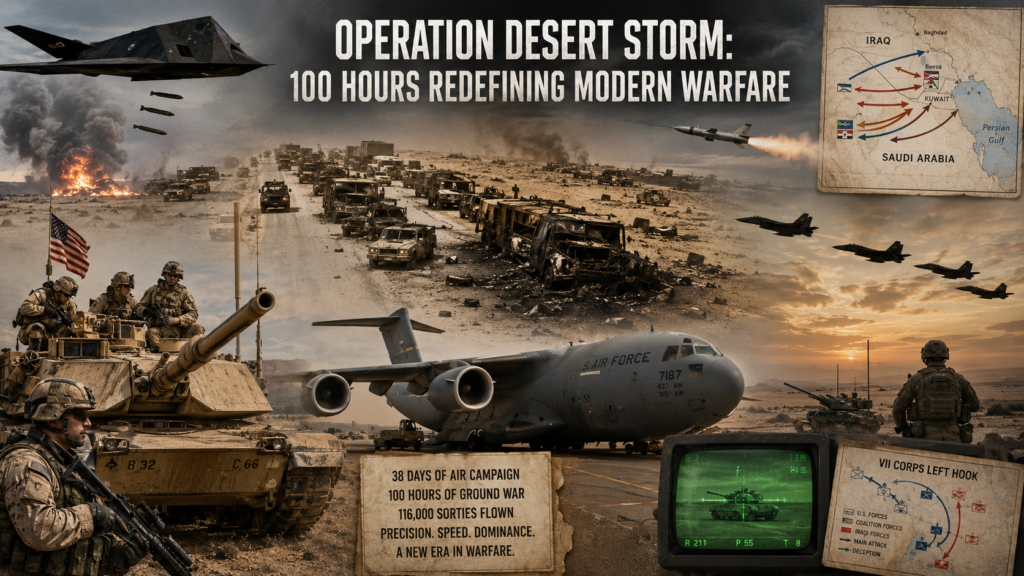
At 02:38 on January 17, 1991, eight AH-64 Apache helicopters of Task Force Normandy crossed into Iraqi airspace at fifty feet and destroyed two early-warning radar sites with Hellfire missiles. The world would not know for another twenty minutes. But Operation Desert Storm had already begun and so had the most consequential military transformation of the twentieth century’s final decade.
Seven hundred thousand coalition troops were massed on the Saudi border. The fourth-largest army in the world was dug into Kuwait behind minefields, berms, and oil-filled trenches. And the United States military, having spent twenty years rebuilding its doctrine, its technology, and its soul after Vietnam, was about to demonstrate what that rebuilding had produced.
What followed over the next six weeks was not merely a victory. It was a proof of concept, a demonstration that precision, speed, and information dominance could shatter a modern military force before it could meaningfully fight back. Desert Storm did not just liberate Kuwait. It rewrote the rules of warfare, defined American military supremacy for a generation, and in ways its architects did not fully anticipate but planted the seeds of the strategic failures that would follow.
Saddam’s Miscalculation: How the Invasion of Kuwait Made Desert Storm Inevitable
On August 2, 1990, eight Iraqi Republican Guard divisions crossed the Kuwaiti border and completed the occupation of the country in less than twelve hours. Saddam Hussein had calculated, with what proved to be fatal precision, that this was a gamble he could win. He was wrong on every count but understanding why he believed he was right is essential to understanding why Desert Storm unfolded the way it did.
The strategic logic was coherent if ultimately catastrophic. Kuwait held 10 percent of the world’s proven oil reserves. Iraq claimed Kuwait had exceeded its OPEC quota, effectively stealing oil from the shared Rumaila oilfield that straddled the border, and costing Baghdad an estimated $2.4 billion annually. More pressingly, Iraq had emerged from its eight-year war with Iran carrying $14 billion in debt owed to Kuwait, debt the Kuwaiti government refused to forgive. From Saddam’s perspective, annexation solved multiple problems simultaneously.
The critical miscalculation was American intent. On July 25, 1990, eight days before the invasion, US Ambassador April Glaspie met with Saddam in Baghdad. In a conversation that has been dissected by historians ever since, Glaspie told the Iraqi leader that the United States had ‘no opinion on Arab-Arab conflicts, like your border disagreement with Kuwait.’ Whether this was diplomatic miscommunication, deliberate ambiguity, or straightforward negligence remains debated. What is not debated is its effect: Saddam interpreted it as a green light. He was not alone as several senior intelligence analysts shared his reading of the signal.
The international response shattered that assumption within days. President Bush built a coalition of 35 nations with a speed and diplomatic skill that surprised even the coalition’s architects. Crucially, Arab states including Saudi Arabia, Egypt, Syria, UAE agreed to fight under US operational command against another Arab state. This was not inevitable. It was an extraordinary diplomatic achievement, and it gave the coalition a legitimacy that transformed what might have been an American intervention into a collective security operation with genuine UN Security Council backing through Resolutions 660, 661, and 678.
The five-month window between invasion and the start of Operation Desert Storm was itself a strategic resource. It allowed for the largest strategic airlift in history to that point, the construction of a command and logistics infrastructure in the Saudi desert, and critically an air campaign planning process that would produce the most sophisticated opening strike in the history of warfare.
Saddam’s belief that the US would not intervene was not irrational given the signals he had received, it was simply wrong, and that error cost him everything. The five-month diplomatic and logistics window was as decisive as any weapon system; it gave the coalition the time to build a hammer that Iraq had no answer for.
Operation Desert Shield: Building the Hammer
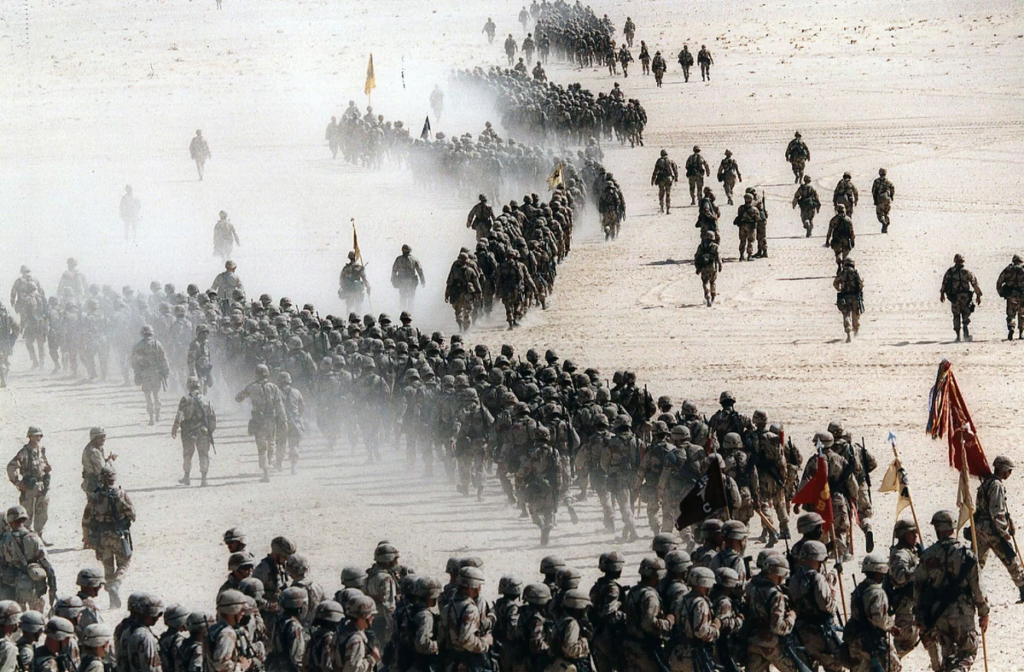
Deploying 540,000 American troops to Saudi Arabia in five months was a logistical achievement without modern precedent. The XVIII Airborne Corps began arriving within 72 hours of the invasion, initially more a tripwire than a fighting force there to demonstrate American commitment while the real buildup proceeded behind them. What followed was an extraordinary demonstration of American power projection capability that the world had not seen tested at this scale since World War II.
General H. Norman Schwarzkopf commanded CENTCOM, but the air campaign would be built by General Chuck Horner, designated Joint Force Air Component Commander. Horner oversaw the development of the Air Tasking Order, a daily document of extraordinary complexity coordinating 2,000-plus sorties across coalition air forces from twelve nations. The ATO had to deconflict altitudes, timing windows, and ingress routes for aircraft types whose capabilities ranged from F-117 stealth bombers to aging A-6 Intruders, preventing fratricidal engagements in a congested combat airspace without a single equivalent planning exercise to draw from.
The doctrine undergirding all of this was AirLand Battle developed at Fort Leavenworth through the late 1970s and 1980s as the US Army’s answer to the question of how to fight and win against a numerically superior Soviet force in Western Europe. It emphasized synchronization of air and ground forces, deep attack against second-echelon forces before they could engage, and operational tempo, the idea that sustained pressure faster than the enemy can respond creates paralysis rather than mere attrition. AirLand Battle had been war-gamed exhaustively against Soviet order-of-battle templates. Against Iraq’s largely Soviet-equipped and Soviet-doctrine military, it was almost perfectly matched.
The intelligence picture showed an Iraqi defensive scheme of considerable depth. The ‘Saddam Line’ ran along the Kuwait-Saudi border minefields, anti-tank ditches, barbed wire, and artillery registered on likely avenues of approach. Behind it sat the tactical reserves. Behind them, deeper in Kuwait and southern Iraq, sat the Republican Guard, Saddam’s most capable and politically loyal formations, held back as the operational reserve and political insurance policy. Understanding this layered defence was what allowed Schwarzkopf’s planners to design a ground campaign that bypassed the entire forward defence with a single flanking movement.
AirLand Battle doctrine was not adapted for Desert Storm it was essentially applied from its design template, against an enemy whose military structure and equipment made it almost an ideal test case. The five-month buildup produced not just troop numbers but an intelligence picture, a logistics base, and a planning architecture that determined the war’s outcome before the first shot was fired.
38 Days of Thunder: The Gulf War Air Campaign
The air campaign of Operation Desert Storm was designed around a theory of war developed by Colonel John Warden of the USAF’s Checkmate planning cell. Warden’s ‘Five Rings’ model conceived of an enemy state as a system of concentric rings: at the centre, the leadership; then key production (power generation, oil refining, military production); then infrastructure (roads, bridges, communications); then the population; and at the outermost ring, fielded military forces. Warden’s revolutionary argument controversial within the Air Force was that attacking the inner rings directly could paralyse the entire system without the costly attrition of the outer ring. You did not need to defeat the Iraqi army in the field if you could collapse the command, control, and logistics system that sustained it.
The opening moments of the air campaign on the night of January 17, 1991 were operationally precise in a way that no previous air campaign had been. Task Force Normandy’s Apache strike at 02:38 cleared a radar gap 20 miles wide through which the first wave of strike aircraft could flow undetected. F-117A Nighthawks of the 37th Tactical Fighter Wing, flying from Khamis Mushait in western Saudi Arabia, penetrated Baghdad’s air defense envelope without a single radar return. They delivered GBU-27 laser-guided bombs, a 2,000-lb penetrating weapon designed for hardened bunkers against command nodes, the Presidential Palace communications center, and the AT&T international telephone exchange that served as Iraq’s primary military communications hub.
Simultaneously, 122 BGM-109 Tomahawk cruise missiles fired from ships in the Gulf struck targets across Iraq, their TERCOM and GPS navigation guiding them to within meters of aim points at the end of 1,000-kilometre flight paths. The electromagnetic warfare dimension of the opening night is frequently underreported. Three EF-111A Ravens operated by the 390th Electronic Combat Squadron flew suppression missions that blinded Iraqi air defence radar operators, making the F-117 and Tomahawk strikes easier even against targets the EF-111s could not directly support.
F-4G Wild Weasels fired AGM-88 HARM missiles against active radar sites, a shoot-and-scoot engagement that forced Iraqi radar operators to choose between tracking coalition aircraft and survival. Within 48 hours, Iraq’s Integrated Air Defense System (KARI: a French-built C2 network) was functionally blind. Over 38 days, coalition aircraft flew 116,000 sorties, approximately 3,000 per day at peak and dropped 88,500 tons of ordnance. The BDA picture is where honest analysis must depart from the official narrative.
The 1997 GAO report (NSIAD-97-134) found that claims about the performance of the F-117, Tomahawk, and laser-guided bombs were in several cases ‘overstated, misleading, inconsistent with the data, or unverifiable.’ The F-117’s claim that it struck 40 percent of strategic targets while comprising 2.5 percent of coalition fixed-wing strength originated in DoD appropriations testimony and was not fully corroborated by independent BDA analysis. Precision weapons performed far better than unguided munitions, the data is clear on that. But the gap between the claimed and the verified was real, and pretending otherwise diminishes the intellectual honesty the subject deserves.
What is unambiguous: by February 23, the eve of the ground offensive, Iraq’s air force had largely fled to Iran (having lost the will to contest coalition air superiority after suffering 38 confirmed kills), its command and control was severely degraded, its ground forces had been subjected to sustained air attack that destroyed an estimated 30 to 50 percent of their equipment and killed or dispersed substantial portions of their manpower. The ground war that followed was not won in 100 hours. It had largely been decided in the air in the 38 days before it began.
The air campaign’s most revolutionary achievement was not the weapons it used but the targeting logic it applied, Warden’s Rings Theory shifted the aim point from armies to the systems that sustain them. Official performance claims for Desert Storm’s precision weapons were partially overstated but even the verified results represented a generational leap over everything that had come before.
The Left Hook: 100 Hours of the Desert Storm Ground War That Ended a War
Schwarzkopf’s ground campaign plan was, at its operational heart, a deception followed by an envelopment. The deception: allow Saddam to believe the main attack would come directly north through Kuwait, supported by a Marine amphibious landing on the coast. The envelopment: secretly reposition VII Corps, four heavy divisions, 1,400 tanks, 300 kilometers to the west in a movement conducted largely at night, under strict communications silence, across open desert. It was the largest armored redeployment since World War II, and it was completed without Iraqi strategic intelligence detecting it.
The ground war began at 04:00 on February 24, 1991. The 1st and 2nd Marine Divisions breached the Saddam Line in Kuwait, moving faster than Iraqi commanders had anticipated and drawing their tactical reserves southward. On the far western flank, the French 6th Light Armored Division with the 82nd Airborne seized As-Salman airfield, securing the coalition’s western flank against any Iraqi countermovement from the Euphrates valley. The 101st Airborne Division conducted the largest air assault in history, 300 helicopters inserting forces 93 miles into Iraq to establish Forward Operating Base Cobra and cut Highway 8, the primary resupply route for Iraqi forces in Kuwait. VII Corps, with the 1st and 3rd Armored Divisions, 1st Cavalry Division, and the UK 1st Armored Division, swept northeast into the Republican Guard’s flank and rear.
On the afternoon of February 26, lead elements of the 2nd Armored Cavalry Regiment made contact with the Tawakalna Mechanized Division of the Republican Guard on a north-south grid line designated 73 Easting. Eagle Troop, 2nd ACR, under Captain H.R. McMaster, crested a rise and found themselves within direct fire range of dug-in T-72s and BMPs, not a reconnaissance skirmish but a full divisional defence. What followed was eighteen minutes of combat that destroyed approximately 28 tanks, 16 APCs, and 30 other vehicles. The 1st and 3rd Armored Divisions and 1st Infantry Division followed through, completing the destruction of the Tawakalna Division. The following day, at the Battle of Medina Ridge, the 1st Armored Division encountered an attempted ambush by the Medina Luminous Division and destroyed over 300 Iraqi tanks, the single largest tank-on-tank engagement of the war.
The technical explanation for why these engagements were so one-sided is engineering, not morale. The M1A1’s AN/VGS-2 thermal imaging system could acquire and engage targets at 3,000 metres in total darkness and through the dense oil-fire smoke that blanketed the battlefield. Iraqi T-72 crews had no equivalent sensor rather they were dependent on optical sights degraded to near-uselessness in the smoke. The M1A1’s M256 120mm smoothbore gun fired M829 APFSDS rounds with depleted uranium penetrators that defeated T-72 frontal armour at ranges where the T-72’s 2A46 115mm could not penetrate M1A1 protection. Coalition tank crews were, in the most literal sense, hunting opponents who could not see them.
President Bush declared a ceasefire at 08:00 on February 28, exactly 100 hours after the ground war began. The decision remains one of the most analyzed command decisions in modern military history. Schwarzkopf later expressed frustration that the Republican Guard’s Hammurabi Division escaped northward under cover of the ceasefire. Powell and Bush’s decision to halt was driven by concerns about the optics of continued slaughter, the diplomatic architecture of the coalition, and the argument that the war’s stated objective, liberation of Kuwait had been achieved. The seed planted on that decision would germinate into the 2003 invasion twelve years later.
The Battle of 73 Easting was not decided by courage or numbers but it was decided by thermal imaging, depleted uranium, and the ability to kill at ranges the opponent could not match. The 100-hour ceasefire decision solved the immediate diplomatic problem and created the long-term strategic one, the incompleteness of Desert Storm’s victory is inseparable from the logic of the 2003 war.
Steel and Silicon: The Gulf War Weapons Technology
Five technology systems defined Desert Storm’s outcome and reshaped every military programme that followed. Each deserves technical treatment, not marketing language.
The F-117A Nighthawk
The F-117 was the product of DARPA’s Have Blue program, which began in 1974 following a mathematical paper by Soviet physicist Pyotr Ufimtsev demonstrating that an aircraft’s radar cross section could be calculated from its shape. Lockheed’s Skunk Works team, led by Ben Rich, built an aircraft around that mathematics: faceted panels angled to deflect radar energy away from the emitter, with a cruciform tail to manage the aerodynamic instability the faceting created. The result was an aircraft that flew like a two-by-four in turbulence and was invisible to the radars it mattered. Its RCS has been variously estimated at 0.001 to 0.025 square meters for context, a bird.
In Desert Storm, 42 F-117As flew 1,271 sorties against the most heavily defended airspace in the world without a single combat loss. DoD claimed they struck 40 percent of strategic targets while comprising 2.5 percent of coalition fixed-wing strength, a claim the 1997 GAO audit found partially unverifiable but directionally supportable. What is not disputed: the F-117 struck targets in downtown Baghdad that no other aircraft could have reached, and it did so with complete impunity.
Precision Guided Munitions
The GBU-10, GBU-12, and GBU-27 Paveway series represent the most consequential shift in aerial bombardment since the invention of the aircraft. The Paveway guidance kit, a laser seeker head and folding control fins attached to a standard Mk-80 series bomb body converted unguided ordnance with a circular error probable (CEP) of 200 to 300 metres into a weapon with a CEP as low as 3 metres under optimal conditions. The comparison with previous conflicts is stark: in Vietnam, USAF analysis found that achieving 90 percent probability of destroying a hardened target required 95 B-52 sorties with unguided bombs.
In Desert Storm, a single F-111F carrying two GBU-24s achieved the equivalent result. Approximately 9 percent of the ordnance dropped in Desert Storm was precision-guided but that 9 percent inflicted a disproportionate share of strategic damage. The remaining 91 percent was still largely unguided, a fact the victory’s clean narrative obscures.
The BGM-109 Tomahawk
The BGM-109 Tomahawk was fired in combat scale for the first time in Desert Storm over 288 launched across the full campaign, with 122 on the opening night alone, fired from battleships, cruisers, destroyers, and submarines in the Persian Gulf and Red Sea. Its TERCOM (terrain contour matching) and DSMAC (digital scene-matching area correlator) guidance systems allowed it to navigate at 50 feet altitude for 1,000+ kilometers and strike within meters of a pre-programmed aim point. No aircrew at risk. No radar signature to exploit.
The Tomahawk fundamentally changed the risk calculus of striking defended targets, and its Desert Storm performance despite the GAO’s finding that effectiveness was partially below official claims established it as the weapon of choice for every politically sensitive strike for the following three decades.
The M1A1 Abrams
The M1A1’s decisive technological advantages over the T-72 were thermal imaging, armor, and firepower in that order. The Hughes AN/VGS-2 thermal imaging sight gave crew members a clear target picture through the oil-fire smoke that rendered Iraqi optical sights useless. The Rheinmetall 120mm smoothbore gun firing M829A1 APFSDS rounds with depleted uranium penetrators could defeat T-72 frontal armor at 3,000 meters beyond the T-72’s maximum effective engagement range even in clear conditions. Chobham composite armor protected M1A1 crews from Iraqi 115mm APFSDS rounds at ranges where the T-72 could theoretically engage.
The blowout panels in the M1A1’s ammunition compartment, designed to vent a catastrophic explosion upward rather than into the crew compartment, saved lives in the handful of cases where M1A1s were struck. The result was a one-sided engagement that has no equivalent in the history of armored warfare at this scale. Coalition tank losses to Iraqi fire: fewer than 10. Iraqi armored vehicles destroyed: over 3,000.
AWACS and C2
The E-3 Sentry AWACS was the air campaign’s central nervous system. Operating continuously in orbits over Saudi Arabia, its APY-2 radar provided a real-time air picture covering all of Iraq and Kuwait tracking coalition aircraft, identifying Iraqi intercepts, and de-conflicting 2,000-plus daily sorties across the most complex airspace ever managed in combat. Prior to AWACS, airspace coordination at this density was operationally impossible without severe fratricide risk. With it, the coalition flew 116,000 sorties and lost fewer than 75 aircraft to all causes combined. Real-time situational awareness, it turned out, was as much a weapons system as any missile.
The F-117’s true significance was not its specific Desert Storm kill count, it was the proof that stealth was operationally viable, a proof that reshaped every major military aviation program for the following 30 years. Desert Storm’s 9 percent precision-guided ordnance percentage is the most important number in the conflict, it reveals both how far precision warfare had advanced and how much further it had to go.
BY THE NUMBERS: DESERT STORM AT A GLANCE
Duration of air campaign: 38 days (January 17 – February 23, 1991)
Duration of ground war: 100 hours (February 24–28, 1991)
Total coalition sorties: ~116,000
Total ordnance dropped: ~88,500 tons
Precision-guided munitions: ~9% of total ordnance
Tomahawk missiles launched: Over 288 (122 on opening night)
F-117 sorties: 1,271 with zero combat losses
Iraqi armored vehicles destroyed: Over 3,000
US battle deaths: 147
Total coalition deaths: 467
Est. Iraqi military deaths: 20,000–35,000 (range uncertain)
Total conflict cost: $61 billion ($48B from coalition partners)
The War Before the War: Intelligence, Deception and Psychological Operations
The military outcome of Desert Storm was shaped as much by what Iraq did not know as by what the coalition brought to the fight. Information dominance, a concept that had existed in US doctrine in embryonic form since the 1970s was demonstrated at operational scale for the first time, and its impact was as decisive as any weapons system.
The CIA and DIA had built a detailed Iraqi order-of-battle picture through a combination of satellite imagery from KH-11 reconnaissance satellites, signals intelligence, and Kuwaiti resistance networks that continued operating inside occupied Kuwait throughout the five-month buildup. This picture allowed Schwarzkopf’s planners to identify not just where Iraqi divisions were positioned, but their supply states, their morale indicators, and their defensive orientations. When VII Corps moved 300 kilometres to the west under communications silence, coalition planners knew exactly where the Republican Guard was and where it was not looking.
The deception operation was elegant and effective. Rear Admiral John LaPlante’s Amphibious Task Force of 17,000 Marines aboard 31 ships in the Persian Gulf conducted repeated feint exercises and conspicuous radio traffic that convinced Iraqi commanders a major amphibious assault on Kuwait City was imminent. Six Iraqi divisions were retained on the coast in response. Those six divisions were not in southern Iraq on February 24 when VII Corps came around their flank.
The psychological operations campaign ran for six weeks before the ground war began. Over 29 million leaflets were dropped over Iraqi positions, some explaining surrender procedures, some showing photographs of B-52 contrails with text informing soldiers that carpet bombing was imminent. The documented effect was significant: 86,000 Iraqi soldiers surrendered during the ground war, many carrying surrender leaflets. Mass surrender at this scale was not spontaneous, it was engineered. The willingness to invest in PSYOP as a genuine force multiplier, rather than a peripheral activity, was a direct product of Vietnam-era lessons about the cost of ignoring the human dimension of warfare.
The amphibious deception that pinned six Iraqi divisions on the Kuwait coast was, in terms of forces neutralized per resource invested, among the most cost-effective operations of the entire war. Twenty-nine million leaflets produced 86,000 surrenders; information operations achieved a kill-chain outcome at a fraction of the cost of kinetic means.
The Arithmetic of Victory: Casualties, Costs and the Questions That Remained
The numbers of Desert Storm are simultaneously impressive and sobering. Coalition deaths: 467, of which 147 were US battle deaths. The US casualty figure was extraordinarily low by any historical comparison for a conflict of this scale and duration lower than many individual days on the Western Front in World War I. Iraqi military deaths are estimated at 20,000 to 35,000, with the wide range reflecting genuine uncertainty in the BDA and prisoner of war accounting. Some estimates of total Iraqi deaths across the conflict including civilian casualties from infrastructure strikes run above 100,000, though these figures are contested and difficult to verify independently.
The financial cost was $61 billion, of which the coalition partners principally Saudi Arabia, Kuwait, and Japan contributed $48 billion. In a narrow sense, the US paid approximately $13 billion for the most decisive conventional military victory in its history. The cost accounting is, however, incomplete: it does not include the decade of sanctions enforcement, the no-fly zone operations, or the eventual price of the 2003 invasion.
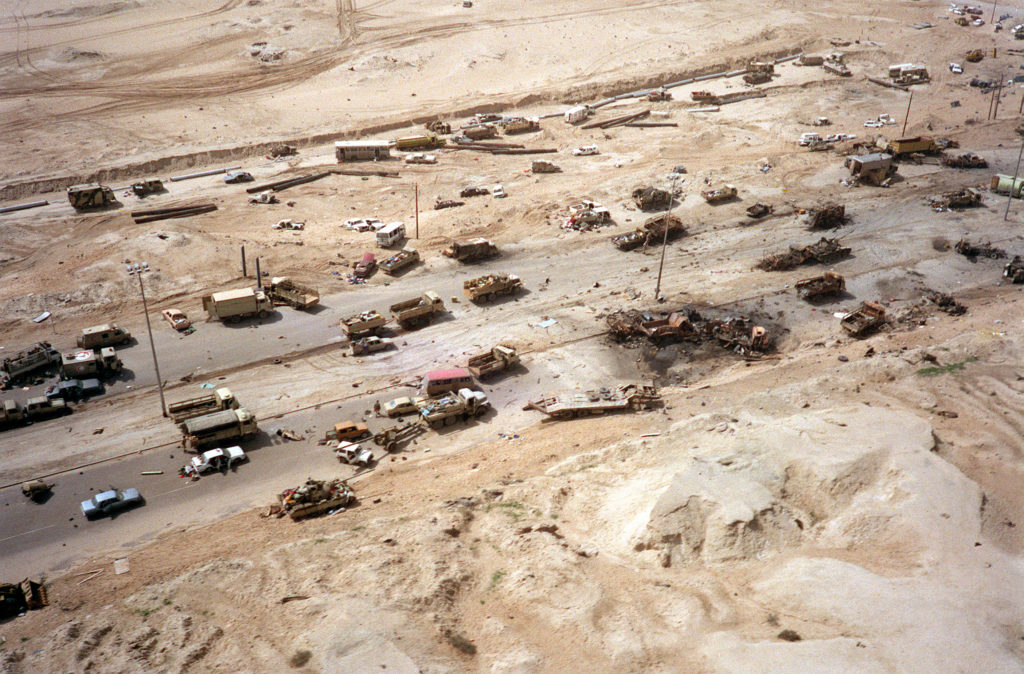
The Highway of Death requires direct engagement. On the night of February 26-27, US aircraft attacked the Basra highway, striking a 60-kilometre column of vehicles evacuating Kuwait City, soldiers, looted civilian property, and some civilians. The images of the resulting destruction generated intense international criticism and contributed to Bush’s decision to halt the ground war. The legal analysis is less emotionally comfortable than the imagery: under the Laws of Armed Conflict, forces remain lawful targets until they have formally surrendered or been rendered hors de combat. The retreating Iraqi column had not surrendered. The strikes were legally defensible. The moral and political debate they generated reshaped international law discussions about proportionality and targeting for the following decade and that debate was legitimate regardless of the legal defensibility.
Schwarzkopf’s halt at 100 hours is the war’s central unresolved question. VII Corps was positioned to complete the destruction of the Republican Guard. Powell and Bush chose to stop, citing the liberation of Kuwait as the achieved objective, concerns about ‘unnecessary killing,’ and the diplomatic architecture of the coalition, Arab partners had signed on to liberate Kuwait, not destroy Iraq’s government. The Republican Guard’s Hammurabi Division, which escaped northward, was instrumental in crushing the Shia uprising in southern Iraq in March 1991 and remained the backbone of Saddam’s internal security apparatus for another twelve years.
The decision not to march to Baghdad in 1991 was strategically defensible. The decision to do so in 2003, without a viable post-conflict plan, was not but the first decision created the conditions that made the second seem necessary. The Highway of Death was legally defensible and morally discomforting that tension is not a contradiction; it is a description of what warfare actually is. The 100-hour halt was not a mistake by the standards of the war’s stated objectives, it became a mistake only in the context of the strategic assumptions that drove 2003.
How Desert Storm Rewrote the Rules of Modern Warfare
The Pentagon’s immediate conclusion from Desert Storm was that it had demonstrated a Revolution in Military Affairs, the idea that precision, stealth, and real-time information dominance had fundamentally changed the relationship between technology and combat power. The investment decisions of the 1990s flowed directly from this conclusion: the B-2 Spirit bomber, the F-22 Raptor, expanded precision munitions production, the Joint STARS ground surveillance system, and the Predator unmanned aerial vehicle program were all accelerated or initiated in Desert Storm’s aftermath.
The doctrine that emerged effects-based operations held that the aim of military force was not to destroy enemy forces but to produce specific effects in the enemy system, targeting the inner rings rather than the outer. Some of these conclusions were correct. The investment in stealth paid dividends in Serbia, Afghanistan, Iraq in 2003, and in every subsequent operation where US aircraft operated in contested airspace. Precision munitions reduced civilian casualties relative to unguided ordnance at equivalent target destruction levels. AWACS and the command and control architecture that Desert Storm validated became the foundation of every subsequent major US air campaign.
Other conclusions were dangerously wrong. The belief that technology eliminates the friction of war that precision weapons and information dominance make insurgency, occupation, and political reconstruction manageable by military means was a misreading of what Desert Storm had actually demonstrated. Desert Storm proved that a conventional military force could be destroyed with remarkable efficiency. It proved nothing about what to do with the country afterward. The architects of the 2003 invasion drew the wrong lesson from the 1991 victory, applying a precision-warfare template to a political problem that precision could not solve. The resulting insurgency cost more American lives than Desert Storm had saved.
The foreign policy implications extended beyond Washington. Both China and Russia studied Desert Storm with a strategic alarm that shaped their defence procurement for the following two decades. China’s response was direct and programmatic: the development of the DF-21D anti-ship ballistic missile was explicitly motivated by the recognition that a US carrier battle group could not be allowed to operate with Desert Storm-style impunity off Chinese shores. The HQ-9 long-range surface-to-air missile system, China’s advanced fighter programmes, and its eventual A2/AD architecture all trace their doctrinal DNA to the shock of watching Desert Storm unfold on satellite television in Beijing.
Russia’s response was parallel: the S-400 Triumf programme, its EW investment, and its eventual doctrine of anti-access operations in Europe were all shaped by the recognition that Desert Storm demonstrated what unchallenged air superiority looked like and that Russia must never allow it to be achieved against Russian forces.
Desert Storm did not just win a war. It defined the template for American military power for thirty years, and it defined the adversary responses that now constrain that power in every theatre where it might be applied. The Revolution in Military Affairs that Desert Storm appeared to validate was real, but it was a revolution in conventional force destruction, not in the political problems that follow conventional force destruction. China’s entire A2/AD architecture and Russia’s S-400 program are, in the most direct sense, Desert Storm’s strategic legacy, the adversary responses that the victory made inevitable.
Conclusion
Desert Storm was a masterpiece of conventional military art. The integration of stealth, precision, airpower, deception, intelligence, and armored maneuver produced a result that professional military analysts are still studying thirty-five years later. The coalition destroyed the fourth-largest army in the world in six weeks at a cost of 467 lives. By any historical measure, this was an achievement without parallel.
It was also a trap. The masterpiece convinced its creators that they had found the formula for frictionless war that technology, properly applied, could produce decisive results with acceptable costs and manageable consequences. That belief was not a strategic insight. It was a category error. Desert Storm demonstrated what was possible when all variables were favorable: a permissive political environment, a coalition with unified objectives, an enemy with no strategic depth, and a battlefield with no population to protect. None of those variables were present in Iraq in 2003. The formula was applied anyway.
The real lesson of Desert Storm is not that precision warfare works. It is that precision warfare works under specific conditions that are far rarer than its advocates acknowledge and that the consequences of misapplying it is not paid by the planners who drew the wrong lesson, but by the soldiers sent to implement it and the populations caught between them.
Technology does not eliminate the nature of war. It only changes the cost of ignoring it.