Two nuclear-armed superpowers, two stealth fighters, and one question the defense establishment has been dancing around for a decade: Su-57 vs J-20
Russia’s Su-57 (NATO codename Felon) and China’s J-20 Mighty Dragon are the most consequential aircraft programs outside the United States. Both were conceived in the shadow of the F-22 Raptor’s 1997 debut. Both represent the apex of their respective nations’ aerospace ambitions. And both, for very different reasons, fall short of what their governments claim them to be.
The Su-57 vs J-20 debate is not merely a technical comparison of two aircraft. It is a forensic examination of two defense industries, two strategic doctrines, and two nations’ willingness to be honest about what fifth-generation air power actually demands. Strip away the propaganda and there is plenty of it on both sides and what remains is a story of engineering compromises, industrial limitations, and the brutal gap between aspiration and capability. One of these aircraft is the better fifth-generation fighter. The answer is less obvious than the internet would have you believe, and more consequential than most analysts admit.
The Strategic DNA: Su-57 vs J-20
The Su-57 was not born in a vacuum. It was born from fear specifically, the institutional shock that ran through the Russian aerospace establishment when the F-22 Raptor entered service and rendered every Soviet-legacy fighter design obsolete overnight. The PAK FA program Perspektivny Aviatsionny Kompleks Frontovoy Aviatsii, or Future Airborne Complex for Tactical Aviation was formally launched in 2002, though its roots stretch back to Soviet-era studies from the late 1980s. The requirement was straightforward by Russian doctrine: build an aircraft that could achieve air superiority over NATO’s best, survive in a dense surface-to-air missile environment, and do so without the logistical overhead of American fifth-generation platforms. Russia needed an aircraft that could fight. It also needed one it could afford to build.
This tension performance versus producibility would haunt the Su-57 from the drawing board to the flight line. The design that emerged from Sukhoi’s engineering bureaus reflected Cold War thinking filtered through post-Soviet fiscal reality. The Su-57 prioritized kinematic performance: high thrust-to-weight ratio, extreme agility, supermaneuvrability inherited from the Su-27’s legendary airframe lineage. Stealth was incorporated, but as a secondary consideration rather than a first principle. That design philosophy decision, made in the early 2000s, defines everything that follows in this comparison.
China’s J-20 program tells a fundamentally different story. Where Russia was building a replacement for the Su-27 family to fight NATO in European airspace, China was solving a specific strategic problem: how to threaten and, if necessary, destroy American carrier battle groups operating in the Western Pacific.
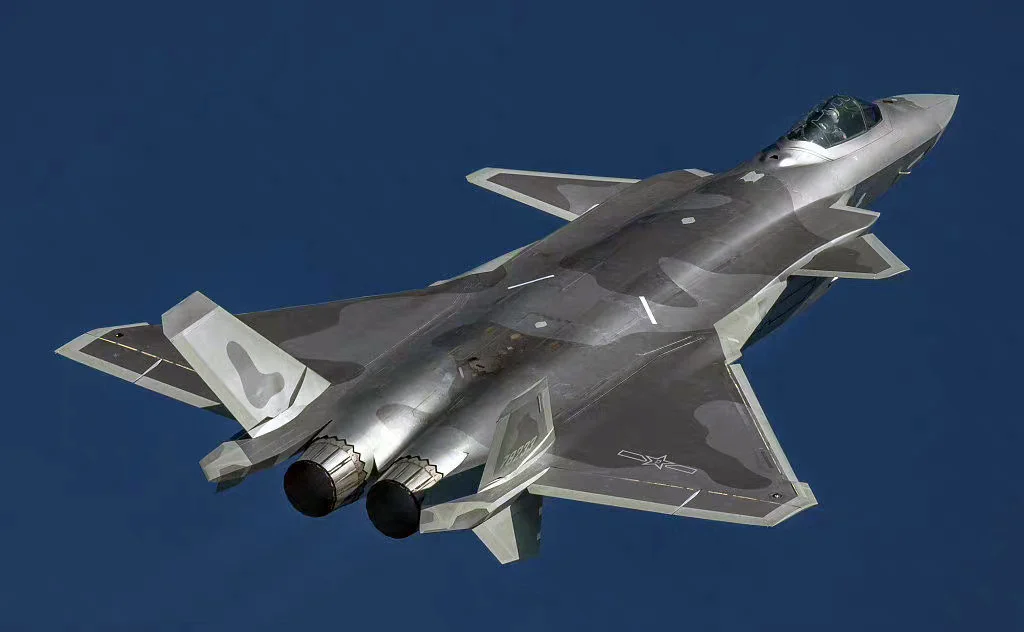
The J-20’s design brief was shaped entirely by the Taiwan Strait calculus. China’s anti-access/area-denial (A2/AD) strategy required an aircraft that could penetrate US-controlled airspace, survive long enough to target high-value assets like AWACS, tankers, F-35 support aircraft and disengage before American escorts could respond. This is a fundamentally offensive, deep-penetration mission profile. It demanded exceptional frontal-aspect stealth and very long range far more than it demanded close-range dogfight agility.
How Stealth Technology Actually Works
These different threat models produced two aircraft with almost opposite design philosophies. The Su-57 is, at its core, a supermaneuverable dogfighter with stealth features grafted onto a performance-optimised airframe. The J-20 is a stealthy long-range strike platform with an air superiority capability built around beyond-visual-range missile employment. Neither aircraft is what Western analysts habitually describe as a ‘true’ fifth-generation fighter in the F-22 sense but both are formidable within the specific envelopes they were designed to operate. Doctrine made metal. The comparison starts here.
How Invisible Is Invisible? Stealth Design Compared
Stealth is not a binary property. An aircraft is not either stealthy or not stealthy. It exists on a spectrum measured in radar cross section, and the engineering decisions that determine where on that spectrum a given aircraft sits are among the most consequential choices any aerospace program makes.
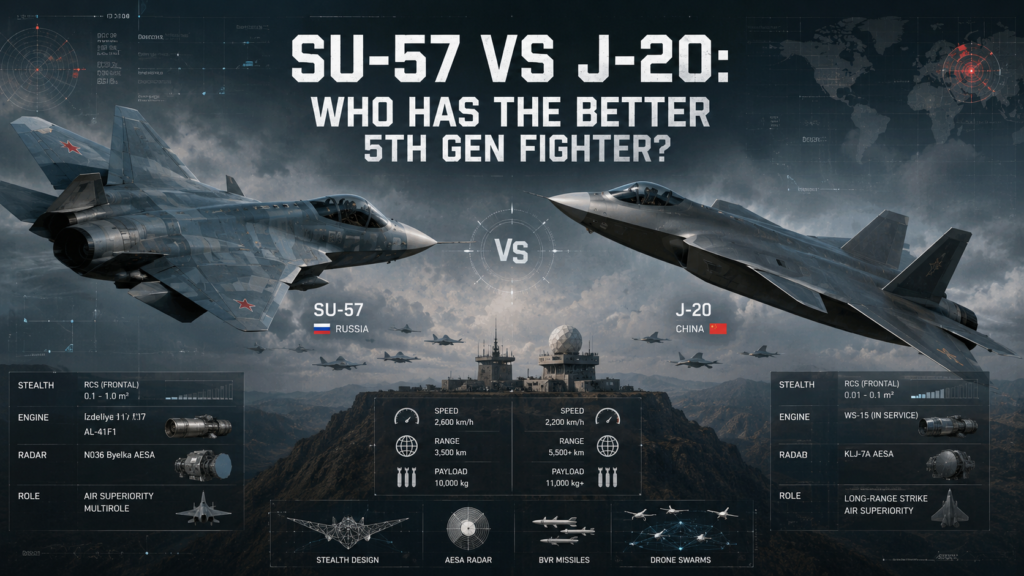
The Su-57’s RCS is the source of considerable controversy. Russian state media has claimed figures as low as 0.1 square meters for the frontal aspect, a number that, if accurate, would place it in the same category as the F-35. Open-source analysis from Western defense institutes, including assessments cited by the International Institute for Strategic Studies, suggests the real figure is considerably higher, likely in the range of 0.1 to 1.0 square meters depending on aspect angle and frequency band. The disparity matters because modern AESA radars operate across multiple frequency bands, and an aircraft optimized for stealth at X-band frequencies can still be detectable at L-band or UHF.
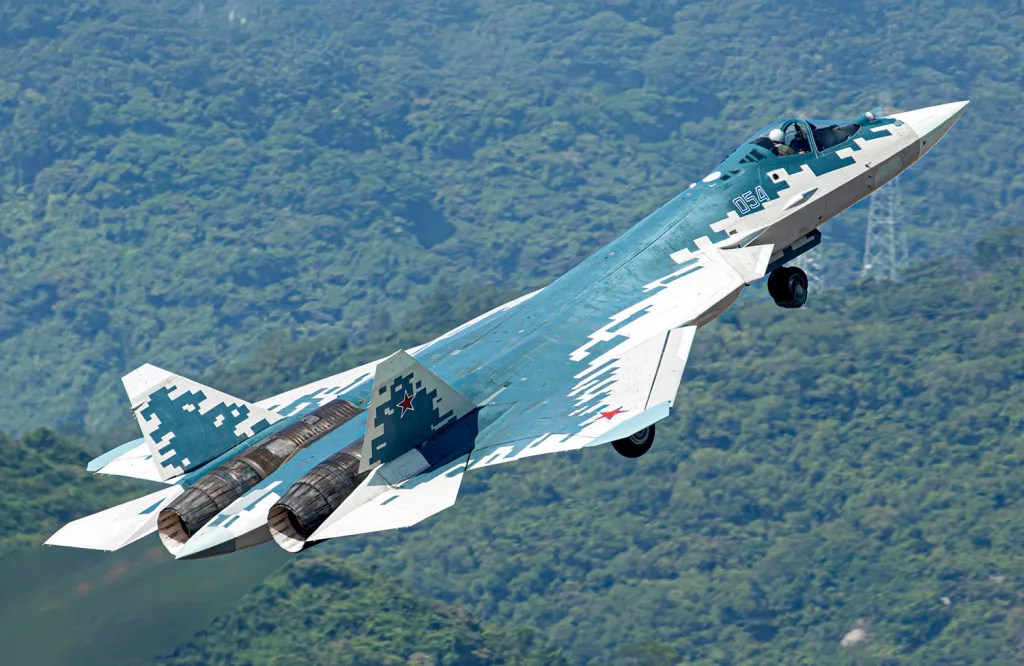
The reasons for the Su-57’s stealth compromises are visible from any published photograph of the aircraft. The engine inlets are the most obvious problem. Unlike the F-22’s carefully shaped serpentine inlet ducts, which completely block the radar return from the engine face, the Su-57’s inlet design provides only partial radar blockage. The canards, the small forward-mounted control surfaces inherited from the Su-27 family create additional radar return surfaces at angles that matter for certain threat geometries. The weapons bays, while internal, show door seam designs that are less refined than American equivalents.
Bottom line: The Su-57’s stealth architecture was designed around an airframe already optimized for aerodynamic performance. The physics of those two requirements are in tension with each other, and Russia chose performance. The J-20 presents a starkly different stealth philosophy — and here we must confront the uncomfortable question that serious analysts do not avoid: how much of the J-20’s design was influenced by compromised American stealth data?
The 2015 Office of Personnel Management breach, the earlier penetration of Lockheed Martin’s F-35 program networks, and the documented theft of stealth coating specifications from contractors have all been attributed to Chinese state-sponsored cyber operations. The J-20’s design choices, its chined nose section, its DSI (diverter less supersonic inlet) configuration, its weapons bay geometry show a sophisticated understanding of stealth engineering principles that China did not demonstrably possess domestically in the early 2000s when the program began. This is not speculation; it is the documented assessment of multiple US counterintelligence reports.
The result is an aircraft with genuinely impressive frontal-aspect stealth. The J-20’s nose-on RCS is estimated in open-source literature at somewhere below 0.05 square metres, potentially lower reflecting design choices that prioritise the head-on threat geometry consistent with its deep penetration mission profile. The tradeoff is that rear-aspect stealth is considerably weaker, which matters if the aircraft needs to disengage through a contested environment.
Bottom line: The J-20 has better frontal-aspect stealth than the Su-57 by a meaningful margin. The Su-57 is the more detectable aircraft at most operationally relevant aspect angles.
The RAM (radar-absorbing material) coatings applied to both aircraft represent another dimension of the comparison. Russian RAM technology, developed through the Soviet-era Kvant programme, is mature but not necessarily cutting-edge. Chinese RAM development has accelerated dramatically in the past decade, with evidence of domestically produced coatings applied to J-20 airframes at a standard that surprised Western analysts reviewing commercial satellite imagery of Chengdu Aircraft Corporation production facilities.
Internal weapons carriage, the fundamental discipline that separates a fifth-generation aircraft from a fourth-generation aircraft carrying a stealth pod is handled differently by both platforms. The Su-57 has four internal weapons stations across two main bays and two smaller side bays for short-range missiles. The J-20 has a similar configuration: one large central bay for long-range missiles and two lateral bays for short-range infrared-guided weapons. Neither aircraft can carry the same internal payload as the F-22, but both achieve meaningful stealth compliance when configured for BVR-primary loadouts.
The Engine Problem: Russia’s AL-41F1 vs China’s WS-15
If stealth architecture reveals the philosophical differences between these two programmes, propulsion reveals their shared Achilles heel. Both aircraft have engine problems. The nature of those problems is different. The strategic implications are the same.
The Su-57 currently flies with the AL-41F1S, an engine derived from the AL-31F family that powers the Su-27 series, with upgrades including full-authority digital engine controls, improved turbine materials, and three-dimensional thrust vectoring nozzles. The thrust vectoring is genuinely impressive: it gives the Su-57 post-stall maneuverability that no other operational non-American fighter can match. At full military power, the AL-41F1S produces approximately 93.2 kN dry thrust and 147 kN in afterburner, giving the aircraft a thrust-to-weight ratio that enables the kind of energy-dominant air combat Russia’s doctrine demands.
But the AL-41F1S is not the engine the Su-57 was designed for. That engine, the Saturn izdeliye 30, sometimes called the Product 30 remains in development. It promises approximately 107 kN dry and 176 kN in afterburner, along with dramatically improved specific fuel consumption and the supercruise capability that the AL-41F1S cannot reliably deliver. The first Su-57 prototype equipped with the izdeliye 30 flew in December 2017. Full-rate production integration has repeatedly slipped. As of available open-source reporting through mid-2024, the izdeliye 30 has still not entered series production and Russia’s precision manufacturing sector has been severely disrupted by Western sanctions imposed following the 2022 invasion of Ukraine.
China’s situation with the J-20 is in some respects worse, and in other respects a sign of trajectory rather than stagnation. The J-20 entered service in 2017 flying on imported Russian AL-31F engines, the same family that powered Chinese fourth-generation fighters because the domestically developed WS-10 engine was not ready in time and the intended WS-15 was years away. This is an extraordinary admission embedded in a program presented to the world as proof of Chinese aerospace self-sufficiency.
The WS-15, designated ‘Emei’ in some Chinese sources is intended to produce approximately 160 kN in afterburner with a thrust-to-weight ratio competitive with the F-22’s Pratt & Whitney F119. Development has proceeded, and there is credible evidence from 2023 and 2024 reporting that WS-15-powered J-20 variants are now in limited testing. Whether the engine has achieved the reliability and time-between-overhaul figures required for operational deployment is unknown from open sources.
Supercruise, the ability to sustain supersonic flight without afterburner is where both programs fall furthest behind the F-22 benchmark. The F-22 supercruises at approximately Mach 1.8. The Su-57 with AL-41F1S engines can sustain approximately Mach 1.1 to 1.2 without afterburner under optimal conditions, which barely qualifies as supercruise by meaningful definition. The J-20 with current engines cannot supercruise at all. Neither aircraft has the engine maturity of the F-22’s F119-PW-100. This is not a close call.
The Eye of the Fighter: AESA Radar, EW Suites and Sensor Fusion
A fifth-generation fighter is not defined by its stealth or its engine alone. It is defined, more than any previous generation of combat aircraft, by its ability to see, process, and act before the adversary completes the same sequence. This is the OODA loop translated into silicon, software, and electromagnetic spectrum.
The Su-57’s primary sensor is the N036 Belka, ‘Squirrel’ which is an AESA radar developed by Tikhomirov NIIP. What makes the Belka architecturally significant is not merely that it is an AESA radar, but that it is a distributed AESA system. In addition to the primary nose-mounted array, the Su-57 incorporates additional antenna arrays in the wing leading edges and potentially the fuselage sides, creating a multi-directional radar picture that no Western production fighter currently matches. The theoretical advantage is obvious: a 360-degree active radar picture that closes the situational awareness gap regardless of aircraft heading.
The practical question is about how well integrated and how reliably functioning this distributed architecture is in operational use. It is harder to answer from open sources. Russian avionics have historically lagged Western equivalents in processing power, software maturity, and reliability. The sanctions regime has now cut off access to Western semiconductor components that were, until 2022, quietly incorporated into Russian avionics systems. The medium-term consequence for Su-57 sensor system reliability and upgrade potential is severe.
The Su-57’s Himalayas electronic warfare suite is among the most capable EW systems fitted to any production fighter. It encompasses radar warning receivers, active jamming emitters, and missile approach warning sensors distributed across the airframe. Russian EW doctrine emphasises electromagnetic spectrum dominance, and the Himalayas system reflects that emphasis.
The J-20’s radar is less publicly documented but assessed by Western analysts to be a development of the KLJ-5 AESA, a capable but single-aperture system rather than a distributed architecture. What China’s J-20 potentially compensates with is sensor fusion maturity. The J-20 appears to incorporate an EODAS-equivalent distributed aperture system; an electro-optical sensor array embedded in the airframe providing 360-degree infrared situational awareness similar in concept to the F-35’s AN/AAQ-37. If this system is as capable as Chinese official sources claim, it partially offsets the single-aperture radar limitation by providing a passive infrared track capability that is difficult to jam and impossible to detect.
Data-link integration is the dimension of this comparison where both programmes show significant gaps relative to American fifth-generation practice. The F-22 and F-35 are designed from the outset as nodes in a networked combat system, sharing data at rates and with protocols that allow multiple aircraft to operate as a coherent sensing and weapons system. Russia’s data-link architecture for the Su-57 centred on the 16-channel S-111 system is less mature. China’s data-link architecture for the J-20 is more opaque but assessed by RAND Corporation analysis as ‘improving but not yet at F-35 integration levels.’
In a realistic BVR engagement between an Su-57 and a J-20, the aircraft that detects first and achieves missile launch first wins. Given the J-20’s superior frontal stealth, an Su-57 approaching from the front is likely to be detected by the J-20’s radar before the Su-57 detects the J-20. The Su-57’s distributed radar architecture partially compensates for this at off-axis angles. Neither aircraft, in this engagement, holds the decisive advantage that the F-22 holds against either of them.
Internal Weapons Bays, Missiles and the BVR Kill Chain
Stealth and sensors are prerequisites. Weapons are the point. The Su-57’s weapons inventory is formidable on paper. Its main weapons bays can carry the R-77M an evolved active-radar-homing BVR missile with a range of approximately 193 km in optimized launch conditions or the extraordinary R-37M, a hypersonic long-range air-to-air missile with a reported range exceeding 300 km. The R-37M, originally developed for the MiG-31, has been employed against Ukrainian aircraft and represents Russia’s most capable air-to-air weapon. It is not clear how many R-37Ms fit internally in the Su-57’s weapons configuration, and at least some published analyses suggest the R-37M’s dimensions require modifications to standard bay configurations.
The side bays carry two R-74M short-range infrared missiles, a modern, high-off-boresight weapon that gives the Su-57 a credible WVR capability. This configuration, long-range in the main bays, short-range in the side bays mirrors the F-22’s standard loadout architecture.
The J-20’s weapons picture centers on the PL-15 VLRAAM which Western analysts have described as one of the most capable BVR weapons currently in production anywhere in the world. The PL-15 uses an active radar seeker, a dual-pulse rocket motor, and is assessed to have a range comparable to or exceeding the AIM-120D at approximately 200+ km depending on launch parameters. Its integration into the J-20’s systems with the aircraft’s AESA radar providing mid-course guidance updates represents a kill chain that should be taken with complete seriousness.
The J-20 carries four PL-15s in its main bay, with two short-range PL-10 missiles in the lateral bays, a credible and balanced loadout. The side-by-side comparison of internal payload is roughly equivalent, though the J-20’s weapons bay geometry appears optimised for the PL-15 in a way that the Su-57’s bays are not specifically optimised for the R-37M.
Internal carriage is the hard constraint on stealth-compliant combat for both aircraft. The moment either opens a weapons bay door, its RCS spikes. The kill chain therefore rewards the aircraft that can detect, track, and launch first before the adversary’s radar has time to react to the bay-open RCS signature. This places enormous premium on sensor range and fusion speed, which brings the avionics comparison full circle.
Specifications at a Glance
| Specification | Su-57 Felon | J-20 Mighty Dragon |
| First Flight | January 29, 2010 | January 11, 2011 |
| Entered Service | December 2020 | 2017 (limited); 2019 (full) |
| Length | 19.8 m | 20.4 m |
| Wingspan | 13.95 m | ~13 m (est.) |
| Max Takeoff Weight | ~34,000 kg | ~34,000 kg |
| Top Speed | Mach 2+ | Mach 2+ |
| Supercruise | ~Mach 1.6 | Mach 1.6+ (WS-15 enabled) |
| Engines (Current) | AL-41F1 / Izdeliye 30 | WS-10C / WS-15 |
| Radar | N036 Byelka AESA (multi-band) | Type 1475 AESA |
| Primary BVR Missile | R-77M (~150-200 km) | PL-15 (~200+ km) |
| Primary WVR Missile | R-74M2 | PL-10 |
| Cannon | 30mm GSh-30-1 | None confirmed |
| Frontal RCS (Est.) | ~0.1-1.0 m² | ~0.001-0.01 m² (est.) |
| Fleet Size (May 2026) | ~32-40 operational | ~300-350+ operational |
| Annual Production Rate | ~20-25 per year | ~100-120 per year |
| Export Customers | Algeria (2 delivered, 2026) | None |
| Combat Deployments | Syria 2018, Ukraine 2022- | East China Sea / Taiwan Strait patrols |
Paper Tiger or Real Threat? Production Numbers and Combat Readiness
The most devastating critique of the Su-57 program is not technical. It is numerical. As of the most recent credible open-source assessments through 2024, the Russian Aerospace Forces have taken delivery of approximately 22 production-standard Su-57s. This is not a large number. To contextualize: the United States operates 183 F-22s. Japan operates 147 F-35As. The UK has ordered 48 F-35Bs. Russia’s entire fifth-generation fleet fits aboard a single American aircraft carrier with room to spare.
The reasons for this glacial production rate are structural. The Komsomolsk-on-Amur Aircraft Plant, which manufactures the Su-57, was producing at a rate of approximately two to four aircraft per year through the early 2020s. Russian government contracts called for increasing this to 15 per year by 2025, but sanctions on precision manufacturing equipment, disrupted supply chains for avionics components, and the consuming priority of producing legacy aircraft for consumption in Ukraine have made that target almost certainly unachievable. The unit cost of the Su-57, estimated at approximately $35 to $50 million depending on the source and configuration, is low by Western standards but meaningless if the industrial capacity to produce it does not exist.
The J-20 comparison here is not even close. China’s Chengdu Aircraft Corporation has been producing J-20s at a rate that Western intelligence assessments, citing imagery analysis, have placed at 30 to 50 airframes per year in recent production years. The PLAAF J-20 fleet was estimated at over 100 aircraft in 2023 assessments, with numbers growing rapidly. Some more recent estimates suggest the number is approaching 150 to 200 airframes across different variants.
The unit cost for the J-20 is estimated at approximately $100 to $120 million, more expensive than the Su-57, but China is actually building them. At current production trajectories, the PLAAF will have a J-20 fleet numerically comparable to the entire US F-22 force within this decade. China’s ability to scale aerospace production reflects genuine industrial transformation. The Chengdu facility operates at a tempo and efficiency that was not considered possible by Western analysts as recently as 2015. Whatever one thinks of where the J-20 sits on the capability spectrum, China is producing it in numbers that create real tactical options.
If They Met Over the Taiwan Strait: Who Wins?
This is the question. Here is the answer in three scenarios, without evasion.
Scenario 1: WVR Knife Fight: Within Visual Range
The Su-57 wins, and it is not particularly close. Thrust vectoring, an exceptional thrust-to-weight ratio, and the supermaneuvrability inherited from the Flanker family give Russian pilots a decisive kinematic advantage at close range. The Su-57 was built, at its core, to win exactly this kind of engagement. The J-20 was not, its large airframe, designed for range and payload, carries a WVR penalty that its designers consciously accepted. With R-74M vs PL-10, both aircraft have capable short-range weapons, but the platform delivering them matters enormously in a turning fight.
Scenario 2: BVR Standoff: Beyond Visual Range
The J-20 holds the advantage, though not overwhelmingly. Superior frontal stealth means the J-20 is harder for the Su-57’s radar to detect and track at long range. The PL-15’s capability gives it a first-shot option against a target that may not yet know it is being engaged. The Su-57’s Himalayas EW suite and distributed radar architecture are the primary mitigating factors, if they function as designed, they complicate the J-20’s fire control solution meaningfully. But a J-20 pilot who correctly executes a frontal-aspect BVR attack against an Su-57 has the better weapons system for that scenario.
Scenario 3: Contested EW Environment
This is where the analysis becomes genuinely uncertain. Russia’s EW doctrine and the Himalayas system represent one of the most sophisticated electromagnetic warfare capabilities fitted to any tactical aircraft. In a high-jamming environment, where radar-guided missiles lose reliability and sensor fusion degrades, the relative advantage of the J-20’s stealth and BVR systems is partially eroded. The Su-57, with its EW emphasis, is arguably better prepared for this specific environment. But the J-20’s infrared search and track capability passive, jam-resistant provides an alternative targeting solution that cannot simply be jammed away.
The aggregate verdict: the J-20 is the more capable fifth-generation fighter by the metrics that define fifth-generation air combat of stealth, BVR weapons, and production numbers. The Su-57 is the more capable aircraft for a specific subset of scenarios that Russia’s doctrine prizes. In the war that is actually likely to happen, a long-range, BVR-dominated, EW-saturated Pacific air war as the J-20’s design philosophy is better matched to the operational reality.
Why This Comparison Matters Beyond the Cockpit
The Su-57 vs J-20 competition is a diagnostic instrument for something larger than aircraft performance. It reveals the state of two defense industrial bases at a moment of maximum strategic consequence. Russia’s program tells a story of a world-class aerospace engineering tradition operating under resource constraints that are growing more severe by the year. The Su-57 exists because Russia has extraordinary aeronautical engineers. It exists in small numbers because Russia has a defense industrial base that was already strained before 2022 and is now under a sanction’s regime designed to accelerate its deterioration. The trajectory is not encouraging.
China’s program tells a story of industrial ambition being translated, with uncomfortable speed, into genuine military capability. The J-20 is not the F-22. But it is a credible, numerically significant, rapidly improving fifth-generation platform being produced by an economy with a defence budget growing at 7 per cent annually. The trajectory is not reassuring.
For US Air Force planners, the combined existence of a J-20 fleet approaching American F-22 numbers and an Su-57 fleet providing Russia with a credible if limited fifth-generation capability reinforces the argument for F-35 procurement rates and the NGAD programme. The F-35, whatever its critics say, is vastly more capable than either the Su-57 or J-20 in the dimensions of stealth, sensor fusion, and networked combat. The F-22 remains categorically superior to both. But numbers matter, and the combined non-Western fifth-generation fleet is growing while American procurement debates drag on.
The next decade will introduce the FC-31, China’s second fifth-generation design, intended for carrier operations alongside whatever the Su-75 Checkmate becomes if Russia finds the industrial capacity to build it. Sixth-generation programs, America’s NGAD, China’s next-generation air dominance concept add another layer of complexity. The competition is not ending. It is accelerating.
Conclusion
The comfortable answer to the Su-57 vs J-20 question is that both are impressive achievements and the winner depends on the scenario. That answer is also, in the specific sense that matters, wrong. The J-20 is the better fifth-generation fighter. It is stealthier where stealth matters most. It carries the world’s most dangerous production BVR missile. It exists in numbers that create real operational options for PLAAF commanders. China built an aircraft designed for the war it actually intends to fight a precise, BVR-dominant, penetrating strike against high-value assets in a contested Pacific theatre and it built it in quantity.
The Su-57 is a remarkable aircraft in many respects, flown by pilots trained in one of the world’s finest air combat traditions. But it is an aircraft optimized for a war that modern airpower doctrine has largely moved beyond the close-range, kinematically dominated dogfight and it exists in numbers that constrain it to a symbolic rather than operational role at scale. Strategy is not decided by the best aircraft on the showroom floor. It is decided by the aircraft on the flight line, in the numbers required, with the weapons that reach the target first. On that accounting, in 2025, the J-20 wins.
Further Reading on Armorexa
If this analysis sparked your interest in the broader fifth-generation landscape, explore these related deep dives:
How Stealth Technology Actually Works: The engineering fundamentals behind radar cross-section, RAM coatings, and low-observable design
Drone Swarms: The Next Revolution in Warfare: How autonomous systems will reshape the tactical context in which these fighters operate
The Ultimate 5th Gen Showdown: Where the Su-57 and J-20 fit against the F-22 and F-35 in a full four-way comparison