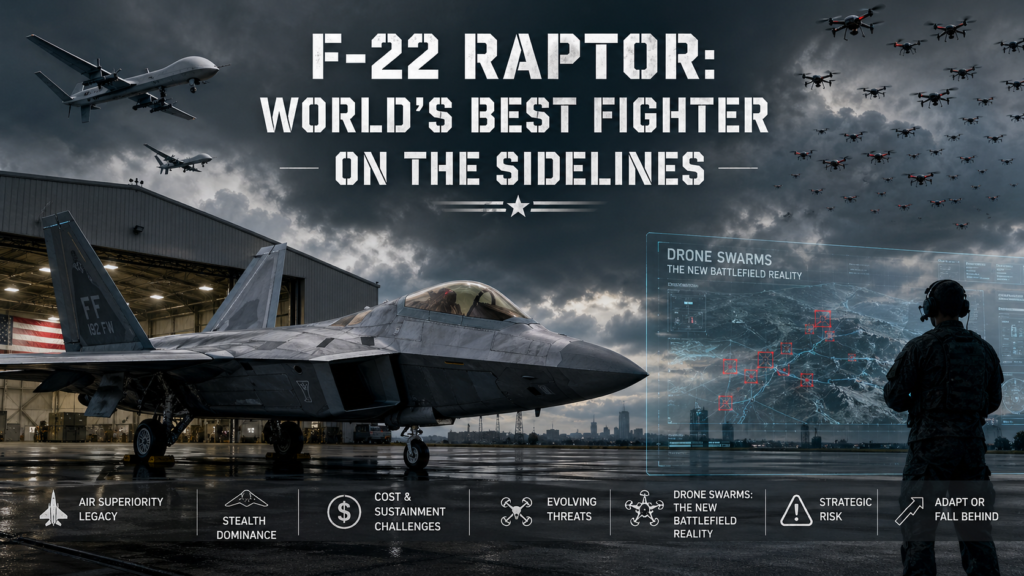
The world’s most capable air superiority fighter, F-22 Raptor has spent 20 years looking for a fight worth having.
750 Planned. 187 Built. 143 Combat-Ready. The Story of the F-22 Raptor: America’s Most Powerful, Most Controversial, and Most Underused Fighter Jet
KEY FACTS AT A GLANCE
- 20 years in service: The F-22 Raptor marked two decades of operational readiness on 12 May 2025 at Langley Air Force Base and still the world’s premier air superiority fighter.
- Only 187 built: The US Air Force originally planned to procure 750 F-22s. Congress and the Pentagon cut production to 187, a strategic blunder recognized too late.
- 143 combat-ready: Of 187 production aircraft, only approximately 143 are combat-coded Block 30/35 variants. At any given time, roughly 95 may be operationally available after maintenance cycles.
- 144-to-0 kill ratio: In training exercises including Northern Edge 2006, small groups of F-22s achieved a 144-to-0 kill ratio against opposing forces of advanced 4th-generation fighters.
- Operation Epic Fury (Feb-Mar 2026): F-22 Raptors deployed to Israel and penetrated Iran’s S-300 and Bavar-373 air defenses in a nine-day campaign. Zero losses. Zero successful radar locks on any Raptor.
- F-47 successor: The Boeing F-47 6th-generation fighter will eventually replace the F-22 but is not expected until the mid-2030s. Congress is already repeating the procurement mistake.
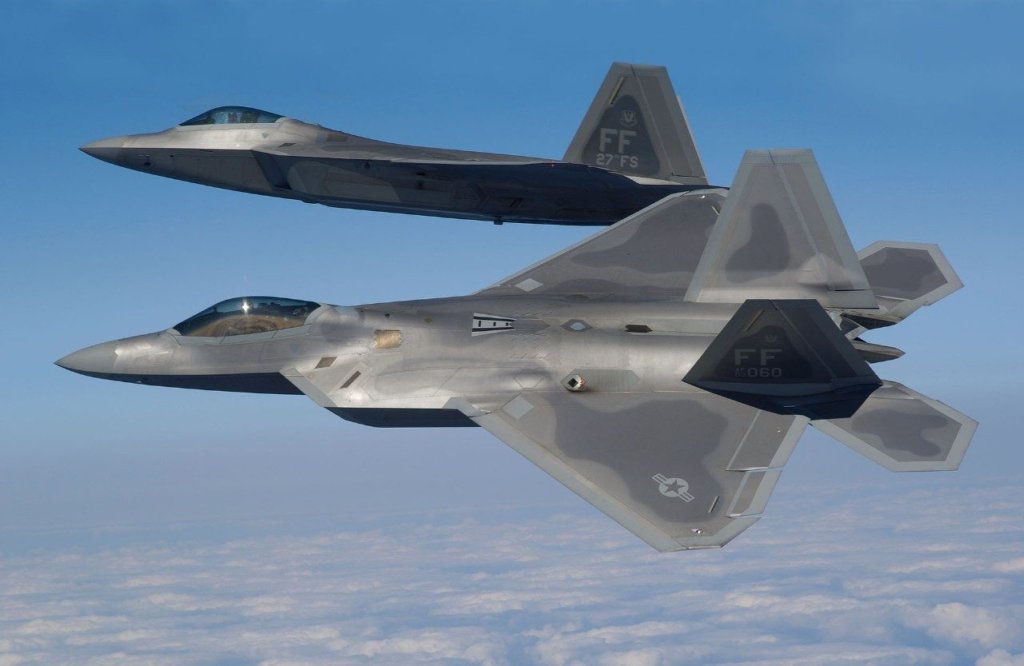
There is a fighter jet sitting in a hardened shelter at Langley Air Force Base, Virginia, that is almost certainly the most capable air combat aircraft in the history of human aviation. It can cruise faster than the speed of sound without using its afterburner. Its radar cross-section is roughly equivalent to a steel marble. Its sensor fusion software can track multiple targets simultaneously across ranges that would astound pilots who flew fighters a decade earlier, while every other aircraft in its threat envelope is blind to its presence. It has a 144-to-0 simulated kill ratio in training exercises against the world’s most advanced fourth-generation fighters. In March 2026, it flew into one of the most heavily defended airspaces on Earth during Operation Epic Fury against Iran, and not a single one was tracked or locked onto by enemy radar across nine days of combat.
The F-22 Raptor is, by virtually every technical and tactical measure, the most lethal air superiority fighter ever built. The F-22 Raptor is an American fifth-generation twin-engine, all-weather, supersonic stealth fighter aircraft. It is part of the Air Force’s Advanced Tactical Fighter (ATF) program. It is also, for a combination of political, strategic, and doctrinal reasons that constitute one of the most consequential decisions in modern defense history, available in a fleet so small that it may never fight the war it was actually designed to win. The United States Air Force originally planned to buy 750 F-22s. It ended up with 187. Of those, only 143 are combat-coded. Of those, approximately 95 may be operationally available on any given day. In a high-intensity conflict with China over Taiwan, air warfare planners would need that fleet across multiple simultaneous theatres while absorbing combat losses. The mathematics are uncomfortable.
This is a definitive account of the F-22 Raptor, not just the aircraft and its extraordinary capabilities, but the full story of what it is, what it has done, why it exists in such dangerously small numbers, why it has largely been kept away from the fights where it would have mattered most, and what its story tells us about the strategic choices America is about to repeat with its next-generation F-47. It is a story of engineering triumph, political failure, strategic miscalculation, and the enduring question of whether the most capable weapon is worth anything if you cannot afford to use it.
ORIGINS OF F-22 RAPTOR
The Threat That Built the F-22 Raptor
The F-22 Raptor did not begin as an aircraft. It began as an answer to a question that terrified US Air Force planners throughout the 1980s: what happens when the Soviet Union fields the MiG-29 Fulcrum and Su-27 Flanker in the numbers it is planning, and what happens after that? The F-15 Eagle was the supreme air superiority fighter of its era, but US intelligence assessments in the early 1980s projected that by the 1990s, Soviet pilot training improvements and the sheer numerical weight of advanced 4th-generation fighters would begin eroding the comfortable kill ratios that American fighters had always enjoyed.
The requirement that emerged from this analysis was the Advanced Tactical Fighter, a program to develop a qualitatively superior replacement for the F-15 that would guarantee American air dominance not against today’s threat, but against the threat of 2010 and beyond. The performance requirements written into the ATF specification were extraordinary by any previous standard.
The new aircraft had to be stealthy enough to survive the Soviet integrated air defence system. It had to supercruise, sustain supersonic flight without afterburner, allowing it to reach engagement areas faster while preserving fuel and reducing infrared signature. It had to be more manoeuvrable than any Soviet fighter, with the avionics to exploit that manoeuvrability in the compressed timescales of beyond-visual-range combat. And it had to integrate sensors and weapons into a single fused battlespace picture that would tell the pilot where every threat was before any threat knew he was there.
These requirements were not merely ambitious. In the 1980s, they were at the absolute edge of the achievable. Lockheed and Boeing competed against Northrop and McDonnell Douglas in a fly-off that concluded in 1991 with Lockheed’s YF-22 defeating Northrop’s YF-23, a decision that remains debated to this day, as the YF-23 was arguably stealthier and faster, while the YF-22 was deemed more manoeuvrable and more amenable to the USAF’s mission requirements.
From YF-22 to Production of F-22 Raptor
The path from Lockheed’s winning 1991 YF-22 demonstrator to the F-22A that entered operational service in December 2005 was fourteen years of engineering challenge, cost growth, and political turbulence. The production aircraft was significantly heavier than the demonstrator due to the structural demands of full stealth compliance, the addition of a second weapons bay, and the requirements of production-standard avionics rather than demonstrator-quality systems.
The first flight of the EMD (Engineering and Manufacturing Development) F-22 occurred in September 1997, and the program then spent eight years refining the aircraft’s software, avionics, and manufacturing processes before the first combat-coded aircraft were delivered to the 1st Fighter Wing at Langley in 2005.
The aircraft that emerged from this process was everything the ATF specification had demanded. The F-22A was the world’s first operational fifth-generation fighter: an aircraft that combined low observability, super cruise, super-maneuverability, and advanced avionics in a single integrated platform. It was also, by the time it entered service, a program that had already been cut from its original 750-aircraft procurement target, was consuming resources at rates that alarmed Congress, and was facing the uncomfortable geopolitical reality that the Soviet adversary it was designed to defeat had ceased to exist fourteen years earlier.
The F-22 Raptor was designed in the 1980s to fight a Soviet Air Force that collapsed before the first production aircraft ever flew. It spent the next twenty years in the world’s most powerful air force, waiting for an adversary worthy of its capabilities. In 2026, that adversary has arrived. The fleet that was supposed to meet it is a quarter the size it was supposed to be.
WHAT MAKES THE F-22 RAPTOR EXTRAORDINARY
The Four S’s of F-22 Raptor
The F-22’s capabilities are best understood through what its designers call the ‘Four S’s’: the four performance pillars that together create an aircraft unlike anything that has existed before or since. These are not marketing phrases. They are the engineering disciplines that define why the F-22 has a 144-to-0 training kill ratio against some of the world’s best pilots in the world’s most advanced 4th-generation fighters.
Stealth is the F-22’s most discussed attribute, and with good reason. The Raptor’s radar cross-section is estimated at approximately 0.0001 square metres roughly the radar signature of a steel marble, or about one ten-thousandth of a typical 4th-generation fighter. This is achieved through a combination of geometric shaping that deflects radar energy away from the emitter, radar-absorbent material coatings that absorb the remainder, and meticulous design of every surface discontinuity to minimise radar return from any angle.
The F-22’s stealth is an all-aspect design: it maintains its low observability from frontal, lateral, and rear aspects simultaneously, a far more demanding engineering achievement than the frontal-only signature reduction of earlier stealth designs. In Operation Epic Fury’s nine days of combat over Iran, not a single F-22 was successfully tracked or locked onto by Iranian S-300 or Bavar-373 systems. That is not a claim. That is an operational record.
Supercruise refers to the F-22’s ability to sustain supersonic flight at approximately Mach 1.5 to 1.8 without using its afterburners. This capability fundamentally changes the tactical calculus of air combat. Afterburner flight is fuel-intensive, dramatically reducing range and endurance. More critically for stealth operations, afterburner produces a massive infrared signature that can be detected by passive infrared search and track systems at ranges far exceeding radar detection. A supercruising F-22 is faster than most threats while remaining stealthy, energy-efficient, and thermally cool. No adversary fighter in current service can match this combination.
Super-maneuverability, enabled by the F-22’s thrust-vectoring nozzles which can deflect the engine’s exhaust stream to generate pitch forces independent of aerodynamic control surfaces, allows the Raptor to execute maneuvers at angles of attack and velocities that violate the conventional assumptions of dogfight tactics. A pilot in a turning fight against an F-22 cannot assume that an F-22 pointed away from him is no longer a threat, the Raptor can point its nose through vectors that conventional aerodynamics would make impossible, and its weapons can engage targets across a wide off-boresight arc.
Sensor Fusion is perhaps the least dramatic-sounding of the Four S’s but is arguably the most decisive in operational terms. The F-22’s AN/APG-77 AESA radar, combined with its Radar Warning Receiver, Electronic Warfare system, and data-linked intelligence from supporting aircraft, is processed by a central fusion engine that presents the pilot with a single, prioritised, automatically updated tactical picture.
The F-22 pilot does not manage sensors and then make decisions. The aircraft manages the sensors, synthesises the information, and the pilot manages the battle. In a training exercise at Northern Edge 2006, this combination was so decisive that F-22 pilots were engaging and killing adversary aircraft before adversary pilots had any indication that they were being tracked.
Technical Specifications
| Specification | F-22A Raptor | F-15C Eagle (predecessor) | Su-57 Felon (nearest peer) |
| Primary Role | Air Superiority / Strike | Air Superiority | Air Superiority / Multirole |
| First Flight | 1997 (EMD) | 1972 | 2010 |
| Service Entry | December 2005 | 1976 | 2020 |
| Length | 18.9 m (62 ft) | 19.4 m (63.8 ft) | 20.1 m (65.9 ft) |
| Wingspan | 13.6 m (44.5 ft) | 13.1 m (42.8 ft) | 14.1 m (46.3 ft) |
| Max Speed | Mach 2+ (AB) / Mach 1.8 (supercruise) | Mach 2.5 | Mach 2+ / Mach 1.6 supercruise |
| Service Ceiling | ~65,000 ft | ~65,000 ft | ~66,000 ft |
| Combat Radius | ~1,000 km (internal) | ~1,900 km (external) | ~1,500 km |
| Thrust (each engine) | ~35,000 lbf (F119) | ~23,770 lbf (F100-220) | ~32,000 lbf (AL-41F1) |
| Radar Cross-Section | ~0.0001 m² (est.) | ~10–25 m² | ~0.1–1 m² (est.) |
| Internal Weapons Bay | Yes (full stealth config) | No | Yes |
| Supercruise | Yes (Mach 1.5–1.8) | No | Yes (Mach 1.6+) |
| Thrust Vectoring | Yes (2D pitch) | No | Yes (3D full) |
| Total Built | 195 (187 production) | 1,198 | ~35 (est. 2026) |
| Fleet Cost (unit) | ~$350 million (programme average) | ~$30 million (1980s) | ~$35–50 million |
| Current Status | Active, undergoing upgrades | Retiring (extended to 2026) | Limited operational service |
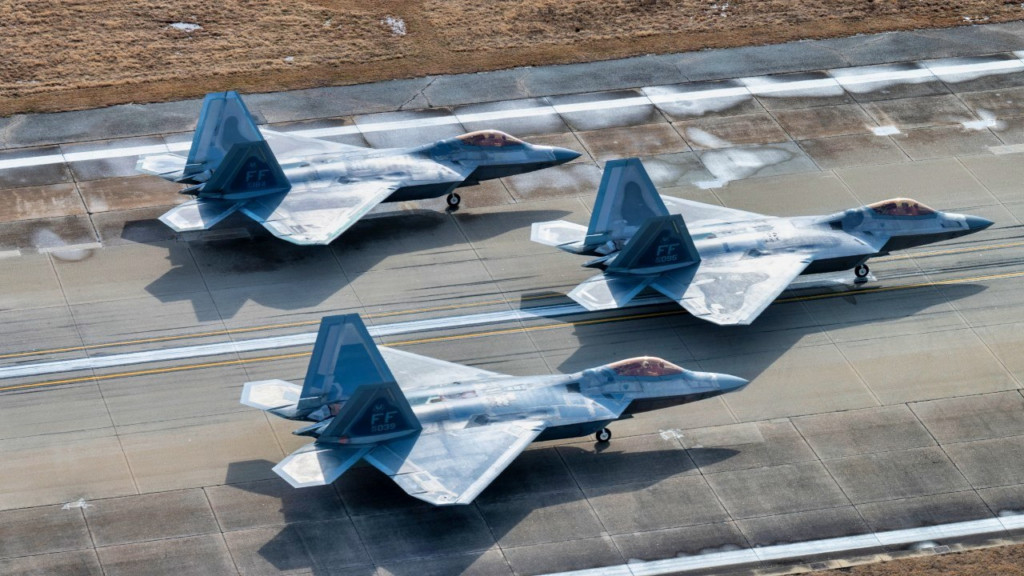
THE STRATEGIC BLUNDER: WHY ONLY 187 WERE BUILT
From 750 to 187 F-22 Raptors
The gap between 750 and 187 is not just a number. It is the measure of a strategic miscalculation that the United States Air Force is now living with in the most dangerous geopolitical environment it has faced since the Cold War. The original ATF requirement called for 750 aircraft, a fleet sized against the Soviet air order of battle, the basing requirements of global power projection, and the assumption that any major conflict would involve combat losses that needed to be absorbed without catastrophic degradation of capability. Even this figure was considered by many air power analysts to be the absolute minimum required to maintain credible air superiority across multiple simultaneous theatres.
Congress and successive Pentagon leaderships chipped away at this number throughout the 1990s and 2000s. The reasoning was straightforward, politically defensible, and strategically wrong. The Soviet Union had collapsed. No nation on Earth had a fighter that could seriously challenge the F-15 in the short term. The F-22 cost was escalating beyond any original estimate reaching approximately $350 million per aircraft when program development costs were included. And America was fighting two land wars in Afghanistan and Iraq against adversaries with no air forces, creating a political environment in which funding an ultra-expensive air superiority fighter felt extravagant and disconnected from the actual conflicts consuming the defense budget.
In 2009, Secretary of Defense Robert Gates made it official. He recommended, and Congress agreed, that F-22 production would be capped at 187 airframes. The production line at Lockheed Martin’s Marietta, Georgia plant would close. The tooling would be mothballed at Sierra Army Depot. The decision was presented as fiscally responsible. It has since been described by virtually every serious air power analyst as a strategic blunder of the first order, a conclusion that has grown steadily more uncomfortable as China’s People’s Liberation Army Air Force has grown from a regional threat to a genuine near-peer competitor with over 200 J-20 fifth-generation fighters and growing.
The Numbers That Make Air Power Planners Lose Sleep
Of 187 production F-22s, the operational picture is considerably bleaker than the headline number suggests. Thirty-two aircraft are Block 20 variants, early-production jets that lack the combat avionics of the Block 30/35 and cannot be deployed in combat without significant upgrades that the Air Force has repeatedly requested funding to perform. Congress has blocked the Air Force’s attempts to retire these aircraft while simultaneously refusing to fund their upgrade, leaving the USAF in the absurd position of being legally required to maintain aircraft it considers obsolete.
Of the 155-remaining combat-coded aircraft, approximately 12 have been lost to accidents over the program’s life, leaving around 143 viable airframes. Factor in the approximately one-third of any fighter fleet that is in maintenance at any given time, and the operationally available F-22 fleet on a normal day is approximately 95 aircraft.
Ninety-five aircraft. That is what the United States has to defend its air superiority concept against an adversary that is producing J-20s at a reported rate of 30 to 40 per year and which may already have more fifth-generation fighters in service than the United States’ entire combat-coded F-22 fleet. The Air Force’s own assessment supported by a February 2026 Mitchell Institute report that called for significantly increased F-47 procurement is that the fleet is dangerously thin. A war with China over Taiwan that lasted more than its opening weeks would consume F-22s at rates that the existing fleet cannot sustain.
Why Restarting Production Is Impossible
The natural question is: why not simply restart F-22 production? The answer reveals a particularly cruel feature of modern defence industrial reality. When Lockheed Martin closed the Marietta production line in 2011, the tooling and jigs were mothballed rather than destroyed, and production documentation was preserved at Sierra Army Depot, specifically to preserve the option of a restart. Congress directed a cost study in April 2016. The results were sobering: restarting the F-22 production line would cost approximately $10 billion in non-recurring engineering and facility costs before a single additional aircraft could be produced.
Each aircraft would then cost more than a new F-35A, because the production efficiencies of a long, high-volume production run cannot be recreated from a standing start. And the aircraft being produced would be a design from the 1990s, using manufacturing processes from the early 2000s, while the Air Force is simultaneously developing the F-47 sixth-generation fighter.
The industrial logic is unassailable. The strategic logic is equally clear in hindsight: the decision to close the production line in 2011 was, in strategic terms, irreversible. The United States will not build more F-22s. It will instead have to bridge the gap between 95 operationally available Raptors and the arrival of the F-47 with upgrades, loyal wingman drones, and the careful management of a fleet that was never large enough for the mission it was built to perform.
The United States built 95 operationally available F-22s. China is producing 30 to 40 J-20s per year. The maths of this comparison is not comfortable, and no amount of qualitative superiority per aircraft can fully offset it if a conflict lasts long enough for quantity to become decisive.
THE EXPORT BAN: THE FIGHTER AMERICA REFUSES TO SELL
The F-22’s strategic isolation is compounded by a legal prohibition unique in the history of American weapons exports. The Obey Amendment, passed by Congress in 1998 and renewed in every subsequent defence authorisation, explicitly bans the export of the F-22 Raptor to any foreign nation, including the United States’ closest allies. No NATO partner, no Five Eyes ally, no treaty partner of any kind has ever operated the F-22 or been given access to its stealth technology or source codes.
This prohibition is absolute, and it has been maintained against sustained international interest from Japan, Australia, Israel, and several other nations that have both the financial means and the strategic relationship with Washington to have otherwise been natural customers. The reasoning behind the export ban is a combination of genuine technology protection concerns and institutional self-interest. The F-22’s stealth technology, radar systems, and software architecture represent the single most advanced set of air combat capabilities America has ever developed.
The concern is that any export even to a trusted ally creates vectors through which adversary intelligence services could acquire insights into the systems that underpin American air power superiority. The F-22’s source codes alone represent decades of classified research whose compromise would benefit China’s J-20 programme and Russia’s Su-57 development more than any single intelligence operation.
The cost of this prohibition has been significant. Japan, facing an increasingly threatening Chinese air force, pursued F-22 export rights aggressively through the late 2000s and was forced to settle for the F-35A after the Obey Amendment blocked the sale. Australia expressed similar interest. The export ban has also denied the F-22 programme the international cost-sharing that has made the F-35 programme economically sustainable, no foreign military sales to offset development costs, no allied contributions to software upgrades, no shared logistics networks to reduce per-aircraft operating costs. The F-22 has been an entirely American investment, in an entirely American fleet, for an entirely American strategic purpose, with an entirely American bill.
THE COMBAT RECORD: WHAT THE F-22 HAS ACTUALLY DONE
Syria 2014: The First Combat Mission
The F-22 Raptor fired its first shots in anger not against an enemy aircraft, but against ground targets in Syria in September 2014, when it participated in US-led strikes against Islamic State positions around Raqqa and Deir ez-Zor. The mission was not what the F-22 was designed for. Air-to-ground strike against non-state actors with no air force and no serious integrated air defence was the operational environment least suited to the Raptor’s specific capabilities. But the Syrian mission demonstrated two important things: the aircraft’s ability to operate in a combat environment after nine years of service without a single combat deployment, and the Air Force’s willingness to use its most advanced platform for missions that, technically, could have been performed by an F-16. The message to China and Russia was deliberate: this aircraft is operational, combat-proven, and ready.
The Balloon and the Unknown Objects : 2023 Kills
The F-22’s most publicly celebrated air-to-air engagements are also, by any conventional measure, its least militarily significant. In February 2023, a Raptor shot down a Chinese surveillance balloon drifting over the Atlantic near South Carolina using an AIM-9X Sidewinder missile/ It is technically the F-22’s first confirmed air-to-air kill. Days later, another Raptor shot down an unidentified object over Alaskan airspace, described as approximately the size of a small car.
These were not the kills the F-22 was built to make. But they were operationally instructive: they demonstrated the aircraft’s ability to engage objects at very high altitude, the effectiveness of the AIM-9X in this application, and the F-22’s role in a new mission set, homeland defence against stratospheric surveillance assets, that no aircraft specification in the 1980s had anticipated.
Iran Nuclear Strikes: June 2025
The most operationally significant deployment of the F-22 Raptor prior to 2026 came in June 2025, during the United States’ airstrikes against Iranian nuclear facilities in Operation Midnight Hammer. In this strike package of approximately 125 aircraft, F-22s and F-35As launched from land bases in the Middle East performed a role that combined their unique capabilities with a mission profile that no 4th-generation aircraft could have attempted: they penetrated Iranian integrated air defence networks specifically to draw surface-to-air missile fire, identify and suppress the defending radar systems, and clear corridors through which B-2 Spirit bombers could execute precision strikes against hardened nuclear infrastructure. Zero losses were recorded.
The operation demonstrated the F-22’s ability to act, in the words of US Air Force assessors, as the ‘invisible quarterback’ of a complex multi-aircraft strike package: directing 4th-generation fighters, suppressing S-300 and S-400 class batteries, and enabling the overall strike through a combination of stealth, electronic warfare, and sensor fusion that nothing else in the inventory could replicate.
Venezuela: January 2026
In January 2026, F-22 Raptors participated alongside F-35s, B-1 bombers, F/A-18s, and EA-18G Growlers in a joint operation to dismantle Venezuelan air defence systems, enabling the safe passage of special operations helicopters into Venezuela in an operation that resulted in the capture of President Nicolás Maduro. The F-22’s role was again the suppression of integrated air defence systems, precisely the first-day strike, enemy air defence penetration mission for which its combination of stealth, electronic warfare, and high-altitude persistence is uniquely suited.
Operation Epic Fury: February to March 2026
Operation Epic Fury, launched on 28 February 2026, represented the most intensive and most operationally significant combat employment of the F-22 Raptor in the aircraft’s history. Deployed to Israel in advance of the operation alongside KC-135 and KC-46 tankers, F-22 Raptors participated in a large-scale joint US-Israeli military operation against Iran. Operating from undisclosed bases, Raptors executed precision missions against Iranian air defences, nuclear-related infrastructure, and command nodes linked to the Islamic Revolutionary Guard Corps.
On the operation’s first day, F-22s opened the campaign by suppressing Iranian S-300 and Bavar-373 surface-to-air missile batteries, clearing corridors for follow-on coalition strike aircraft to enter defended airspace. They then coordinated with B-2 Spirit bombers and EA-18G Growler electronic attack jets in layered strike packages designed to overwhelm Iran’s entire integrated air defence architecture.
Iran launched dozens of surface-to-air missiles during the nine-day campaign. US officials confirmed that none successfully tracked or locked onto any F-22 Raptor. The Low Drag Tank and Pylon program, new stealth-compliant external fuel tanks that extend the F-22’s combat range by 850 nautical miles without compromising its radar cross-section that was integrated and operationally used for the first time during Operation Epic Fury, demonstrating that the aircraft’s range limitations, long a point of criticism, were being directly addressed. The Raptor also coordinated with MQ-20 Avenger Collaborative Combat Aircraft drones during the operation, the first time an F-22 has operationally controlled autonomous wingmen in a contested environment.
Nine days of combat over Iran. Dozens of surface-to-air missiles launched at American aircraft. Not a single F-22 tracked. Not a single F-22 locked onto. Not a single F-22 lost. After 20 years of waiting, the Raptor finally showed the world why it was built. The answer, for those paying attention, was everything the Air Force always claimed it was.
WHY THE F-22 NEVER FOUGHT ITS REAL WAR
The Adversary That Arrived Too Late
The fundamental irony of the F-22 Raptor’s operational history is that the adversary it was built to face did not exist in credible form for the first fifteen years of its operational service, and by the time that adversary had arrived, the fleet was already too small to fight the war properly. The Soviet Union, which inspired every performance requirement in the ATF specification, collapsed in 1991 while the F-22 was still in development.
Russia’s air force spent the 1990s and early 2000s in a state of severe degradation, unable to fund the training, maintenance, or procurement program that would have made it the peer competitor the F-22 was designed against. China’s air force in the early 2000s was a modernizing but still predominantly 4th-generation force whose ability to challenge F-22s in air combat was not yet a serious planning assumption.
The conflicts that America fought during the F-22’s operational prime, Afghanistan and Iraq were not air superiority wars. The Taliban never had an air force. Iraq’s air force was destroyed in 1991 and was not reconstituted. The War on Terror’s air component was entirely close air support and strike, missions for which the F-22 is poorly suited and which could be performed more cheaply and just as effectively by F-16s and A-10s. Deploying an F-22 to fly close air support in Afghanistan was the strategic equivalent of deploying a Formula 1 racing car to run errands around a shopping centre. The capability was there. The need was not.
The Cost-Risk Calculation
A second reason the F-22 has been held back from combat involves a calculation that no senior commander will state publicly but that shapes every deployment decision: the F-22 is so expensive, so strategically significant, and so irreplaceable, with only 143 combat-coded airframes available and no production line to replace losses, that its operational commanders are acutely aware of the consequences of losing one.
This is not cowardice or excessive caution. It is rational force management applied to an unrepeatable asset. When the entire available fleet is 95 operationally ready aircraft, the loss of even a handful in combat would represent a strategically disproportionate reduction in capability. The F-22 is, in a very real sense, too precious to risk against targets that do not require it.
This calculation has shaped the aircraft’s deployment pattern throughout its service life. Syria in 2014 was considered acceptable because Syria’s air defence infrastructure was degraded and the F-22 was operating in a permissive environment. Iran in 2025 and 2026 was the right mission, suppressing high-end integrated air defences where the F-22’s specific capabilities were not merely useful but essential and irreplaceable. The missions where the F-22 has not been used are the ones where its loss probability was non-trivial and the mission could be accomplished by less irreplaceable platforms.
The Operational Restrictions Problem
The F-22 has also faced a technical constraint on operational deployment that has received insufficient public attention: its oxygen system. In 2012, the Air Force grounded the entire F-22 fleet after a series of incidents in which pilots reported hypoxia-like symptoms during flight. Investigation eventually pointed to a combination of inadequate backup oxygen supply and issues with the On-Board Oxygen Generation System. The grounding lasted months and resulted in operational restrictions that limited F-22 deployments for years afterward.
A subsequent issue with the aircraft’s stealth coating, the tiles and treatments that provide its radar-absorbing properties require significantly more maintenance than the Air Force originally planned for, has also reduced mission-capable rates below optimal levels. These are engineering problems with engineering solutions, but they have contributed to the gap between the F-22’s theoretical availability and its practical operational readiness.
HOW THE F-22 IS BEING REINVENTED FOR 2026 AND BEYOND
The $9 Billion Modernisation Program
The United States Air Force has committed approximately $9 billion to a comprehensive F-22 modernisation programme that is transforming what was already the world’s best fighter into something that has been, with appropriate journalistic licence, described as the ‘Super Raptor.’ This upgrade programme is driven by a simple strategic reality: the F-47 will not be available until the mid-2030s, and the F-22 must remain credibly dominant against China’s J-20 and any successor platforms for at least another decade. The upgrades being implemented address the F-22’s most significant operational gaps while enhancing its already formidable strengths.
Key Upgrade Elements
AIM-260 Joint Advanced Tactical Missile (JATM)
The AIM-260 JATM is the most operationally significant weapons upgrade being integrated onto the F-22. Designed specifically to outrange and outperform China’s PL-15 (the PLA Air Force’s primary beyond-visual-range missile, with a reported range exceeding 200 kilometers), the AIM-260 will give the F-22 the ability to engage J-20s at ranges that negate any kinematic advantage the Chinese fighter might possess. Flight testing of the AIM-260 on the F-22 was underway through 2025, with integration expected to complete in 2026.
Infrared Search and Track (IRST)
The F-22’s original design included provision for an Infrared Search and Track system, a passive sensor that detects aircraft by their heat signature without emitting any radar signal, making it effective against stealth targets that have reduced radar cross-sections. Budget cuts during the original development program eliminated the IRST from production aircraft. The modernization program is restoring it through a distributed IRST architecture, giving the F-22 a passive detection capability that will be particularly valuable in engagements against the J-20 and other stealth platforms.
Low Drag Tank and Pylon Programme (LDTP)
The F-22’s combat radius has always been a limitation. Its internal fuel capacity provides approximately 1,000 kilometers of combat radius in internal fuel configuration, sufficient for many missions but potentially inadequate for the vast distances of a Pacific conflict. The LDTP program has developed 600-gallon stealth-compliant drop tanks and pylons that extend the Raptor’s unrefueled range by up to 850 nautical miles while maintaining Mach 1.2 supersonic capability with tanks attached. This upgrade was operationally validated during Operation Epic Fury in early 2026, and initial operating capability was achieved on schedule.
Link 16 Connectivity
The F-22’s original communications architecture used the Intra-Flight Data Link (IFDL), a highly secure but proprietary system that could not communicate with F-15s, F-16s, and other legacy aircraft using the standard Link 16 datalink. This meant that in coalition operations, F-22s were effectively invisible to their wingmen as they could receive Link 16 data but not transmit back, creating a one-way information flow that limited collaborative tactics. The Link 16 upgrade, with fleet-wide completion extended to FY2027, adds full two-way Link 16 connectivity, allowing F-22s to share their superior sensor picture with every other aircraft in a strike package.
Collaborative Combat Aircraft Integration
Perhaps the most transformative upgrade is the integration of the F-22 as a command aircraft for Collaborative Combat Aircraft, the autonomous drone wingmen that will multiply the combat power of every F-22 in the fleet. FY2026 funding has initiated the Crewed-Platform Integration program, which will install tablet-based CCA control stations in F-22 cockpits from 2026, with all 143 combat-coded jets eventually able to command autonomous wingmen through the IFDL datalink. An F-22 pilot controlling an MQ-20 Avenger drone was successfully demonstrated in flight testing in 2025.
The operational implication is significant: a fleet of 143 combat-coded F-22s commanding 1,000 autonomous drone wingmen is a very different force than 143 F-22s flying alone.
| Upgrade | Problem Solved | Status (April 2026) | Operational Impact |
| AIM-260 JATM | PL-15 range deficit | Flight testing, integration 2026 | Outranges any adversary BVR missile |
| IRST System | Passive stealth detection gap | In development | Detect J-20 without radar emissions |
| LDTP Stealth Tanks | Limited combat radius | IOC achieved, used in Epic Fury | +850 nm range, stealth maintained |
| Link 16 Connectivity | Legacy comms isolation | Fleet-wide by FY2027 | Full coalition data sharing |
| Scorpion Helmet Display | Off-boresight targeting | In viability upgrade package | Restored high-angle AIM-9X employment |
| CCA Integration | Small fleet / numbers gap | FY2026 funding begun | 143 jets commanding 1,000+ drones |
| RAMP (Reliability) | High maintenance burden | Ongoing | Increased mission-capable rates |
| Hardened Radar (EW) | GPS/nav jamming vulnerability | Testing phase | Jam-resistant navigation |
F-22 VS THE WORLD
F-22 vs Su-57 Felon
The F-22 and Su-57 comparison is the most analytically interesting in 5th-generation fighter discourse, because the two aircraft represent almost diametrically opposed solutions to the same operational problem. The F-22’s estimated radar cross-section of 0.0001 m² compared to the Su-57’s estimated 0.1 to 1 m² represents a difference of three to four orders of magnitude, meaning that at the distances where an Su-57’s radar might detect the F-22, the Su-57 is already well within lethal AIM-120 or AIM-260 range of the Raptor.
The F-22’s sensor fusion and AESA radar give it a first-detection and first-shot advantage in BVR combat that compensates for the Su-57’s superior speed, larger combat radius, and 3D thrust vectoring advantage in within-visual-range manoeuvre combat. The conclusion of virtually every open-source analysis: in BVR combat, the F-22 wins. In a close-in turning fight that the F-22 should never allow to develop, the Su-57’s thrust vectoring advantage is real.
F-22 vs J-20 Mighty Dragon
The J-20 Mighty Dragon is the comparison that keeps US Air Force planners awake at night, not because the J-20 is assessed as superior to the F-22, but because China is producing approximately 30 to 40 J-20s per year against zero F-22 production. Individual aircraft quality analysis consistently favors the F-22: its stealth is assessed as superior to the J-20’s, its sensor fusion is more mature, its super cruise performance is comparable, and its overall BVR kill probability against a J-20 is assessed as favorable in US simulations. But the J-20 is capable enough to demand F-22-level capability to defeat, and China’s production rate means that in any conflict that extends beyond its opening days, the numerical balance will progressively worsen.
The AIM-260 JATM’s integration is a direct response to this challenge. The J-20’s primary armament includes the PL-15, reportedly effective to over 200 kilometers, which potentially out-ranges the AIM-120D that the F-22 currently carries. The AIM-260, designed to out-range the PL-15, restores the F-22’s ability to engage J-20s beyond the reciprocal missile employment range, the critical tactical parameter that determines whether BVR combat favors the attacker or the defender.
THE FUTURE F-47, LOYAL WINGMEN, AND THE RAPTOR’S FINAL YEARS
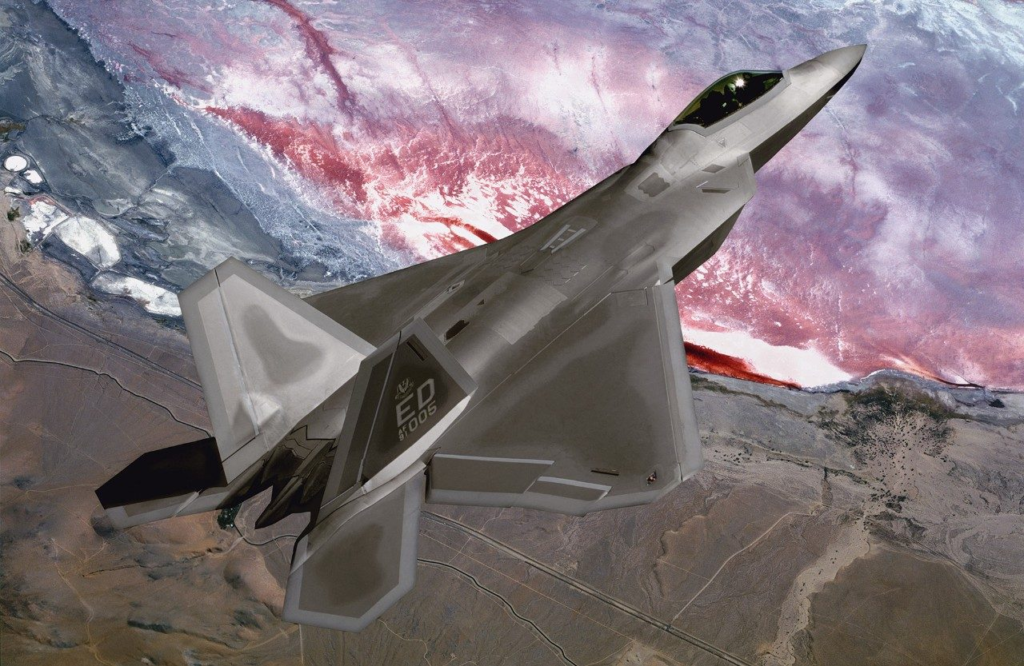
The Boeing F-47 (the Air Force’s sixth-generation Next Generation Air Dominance fighter) is the F-22’s designated successor. Selected in March 2025 under the NGAD program, the F-47 will incorporate everything learned from two decades of F-22 operations, with a sixth-generation avionics architecture, improved stealth at all frequencies, greater range, and the ability to command larger formations of autonomous CCA wingmen. Its estimated entry to service is the mid-2030s.
The strategic concern that surrounds the F-47 is identical to the one that produced the F-22’s small fleet: the plan is to build approximately 185 F-47s, a one-for-one replacement of the F-22. A February 2026 Mitchell Institute report by the USAF Academy explicitly warned that 185 is far fewer than the required number, that the logic of replacing a known-insufficient F-22 fleet with an equivalently-sized F-47 fleet ignores the lessons of the past twenty years, and that the United States is at risk of repeating the procurement blunder of the F-22 program with its successor.
A member of Congress familiar with the program confirmed that the one-for-one rationale is explicitly driven by budget constraints rather than operational analysis and that the formula ‘ignores the fact that the F-22 total production run was less than a third of the number we needed initially.’
The F-22’s future in the interim period is shaped by the CCA program. The aspiration of 1,000 autonomous drone wingmen commanded by 143 F-22 cockpits is not science fiction. It is the Air Force’s stated procurement goal, backed by FY2026 budget funding. If achieved, it transforms the F-22 fleet from 143 individual air superiority fighters into 143 manned command nodes each directing multiple autonomous strike and support drones, a force multiplication that partially compensates for the Raptor’s small fleet size without requiring the politically impossible restart of the production line.
FREQUENTLY ASKED QUESTIONS ABOUT F-22 RAPTOR
Q1. Has the F-22 Raptor ever been in combat?
Yes. The F-22 has been in combat multiple times, though not in the air-to-air role it was designed for. It first fired weapons in September 2014 against Islamic State ground targets in Syria. In June 2025, F-22s participated in airstrikes against Iranian nuclear facilities, suppressing S-300 air defence systems. In January 2026, F-22s helped disable Venezuelan air defences in the operation that captured President Maduro. Most significantly, F-22 Raptors participated in Operation Epic Fury against Iran from 28 February 2026, conducting nine days of combat operations with zero aircraft lost and zero successful radar locks by Iranian surface-to-air missiles.
Q2. Why were so few F-22 Raptors built?
The US Air Force originally planned to build 750 F-22s, but production was cut to 187 by Congress and the Pentagon in 2009. The decision was driven by three factors: the per-aircraft cost had risen to approximately $350 million including program costs; the Soviet Union, the threat the F-22 was designed against had collapsed in 1991; and America’s post-9/11 wars in Afghanistan and Iraq required ground attack and close air support aircraft, not air superiority fighters. Secretary of Defense Robert Gates recommended the production cap, and it has since been widely described as a strategic blunder given China’s subsequent rise as a near-peer air power competitor.
Q3. How many F-22 Raptors are combat-ready?
Of 187 production F-22s, approximately 143 are combat-coded Block 30/35 variants. Thirty-two Block 20 aircraft are training variants that cannot be deployed in combat without significant upgrades. At any given time, approximately one-third of any fighter fleet is in maintenance, suggesting around 95 F-22s are operationally available on a normal day. The Air Force has wanted to either upgrade or retire the Block 20s but has been blocked by Congress, leaving a fleet that is simultaneously too small and partially encumbered by non-combat-capable aircraft.
Q4. Can the F-22 be exported to allied nations?
No. The Obey Amendment, passed by Congress in 1998, specifically and permanently bans the export of the F-22 Raptor to any foreign nation, including the United States’ closest allies. Japan, Australia, and Israel have all expressed interest in purchasing F-22s and have all been refused. The ban is based on protecting the aircraft’s stealth technology and source codes. This export prohibition has prevented the F-22 program from benefiting from the international cost-sharing that has made the F-35 program economically sustainable.
Q5. What is the F-22 Raptor’s radar cross-section?
The F-22 Raptor’s radar cross-section is classified, but is widely estimated at approximately 0.0001 square meters, roughly equivalent to the radar return of a steel marble, or a large metal ball bearing. This makes it roughly 100,000 to 250,000 times smaller than a typical 4th-generation fighter. The aircraft maintains this low observability from all aspects; frontal, lateral, and rear making it extremely difficult to detect with any current radar technology. Its all-aspect stealth was validated in Operation Epic Fury when Iranian S-300 and Bavar-373 systems launched dozens of missiles and achieved zero radar locks on any F-22.
Q6. What replaced the F-22 Raptor?
The F-22 has not yet been replaced. Its designated successor is the Boeing F-47, the Air Force’s sixth-generation Next Generation Air Dominance (NGAD) fighter, selected in March 2025. The F-47 is not expected to enter service until the mid-2030s. The plan is to build approximately 185 F-47s as a one-for-one replacement for the F-22 fleet, a procurement decision that military analysts have criticized as repeating the same mistake that limited the F-22 to only 187 aircraft. The F-22 will remain in service alongside early F-47s through the late 2030s.
Q7. How fast is the F-22 Raptor?
The F-22 Raptor has a maximum speed of approximately Mach 2.25 with afterburner. More significantly, it is one of the very few fighters in the world capable of super cruise, sustained supersonic flight at approximately Mach 1.5 to 1.8 without using its afterburners. This super cruise capability allows the F-22 to reach combat areas faster, conserve fuel, and maintain a lower infrared signature compared to afterburner-dependent supersonic flight. Combined with its service ceiling of approximately 65,000 feet, the F-22 operates in an altitude-speed envelope that adversary fighters cannot easily match.
Q8. What is the F-22’s kill ratio in exercises?
The F-22 has achieved a 144-to-0 kill ratio in training exercises against opposing forces of advanced 4th-generation fighters. During the Northern Edge 2006 exercise, a small group of Raptors defeated large opposing air forces without suffering a single simulated loss. US Air Force assessments credit the F-22 with far greater effectiveness than any other air superiority fighter in beyond-visual-range combat, attributing this to its sensor fusion, stealth-enabled first-shot advantage, and supercruise capability. These exercise results have not been replicated by any other aircraft against comparable opposition.
Q9. How does the F-22 compare to the J-20?
Individual aircraft quality comparisons generally favour the F-22. Its stealth is assessed as superior, its sensor fusion more mature, and its BVR kill probability against the J-20 is assessed favourably in US simulations. However, China produces approximately 30 to 40 J-20s per year against zero F-22 production, and the numerical balance is therefore worsening continuously. The integration of the AIM-260 JATM, specifically designed to out-range the J-20’s PL-15 missile will maintain the F-22’s qualitative edge in BVR combat. The strategic concern is not individual aircraft quality but fleet size: 95 operationally available F-22s against a growing J-20 fleet creates a numbers problem that quality alone cannot solve in a prolonged conflict.
Q10. What upgrades is the F-22 Raptor receiving in 2026?
The F-22 is undergoing a comprehensive modernisation programme worth approximately $9 billion. Key elements include: AIM-260 JATM integration to outrange the Chinese PL-15 missile; a distributed Infrared Search and Track (IRST) system for passive detection; the Low Drag Tank and Pylon (LDTP) programme providing 600-gallon stealth tanks extending range by 850 nautical miles (operationally validated in Operation Epic Fury); Link 16 connectivity for two-way data sharing with legacy aircraft (fleet-wide by FY2027); and Collaborative Combat Aircraft integration allowing each F-22 to command autonomous drone wingmen from 2026 onwards.
CONCLUSION: MAGNIFICENCE CONSTRAINED BY MATHEMATICS
The F-22 Raptor’s story is the story of a weapon that is almost everything its designers promised, deployed in numbers that are almost nothing like what sound strategy required. The aircraft itself is extraordinary. Its 144-to-0 exercise kill ratio is not marketing mythology, it is a consistent operational finding validated by pilots from allied nations who have flown against it and described the experience as uniquely humbling. Its performance in Operation Epic Fury in early 2026, nine days of combat over one of the world’s most heavily defended airspaces, zero losses, zero radar locks is the most definitive validation a stealth aircraft has ever received in real-world contested conditions.
And yet the F-22’s career has been shaped not by its capabilities but by their absence. The absence of 563 aircraft that should have been built but were not. The absence of the peer adversary that would have justified its full employment for the first fifteen years of its service life. The absence of the export program that would have made it economically sustainable. The absence, still, of the air-to-air combat it was designed for, the fight against a near-peer adversary’s 5th-generation fighters over contested airspace where the full weight of the F-22’s capabilities would be brought to bear against opponents capable of genuinely threatening it.
That fight may yet come. China’s J-20 fleet is growing. The Taiwan Strait’s status is contested. The F-22’s ongoing deployment to the Indo-Pacific, the completion of its AIM-260 integration, the activation of its drone wingman capability, and the hard lessons of Operation Epic Fury have produced an aircraft that, in 2026, is demonstrably better than it was in 2005. The Super Raptor is not a nostalgic upgrade of an ageing platform. It is the world’s most capable air superiority fighter, continuously improved, being prepared for the conflict it was always meant to fight.
Whether 95 operationally available aircraft are enough to win that conflict if it comes is a question that no upgrade programme, no drone wingman capability, and no amount of qualitative superiority can answer with confidence. The F-22 Raptor may be America’s greatest fighter. Whether it is America’s greatest strategic mistake or its greatest undeployed asset depends entirely on what happens next and on whether the F-47 program learns the only lesson the F-22’s history has to teach: build enough of the best, or the best is not enough.
About Armorexa
Armorexa is a military intelligence and defence analysis platform delivering in-depth, rigorously researched analysis across weapons systems, warfare technology, military history, and strategic doctrine. This article was last updated April 2026 and reflects the most current publicly available operational and technical data on the F-22 Raptor programme.