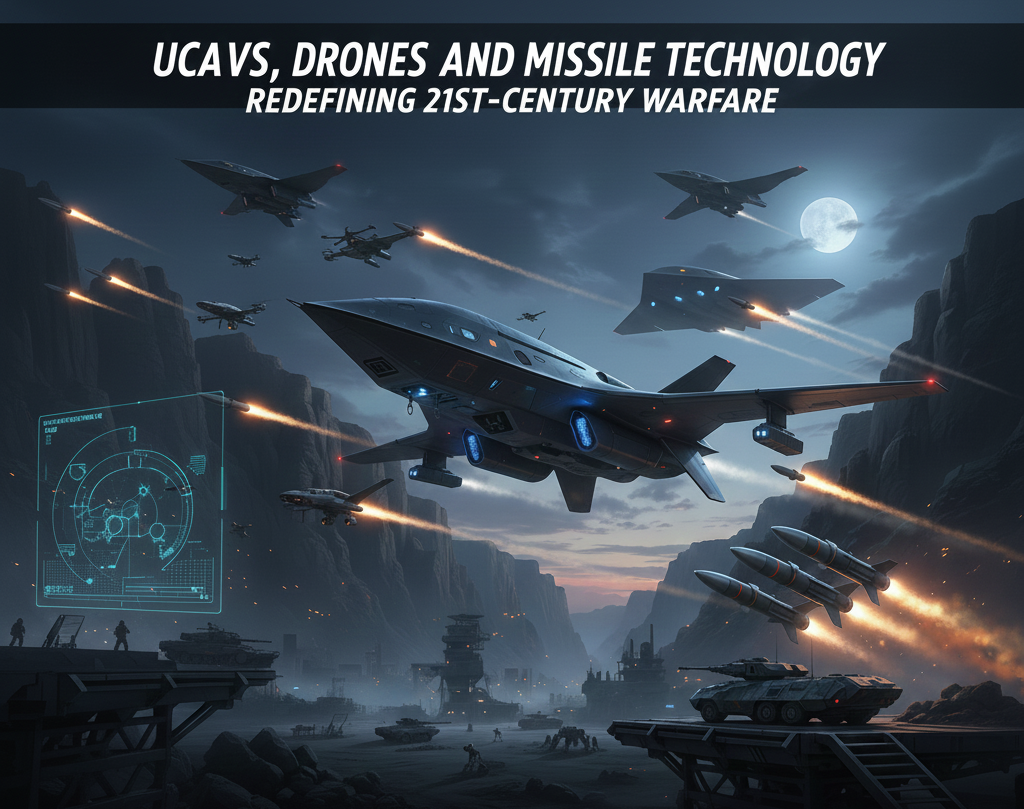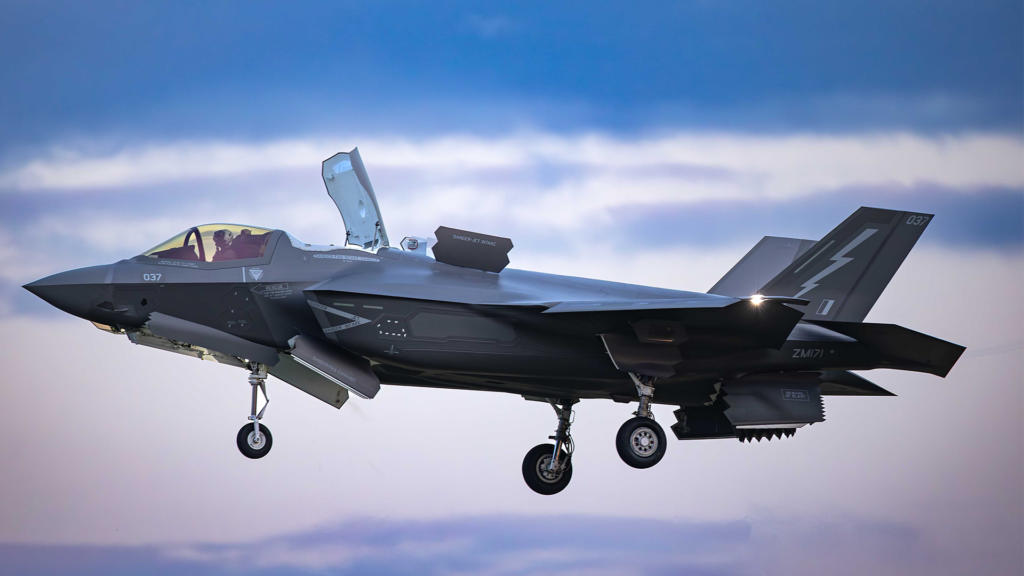
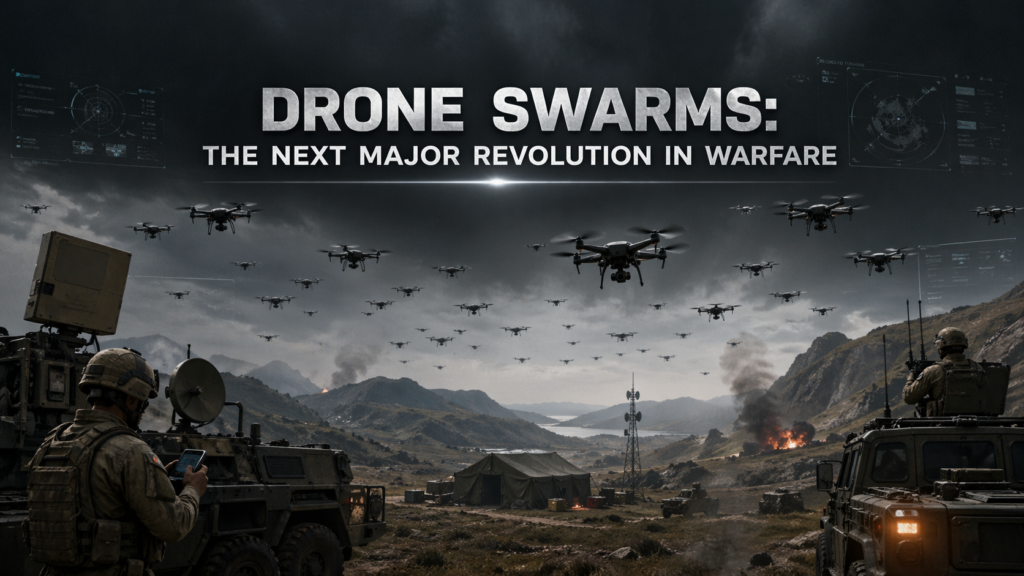
How Autonomous Drone Swarms Are Rewriting the Rules of Modern Combat
From Ukraine’s 9,000-Drone Days and Turkey’s First Live-Fire Swarm Kill to China’s Flying Mothership and the Pentagon’s $13.4 Billion Bet: The Complete Military Analysis
KEY FACTS AT A GLANCE
- Ukraine deploys ~9,000 drones per day against Russian forces as of early 2026, more than a million sent to frontline units in a single year.
- China’s Jiutian mothership completed its maiden flight on 11 December 2025; a 16-tonne UAV designed to release over 100 autonomous attack drones from 50,000 feet.
- Turkey’s Kargu-2 conducted the world’s first verified live-fire autonomous swarm strike with real warheads on 27 January 2026.
- AUKUS AWE26 (April 2026): US, UK, and Australian forces achieved the first real-time cross-national drone swarm data-sharing network in operational testing history.
- The Pentagon’s FY2026 budget dedicates $13.4 billion specifically to autonomous systems, the first time in US military history this has appeared as a standalone funding category.
- 80% of combat casualties on both sides of the Ukraine war are now attributed to drones per CBS News / 60 Minutes reporting, April 2026.
Drone swarms are not coming. They are already here, and they are already killing people. On any given day in 2026, Ukrainian drone operators sitting behind screens in hardened bunkers are releasing waves of coordinated First-Person View drones that hunt Russian armor across the eastern front with a precision and relentlessness no human attacker can match. In a January 2026 live-fire demonstration that went largely unreported outside specialist defense circles, twenty Turkish Kargu-2 quadcopters autonomously navigated toward a target zone, maintained formation through continuous inter-drone communication, and struck in a coordinated kinetic attack without a single instruction from a human operator after launch.
In April 2026, soldiers from Britain, Australia, and the United States completed the Army Warfighting Experiment 2026, establishing for the first time a common machine-language network through which drone swarms from three different nations could share targeting intelligence in real time across a unified battlefield picture. The age of drone swarms has not arrived with a press conference or a Treaty signing. It has arrived the same way every genuine military revolution arrives through thousands of incremental battlefield decisions made by engineers, soldiers, and commanders who are too busy solving immediate problems to pause and announce that the rules have changed.
The rules have changed. And the implications ripple outward from the individual FPV operator in a Ukrainian trench to the naval war-planners in Washington contemplating what an aircraft carrier is worth in a world where China’s Jiutian mothership can release 100 autonomous attack drones from the stratosphere at standoff range.
This is a definitive analysis of drone swarms in 2026, not a speculative preview of tomorrow’s technology, but a rigorous, evidence-based examination of what is happening right now, on real battlefields, in real laboratories, and in real budget documents. We cover the science and engineering of swarm intelligence, the operational lessons from Ukraine and beyond, the global race between the United States, China, Russia, and their allies, the counter-swarm response, the ethical and legal precipice humanity is approaching, and the trajectories that will define this domain through 2030 and beyond.
WHAT ARE DRONE SWARMS? BEYOND THE BUZZWORD
The Precise Military Definition
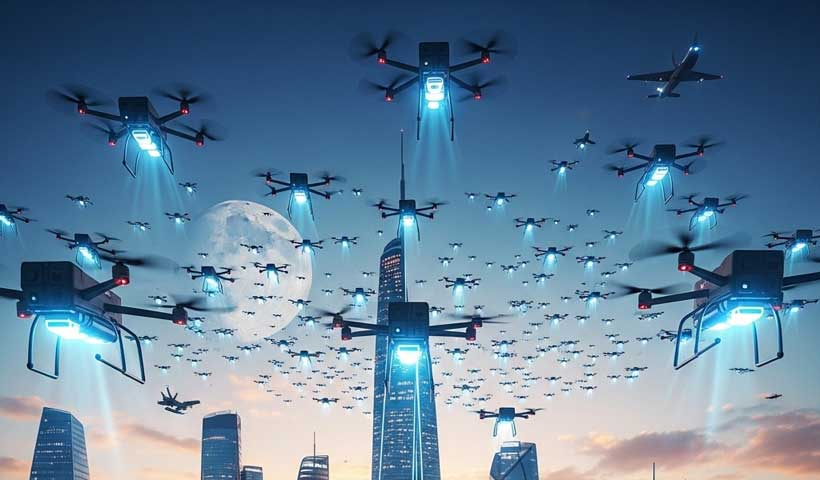
The term drone swarm is used loosely in popular media to describe any large-scale drone deployment, but its precise military meaning is significantly more specific and significantly more alarming. A drone swarm, as defined in US and NATO doctrine, is a coordinated group of unmanned aerial vehicles in which the collective behavior of the group is governed by distributed algorithms rather than by direct individual human control of each unit. The critical distinction is not the number of drones but the nature of their coordination: a swarm thinks collectively. Individual units respond to their immediate environment and to the signals of their neighbors, and the complex, adaptive behavior of the whole group emerges from these local interactions.
This architecture is borrowed from biology. The murmuration of starlings, thousands of birds moving as a single fluid entity without any individual leader is not choreographed from above. Each bird follows three simple rules: maintain proximity to your neighbors, avoid collisions, and align your direction with theirs. The emergent result is a collective intelligence that can respond to predators, change direction instantaneously across the entire group, and absorb the loss of individuals without fragmenting. Military swarm designers are engineering exactly this quality into weapons systems: collective resilience, emergent complexity, and distributed decision-making that cannot be neutralized by destroying any single node.
The operational spectrum of drone swarm capability runs from the relatively simple to the genuinely terrifying. At one end: multiple drones flying pre-programmed approach routes that happen to arrive simultaneously at a target, overwhelming a point defence by sheer numerical convergence. At the other end: fully autonomous swarms in which each unit independently identifies threats and targets, communicates this information to its neighbours in milliseconds, dynamically allocates engagement responsibilities across the group, elects a new coordination node if the previous one is destroyed, and continues its mission even when GPS is jammed and communications are severed. The first end of this spectrum has already been operationally deployed. The second end is close enough that the world’s most sophisticated military programmes are treating it as a near-term planning assumption rather than a distant contingency.
Why Drone Swarms Change Everything
Every previous military revolution, the introduction of the longbow, the cannon, the machine gun, the tank, the aircraft, the nuclear weapon changed the balance of power between specific types of forces. Drone swarms are different in kind, not just in degree, because they simultaneously attack three constraints that have governed military operations since the beginning of organized warfare: the cost constraint, the manpower constraint, and the attritional mathematics of defense.
The cost constraint: a single Patriot interceptor missile costs approximately $3 to $4 million. A Shahed one-way attack drone costs approximately $20,000 to $40,000. A Ukrainian FPV drone costs as little as $400. When an attacking swarm forces a defender to expend interceptors at a 10-to-1 or 100-to-1 cost ratio, the defender’s ammunition inventory depletes catastrophically faster than the attacker’s production capacity. This is not a tactical problem. It is a strategic one, and it has no solution within the current missile-based air defence paradigm.
The manpower constraint: historically, the number of weapons that could be simultaneously directed against a target was limited by the number of human operators available. Swarm software dissolves this constraint. Sweden’s Saab system, tested in March 2025, demonstrated a single operator controlling 100 drones simultaneously. The Pentagon’s Orchestrator challenge is seeking systems that allow a commander to direct hundreds of heterogeneous drones across multiple mission types using plain-language instructions. Ukraine’s Swarmer platform has enabled a three-person team to manage missions that previously required nine operators. The force multiplication mathematics of autonomous coordination have no theoretical ceiling.
The attritional mathematics: traditional air defences are designed around the assumption that each incoming threat requires a dedicated engagement solution. A swarm of 200 drones presenting simultaneous targets from multiple vectors at varying altitudes overwhelms any air defence system that must engage targets one at a time. The mathematics of saturation guarantee that if a swarm is large enough relative to the defender’s interceptor inventory, some portion of the swarm will reach its target. No individual drone needs to be survivable. The swarm is survivable as a collective even when most of its members are destroyed.
The drone swarm does not need to be invisible. It does not need to be fast. It does not need to be sophisticated. It needs to be numerous, coordinated, and cheap enough that the defender runs out of interceptors before the attacker runs out of drones. Ukraine has proven this arithmetic works at scale. China is building it at civilisational scale.
THE ENGINEERING AND SCIENCE BEHIND SWARM INTELLIGENCE
AI at the Heart of the Swarm
The engineering that makes drone swarms genuinely dangerous as opposed to merely numerous is the convergence of miniaturized AI processing with mesh networking and computer vision. Each drone in an advanced swarm carries an onboard processor running deep-learning models trained on millions of images of battlefield objects: vehicles, radar installations, personnel, buildings. The AI does not merely help the drone navigate; it allows the drone to understand what it is looking at and make targeting decisions in milliseconds without reference to a human operator or an external database.
A landmark demonstration of how rapidly this capability is maturing came from a Ukrainian company called The Fourth Law, which developed an AI terminal-guidance module costing approximately $70 that, when integrated into a standard commercially available FPV drone, increased first-shot strike accuracy from roughly 20 percent to 80 percent. The module takes autonomous control of the drone in the last seconds of its attack run, making micro-corrections to the flight path based on real-time visual processing of the target. No GPS required. No communications link required. No human in the loop at the moment of strike. At $70 per unit, this is not exotic military technology. It is commercially accessible autonomous lethal capability, and it is already deployed in an active war zone.
At the collective level, swarm AI operates through mesh networking: a radio-frequency architecture in which every drone simultaneously serves as a communication node and a relay, routing information through whichever members of the swarm are available at any given moment. Unlike hub-and-spoke systems in which all drones communicate through a central controller that represents a single point of failure, a mesh network heals around losses automatically. Destroy the swarm leader and another unit assumes coordination. Jam one frequency band and the swarm frequency-hops to another. The architecture is deliberately modelled on the internet’s original ARPANET design philosophy: route around damage.
The Anti-Jamming Breakthrough
The development that has most alarmed Western counter-swarm planners is the claimed anti-jamming capability of China’s PLA swarm systems. In January 2026, China’s National University of Defense Technology demonstrated a 200-drone swarm controlled by a single soldier that, according to researchers, could autonomously plan flight paths and maintain coordinated operation even under active electronic warfare jamming. CCTV footage showed each drone capable of switching between mission types autonomously; reconnaissance, strike, decoy in response to environmental conditions, without restoring communications to a human operator.
If this anti-jamming claim is validated in contested real-world conditions, it represents a fundamental shift in the defensive calculus. Electronic warfare has been the first and most scalable line of defense against drone attacks precisely because most drone platforms are dependent on communications links for navigation and targeting.
A swarm that operates reliably without those links navigating by inertial reference and visual processing, coordinating by direct inter-drone radio communication across multiple frequency bands removes the primary non-kinetic response option from a defender’s toolkit. The sceptic’s note is valid: CCTV demonstrations occur in controlled conditions with no one shooting back. The gap between a Beijing laboratory and a contested battlefield has humbled defense programs from every nation. But the trajectory is clear and the engineering logic is sound.
Ground Robots Enter the Swarm
The swarm concept is no longer confined to the air domain. In early 2026, IEEE Spectrum’s April print issue documented thousands of ground robots crawling the grey zone of the Ukrainian front line. Most deliver supplies or evacuate wounded unglamorous but operationally essential roles that preserve human lives. But some are armed. Ukrainian authorities released a video in February 2026 of a wheeled ground robot using its thermal camera to detect a Russian soldier in darkness and kill him with a burst from a heavy machine gun. This was not a prototype test. This was an operational deployment on an active front line. The extension of swarm coordination principles to ground robots potentially allowing networked swarms of aerial and ground platforms to operate in concert, the aerial elements providing ISR and fire support while ground elements exploit gaps, represents the next frontier in autonomous warfare architecture.
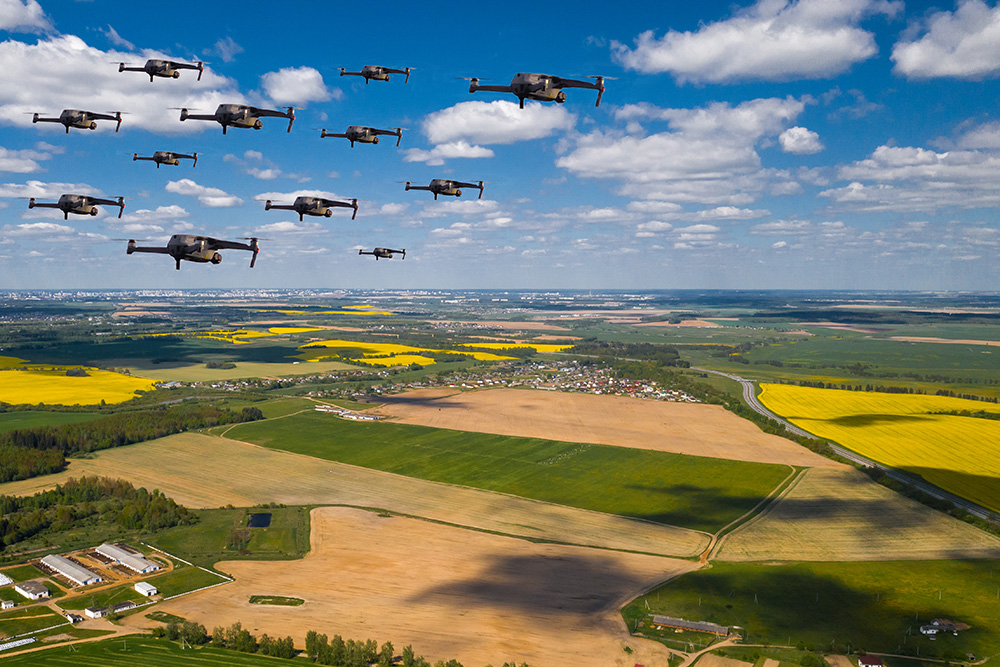
THE BATTLEFIELD LABORATORY: UKRAINE IN 2026
The Scale That Redefines Everything
No academic exercise or laboratory demonstration has done more to accelerate the world’s understanding of drone warfare than Russia’s invasion of Ukraine. The numbers alone are staggering and deserve to be read slowly: Ukraine deploys approximately 9,000 drones per day. Ukraine has approximately 500 domestic drone manufacturers. Ukraine produces up to 200,000 FPV drones per month. President Zelensky declared Ukraine capable of manufacturing 4 million drones annually. Russia has stabilised production of its Shahed one-way attack drone at approximately 5,000 units per month, while establishing a dedicated military unit for unmanned systems with 80,000 personnel and a stated goal of 210,000 by 2030.
These are not statistics from a distant future scenario. They describe the current operational tempo of a conflict that has been running continuously since February 2022 and which, as of April 2026, shows no sign of resolution. Every military on Earth is studying this data with urgent attention, because Ukraine is providing what no wargame, simulation, or peace-time exercise can provide: a real-time, high-tempo, live-fire test of drone warfare doctrine, technology, and industrial capacity against a near-peer adversary.
The Kill Zone and What It Means for Every Army
The most operationally significant lesson from Ukraine is one that every Western military planner has heard but is only beginning to truly internalize: the battlefield kill zone. As CBS News’ 60 Minutes reported in April 2026, approximately 80 percent of combat casualties on both sides are now caused by drones. The front line has expanded into a ten-mile-wide hunting ground in which any movement by military vehicles, equipment, or personnel is subject to detection by persistent drone surveillance and rapid strike response. The concept of a safe rear area, a zone behind the front line where troops and logistics could move with relative security has been structurally destroyed.
In a March 2026 exercise reported by The Wall Street Journal and Ukrainian military sources, ten Ukrainian drone operators from the 412th Nemesis and Rarog brigades, supported by an Estonian UAS unit, located NATO columns using ISR drones and over twelve hours knocked out 17 armored vehicles, rendering two NATO battalions combat ineffective using dummy rounds in a simulated engagement. Ten operators. Two battalions. The implication for conventional mechanized warfare doctrine is not subtle. The armored assault that has been the centerpiece of NATO’s warfighting concept since the Cold War is now catastrophically vulnerable to a small team of drone operators with sufficient ISR coverage and an adequate supply of cheap munitions.
Operation Spiderweb and Deep-Strike Doctrine
Ukraine’s most operationally sophisticated drone campaign to date what analysts have termed Operation Spiderweb demonstrated coordinated multi-axis deep-strike capability against Russian military infrastructure hundreds of kilometers inside Russian territory. The operation employed waves of drones along coordinated approach corridors, using decoy drones to pre-saturate and deplete Russian air defenses before the primary strike wave arrived, and exploiting real-time intelligence to redirect strike elements toward the highest-value targets as the operation evolved.
Russian warplanes parked at airfields deep inside Russia were destroyed in their shelters. This was not a lucky strike by a single drone that slipped through. It was a planned, coordinated swarm operation that achieved strategic effects.
The operational intelligence derived from Spiderweb is that drone swarm tactics, even with relatively modest individual platforms, can achieve results previously requiring manned deep-strike aircraft with substantially greater risk to human crew and political cost of loss. Ukraine has effectively demonstrated an asymmetric air power capability that it funded not with a defence budget capable of procuring F-35s but with ingenuity, software, and commercially available hardware.
The Honest Failure Record: What Ukraine Also Reveals
Any credible analysis of drone warfare must include the failures, and Ukraine has provided those too. Anduril Industries, the $30.5 billion Silicon Valley defence startup founded by Palmer Luckey, faced public scrutiny in late 2025 over a series of high-profile failures: Ukrainian forces abandoned the company’s Altius loitering drones after repeated crashes and target misses in 2024. More than a dozen Anduril autonomous drone boats failed during US Navy exercises off the California coast.
A 22-acre fire was sparked by a malfunctioning counter-drone system during testing. These failures are instructive precisely because they come from one of the most well-funded and hyped autonomous weapons programmes in the world. The gap between a convincing investor demonstration and reliable battlefield performance remains real, significant, and often life-threatening.
The lesson is not that autonomous swarm technology does not work. It is that the technology is maturing unevenly, that field conditions impose demands that no laboratory can fully anticipate, and that the organizations most likely to succeed in this space are those that iterate rapidly under real operational conditions which is exactly what Ukraine’s domestic drone industry has been doing, at a pace and under conditions of genuine necessity that no US defense prime can replicate in a test range in Nevada.
Ten Ukrainian drone operators knocked out 17 armoured vehicles and rendered two NATO battalions combat ineffective in a single exercise. That is not a capability gap. That is a doctrinal crisis. Every army that still plans to win wars by moving armour across open ground needs to reckon with what happened in that exercise.
THE GLOBAL RACE: WHO IS WINNING AND WHERE
The United States: Ambition, Budget, and the Orchestrator Problem
The United States entered 2026 with the most significant restructuring of its autonomous systems strategy in history. The Pentagon’s FY2026 budget dedicated $13.4 billion specifically to autonomous systems, a figure that, for the first time, appears as a standalone funding category rather than being distributed across service procurement lines. The Navy alone requested $5.3 billion for unmanned systems, a $2.2 billion increase over FY2025. The US Marine Corps is acquiring 10,000 new drones. The Air Force is creating specialized drone swarm units.
The Replicator initiative restructured under the Defense Autonomous Warfare Group (DAWG) after missing its August 2025 delivery milestone — remains the conceptual centerpiece of US swarm strategy. Its philosophy is a deliberate inversion of America’s traditional weapons procurement approach: instead of investing in small numbers of exquisite, expensive platforms, Replicator seeks to flood the battlefield with thousands of cheap, autonomous systems whose collective effect overwhelms adversary defenses through volume and coordination rather than individual platform superiority.
In January 2026, DAWG and the Defence Innovation Unit announced the $100 million Orchestrator Prize Challenge, seeking the technology that bridges the gap between having thousands of drones and being able to use them effectively: a system that allows a single human commander to direct heterogeneous drone fleets multiple types from multiple manufacturers using plain-language commands expressing desired effects, constraints, and priorities.
General Frank Donovan articulated the requirement precisely: commanders need to work the way they already command, not by clicking through menus or programming drone behaviours. This human-machine interface problem is the decisive bottleneck between current US drone inventories and genuine swarm warfare capability. Solving it is what the Pentagon spent $100 million to find in 2026.
The March 2026 Crucible event pushed further, testing ‘end-to-end autonomous completion’ of mission sets under the Find, Fix, Finish concept: swarms that can independently locate, fix, and engage targets across ISR and strike missions, with AI agents autonomously coordinating role assignments among robotic systems in decentralised architectures designed to survive the loss of any individual component.
China: The Jiutian Mothership and Civilisational-Scale Production
China’s approach to drone swarm development is best understood not as a military programme but as a civilisational project. The Chinese Communist Party has directed the full weight of China’s state-industrial capacity toward autonomous systems dominance, combining the manufacturing scale of the world’s largest factory economy with the research infrastructure of its most rapidly expanding university system and the software talent of its technology sector. The results, in 2025-2026, have been breathtaking in scope.
The crown achievement is the Jiutian, meaning High Sky drone mothership, which completed its maiden flight on 11 December 2025 at Pucheng, Shaanxi Province. Developed by the state-owned Aviation Industry Corporation of China, the Jiutian is a 16-tonne unmanned aircraft with a 25-metre wingspan, a payload capacity of 6,000 kilograms, an operational endurance of 12 hours, and a ferry range of 7,000 kilometers. Its purpose is unmistakable: Chinese state television broadcast concept footage of the Jiutian releasing cascades of hundreds of autonomous attack drones from its internal bay at 15,000 meters, the swarm then coordinating to overwhelm US Navy carrier battle groups while land-based PLA missile barrages struck simultaneously. This is not ambiguous strategic communication. China is building a platform specifically designed to defeat America’s most powerful naval asset in a Taiwan Strait scenario.
The PLA’s National University of Defence Technology demonstrated a 200-drone swarm controlled by a single soldier in January 2026, with claimed anti-jamming capabilities. Beijing has simultaneously initiated a programme to field one million tactical UAVs by 2026. The Centre for Naval Analyses estimates that the Jiutian, if deployed in formations of ten aircraft at full drone complement, could release over 1,000 simultaneously coordinated autonomous attack drones against a single carrier battle group, a saturation level for which no current US naval defence system is optimised or even designed.
Russia: The Shahed Economy and the Attritional Model
Russia’s drone strategy has consciously prioritized volume over sophistication, and the Ukraine conflict has provided it with an exceptionally demanding real-world test environment. Shahed production has stabilized at approximately 5,000 units per month, providing a sustained supply of low-cost strike weapons that have caused cumulative damage to Ukrainian infrastructure through repeated mass-saturation attacks that no available air defense system has been able to fully neutralize. The Lancet loitering munition has proven operationally effective against specific high-value targets artillery systems, radar installations, armored vehicles demonstrating that precision within an attritional doctrine is achievable with semi-autonomous systems at moderate cost.
Russia’s establishment of a dedicated military unit for unmanned systems, planned to expand from its current 80,000 personnel to over 210,000 by 2030, signals that Moscow’s post-Ukraine military reorganization places autonomous systems at the center of its future warfighting capability, not as a supplementary capability to complement conventional forces, but as a primary warfighting arm in its own right.
The AUKUS AWE26 Milestone: Allied Swarms Talk to Each Other
In April 2026, the British Army published the results of the Army Warfighting Experiment 2026, which represented a genuine milestone in the history of coalition drone warfare. For the first time, drone swarms from three different nations, the United States, the United Kingdom, and Australia, the three AUKUS partners achieved real-time cross-national data sharing through a common machine-language network. As a British Army spokesperson described it: ‘Just as we speak English to one another, machines need common languages to work together effectively.’ When a British swarm collected intelligence, that information was instantly shared with American and Australian drone networks without human relay or translation delay.
AWE26 also confronted the most philosophically difficult dimension of swarm warfare: how to keep humans in control when machines are making decisions and communicating with each other at speeds that exceed human reaction time. The AUKUS solution giving swarms clear rules of engagement that must be agreed across three different national legal frameworks before any autonomous action is taken, is the coalition’s answer to the autonomous lethal force dilemma. It is also a signal that the Western alliance is beginning to treat drone swarms not as a future research program but as an operational capability that requires current command-and-control doctrine.
Turkey’s Kargu-2: The First Live-Fire Autonomous Swarm Strike
January 27, 2026 is a date that deserves to be in every military history textbook. On that day, Turkey’s defence company STM conducted the first verified live-fire test of a rotary-wing loitering munition swarm using real warheads rather than simulated effects. Twenty Kargu-2 quadcopters, launched simultaneously from a ground control station, autonomously navigated toward the designated target area, maintained formation through continuous inter-UAV communication and collision-avoidance protocols, and executed a coordinated kinetic strike without a centralised command node and without relying on a continuous communications link to a human operator after launch.
The Kargu-2 has a troubled history. A UN Panel of Experts report from March 2021 documented what appeared to be the world’s first autonomous lethal strike in combat, when a Kargu-2 reportedly hunted down and attacked retreating Libyan National Army forces in 2020 in fire-forget-find mode. The January 2026 test was different: this was not an ambiguous incident in a chaotic conflict but a deliberate, documented, publicly acknowledged demonstration that autonomous swarm lethality is not a laboratory concept. It is a delivered, exportable, commercially priced capability that Turkey is actively marketing to nations that cannot afford and are not eligible for American Patriot batteries or Israeli Iron Dome systems. The proliferation implications are severe.
| Nation | Key Programme | Current Scale | Strategic Focus | 2026 Status |
| USA | Replicator / DAWG / Orchestrator | $13.4B FY26; 50K UAS in 2025 | AI orchestration, autonomous kill chain | Crucible testing March 2026 |
| China | Jiutian / Million-UAV programme | 1M+ tactical UAVs targeted | Carrier group saturation / Taiwan | Jiutian first flight Dec 2025 |
| Ukraine | Domestic FPV / Swarmer software | 9,000 drones/day; 4M/yr | Battlefield attrition, deep strike | Fully operational |
| Russia | Shahed / Lancet / UAS force | 5,000 Shaheds/month; 80K personnel | Mass attrition, infrastructure | Expanding to 210K by 2030 |
| Turkey | Kargu-2 swarm / Bayraktar | 20-unit live fire Jan 2026 | Export market, asymmetric deterrence | First live swarm strike Jan 2026 |
| AUKUS | AWE26 cross-national network | Multinational swarm data link | Coalition interoperability | Achieved April 2026 |
| France | Pendragon project (Thales) | First combat unit 2027 | AI combined-arms autonomy | Demo 2026 planned |
| Sweden | Saab 100-drone control | 1 operator / 100 drones | NATO interoperability | Tested March 2025 |
TACTICAL DIMENSIONS: HOW DRONE SWARMS CHANGE THE FIGHT
Saturation: The Mathematics of Overwhelm
The tactical foundation of swarm warfare is saturation, presenting more simultaneous threats than a point defense system has the capacity to engage. Every air defence system ever built has three finite limits: the number of missiles in its interceptor magazine, the number of radars tracks it can maintain simultaneously, and the rate at which it can generate and launch engagement solutions. A swarm that exceeds any one of these limits’ forces through. A swarm that exceeds all three simultaneously is effectively unstoppable by that system alone.
The cost asymmetry compounds the tactical problem into a strategic one. A Patriot PAC-3 missile costs approximately $4 million per shot. A Shahed drone costs $20,000 to $40,000. An FPV drone costs $400. When a defender expends a $4 million interceptor against a $400 drone, the attacker can field 10,000 attack drones for the cost of a single defensive engagement. Multiply this across the duration of a sustained campaign and the defender’s inventory depletes catastrophically. This is not a hypothetical scenario. It is the operational reality that Ukraine’s air defence network has faced continuously since 2022, and which has driven the desperate search for directed-energy counter-swarm systems capable of engaging drones at costs measured in electricity rather than inventory.
Distributed Sensing: The Swarm as an Intelligence Machine
The strike function of drone swarms generates most of the headlines, but their intelligence function may be more strategically significant. A swarm of drones distributed across a contested area creates a persistent, multi-angle, multi-spectral surveillance network of extraordinary richness and granularity. Individual units can be assigned specialized sensing roles, optical reconnaissance, signals intelligence collection, communications relay while others perform strike or electronic attack functions. The aggregated intelligence picture that emerges from a coordinated swarm is more current, more geographically comprehensive, and more tactically actionable than any combination of traditional ISR assets.
This is precisely what the Ukrainian drone operators demonstrated in the March 2026 exercise against NATO forces: ISR drones populated their battle management systems with the positions of NATO armored columns before a single strike drone was deployed. The strike function only worked because the intelligence function had already worked. The swarm saw the target before the target knew it was being watched. This sequence, pervasive ISR enabling rapid precision strike is the defining operational cycle of modern drone warfare and the primary reason why large-scale armored maneuver has become catastrophically costly in drone-saturated environments.
Multi-Domain Convergence: Air, Sea, Ground
Drone swarms are no longer exclusively an air domain phenomenon. China’s PLA conducted exercises in the summer of 2025 that tested coordinated swarms of unmanned surface vessels alongside aerial drone swarms, presenting a layered challenge to US carrier battle group defenses that taxes different defensive systems simultaneously from different domains. Ukraine’s ground robot deployments in early 2026, thousands of wheeled platforms crawling the grey zone, some armed with machine guns extend the swarm concept to the surface domain. NATO’s SeeByte programme has been developing secure swarm operation methods for the Royal Navy’s undersea domain since 2023.
The tactical logic of multi-domain swarm convergence is straightforward: an adversary’s defences are optimised for specific domains. Naval air defence systems are not designed to simultaneously counter aerial, surface, and subsurface drone attacks at scale. Ground force air defence systems are not designed to manage swarms arriving from three directions at once while ground robots probe their perimeter. The simultaneous multi-domain swarm attack, aerial swarms from the Jiutian, surface swarms from naval USVs, subsurface swarms from UUVs, ground swarms from robotic vehicles is the nightmare scenario that is not yet deployable at full scale but for which the engineering foundations are being actively laid.
The Psychological Dimension of Drone Warfare
Military planners often overlook the psychological dimension of drone warfare because it is difficult to quantify, but French military observers of Ukrainian operations have consistently identified it as one of the most operationally significant aspects of the conflict. The persistent presence of aerial surveillance means concealment is never certain. The silence of approaching FPV drones means attack can arrive without audible warning. The relentlessness of wave attacks, wave after wave, throughout the day and night, with no human opponent to deter, negotiate with, or read for intention imposes a form of psychological stress that military psychology frameworks built around conventional combat are poorly equipped to address.
U.S. Army Captain Ronan Sefton, serving on the Ukraine Lessons Learned Task Force, described the psychological weight of swarm operations in the CBS News reporting: a drone swarm takes cognitive load away from a human pilot and distributes it across autonomous systems that do not fatigue, do not hesitate, do not experience fear, and do not make the kind of errors that human exhaustion produces. Against soldiers operating under combat stress with degraded sleep and sustained artillery and drone pressure, this asymmetry in cognitive burden is not merely a tactical advantage. It is a weapon in its own right.
COUNTER-SWARM WARFARE: DEFENDING AGAINST THE SWARM
Electronic Warfare: The First Line That Is Failing
Electronic warfare, GPS jamming, communications disruption, spoofing has been the most scalable and cost-effective first response to drone attacks since the Ukraine war began. Russian jamming systems have forced Ukrainian drone operators to develop increasingly sophisticated navigation solutions that do not rely on GPS. Ukrainian EW systems have disrupted Russian drone attacks with meaningful effect. The problem, as China’s January 2026 swarm demonstration illustrated, is that the most capable swarm systems are being specifically engineered to defeat electronic countermeasures.
A swarm that navigates by inertial reference and computer vision, coordinates by frequency-hopping mesh radio that cycles faster than a jammer can follow, and whose onboard AI can plan alternative flight paths autonomously when communications are disrupted, is a system against which electronic warfare provides limited protection.
Directed Energy: The Only Sustainable Economics
The directed-energy revolution in counter-drone warfare is not a future aspiration. It is a current acceleration. In March 2026, at the National Defense Industrial Association’s Pacific conference, US officials confirmed that directed-energy systems are ‘now approaching the maturity required for wider deployment,’ marking a transition from experimental programmes to scalable battlefield capabilities. The US military is accelerating the deployment of high-energy lasers ranging from 50 to 300 kilowatts and high-powered microwave systems capable of disrupting drone electronics across wide areas.
The economic logic is compelling. A 100-kilowatt laser can engage a drone at a cost measured in dollars of electricity. British radiofrequency directed-energy trials in 2025 demonstrated the ability to disable multiple drones simultaneously at costs described as pennies per engagement, a phrase that should be read as a doctrinal statement, not a technical curiosity. The weapon that can engage the $400 FPV drone at a cost of $0.10 fundamentally restores the cost-exchange ratio in the defender’s favour. The remaining challenges of thermal management in sustained operation, atmospheric degradation in rain and dust, the mechanical complexity of tracking multiple fast-moving targets simultaneously are engineering problems with engineering solutions. The physics work. The manufacturing is catching up.
Counter-Drone Drones and the Defensive Swarm
The most operationally innovative counter-swarm development to emerge from Ukraine is the counter-drone drone: an interceptor UAV specifically designed and priced to hunt attacking drones. Ukraine’s development of FPV interceptors costing approximately $2,500 that can successfully engage Russian Shahed drones mid-flight achieves, for the first time, a cost-exchange ratio in the defender’s favour on a per-engagement basis.
The UK’s Octopus interceptor drone programme, initiated in January 2025 with a target of thousands of units per month, industrialises this concept. The logical endpoint is the defensive swarm: an autonomous swarm of interceptors that can be released in response to an attacking swarm and engage it autonomously, drone-on-drone, at machine speed, the only system that can match the attack swarm’s tempo and scale.
Integrated Layered Defence: The Architecture That Survives
No single counter-swarm technology is sufficient. The architecture that leading militaries are converging on combines electronic warfare for the outer perimeter disrupting communications-dependent drones before they reach defended airspace; directed energy at mid-range engaging individual or small groups of drones at near-zero cost per engagement; kinetic interceptors for the highest-priority threats that penetrate the outer layers; and counter-drone drones for the close-in engagements where directed energy systems face line-of-sight limitations.
Lockheed Martin’s integrated C-UAS architecture combining the Fortem R30 radar, advanced AI track processing, and the IPG Photonics Crossbow laser weapon system represents this multi-layer philosophy in deployed form.
The insight that is still not fully integrated into most military doctrine is that C-UAS cannot be a specialist function assigned to dedicated units. In Ukraine, every echelon from company to corps is a drone target and must have organic C-UAS capability. A logistics convoy without C-UAS is a target. An artillery position without C-UAS is a target. A command post without C-UAS is a target. The distribution of C-UAS capability to every tactical unit, not as a secondary capability but as a primary survival requirement is the doctrinal revolution that Ukraine has forced and that NATO armies are only beginning to implement.
| Counter-Swarm Method | Cost Per Kill | Effective Against | Limitation | 2026 Status |
| GPS / Comms Jamming | Very Low | Comms-dependent drones | Anti-jam swarms bypass it | Widely deployed but degrading |
| High-Energy Laser (100kW+) | ~$1–10 electricity | Individual drones | Heat, weather, single-target | Accelerating deployment 2026 |
| RF Directed Energy | Pennies per kill | Multiple drones, wide area | Range, power requirements | UK tested 2025; US scaling |
| Kinetic Missiles (Patriot) | $3–4 million/shot | High-value, high-speed threats | Economically catastrophic vs swarms | Supplementary role only |
| Counter-Drone Drones (FPV) | $2,500–25,000 | Comparable attack drones | Needs industrial scale | Operational in Ukraine 2025 |
| Defensive Autonomous Swarm | Variable | Full swarm attack | Development phase | US Orchestrator 2026 |
| AI-Integrated C-UAS Network | Variable | Coordinated multi-type swarms | Integration complexity | AWE26 milestone April 2026 |
THE ETHICS, LAW, AND EXISTENTIAL QUESTIONS
The Autonomous Lethal Force Threshold
The single most consequential question in the drone swarm era is the one that military lawyers, ethicists, and strategists have been avoiding for two decades: at what point does autonomous lethal action by a machine without human authorization of each individual kill cross a legal and moral threshold that fundamentally changes the nature of war? The Kargu-2’s reported 2020 action in Libya, where the UN’s own panel of experts documented a drone system that ‘hunted down and remotely engaged’ retreating soldiers without human authorization was the first documented crossing of that threshold. The January 2026 live-fire swarm demonstration was its deliberate, publicly celebrated repetition.
Current US and NATO doctrine requires that a human maintain ‘meaningful control’ over any decision to use lethal force. But the AWE26 exercise itself exposed the operational absurdity of this requirement when applied to a 200-drone swarm attacking simultaneously from multiple vectors: there is no human cognitive process fast enough to authorise each individual engagement across a swarm operating at machine speed. The AUKUS solution, pre-authorised rules of engagement that the swarm executes autonomously within agreed constraints is a pragmatic operational compromise. It is also an admission that ‘meaningful control’ at the individual-engagement level is incompatible with swarm warfare at scale.
The International Legal Vacuum
The United Nations Secretary General, the International Committee of the Red Cross, and in December 2025, the New York Times editorial board all called for a binding international treaty on autonomous weapons to be concluded by 2026. Russia and China have resisted binding constraints. The United States has committed to maintaining human oversight while simultaneously deploying systems in which human oversight at the moment of individual engagement is physically impossible. This is not hypocrisy; it is the lived tension of a technology that is advancing faster than the ethical and legal frameworks available to govern it.
Andrew Weber, former Pentagon official responsible for nuclear, chemical, and biological defense, gave a warning in late 2025 that should be quoted in every policy brief on this subject: ‘The speed of warfare will soon outpace human ability to control it.’ Israel’s use of AI-enabled surveillance systems in Gaza, which reportedly misidentified civilians as combatants in documented incidents, provides a real-world case study of what happens when autonomous targeting systems are deployed faster than their validation is completed. The speed pressure that military commanders face, deploy now or cede advantage to adversaries who will deploy without constraint is not going to slow down. The legal vacuum is not going to be filled quickly enough.
The drone swarm era has produced a paradox that no international institution has yet resolved: the only way to defend against an autonomous lethal swarm, at the speed and scale at which it operates, may be to deploy an autonomous lethal swarm of your own. And once both sides have made that deployment, the question of meaningful human control becomes rhetorical rather than operational.
FUTURE TRAJECTORIES: WHERE THE SWARM GOES FROM HERE
Hypersonic Swarm Delivery
China has proposed a hypersonic drone carrier concept operating at Mach 5 that would deploy swarms at speeds eliminating any meaningful warning or defensive response time. A swarm released from a Mach 5 carrier at standoff range arrives over its target before most air defence engagement sequences can complete. This concept, if realised, represents the most significant advance in strike capability since the ballistic missile.
Insect-Scale Miniaturisation
DARPA and equivalent programs in China are pursuing swarms at the scale of insects, micro-drones small enough to be virtually undetectable by current sensors, capable of infiltrating buildings or vehicles for intelligence collection, targeted disruption, or attack against specific individuals. While currently at advanced research stage, the trajectory of electronics miniaturization makes insect-scale autonomous systems a credible near-to-medium-term technology.
Space-Based Swarm Coordination
Low-earth orbit satellite constellations as the communications and positioning backbone for drone swarm operations would provide resilient, high-bandwidth, anti-jamming-resistant links that extend swarm operational range from regional to global. Several programmes already underway in the US and China treat LEO constellations as dual-use infrastructure for both civilian and military autonomous systems coordination.
Swarm vs Swarm: The Autonomous Dogfight
As both offensive and defensive swarm capabilities mature simultaneously, the logical endpoint is autonomous forces engaging each other at machine speed, with human commanders unable to meaningfully influence individual engagements but setting the strategic parameters within which the machines operate. This is not a distant scenario. AWE26 was explicitly designed to test the command-and-control architecture for exactly this environment. The nation that develops superior swarm AI, better coordination algorithms, more robust target identification, more effective counter-swarm tactics will hold an asymmetric advantage in this domain that may prove as strategically decisive as air superiority was in the 20th century.
FREQUENTLY ASKED QUESTIONS ABOUT DRONE SWARMS
The following FAQ section is formatted for Google Featured Snippet and People Also Ask eligibility. Each answer is designed to provide direct, complete responses to the highest-volume search queries on this topic.
Q1. What are drone swarms in military warfare?
Drone swarms are coordinated groups of unmanned aerial vehicles in which collective behaviour is governed by distributed AI algorithms rather than direct human control of each unit. Unlike conventional multi-drone deployments, a true military swarm operates with collective intelligence: individual drones communicate with each other in real time, share sensor data, dynamically allocate roles and targets, and continue operating even when communications with human operators are disrupted. The swarm’s resilience comes from its distributed architecture destroying any single unit does not degrade the collective capability.
Q2. Have drone swarms been used in actual combat?
Yes. The Turkish Kargu-2 drone reportedly conducted the first autonomous lethal strike in Libya in 2020, as documented by a UN Panel of Experts. On 27 January 2026, Turkey conducted the first verified live-fire autonomous swarm strike with real warheads, using 20 Kargu-2 units in a coordinated kinetic attack without human authorisation after launch. Ukraine has deployed coordinated drone waves throughout its conflict with Russia, with an estimated 9,000 drones deployed per day by early 2026. These deployments range from semi-autonomous coordinated attacks to fully autonomous terminal guidance strikes.
Q3. Which country has the most advanced drone swarm technology in 2026?
China and the United States are the leading powers, each with significant capabilities in different dimensions. China’s Jiutian mothership drone, first flown December 2025 is the world’s most capable swarm-deployment platform, and China has initiated programs to field one million tactical UAVs. The United States leads in AI orchestration software and autonomous decision-making architecture, with the $100 million Orchestrator Challenge and $13.4 billion FY2026 autonomous systems budget. Ukraine is the global leader in real-world operational drone warfare experience. Turkey has demonstrated the only publicly verified live-fire autonomous swarm strike with real warheads.
Q4. How do drone swarms overcome air defences?
Drone swarms defeat air defences through saturation: presenting more simultaneous targets than the defence system has interceptors, radar tracking capacity, or engagement rate to handle. A Patriot battery can engage a finite number of targets per minute; a swarm that exceeds that number forces penetrations through sheer volume. The cost asymmetry compounds this: a $4 million Patriot interceptor against a $400 FPV drone creates an unsustainable exchange ratio. Advanced swarms also use decoy units to trigger premature interceptor expenditure before the main strike wave arrives, and approach from multiple vectors simultaneously to overwhelm the defender’s sector assignment capacity.
Q5. What is the Pentagon’s Replicator programme?
The Replicator programme is the US military’s initiative to deploy thousands of low-cost, autonomous drone systems rapidly to counter China’s numerical advantages in military hardware. Launched in 2023 and restructured under the Defence Autonomous Warfare Group (DAWG) in 2025, it represents a philosophical shift in American weapons procurement away from small numbers of exquisite platforms toward mass-produced, expendable autonomous systems. The FY2026 budget allocated $13.4 billion specifically to autonomous systems, and the January 2026 Orchestrator Challenge offered $100 million for technology enabling commanders to direct heterogeneous drone fleets through natural-language commands.
Q6. What is the most effective counter to drone swarms?
No single counter-swarm technology is sufficient alone. The most effective architecture combines multiple layers: electronic warfare to disrupt communications-dependent drones at the outer perimeter; directed-energy weapons (lasers and RF systems) to engage drones at costs of pennies to dollars per kill; kinetic interceptors for the highest-priority penetrating threats; and counter-drone drones for close-in engagements. The UK’s 2025 radio-frequency directed-energy trials demonstrated the ability to disable multiple drones simultaneously at pennies per engagement. The US is accelerating deployment of 50-to-300 kilowatt high-energy lasers specifically to restore cost-exchange ratios in the defender’s favour.
Q7. How does China’s Jiutian drone mothership work?
The Jiutian, first flown on 11 December 2025, is a 16-tonne unmanned aircraft with a 25-metre wingspan, 12-hour endurance, and 7,000-kilometre ferry range. Its modular internal payload bay can carry up to 6,000 kilograms of ordnance or drone swarm packages. In its primary military role, it acts as an airborne drone carrier: releasing swarms of 100 or more smaller autonomous attack drones from dual internal bays at altitudes of up to 15,000 metres. Chinese state television concept footage depicted formations of Jiutians releasing drone swarms that overwhelmed US Navy carrier battle groups, which analysts interpret as a direct signal of China’s anti-access/area denial strategy for a potential Taiwan conflict.
Q8. Are drone swarms legal under international law?
The legal status of autonomous drone swarms remains one of the most contested questions in international humanitarian law. No binding international treaty specifically governs lethal autonomous weapons systems. The UN Secretary General, the ICRC, and numerous nations have called for a treaty by 2026, but Russia and China have resisted binding constraints. The core legal tension is the requirement under IHL (International Humanitarian Law) for distinction, proportionality, and precaution in attacks, requirements that autonomous systems must demonstrably satisfy before employing lethal force. Whether an AI targeting system can reliably distinguish combatants from civilians in the chaos of an active swarm engagement remains unproven at the scale that military programmes are now deploying.
Q9. What is the difference between a drone swarm and a regular drone attack?
A regular drone attack involves one or more drones controlled individually by human operators, each making targeting and navigation decisions under human direction. A drone swarm involves multiple drones operating collectively under distributed autonomous control: the drones communicate with each other directly, allocate tasks among themselves, adapt their collective behaviour to battlefield conditions without waiting for human instruction, and continue their mission even when communications with operators are degraded or severed. The defining characteristic of a true swarm is collective intelligence, the group’s behaviour is more adaptive and resilient than any central controller could produce, because the intelligence is distributed across every member.
Q10. What is the Kargu-2 and why is it significant?
The Kargu-2 is a Turkish-made 15-pound quadcopter loitering munition developed by STM, capable of autonomous operation using AI-based object recognition and machine-learning target classification. It is militarily significant for two reasons: first, a UN report documented what appears to be its use in autonomous lethal mode in Libya in 2020, widely regarded as the first instance of an autonomous weapon hunting and attacking human targets without a human decision to fire; second, Turkey publicly conducted the world’s first verified live-fire autonomous swarm strike with real warheads on 27 January 2026, using 20 Kargu-2 units in a coordinated kinetic attack. Its $70,000 unit cost and export availability make it accessible to a wide range of military buyers.
CONCLUSION
There is a peculiar quality to military revolutions: they rarely announce themselves. The machine gun did not arrive with a press conference declaring that the age of cavalry was over. The tank did not come with an announcement that the trench system had been made obsolete. And drone swarms have not waited for international law to catch up, for doctrine to be written, or for the world’s defence establishments to reach consensus on how to respond. They have arrived in the smoke and rubble of eastern Ukraine, in the stratospheric test flights above Shaanxi Province, in a pentagon conference room in January 2026 where a tabletop exercise demonstrated that 10 drone operators can neutralise two armoured battalions, and in the software running on a $70 chip that turns a commercially available quadcopter into a precision autonomous kill vehicle.
The three strategic truths that this analysis supports are these. First: the economics of swarm warfare have permanently shifted the advantage from exquisite, expensive defensive systems toward cheap, numerous offensive ones and no amount of investment in more sophisticated interceptors alone will reverse this. The only sustainable defence economics come from directed energy, from counter-drone drones, and from the kind of integrated layered architecture that treats C-UAS as a universal force requirement rather than a specialist capability.
Second: the autonomous lethal force threshold has already been crossed, in Libya in 2020 and publicly, deliberately, and with real warheads in Turkey in January 2026. The international community’s failure to establish binding legal constraints before this crossing has occurred means that the precedent is set, the technology is proliferating, and the ethical framework will now have to be built retroactively around a capability that is already deployed.
Third, and most consequentially: the nation that solves the swarm problem, not merely the problem of building swarms, but the deeper problem of orchestrating them effectively in contested, degraded, multi-domain environments against an adversary doing the same thing will define the character of warfare in the same way that air power defined it after 1940. That problem is a software and AI problem as much as it is a hardware one. It is a problem of human-machine interface, of distributed decision architectures, of latency and bandwidth and machine learning that generalizes from training data to genuinely novel battlefield conditions. It is a problem that the United States, China, Ukraine, Turkey, and a dozen other nations are spending billions of dollars to solve simultaneously. What they build will not merely change how wars are fought. It will change what wars are.
The swarm has been released. The question is no longer whether autonomous weapons will reshape warfare. It is whether the humans who built them will be able to shape what they become.
About Armorexa
Armorexa is a military intelligence and defence analysis platform delivering in-depth, rigorously researched analysis across weapons systems, warfare technology, military history, and strategic doctrine. This article was last updated April 2026 and reflects the latest available operational and technical data.