
The Complete Military and Scientific Guide to Low Observability and Stealth
From Radar Cross Sections and RAM Coatings to Infrared Suppression, Metamaterials, and the Counter-Stealth Race That Will Define Air Power in 2026 and Beyond
KEY FACTS AT A GLANCE
- Stealth is not invisibility. No aircraft is completely invisible to radar. Stealth technology reduces detectability to the point where tracking, targeting, and engagement become operationally unreliable.
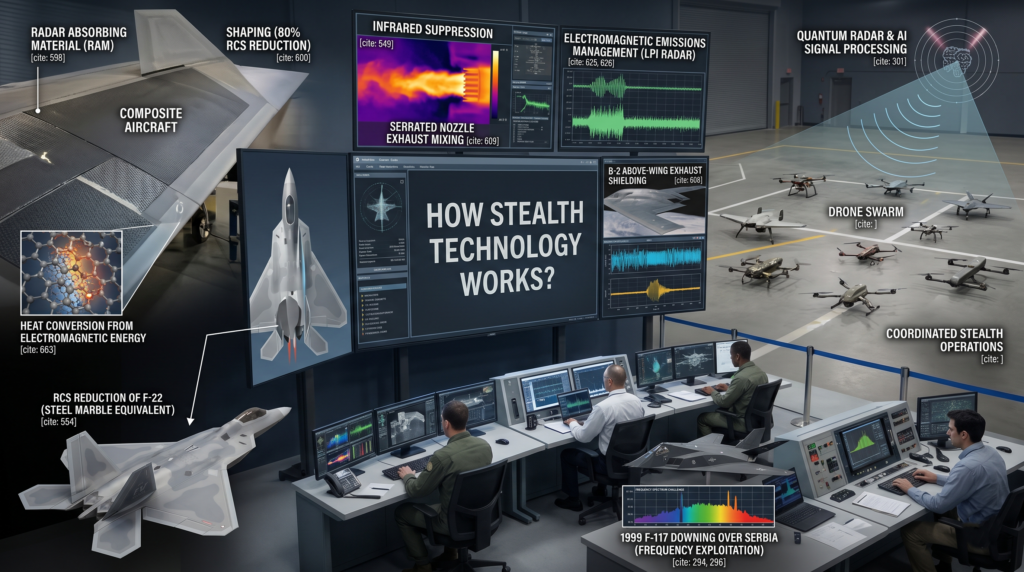
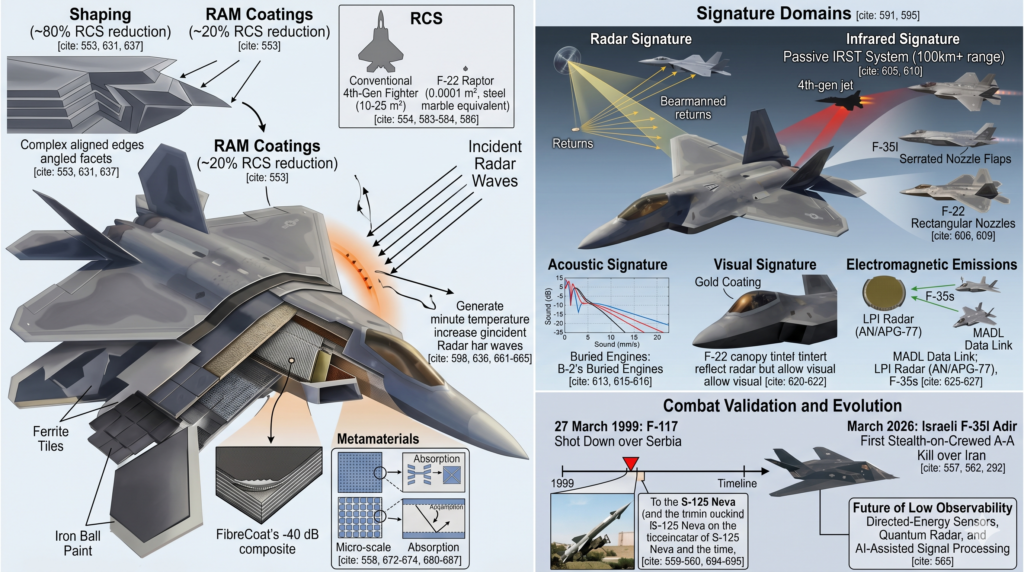
- Shaping accounts for ~80% of an aircraft’s radar cross-section reduction. Radar-absorbing materials (RAM) account for the remaining ~20%.
- The F-22’s RCS (~0.0001 m²) is equivalent to a steel marble roughly 100,000 times smaller than a conventional 4th-generation fighter at approximately 10–25 m².
- Six operational stealth aircraft exist: B-2 Spirit, F-22 Raptor, F-35 Lightning II (USA); J-20 and J-35 (China); Su-57 (Russia). The J-35 entered service in 2025.
- Stealth technology proved its worth in March 2026, when an Israeli F-35I Adir flying in combat over Iran became the first stealth aircraft ever to shoot down a crewed enemy aircraft in air-to-air combat.
- FibreCoat’s July 2025 breakthrough produced a radar-absorbing composite achieving -40 dB reflection loss equivalent to 99.99% radar wave absorption across key frequency bands.
On the morning of 27 March 1999, a United States Air Force F-117 Nighthawk was shot down over Serbia by a Serbian Army air defence battery operating a Soviet-era S-125 Neva surface-to-air missile system. The aircraft that had been described as invisible to radar, that had flown undetected through the most sophisticated air defence networks in the Middle East during the Gulf War eight years earlier, was tracked, engaged, and destroyed by a 40-year-old missile system operated by a commander who had done something elegantly simple: he had turned on his radar on a different frequency from the ones the F-117’s designers had optimised against, waited patiently for a known take-off pattern, and fired when his targeting solution was solid.
Stealth technology has never been perfect. It has never been a cloak of invisibility. What it is and what it does with a precision and consistency that has been validated in combat from the streets of Panama in 1989 to the airspace over Iran in 2026, is make detection, tracking, and engagement of an aircraft so difficult, so uncertain, and so operationally unreliable that adversary air defenses cannot perform their primary function with confidence. That functional uncertainty is the point of stealth technology. Not invisibility. Unreliability of response. And that distinction, properly understood, explains every engineering decision in every stealth aircraft ever built.
This Armorexa deep-dive is the definitive explainer on how stealth technology actually works from the fundamental physics of radar detection through the five distinct signature domains that stealth engineers must manage simultaneously, the specific technologies applied to each, the operational aircraft that embody these principles at their current state of development, the counter-stealth developments that are forcing a new generation of stealth materials and concepts, and the future of low observability in a world where directed-energy sensors, quantum radar, and AI-assisted signal processing are challenging assumptions that have underpinned stealth doctrine since the F-117’s first flight in 1981.
THE PHYSICS OF RADAR AND WHY DETECTION IS THE PROBLEM
How Radar Works: The Electromagnetic Principle
To understand stealth technology, you must first understand what stealth is trying to defeat. Radar, Radio Detection And Ranging operates on a straightforward electromagnetic principle: transmit a pulse of radio-frequency energy in a chosen direction; measure whether any of that energy returns to a receiver; calculate the time elapsed between transmission and return to determine range; and analyse the return signal’s characteristics to determine the target’s velocity, altitude, and, in modern systems, shape. A radar system that receives a strong return signal has detected an object. A radar system that receives no return signal, or a return signal too weak to distinguish from background noise, has not detected anything regardless of whether something is actually there.
Radar operates across a broad spectrum of radio frequencies, from the long-wave HF bands (3–30 MHz) through VHF (30–300 MHz), UHF (300–3,000 MHz), through the microwave bands, L-band (1–2 GHz), S-band (2–4 GHz), C-band (4–8 GHz), X-band (8–12 GHz), and Ku/Ka bands above that up to millimeter-wave frequencies above 30 GHz. Different frequencies have different operational characteristics: lower frequencies (VHF, UHF) travel farther, penetrate weather better, and are harder to absorb with thin coatings, but provide less precise targeting resolution.
Higher frequencies (X-band, Ku-band) provide precise targeting resolution but are more susceptible to weather attenuation and more easily absorbed by RAM coatings. This frequency spectrum diversity is one of the fundamental challenges facing stealth designers: optimize for one frequency band and you may be visible in another.
Radar Cross-Section: The Number That Defines Stealth
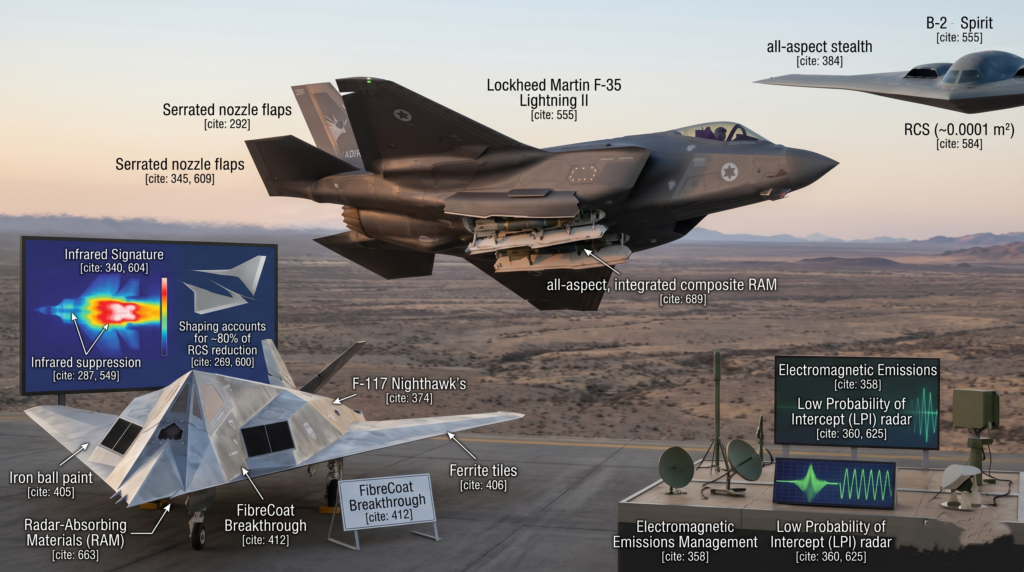
The single most important concept in understanding stealth technology is the Radar Cross-Section, universally abbreviated as RCS and expressed in square meters. RCS is not the physical size of an aircraft. It is a measure of how much radar energy an object reflects back toward the transmitting radar effectively, how large the object appears to the radar receiver. A large metallic airliner might have an RCS of several hundred square meters, it reflects enormous amounts of radar energy back. A conventional 4th-generation fighter like the F-15 has an RCS of approximately 10 to 25 square meters from most aspects. The B-2 Spirit stealth bomber, despite being an aircraft with a 52-metre wingspan, has an estimated RCS of approximately 0.0001 square meters roughly the same as a large steel ball bearing.
The relationship between RCS and radar detection range is governed by the radar equation, specifically the fourth-power relationship: halve the RCS of a target and you reduce its detection range not by half but by the fourth root of two, approximately 16 percent. More dramatically, reduce RCS by a factor of 10,000 from a conventional fighter’s 10 m² to the F-22’s estimated 0.0001 m², and detection range is reduced by the fourth root of 10,000, which is 10: the radar that could detect the conventional fighter at 100 kilometres can only detect the stealth aircraft at approximately 10 kilometres. At 10 kilometres, a supersonic fighter is across the horizon, within weapons employment range, and gone before an engagement sequence can be completed. That is what stealth technology is designed to achieve: compressing the detection range to the point where a meaningful tactical response becomes impossible.
Stealth technology does not make an aircraft invisible. It makes detection ranges so short, and tracking so unreliable, that an adversary’s weapons system cannot complete a kill chain before the aircraft has already passed. The physics of radar detection are not cheated. They are exploited.
THE FIVE SIGNATURE DOMAINS: WHAT STEALTH MUST MANAGE
A common misconception about stealth technology is that it is exclusively about radar. Modern stealth design must manage five distinct signature domains simultaneously, because modern air defense systems do not rely on radar alone. An aircraft that is invisible to radar but visible to infrared sensors, audible to acoustic arrays, or detectable through its own radio emissions has not achieved meaningful stealth. The five domains are: radar signature, infrared signature, acoustic signature, visual signature, and electromagnetic emissions signature.
Radar Signature
Radar signature management is the dominant and most technically demanding element of stealth design, accounting for the majority of the engineering investment in any low-observable platform. It encompasses two complementary approaches: airframe shaping to deflect radar energy away from the transmitting source, and radar-absorbing materials to convert the residual radar energy that cannot be deflected into heat. These two techniques together account for virtually all of the RCS reduction achieved in current operational stealth aircraft.
Shaping contributes approximately 80 percent of the total RCS reduction; RAM contributes the remaining 20 percent. Neither alone is sufficient: shaping without RAM leaves residual specular reflections from surface features; RAM without shaping still reflects radar energy from large surface areas even if each area reflects a smaller proportion.
Infrared Signature
Every object with a temperature above absolute zero emits infrared radiation heat. A jet aircraft engine operating at full thrust produces exhaust gases at temperatures exceeding 1,000 degrees Celsius, representing an infrared signature detectable by passive infrared search and track (IRST) systems at ranges of 100 kilometres or more against the cold background of high-altitude sky. Stealth aircraft designers address the infrared signature problem through a combination of engine nozzle shaping and exhaust mixing.
The F-117’s distinctive slit-shaped exhaust nozzles were specifically designed to maximise the mixing of hot exhaust gases with cooler ambient air, reducing the exhaust plume’s peak temperature and spreading it over a larger, cooler area. The B-2 Spirit vents its exhaust above the wing surface, shielding the hot plume from ground-based observers while cool air is deliberately injected into the exhaust flow. The F-22’s rectangular nozzles serve the same mixing function, while the F-35’s serrated nozzle flaps increase turbulent mixing at the exhaust boundary.
The growing sophistication of IRST systems which detect heat rather than radar return and therefore cannot be defeated by RAM coatings has made infrared signature management increasingly critical. China’s J-20 and Russia’s Su-57 both carry IRST systems as standard equipment. The F-22’s infrared suppression measures and the F-35’s Distributed Aperture System, which provides passive 360-degree infrared awareness, reflect the dual reality that stealth aircraft must both minimize their own IR signature and detect adversary IR emissions before they are detected by them.
Acoustic Signature
Aircraft engine noise is detectable by passive acoustic sensors at ranges that can expose an aircraft’s approach before radar or infrared detection is achievable. Acoustic signature management in stealth aircraft focuses on engine inlet and nozzle design to suppress or redirect the most detectable frequency components of engine noise. The B-2 Spirit’s flying-wing configuration with buried engines and its above-wing exhaust routing provides substantial acoustic suppression from below, the most tactically relevant direction for ground-based acoustic arrays.
High-altitude cruise above 50,000 feet further attenuates acoustic signatures because sound disperses with altitude and the ambient noise floor at high altitude is lower, paradoxically making a quieter aircraft easier to detect if it flies low but harder to detect at altitude.
Visual Signature
Visual detectability, while limited to daylight and relatively short ranges in clear weather, remains a relevant design consideration for low-observable aircraft. Stealth aircraft typically use paint schemes optimised for the most likely operational altitude, the dark grey of the F-22 and F-35 reduces contrast against high-altitude sky backgrounds, while the B-2’s black scheme is optimised for night operations.
Cockpit canopies present a particular challenge: the pilot’s helmet and the cockpit interior are highly visible to radar as well as visually, so stealth aircraft canopies incorporate a thin metallic gold or indium tin oxide coating in the transparency itself, which reflects radar energy while remaining visually transparent to the pilot. The F-22’s distinctive gold-tinted canopy is the visible expression of this technique.
Electromagnetic Emissions Signature
An aircraft that reduces its radar, infrared, acoustic, and visual signatures but then radiates copiously through its own radar, communications, or electronic warfare systems has largely defeated its own stealth. Electromagnetic emissions management requires Low Probability of Intercept (LPI) radar waveforms that spread their energy across broad frequency ranges and time intervals such that they appear as background noise to adversary receivers rather than identifiable radar transmissions.
The F-22’s AN/APG-77 AESA radar operates in LPI mode that can illuminate adversary aircraft without triggering their radar warning receivers. The F-35’s communications use the Multifunction Advanced Data Link (MADL), a directional, low-probability-of-intercept link that shares targeting data between F-35s without broadcasting broadly detectable signals. The discipline of emissions control, EMCON requires stealth aircraft crews to manage when, how, and at what power level every emitting system on the aircraft operates, because a single undisciplined radar or radio transmission can reveal a position that twenty tonnes of RAM coating have carefully concealed.
AIRFRAME SHAPING: THE SCIENCE OF DEFLECTING RADAR
The Fundamental Principle: Don’t Reflect Back
Airframe shaping is the single most powerful tool available to the stealth designer, accounting for approximately 80 percent of total RCS reduction on modern stealth platforms. The principle it exploits is straightforward: radar energy reflected from a surface travel in a direction governed by the angle of that surface relative to the incident radar beam. A flat surface perpendicular to the radar beam reflects energy directly back to the transmitter, a ‘specular’ return that appears as a strong radar target. A flat surface angled 30 degrees from perpendicular reflects energy 30 degrees away from the transmitter, it may still be detectable but only by a radar positioned precisely in the direction the reflected energy travels. A curved surface disperses reflected energy in many directions simultaneously, producing a weaker return than a flat surface of similar area.
Stealth shaping design uses these principles to ensure that virtually all radar energy striking the aircraft is reflected away from the transmitting radar receiver rather than back toward it. This is accomplished through careful edge alignment: the leading edges, trailing edges, panel seams, access hatches, and control surface gaps are all aligned to a small number of discrete angles, so that any specular returns from these features occur only in specific, narrow angular sectors rather than broadly across all aspects. On the F-22, for example, essentially all edge features are aligned to four principal angles, meaning that strong specular radar returns only occur in those four precise directions. An adversary radar at any other angle receives a dramatically reduced return.
The F-117’s Faceted Approach
The F-117 Nighthawk represents the first generation of operational stealth shaping, and its distinctive angular, faceted appearance is a direct consequence of the computational limitations available to its designers at Lockheed’s Skunk Works in the 1970s. The mathematical problem of optimising a curved surface to minimise radar return in three dimensions simultaneously was beyond the computational power available at the time. Lockheed’s engineer Denys Overholser solved this problem by applying a 1960s Soviet mathematical paper by Pyotr Ufimtsev that predicted the radar cross-section of two-dimensional shapes with precision, and extended it to a three-dimensional surface by breaking the surface into flat facets, each of which could be analysed using Ufimtsev’s two-dimensional equations. The resulting aircraft is a collection of flat facets precisely angled to reflect radar energy in predetermined directions away from any likely radar position, which achieved an RCS reduction of approximately four orders of magnitude compared to a conventional aircraft of similar size.
The faceted design’s limitation is aerodynamic efficiency: flat surfaces produce more drag than curved ones, and the F-117’s aerodynamics were so unnatural that the aircraft required fly-by-wire computer systems to remain controllable. It was subsonic, limited in range without refuelling, and could not carry a large weapons load. But it could fly through the most sophisticated air defences in the world, as it proved in the Gulf War of 1991, when F-117s flew approximately 1,300 sorties against Iraqi targets without a single aircraft lost to air defences.
The B-2 and F-22: Curved Surfaces and All-Aspect Stealth
Advances in computational power through the 1980s and 1990s enabled the next generation of stealth shaping, in which curved surfaces could be precisely optimised for minimum radar return across all aspects simultaneously. The B-2 Spirit’s flying-wing design is the most elegant expression of this capability: a smooth, blended surface with no vertical stabilisers, no fuselage breaks, no protruding engine nacelles, and carefully contoured edges that reduce the aircraft’s RCS to approximately 0.0001 square metres despite a wingspan of 52 metres and a maximum takeoff weight of 170 tonnes. The B-2’s shaping achieves all-aspect stealth. It maintains its low radar signature from frontal, lateral, and rear aspects simultaneously which is a vastly more demanding design problem than frontal-only stealth.
The F-22 Raptor combines the curved surface optimisation of the B-2 approach with the requirement to remain supersonic and highly manoeuvrable. Every surface on the F-22 is sculpted to manage its radar contribution: the wing’s leading-edge sweep is carefully chosen to align with the principal edge angles; the engine inlets use diverterless supersonic inlet geometry that eliminates the radar-reflective inlet ramp while maintaining engine efficiency; the weapons bays are internally mounted to avoid the radar-bright external hardpoints of conventional fighters; and even the canopy’s metallic coating eliminates the specular return that an uncoated transparency would produce from the pilot’s helmet and cockpit interior.
The B-2 Spirit is 52 metres wide and weighs 170 tonnes. Its radar cross-section is approximately 0.0001 square metres. This is not science fiction. It is the result of 40 years of accumulated understanding of how electromagnetic waves interact with precisely shaped surfaces, translated into the most expensive aircraft ever built. The physics works. The cost is breathtaking. The result is a bomber that penetrates any currently deployed air defence system.
RADAR-ABSORBING MATERIALS
How RAM Works: Converting Energy to Heat
Radar-absorbing materials address the portion of radar energy that shaping cannot redirect, the residual reflections from surface features, panel edges, and material boundaries that cannot be eliminated by geometry alone. RAM works through a different mechanism from shaping: rather than deflecting incoming radar energy away from the transmitter, it absorbs it and converts it into heat through dielectric or magnetic loss mechanisms within the material’s molecular structure. The radar energy that enters a RAM coating does not bounce back to the radar receiver. It is dissipated as a minute temperature rise in the coating itself, undetectable at any practical range.
The physics of RAM absorption operate at the molecular scale. Most RAM formulations contain materials with high electromagnetic loss tangents, a measure of a material’s ability to convert electromagnetic energy into thermal energy. Common active ingredients include iron particles, ferrite ceramics, carbon black, carbon nanotubes, and graphene flakes, suspended in polymer matrices and applied as coatings or incorporated into composite structural panels. When radar waves penetrate the coating, the alternating electromagnetic field causes the loss-tangent materials’ magnetic domains or electrical charge distributions to oscillate in response and the friction of this oscillation generates heat, dissipating the radar energy before it can reach a reflective metal surface beneath.
Coating Types and Application
Modern RAM is not a single material but a family of formulations optimised for specific frequency bands, structural requirements, and operational environments. Iron ball paint, a ferrite-loaded paint formulation is the simplest and most widely applied form, used particularly on edges and small-area features where structural integration is impractical. Ferrite tiles, ceramic tiles incorporating iron oxide compounds provide higher absorption performance and were used extensively on the B-2 Spirit’s leading edges.
Carbon-fibre composite panels that incorporate RAM materials directly into their structural matrix offer the best combination of absorption performance, structural strength, and surface quality, and are used throughout the F-22 and F-35 airframes. The F-35 uses approximately 30 percent fewer RAM-specific coatings than the F-22 because more of its stealth performance is achieved through structural composites with integrated absorption properties, reducing the maintenance burden that has historically been one of stealth’s most significant operational limitations.
Multi-layer RAM architectures applying successive layers of materials optimized for different frequency sub-bands provide broadband absorption across wider frequency ranges than any single material can achieve. The outer layer of a multi-layer stack is typically tuned to absorb the highest-frequency radar threats (X-band, Ku-band); successive inner layers handle progressively lower frequencies. This layered approach is critical because most advanced air defense systems employ multi-frequency radar networks that use different frequency bands for acquisition, tracking, and targeting, an aircraft optimized against one frequency may be visible on another.
The 2025–2026 RAM Breakthrough: FibreCoat and Metamaterials
The state of RAM technology advanced significantly in 2025 with the announcement by German materials company FibreCoat of a next-generation radar-absorbing fibre-reinforced composite. Announced in July 2025, the material achieves reflection losses of up to -40 dB equivalent to 99.99 percent radar wave absorption across key frequency bands. Critically, the material maintains high performance even on angled and curved surfaces, a long-standing limitation of previous RAM generations that required flat or near-flat surfaces for optimal performance and constrained stealth aerodynamic design. FibreCoat’s composite uses a metallic fibre coating process that produces fibres with consistent electromagnetic properties at high production rates addressing the manufacturing consistency challenge that has historically made high-performance RAM both expensive and difficult to apply uniformly at scale.
Metamaterials and metasurfaces represent the most advanced frontier of current RAM research. Unlike conventional RAM, which absorbs radar energy through bulk material properties, metamaterials achieve their electromagnetic behaviour through precisely engineered sub-wavelength structures, patterns of geometric features smaller than the radar wavelength being absorbed. By tuning the geometry of these sub-wavelength structures, designers can produce materials with electromagnetic properties that do not exist in nature: negative refractive indices, extraordinary absorption at specific frequencies, and the ability to redirect scattered radar energy in precisely controlled directions rather than merely absorbing it. Current metamaterial RAM research, published in journals including Materials Today Communications in 2026, shows dual-band radar and infrared stealth performance in a single material layer potentially solving the multi-signature management problem that currently requires separate treatments for radar and infrared suppression.
STEALTH AIRCRAFT COMPARED: HOW THE TECHNOLOGY IS IMPLEMENTED
| Aircraft | Nation | Service Entry | Est. RCS (m²) | Stealth Approach | Primary Limitation |
| F-117 Nighthawk | USA | 1983 (classified) | ~0.003 | Faceted shaping + RAM | Subsonic, limited payload, retired 2008 |
| B-2 Spirit | USA | 1997 | ~0.0001 | Flying wing, curved surfaces, all-aspect | Cost ($2B/unit), maintenance intensive |
| F-22 Raptor | USA | 2005 | ~0.0001 | All-aspect curved stealth, LPI radar | Small fleet (187), no export |
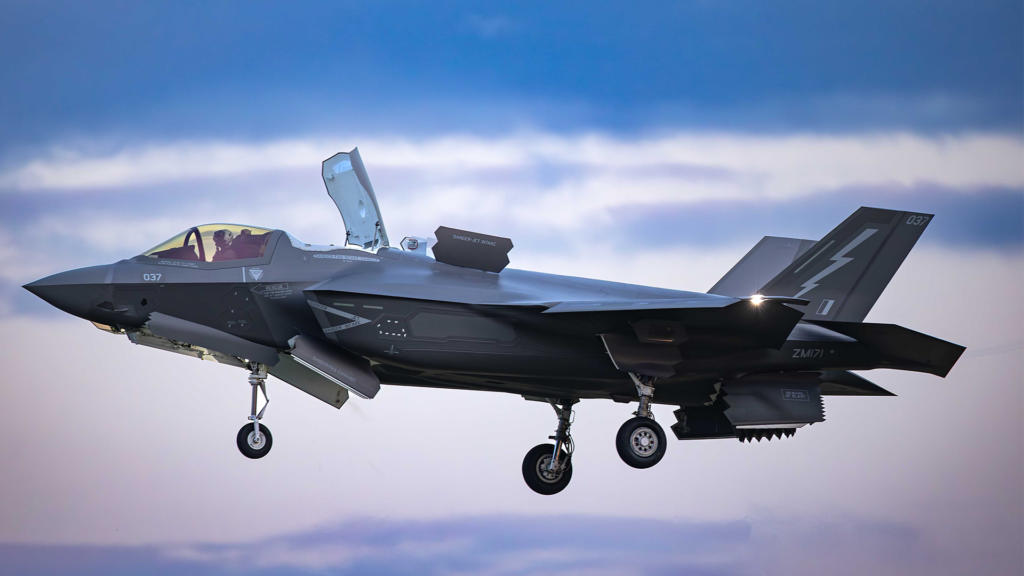
| F-35 Lightning II | USA/Allied | 2015 | ~0.001–0.005 | All-aspect, integrated composite RAM | Speed (Mach 1.6 max), maintenance |
| B-21 Raider | USA | 2025 (limited) | ~0.0001 (est.) | Next-gen all-aspect, advanced composites | Production ramp-up, classified details |
| J-20 Mighty Dragon | China | 2017 | ~0.01–0.05 (est.) | Frontal stealth optimised, canards limit LO | Canards, exposed nozzles compromise all-aspect |
| J-35 Gyrfalcon | China | 2025 | ~0.005–0.01 (est.) | Carrier-based, F-35 influenced design | Limited operational data, early service |
| Su-57 Felon | Russia | 2020 | ~0.1–1.0 (est.) | Reduced observability, EW compensation | Significant stealth compromises vs US/China |
The F-117 Nighthawk: First Generation, Proven in Combat
The F-117 Nighthawk holds its place in history as the world’s first operational stealth aircraft, a platform that took ideas that most of the military establishment considered theoretical and translated them into an operational weapon that flew its first classified missions in 1983 and its first public combat in 1989, during the US invasion of Panama. The F-117’s Gulf War performance in 1991 was its definitive validation: over 1,300 sorties against the most sophisticated air defence network in the Middle East, zero aircraft lost to air defences, and precision strikes against targets including command bunkers, communications facilities, and hardened aircraft shelters that no previous weapon system could have reached. The F-117 proved that stealth technology worked in real-world contested environments, not just in the idealistic conditions of computer simulations.
The F-117’s 1999 loss over Serbia, which generated enormous press coverage and speculation about the death of stealth, is best understood as a cautionary tale about operational discipline rather than a technical failure of the stealth concept. The Serbian commander’s success required: knowledge of the F-117’s specific flight path and timing from a NATO-affiliated intelligence source; operation of his radar on the lower-frequency L-band (70 cm wavelength) against which the F-117’s stealth optimisation was least effective; knowledge that the F-117 opened its weapons bay doors on approach dramatically increasing its RCS at a predictable point in its attack profile; and exceptional situational awareness and timing in firing. These were human and operational factors, not fundamental limitations of stealth physics.
The B-2 Spirit: Stealth’s Strategic Apex
The B-2 Spirit strategic bomber is the fullest expression of stealth technology’s potential in a currently operational platform. Its flying-wing design, developed at Northrop under the advanced technology bomber programme, achieves an RCS that is effectively indistinguishable from background clutter for most radar systems at operationally relevant ranges estimated at approximately 0.0001 square metres despite the aircraft’s enormous physical size.
The B-2 has flown combat missions in Kosovo in 1999, Afghanistan from 2001, Iraq in 2003, Libya in 2011, against ISIS in 2017, and against Iranian nuclear facilities in June 2025, a 26-year operational combat record in which no B-2 has ever been successfully engaged by adversary air defences. It remains, in 2026, the most strategically significant individual air platform in the US inventory.
The F-35 Lightning II: Stealth at Scale
The F-35 Lightning II’s contribution to stealth technology history is less about technical extremism than about industrial democratization: it brought all-aspect stealth performance to a multi-mission, multi-service, multi-national platform at a scale no previous stealth program had approached. With over 1,300 delivered as of early 2026 to more than 20 nations, the F-35 has made operational stealth capability available to allied air forces that could never have afforded F-22-class aircraft.
Its combat record includes Israeli F-35I Adir strikes that penetrated Syrian, Lebanese, and Iranian air defenses including S-300 and S-400 class systems and in March 2026, the world’s first confirmed air-to-air kill by a stealth aircraft against a crewed adversary aircraft, when an Israeli F-35I shot down an Iranian Yak-130 trainer over Tehran. The F-35’s stealth performance, while assessed as slightly below the F-22’s, has been validated in exactly the operational environment it was designed for: penetrating advanced integrated air defense systems to deliver precision effects.
THE COUNTER-STEALTH RACE: HOW ADVERSARIES ARE FIGHTING BACK
Low-Frequency Radar: The Frequency Gap Problem
The fundamental vulnerability that the 1999 F-117 shootdown exposed and that adversary military programs have been systematically exploiting since is the frequency gap in stealth optimization. Modern RAM coatings and shaping optimizations are most effective at the higher radar frequencies; X-band, Ku-band used by fire-control and targeting radars. At lower frequencies of VHF and UHF, with wavelengths from 0.1 to 10 meters, the physics of absorption and scattering change fundamentally. When the radar wavelength approaches or exceeds the physical dimensions of the target’s stealth features (panel edges, intake lips, weapon bay doors), the RAM’s absorption efficiency drops dramatically and what is called ‘resonance scattering’ can produce much larger radar returns than the geometry would predict at shorter wavelengths.
China’s JY-27A ‘Skywatch-V’ VHF radar system and Russia’s 55Zh6M Nebo-M metre-wave radar complex are both explicitly described by their developers as ‘counter-stealth’ systems capable of detecting and tracking 5th-generation aircraft at VHF frequencies. The limitation of low-frequency radar for actual engagement is significant: VHF and UHF radars provide insufficient targeting precision for direct weapons guidance, they can detect and broadly locate a stealth aircraft but cannot provide the precision tracking necessary to guide a surface-to-air missile to impact. However, as a cuing system alerting fire-control radars in what sector to search, reducing the time available for a stealth aircraft to pass through a defended area, they represent a genuine and growing challenge to stealth operations.
Passive Detection Systems: Radar Without a Radar
The most concerning class of counter-stealth technology from the perspective of a stealth aircraft designer is passive detection sensors that detect aircraft without emitting any radar energy themselves, making them immune to the emissions-control measures that protect against conventional radar detection. Passive detection systems exploit every emission that an aircraft unavoidably produces: the heat of its engines, the radio-frequency leakage from its own electronic systems, the acoustic signature of its engines, and most cleverly reflections of other people’s radio transmissions from the aircraft’s airframe.
Passive coherent location (PCL) systems, also called ‘parasitic radar,’ use the omnipresent electromagnetic environment, commercial FM radio broadcasts, digital television signals, mobile phone base station transmissions as their illumination source. By comparing what a direct-path receiver detects from a known FM broadcast transmitter with what a separate antenna detects from the same transmitter plus any reflections from moving objects, a PCL system can detect aircraft at ranges of 100 to 200 kilometers with position accuracy sufficient for fighter vectoring. Since the PCL system emits nothing itself, it cannot be detected by the stealth aircraft’s radar warning receivers. Several European nations and China have fielded operational PCL systems.
Multi-Static and Networked Radar
The stealth aircraft’s shaping strategy reflecting radar energy away from the transmitting radar’s receiver depends critically on the radar’s transmitter and receiver being co-located, as in conventional monostatic radar. In a multi-static radar network, multiple receivers are deployed at locations separated from the transmitter by large distances. The radar energy that a stealth aircraft deflects away from the transmitting radar’s co-located receiver may be directed precisely toward one of the network’s geographically distributed receivers. By correlating returns from multiple receivers and multiple illumination angles simultaneously, a multi-static network can reconstruct the aircraft’s position and track from reflections that no single conventional radar would detect.
China’s development of networked air surveillance architectures specifically designed to correlate returns from multiple radar types across broad geographic areas combining VHF long-range detection radars, X-band fire control radars, and passive systems in a single integrated picture represents the most sophisticated counter-stealth architecture currently under development. The DF-27’s development specifically addresses whether US stealth aircraft operating from Pacific bases can be tracked from launch to target, a question that stealth planners cannot currently answer with full confidence.
AI and Signal Processing: Finding the Signal in the Noise
Perhaps the most transformative counter-stealth development of the current decade is the application of artificial intelligence to the problem of detecting weak, uncertain signals in radar data. Traditional radar signal processing uses fixed thresholds and algorithms: a return stronger than a defined noise threshold is reported as a detection; a return below threshold is not. A stealth aircraft’s returns may be consistently below threshold for a conventional processor but not below the noise floor, they produce small, consistent anomalies in the radar’s noise picture that a pattern-recognising AI can identify as indicative of a moving target over extended observation periods.
Chinese researchers published work in 2024 and 2025 describing AI-assisted radar processing systems that claim to detect stealth aircraft by accumulating weak returns over multiple radar sweeps and applying machine learning to identify the consistent anomalies that distinguish a moving stealth platform from genuine random noise. These claims have not been independently verified under realistic operational conditions, and the gap between a laboratory processing demonstration and a deployed operational system is significant. But the direction of travel is clear: as AI processing capability improves and radar networks become more interconnected, the noise floor below which stealth aircraft currently hide may rise.
The counter-stealth race is not a race between radar and RAM. It is a race between detection physics and signal processing intelligence. Stealth technology exploits the gap between the radar energy a stealthy aircraft reflects and the minimum signal a radar processor can detect. AI is shrinking that gap. The next generation of stealth materials will need to widen it again.
THE FUTURE OF STEALTH: NEXT GENERATION AND BEYOND
The F-47 and Sixth-Generation Stealth
The Boeing F-47, selected as the US Air Force’s Next Generation Air Dominance fighter in March 2025, represents stealth technology’s next evolution. While specific details of the F-47’s stealth architecture are classified, the NGAD requirement specifies performance against ‘multi-domain threats’ including the networked, multi-static, AI-enhanced detection systems that China and Russia are developing.
This requirement almost certainly drives several advances beyond the F-22’s current stealth architecture: broader-band RAM optimization that maintains low RCS across VHF through millimetre-wave frequencies simultaneously; improved infrared suppression to counter advanced IRST systems; and active stealth capabilities that may use controlled emissions to cancel or confuse radar returns rather than merely reducing them.
Active Stealth and Plasma Concepts
Active stealth systems that emit energy to cancel or confuse adversary radar returns rather than passively reducing them has been a research concept since the 1990s. The plasma stealth concept proposes surrounding an aircraft with an ionized gas layer, a plasma that absorbs and re-emits radar energy in ways that either reduce the apparent RCS or produce returns inconsistent with a real target. Russia has claimed operational plasma stealth systems on the Su-57, though independent verification is absent. True plasma stealth faces significant practical challenges: generating and maintaining a stable plasma envelope around a supersonic aircraft in flight requires enormous power and presents engineering problems that have not been publicly resolved.
More promising near-term active stealth approaches include active cancellation systems analogous to active noise-cancelling headphones in which onboard sensors detect incoming radar waves and the aircraft’s own systems emit a precisely timed, phase-inverted signal that destructively interferes with the return at the radar’s receiver position. This approach has been demonstrated in laboratory conditions but faces formidable engineering challenges in real-world flight conditions, particularly against multiple simultaneous radar illumination sources at different frequencies and angles.
Multi-Domain Stealth: Beyond the Aircraft
The future of stealth technology extends beyond the aircraft to the entire operational system. Collaborative combat aircraft, the autonomous drone wingmen that the F-22 and F-35 are being modified to command and create new stealth dynamics: a manned stealth aircraft operating with a forward screen of unmanned, lower-cost, less stealthy drones can remain in its own protected stealth envelope while its drone wingmen penetrate defenses, gather intelligence, and provide targeting data. The stealth aircraft’s own emissions are minimized while its combat effectiveness is multiplied. This is stealth technology operating not as an aircraft attribute but as a system architecture, the logical extension of principles that began with the F-117’s first classified flight over the Nevada desert in 1981.
FREQUENTLY ASKED QUESTIONS: STEALTH TECHNOLOGY
Q1. How does stealth technology work?
Stealth technology works by reducing an aircraft’s detectability across five signature domains: radar, infrared, acoustic, visual, and electromagnetic emissions. The most important is radar signature reduction, achieved through two complementary methods: airframe shaping that deflects radar energy away from the transmitting radar’s receiver (accounting for approximately 80% of total RCS reduction), and radar-absorbing materials (RAM) that convert the residual radar energy into heat (accounting for the remaining 20%). True stealth is not invisibility but the reduction of detection range to a point where an adversary’s radar cannot provide a reliable targeting solution before the aircraft has passed.
Q2. What is radar cross-section (RCS)?
Radar cross-section (RCS), measured in square metres and expressed as sigma (σ), is a measure of how much radar energy an object reflects back toward the transmitting radar. It is not the physical size of the object but a measure of its radar reflectivity. A conventional 4th-generation fighter like the F-15 has an RCS of approximately 10-25 square metres. The F-22 Raptor’s RCS is estimated at approximately 0.0001 square metres equivalent to a steel marble, roughly 100,000 times smaller. This reduction decreases radar detection range by a factor of approximately 10, compressing the detection window to tactically unworkable distances.
Q3. Can stealth aircraft be detected?
Yes. No aircraft is completely invisible to all radar at all ranges and frequencies. Stealth aircraft can be detected by: low-frequency VHF/UHF radars whose longer wavelengths are less effectively absorbed by RAM coatings; passive detection systems (including passive coherent location, which uses FM radio and TV broadcast signals as illumination); multi-static radar networks with distributed receivers; infrared search and track (IRST) systems that detect heat rather than radar return; and AI-enhanced signal processing that finds weak returns below conventional detection thresholds. The 1999 F-117 shootdown over Serbia demonstrated that operational vulnerabilities exist when stealth aircraft operate predictably against an adversary who understands those vulnerabilities.
Q4. What aircraft has the lowest radar cross-section?
The B-2 Spirit strategic bomber and F-22 Raptor share the lowest estimated RCS of any currently operational aircraft at approximately 0.0001 square metres each equivalent to a golf ball or steel marble. The B-21 Raider, which entered limited service in 2025, is believed to achieve comparable or superior RCS using next-generation materials, though its specific figures are classified. Among fighter aircraft, the F-22 is assessed as having superior all-aspect stealth to the F-35, which in turn significantly outperforms the Chinese J-20 and Russian Su-57, which are described more accurately as ‘reduced-observable’ rather than true low-observable platforms.
Q5. What are radar-absorbing materials (RAM)?
Radar-absorbing materials (RAM) are coatings, paints, and structural composites specifically engineered to absorb incoming radar energy and convert it to heat rather than reflecting it back to the transmitting radar. Common ingredients include ferrite composites, carbon-based materials (carbon black, carbon nanotubes, graphene), and iron particles suspended in polymer matrices. RAM achieves absorption through dielectric or magnetic loss mechanisms at the molecular scale: the alternating electromagnetic field of the radar wave causes oscillation in the loss-tangent materials, and the friction of this oscillation generates heat. Modern stealth aircraft use multi-layer RAM architectures optimised across multiple frequency bands simultaneously.
Q6. What is the difference between the F-117, B-2, F-22, and F-35 stealth approaches?
The F-117 used first-generation faceted shaping flat surfaces angled to deflect radar away plus RAM coatings, optimised primarily for frontal stealth at X-band frequencies. The B-2 uses a flying-wing design with curved all-aspect surfaces achieving the world’s best known operational RCS at approximately 0.0001 m². The F-22 combines curved all-aspect shaping with an LPI radar and full internal weapons carriage for all-aspect stealth while maintaining supersonic and high-manoeuvrability performance. The F-35 uses structural composite RAM panels to reduce maintenance compared to F-22 coatings, delivering slightly lower stealth performance but at far greater production scale and multirole capability.
Q7. How do countries defeat stealth aircraft?
Nations counter stealth aircraft through several approaches: low-frequency (VHF/UHF) radar networks that exploit the reduced effectiveness of RAM at longer wavelengths; passive coherent location (PCL) systems that use FM/TV broadcast signals as radar illumination without any radar emissions; multi-static radar networks with geographically distributed receivers that capture radar energy deflected away from conventional co-located receivers; advanced IRST systems that detect the aircraft’s infrared signature rather than its radar return; and AI-enhanced signal processing that identifies weak, consistent radar anomalies below conventional detection thresholds. China’s JY-27A VHF radar and Russia’s Nebo-M are specifically marketed as counter-stealth systems.
Q8. What is the next generation of stealth technology?
Next-generation stealth technology focuses on four areas: broadband RAM (metamaterials and metasurfaces that maintain absorption performance across VHF through millimetre-wave frequencies simultaneously, addressing the low-frequency gap that current RAM leaves vulnerable); dual-band radar/IR stealth materials that manage both radar and infrared signatures in a single composite layer; active stealth using phase-inverted emissions to cancel radar returns at the receiver; and system-level stealth through collaborative combat aircraft architectures in which manned stealth aircraft remain in protected envelopes while autonomous drone wingmen operate in more contested zones. FibreCoat’s July 2025 composite achieving -40 dB absorption (99.99% absorption) represents the current leading edge of the field.
CONCLUSION: THE PHYSICS DON’T LIE, AND NEITHER DOES THE COMBAT RECORD
Stealth technology has been declared dead or irrelevant more times than any other military technology concept in the post-Cold War era. The F-117 shootdown over Serbia in 1999 prompted a wave of obituaries for the stealth concept. The demonstration of Chinese VHF counter-stealth radars prompted another wave. Each wave receded when the operational record of stealth aircraft in actual combat continued to accumulate, uninterrupted, through Kosovo, Afghanistan, Iraq, Libya, Syria, and most definitively through the penetration of Iranian air defenses by F-22s and F-35s in 2025 and 2026 without a single aircraft lost to Iranian radar-guided weapons.
The physics of stealth technology are not cheated. They are exploited with extraordinary precision. An F-22 Raptor carrying an estimated RCS of 0.0001 square metres does not disappear from the laws of electromagnetism. It operates within those laws with a precision that reduces a 400-kilometre detection range to 10 kilometres and at 10 kilometres, a Mach 1.8 aircraft is across the horizon, gone, and already transmitting targeting data to the follow-on strike package before the radar operator has finished processing what just happened. The counter-stealth race VHF radars, passive coherent location, multi-static networks, AI signal processing is real, consequential, and driving the next generation of stealth design at a pace that has not been seen since the Skunk Works first translated Ufimtsev’s mathematics into the F-117’s angular silhouette.
What comes next is a competition between the physics of detection and the physics of concealment, played out in classified laboratories, flight test centres, and the operational planning cells of the world’s most advanced air forces simultaneously. The F-47, the H-20, the GCAP each is a bet on which side of that competition will prevail in the decade ahead. Stealth technology’s history suggests that the engineers have consistently stayed ahead of the detectors. The detectors are now closer behind than they have ever been. The next chapter of stealth technology may be its most consequential.
About Armorexa
Armorexa is a military intelligence and defence analysis platform delivering in-depth, rigorously researched analysis across weapons systems, warfare technology, military history, and strategic doctrine. This article was last updated April 2026 and reflects the most current publicly available technical and operational data on stealth technology.
Pingback: Su-57 vs J-20: Who Has the Better 5th Gen Fighter?