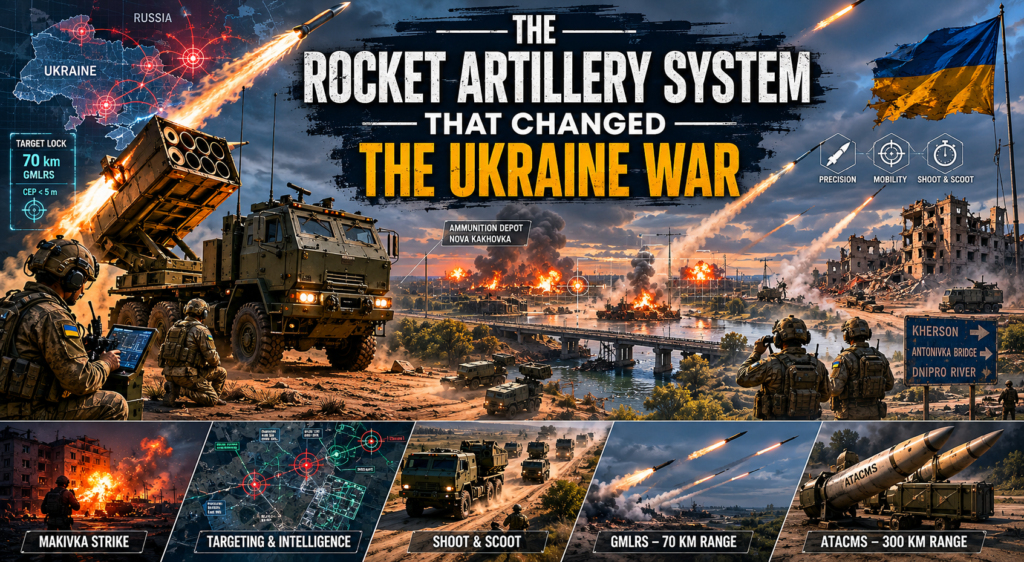
It is July 11, 2022. In a field somewhere in Zaporizhzhia Oblast, a Ukrainian crew receives a set of targeting coordinates. The HIMARS in Ukraine War is three weeks old. The truck-mounted launcher swings into position. Six rockets leave the pod in under 60 seconds. The rockets travel 70 kilometers. They hit the Russian ammunition depot at Nova Kakhovka. The warheads detonate. Then the secondary explosions begin. Forty tones of propellant cook off in a chain reaction visible from 20 kilometers away. It takes four hours to stop.
That was the ninth confirmed HIMARS strike in nine days. Russia had not yet figured out how to stop it. It would spend the next two years trying. HIMARS did not win the Ukraine War. But it prevented Ukraine from losing the first phase of it. In doing so, it changed how every military in the world thinks about precision rocket artillery.
What HIMARS Actually Is
The M142 High Mobility Artillery Rocket System is one of the most important weapons of the 21st century. Its full name is less important than what it actually is: a single flatbed truck carrying a rocket pod, a fire control computer, and three crew members. Lockheed Martin developed HIMARS beginning in 1996. The system entered US Army service in June 2005 with the 3rd Battalion, 27th Field Artillery Regiment at Fort Bragg, North Carolina. It weighs 16,250 kg at combat weight. It is seven meters long. It looks, at first glance, like a military logistics truck. That ordinariness is part of its power.
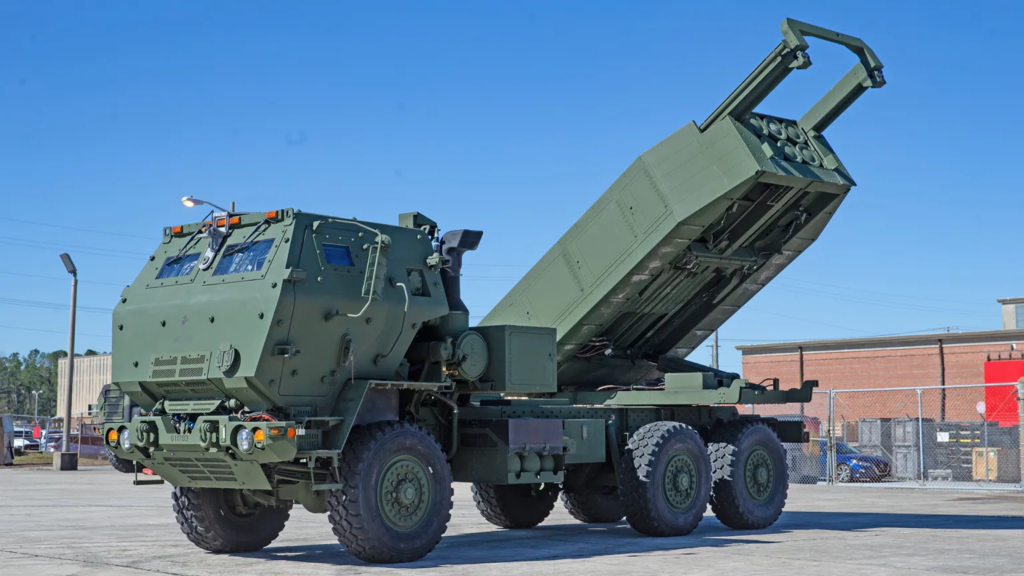
The core tactical doctrine built around HIMARS is called shoot and scoot. The crew fires its six-rocket pod and then moves before the enemy can respond. Counter-battery radar systems track incoming rocket fire and calculate the firing position. That calculation takes time. HIMARS is designed to be gone before the calculation is complete. This is not just a feature. It is the entire philosophy of the system. A weapon that fires from one position and is never there when the counterstrike arrives is a weapon that is extremely difficult to suppress.
HIMARS is the lighter, truck-mounted version of the M270 Multiple Launch Rocket System. The M270 carries two rocket pods on a tracked chassis. HIMARS carries one pod on a truck. That halving of capacity comes with a decisive operational advantage. HIMARS can be carried inside a C-130 Hercules transport aircraft. The M270 cannot. That capability allowed HIMARS to be delivered to Ukraine when heavier systems were politically and logistically impossible to deploy. Ukraine did not receive just rockets when the first launchers arrived in June 2022. It received a completely different philosophy of artillery warfare.
HIMARS is not primarily a weapon. It is a doctrine encoded in steel and electronics: strike precisely, relocate immediately, and remain permanently unpredictable. The C-130 transportability of HIMARS is the single logistical fact that made its Ukraine deployment possible. Without it, the decision calculus for Western governments would have been entirely different.
| M142 HIMARS: FAST FACTS Full designation: M142 High Mobility Artillery Rocket System Manufacturer: Lockheed Martin Missiles and Fire Control First service entry: June 2005, US Army Combat weight: 16,250 kg (35,800 lb) Crew: 3 (commander, gunner, driver) Primary rocket: M31 GMLRS (Guided Multiple Launch Rocket System) Guidance system: GPS plus inertial navigation unit (INS) Range: Up to 70 km (GMLRS); up to 300 km (ATACMS Block IVA) Circular Error Probable (CEP): Under 5 metres at maximum range Rockets per pod: 6 GMLRS rockets OR 1 ATACMS missile Reload time: Approximately 5 minutes by trained crew Air transport: C-130 Hercules (single aircraft) Unit cost: Approximately USD 4.9 million per launcher (FY2024) Total built: 750 as of November 2025 |
The Engineering Behind HIMARS
The M31 GMLRS rocket is 227mm in diameter. It is approximately four metres long. It weighs 308 kg. Those are the dimensions of a weapon designed to fly 70 kilometres and land within five metres of where you aimed it.
That accuracy comes from two systems working together. The first is GPS. The rocket receives a continuous position fix from satellite navigation throughout its flight. The second is an inertial navigation unit. The inertial navigation unit measures the rocket’s acceleration and rotation on all three axes, every fraction of a second, and calculates where the rocket is even when GPS is temporarily disrupted. Together, they give the rocket a precise picture of its location at every point in its flight.
Course corrections are made by four moveable fins at the rear of the rocket. They adjust continuously based on the gap between where the rocket is and where it needs to be. The result is a circular error probable of under five metres at maximum range. CEP is the radius within which 50 percent of rounds will land. Under five metres at 70 kilometres means the weapon is precise enough to hit a specific vehicle in a parking lot from across a county.
Compare that to an unguided artillery round fired at the same range. An unguided 155mm shell at 30 kilometres has a CEP of roughly 100 to 250 metres. At 70 kilometres, if the gun could reach that far, the CEP would be larger still. The difference between five metres and 250 metres is the difference between reliably destroying a target and statistically hoping to damage it.
The fire control system inside the launcher cab does the targeting mathematics automatically. The crew enters the target grid coordinates. The computer calculates the elevation and bearing. The launcher pod adjusts to the correct angle. A trained crew can complete the process from receiving a fire mission to launching all six rockets in under five minutes.
After firing, the crew relocates in approximately two to three minutes. Russia’s primary counter-battery radar systems, the Zoopark-1 and the 1L219, need three to five minutes to track a rocket salvo, calculate the firing position, and transmit targeting data for a counter-strike. HIMARS exploits that window deliberately and precisely.
Ukraine used almost exclusively the GPS-guided GMLRS variant throughout the conflict. HIMARS can also fire older unguided rockets. But in a war where ammunition supply is limited and every round matters, firing an unguided rocket at a 70-kilometre target is not a serious option. You cannot afford the miss.
The combination of GPS guidance and inertial navigation gives HIMARS a redundancy that purely GPS-dependent systems lack. It can still hit targets in a degraded GPS environment, which is exactly the environment Russia attempted to create. Five minutes from fire mission to launch, and two minutes to relocate: that timeline is not an operational convenience. It is the entire margin of survival for a crew operating within range of Russian counter-battery systems.
Ukraine’s Artillery Situation Before June 2022
By May 2022, Russian forces were firing an estimated 60,000 artillery rounds per day on the Donbas front. Ukraine was firing approximately 6,000. That is a ten-to-one ratio. In attritional artillery warfare, a ten-to-one ratio is not a disadvantage. It is a sentence. The Russian strategy was not sophisticated. Mass the artillery. Shell Ukrainian positions until nothing survives. Then send the infantry. It was working. Ukrainian units defending Sievierodonetsk and Lysychansk were taking catastrophic losses. Positions that held for weeks were being ground down in days.
Ukraine’s artillery at the time was Soviet-era equipment. The 2S3 Akatsiya and D-30 howitzers had effective ranges of 15 to 25 kilometers. The BM-21 Grad multiple rocket launcher could reach 20 kilometers. These were not bad weapons. They were simply being outranged. Russian artillery, particularly the 2S7 Pion and 2S5 Giatsint, could fire from 37 to 47 kilometers. Those systems were positioned well beyond the reach of anything Ukraine had. Russian crews fired at will without any meaningful counter-battery threat. Ukrainian crews who tried to return fire were locating themselves for destruction without being able to reach the problem.
Russia understood this dynamic completely. It positioned its ammunition depot complexes 40 to 80 kilometers behind the front line. Those depots held weeks of shells, rockets and fuel. They were the logistical backbone of the entire operation. And they were placed specifically to be unreachable. Nobody in Ukraine could touch them. The Western artillery systems that began arriving in spring 2022, including M777 howitzers and Caesar SPGs, extended Ukrainian range somewhat. But their maximum effective range of 30 to 40 kilometers still fell short of those depots. The Russian logistics chain was, for practical purposes, invulnerable.
The 60,000 rounds per day figure is not just a statistic about Russian firepower. It is a description of a logistical system that HIMARS was specifically capable of dismantling. Placing ammunition depots beyond enemy artillery range is standard doctrine. What Russia did not account for was an enemy acquiring a weapon system that did not yet exist in the threat calculus when the depot positions were chosen.
June 2022 and the HIMARS in Ukraine War
In May 2022, President Biden wrote in the New York Times that the United States would provide Ukraine with more advanced rocket systems and munitions. He did not specify which ones. The confirmation came quickly. The first four HIMARS launchers were delivered to Ukraine in late June 2022, as part of a 700 million dollar military assistance package.
There was a condition attached. Ukraine would receive HIMARS but not with the ATACMS long-range missile. It would receive only the shorter-range GMLRS rockets. The stated rationale was avoiding a capability that could strike deep into Russian territory. Ukraine accepted the constraint. It did not need to reach Moscow. It needed to reach the depot at Nova Kakhovka.
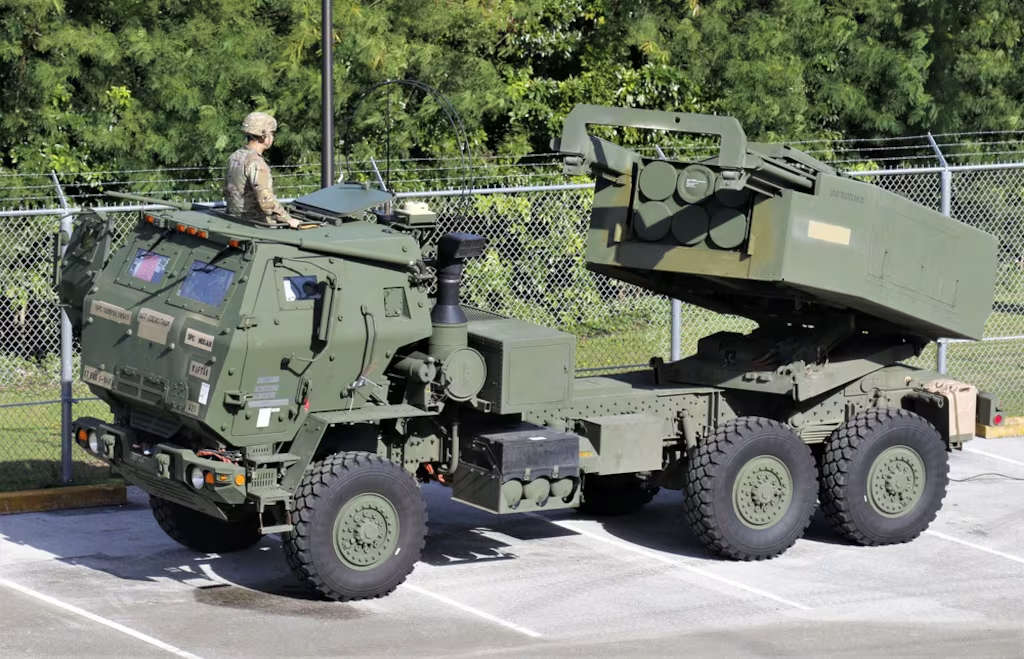
Ukrainian crews trained on HIMARS in approximately three weeks. That compressed timeline reflected both the urgency of the situation and the design of the system. HIMARS shares its fire control architecture with the M270, which Ukrainian crews were already familiar with in principle. The learning curve was steep but the system was not foreign.
The first confirmed HIMARS strikes began in early July 2022. The results were immediate and visible. On July 11, the depot at Nova Kakhovka was struck and produced secondary explosions for four hours. Ammunition, fuel and equipment were destroyed. Ukrainian sources reported the strike killed or wounded dozens of Russian personnel at the facility.
The Chornobaivka helicopter base in Kherson Oblast had already been struck multiple times by Ukrainian missiles before HIMARS arrived. After HIMARS arrived, it was struck again with far greater precision, destroying Russian air defence systems that had previously been difficult to suppress. The psychological effect on Russian commanders in Kherson was significant.
Within three weeks, HIMARS had struck more than 50 confirmed high-value targets. The number is remarkable not just for its scale but for what it forced Russian commanders to do. Ammunition depots began moving. Command posts relocated. Support infrastructure was dispersed.
Moving depots further from the front means longer supply routes. Longer supply routes mean slower resupply. Slower resupply means fewer rounds available at the front on any given day. The Ukrainian soldiers who had been absorbing 60,000 rounds a day started absorbing fewer. The ratio was still unfavorable. But it was no longer a sentence. Ukrainian signals intelligence began intercepting communications from Russian units reporting that ammunition deliveries were running late. Some units were being rationed. The fire superiority that had defined the Donbas campaign for four months was beginning to crack.
HIMARS did not destroy Russia’s artillery. It destroyed the logistical chain that sustained it. That distinction is the difference between a tactical weapon and a strategic one. The decision to restrict HIMARS to GMLRS-only ammunition was a political choice that created an operational constraint. Ukraine adapted to that constraint with targeting methodology that maximised GMLRS effectiveness against the specific target set within range.
The Logistics in Ukraine War
The identification of Russian ammunition depots as the primary target set was not accidental. It was a deliberate strategic decision by Ukrainian planners who understood that Russia’s fire superiority depended entirely on its ability to move shells from depot to gun at scale.
Ukrainian targeting relied on three intelligence streams working together. Commercial satellite imagery from providers including Maxar and Planet Labs identified depot locations and tracked vehicle movements. Signals intelligence detected the radio and electronic signatures of logistics operations. Human intelligence networks inside occupied territory confirmed targets that satellites could identify but not characterise with certainty.
By August 2022, open-source analysts tracking the conflict had confirmed HIMARS strikes on more than 100 high-value targets. The list included command posts, ammunition depots, fuel storage facilities, artillery positions, radar systems and logistics hubs. No single category tells the full story. The cumulative effect on Russian operational planning was the point.
The most devastating single strike of the HIMARS campaign occurred at the turn of 2023. At 00:01 local time on January 1, 2023, Ukrainian forces fired six GMLRS rockets at Professional Technical School No. 19 in Makiivka, Donetsk Oblast. The school was being used as a temporary barracks for mobilised Russian soldiers from Samara Oblast, part of the 1444th Motor Rifle Regiment.
Four rockets penetrated Russian air defences. Two were intercepted. The detonations caused the building’s structural supports to collapse. A nearby ammunition cache reportedly cooked off in secondary explosions. Russia initially acknowledged 63 dead on January 2, then revised the figure to 89 on January 4 after rubble was cleared. BBC News Russian Service subsequently confirmed 139 deaths by name. Ukrainian intelligence estimated 400 killed and 300 wounded.
The reason that many soldiers were concentrated in one building is documented. Russian soldiers were using mobile phones in violation of standing orders. Mobile phone signals emit radio frequency energy detectable by signals intelligence direction-finding equipment. Ukrainian intelligence networks were monitoring that traffic. The location was identified. The fire mission was issued.
The Makiivka strike produced open criticism of Russian military leadership inside Russia itself. Igor Girkin, the former minister of defence of the Russian-backed Donetsk People’s Republic, wrote publicly that commanders had been warned about the danger of concentrating troops within HIMARS range and had ignored the warning.
The operational lesson spread quickly through Russian forces. Large concentrations of troops in fixed locations became rarer. Command posts moved constantly. Ammunition was dispersed into smaller caches rather than consolidated depots. All of this imposed friction on Russian operations at exactly the moment they needed to sustain offensive pressure in the Donbas.
The Makiivka strike was caused by mobile phone discipline failure, not a intelligence breakthrough. The signal already existed. Ukrainian forces simply had the tools to act on it within minutes. Russia’s dispersal response to HIMARS strikes was a form of tactical success for Ukraine achieved without firing a single additional rocket: forcing the enemy to change its behaviour is a weapons effect in itself.
How HIMARS Made the Kherson Liberation Possible
In the summer of 2022, approximately 25,000 Russian troops were stationed on the west bank of the Dnipro River in Kherson Oblast. They had been there since the early days of the invasion. The position gave Russia a bridgehead west of the Dnipro and control of Kherson city, the only Ukrainian regional capital captured during the 2022 invasion.
Their supply depended entirely on two bridges. The Antonivka Road Bridge and the Antonivka Rail Bridge were the only heavy-load crossing points for 200 kilometres in either direction. Without those bridges, 25,000 soldiers could not receive enough ammunition, food, fuel or reinforcement to sustain combat operations.
HIMARS began targeting both bridges in July 2022. The strikes were not designed to destroy the bridges outright. The M31 GMLRS warhead is a 90 kg blast-fragmentation weapon. It can destroy the road surface, collapse a bridge deck section, and damage supporting structures. But severing the structural girders of a large bridge in a single strike is beyond its design capability.
Ukrainian forces applied a sustained campaign instead. Repeated strikes cratered the road deck. Structural damage accumulated. Repair crews working under fire could not maintain pace with the damage being inflicted. By late July 2022, both bridges were confirmed as structurally damaged and no longer passable by heavy military vehicles.
Russia attempted to compensate using pontoon ferry crossings. The ferries were slower, carried less weight, and operated in full view of Ukrainian reconnaissance. HIMARS and other precision systems targeted the ferry operations as they became identifiable. The ferry crossings never restored adequate resupply.
By October 2022, Russian forces on the west bank were receiving what observers described as ‘survival rations.’ Artillery ammunition was allocated at a fraction of normal rates. Reinforcement of positions was impossible at meaningful scale. The logistical mathematics had turned decisively against holding the bridgehead.
On November 11, 2022, Russian forces completed a withdrawal from Kherson city and the west bank. Ukrainian forces entered Kherson city the same day. It was the largest territorial recovery of the war to that point. George Barros of the Institute for the Study of War stated in public analysis that the Kherson liberation would not have been possible without HIMARS bridge strikes. The assessment is defensible. Without the bridge campaign, Russian forces could have sustained the Kherson bridgehead indefinitely. With it, the position became untenable.
The Kherson operation demonstrates that HIMARS does not need to destroy enemy forces directly. It needs to make their position logistically impossible to sustain. That is a different and often more efficient use of precision fire. The GMLRS warhead’s limitations against bridge structures became an operational planning factor. The answer was repetition rather than increased explosive power, which is consistent with ammunition conservation under supply constraints.
The Countermeasures: How Russia Adapted to HIMARS
No weapon system maintains permanent dominance. Russia studied the HIMARS problem and adapted. Understanding what Russia did and how well it worked is essential to an honest assessment of the system. The primary Russian response was electronic warfare. By late 2022, Russian forces had deployed Krasukha-4 and R-330Zh Zhitel electronic warfare systems along sections of the front. Both systems are designed to suppress satellite navigation signals over specific areas, degrading the GPS component of GMLRS guidance.
The effect was documented. Ukrainian operators and US officials reported that some GMLRS rounds were missing intended aim points by significant margins in EW-saturated environments. The National Interest reported cases of rockets missing targets by more than 50 feet. In comparative terms, 50 feet at 70 kilometres is still far more accurate than an unguided round. But it is degraded enough to miss a specific vehicle or a precise structural aim point.
Ukraine adapted in response. Drone reconnaissance became increasingly integrated with HIMARS targeting. Rather than relying solely on pre-planned grid coordinates, Ukrainian crews began using real-time drone observation to assess whether rounds were hitting aim points and to refine targeting accordingly. The integration of unmanned aerial systems with precision rocket fire became a defining feature of Ukrainian combat methodology by mid-2023.
Russia also pursued physical destruction of HIMARS launchers through counter-battery fire, ground interdiction and air strikes. The shoot-and-scoot doctrine protected most launchers most of the time. But not always. By early 2024, footage published by Russian military sources showed at least one confirmed HIMARS launcher destroyed in the conflict. Russia claimed additional kills. Independent verification of those claims varied. At least some claimed kills were assessed as destruction of decoys or misidentified vehicles.
The dispersal and relocation responses to HIMARS strikes reduced their effectiveness against the original target set. Ammunition depots moved beyond 80 kilometres from the front. The longer-range ATACMS that arrived in October 2023 partially compensated by extending the threat horizon. Russia then moved logistics infrastructure further still. The evolving competition between HIMARS precision and Russian electronic warfare became one of the defining technological sub-plots of the war. Neither side achieved permanent dominance. The adaptation cycle continued throughout the conflict.
Russia’s electronic warfare response to HIMARS is the strongest evidence that the system was effective. Nations do not deploy expensive and complex EW infrastructure to suppress weapons that are not threatening them. The integration of drone reconnaissance with HIMARS targeting was not planned before the war. It emerged from battlefield necessity when GPS jamming reduced the reliability of pre-planned grid targeting. Ukraine’s ability to adapt in real time is as significant as the weapon system itself.
ATACMS and the Expansion of Ukraine’s Strike Reach
In October 2023, the United States quietly provided Ukraine with its first ATACMS missiles. The decision was kept secret until after first use. The scale of initial delivery was small. But the strategic effect was immediate. ATACMS stands for Army Tactical Missile System. It is a ballistic missile fired from the same HIMARS launcher pod, replacing all six GMLRS rockets with a single large missile. The M39 ATACMS variant has a range of 165 kilometres. The M57 ATACMS Block IVA extends that range to approximately 300 kilometres.
The first confirmed ATACMS strikes occurred on October 17, 2023. Ukrainian forces targeted Russian helicopter concentrations at Berdyansk airfield in Zaporizhzhia Oblast and at Luhansk airfield. Open-source imagery analysis by Oryx and others confirmed at least nine helicopters destroyed at Berdyansk, including Ka-52 Alligator attack helicopters. Those helicopters had been operating from Berdyansk because it was considered beyond GMLRS range. It was no longer beyond ATACMS range.
The strategic effect was immediate and measurable. Russian air assets that had been operating from rear-area airfields within 165 kilometres of the front were forced to relocate further back. The relocation reduced their availability for close air support missions. It added flight time to every sortie. It complicated maintenance and logistics operations.
The US initially provided older ATACMS variants with shorter range and cluster-munition submunitions. In 2024, it authorised the longer-range versions. Western allies also eventually authorised Ukraine to use HIMARS rockets against military targets inside Russian territory in the Belgorod and Bryansk regions, following Russia’s 2024 offensive push toward Kharkiv. Russian artillery and air defence systems that had positioned themselves just across the border, exploiting the restriction, were now targetable.
The constraint that remained was inventory. ATACMS rounds cost approximately 1.5 million dollars each. US Army stockpiles are not unlimited. Ukraine could not fire ATACMS at the rate it fired GMLRS. Precision and range came at the cost of volume. Every ATACMS strike required justification in a way that a GMLRS strike did not.
ATACMS changed the threat geography of the war. The line beyond which Russia could stage forces and equipment without consequence moved from 70 kilometers to 165 kilometers overnight. That is not an incremental improvement. It is a different war. The gap between ATACMS capability and ATACMS inventory is the defining constraint on its strategic impact. A weapon that can strike anywhere within 300 kilometers is only as effective as the number of rounds available to fire.
Lessons from HIMARS in Ukraine War
Before Ukraine, HIMARS was classified as a tactical battlefield support system. It was designed to support ground forces with long-range fire. It was not conceived as a strategic tool capable of shaping the operational environment at the level of an entire theatre. After Ukraine, that classification is no longer credible. A truck-mounted precision rocket system, used with competent targeting methodology and reliable intelligence, isolated a 25,000-man army on the west bank of a major river, dismantled a logistics network sustaining 200,000 soldiers, and forced an adversary to change its operational doctrine. That is not tactical fire support. That is strategic effect.
The procurement response from allied nations was direct and large. Poland ordered 486 HIMARS launchers, the largest single HIMARS order ever placed by any nation. Australia, Romania, Latvia, Lithuania, Estonia and Taiwan initiated or significantly expanded orders for HIMARS or related MLRS family systems. The shared observation was the same: a precision, mobile, long-range rocket system provided asymmetric capability that outweighed its cost.
The shoot-and-scoot doctrine proved its survivability. Russian forces with one of the most capable artillery and electronic warfare inventories in the world could not reliably suppress 40 HIMARS launchers operating across a 1,000-kilometre front. The combination of mobility and precision created a system that was both lethal and nearly impossible to reliably kill.
Russia’s doctrinal response was the clearest measure of HIMARS effectiveness. The Kremlin invested heavily in counter-battery electronic warfare specifically designed to degrade GPS-guided rockets. It redesigned how it positioned logistics infrastructure across the entire theatre. It changed standing orders about troop concentration and mobile phone discipline. An adversary does not restructure its doctrine in response to a weapon that is not working.
The People’s Liberation Army of China observed the HIMARS performance throughout the conflict. Chinese military publications analysed its effectiveness against logistics nodes, command infrastructure and concentrated forces. Those are exactly the target categories that would matter in a Taiwan Strait scenario, where US and allied precision fires would need to suppress PLAAF airfields, naval staging bases, amphibious logistics, and ground force concentration areas. The implications were not lost on PLA planners. Or on the US Army officials watching them watch.
Poland’s order of 486 launchers is a strategic signal. It is not a purchase of a battlefield tool. It is a national decision about how a country defends itself against a superior conventional force. The fact that Russia changed its doctrine in response to HIMARS is the most accurate measure of the system’s effectiveness. Enemies do not adapt to things that are not working against them.
Conclusion
HIMARS entered the Ukraine War as a tactical asset. Ukraine’s commanders turned it into a strategic one. Forty launchers altered the logistical balance for an army of hundreds of thousands. They did not win the war. Wars are not won by individual weapon systems. But they prevented defeat in the summer of 2022. They enabled the liberation of Kherson. They forced an adversary with one of the world’s largest artillery parks to relocate its depots, change its doctrine, and rethink how it concentrates forces.
The lesson is not Ukraine-specific. Precision matters more than volume. Mobility matters more than weight. A weapon that can reach 70 kilometres, land within five metres, and be somewhere else before the counter-strike arrives is a weapon that changes the mathematics of everything around it. Militaries that absorbed that lesson quickly placed large orders and redesigned their fire support doctrine. Militaries that dismissed it as Ukraine-specific will find the lesson waiting for them.
Forty launchers did not change the Ukraine War. They changed what it costs to ignore precision.