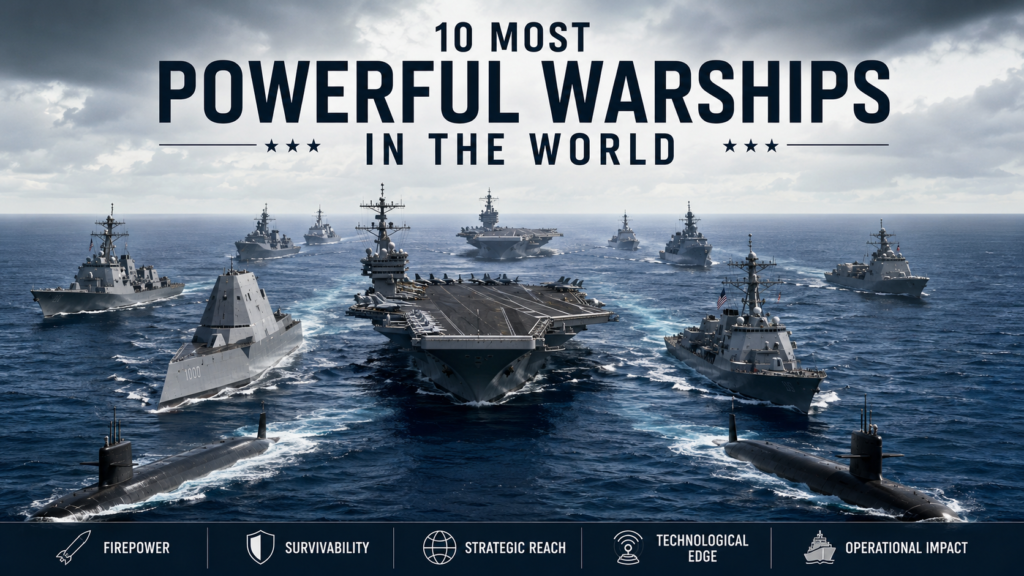
The most powerful warships in the world are not simply the largest or most expensive. They are the platforms that most decisively change what a navy can threaten, defend, and control. This ranking assesses ten operational or near-operational warships on five criteria: firepower, survivability, strategic reach, technological edge, and real-world operational impact. Prototype vessels and paper designs are excluded. Every ship on this list has either been commissioned or is in active operational service in 2026.
Three major naval powers are spending at historically unprecedented rates. The powerful warships they are fielding would have seemed impossible fifteen years ago. China commissioned its third aircraft carrier, CV-18 Fujian, in November 2025. The US Navy’s FY2026 shipbuilding budget reached 47.3 billion dollars. Russia is deploying Borei-A class submarines, each carrying 16 nuclear-armed ballistic missiles. The oceans are contested in ways they have not been since the Cold War.
Firepower covers vertical launch system (VLS) cell counts, missile designations, torpedo capacity, and nuclear capability. VLS cells are modular launch tubes embedded in a ship’s hull; they can carry almost any missile in a navy’s inventory. Survivability covers hull design, stealth signature, damage control, and close-in weapons systems (CIWS), which are automated last-ditch gun or missile systems that engage incoming threats. Strategic reach covers range, endurance, and the ability to operate independently far from home waters. Technological edge covers radar systems, electronic warfare, and combat management software. Operational impact covers deployment history, deterrence value, and fleet leadership role.
All 10 Warships at a Glance
The table below provides a reference summary of all ten warships in rank order.
| Rank | Ship / Class | Nation | Type | Displacement | Primary Armament | Propulsion |
| 1 | USS Gerald R. Ford (CVN-78) | USA | Nuclear Supercarrier | ~110,000 t | F-35C/F/A-18, Tomahawk, ESSM, SeaRAM | Nuclear (2× A1B) |
| 2 | Ohio Class SSBN (14 boats) | USA | Ballistic Missile Sub | ~18,750 t (surfaced) | 24× Trident II D5LE (up to 192 warheads) | Nuclear (1× S8G) |
| 3 | USS Zumwalt (DDG-1000) | USA | Stealth Destroyer | ~15,600 t | 80× VLS, Conventional Prompt Strike (CPS) hypersonic | Gas turbine / IPS |
| 4 | Type 055 Renhai (Nanchang) | China | Heavy Destroyer/Cruiser | ~13,000 t | 112× universal VLS (HQ-9B, YJ-18, CJ-10, Yu-8) | Gas turbine / CODAG |
| 5 | Fujian (CV-18) | China | CATOBAR Carrier | ~80,000 t | J-35 / J-15T / KJ-600 air wing, HHQ-10 CIWS | Conventional steam turbine |
| 6 | Arleigh Burke Flt III (DDG) | USA | Guided Missile Destroyer | ~9,200 t | 96× VLS (SM-6, SM-3, Tomahawk, ASROC) | Gas turbine (COGAG) |
| 7 | Borei-A Class (Project 955A) | Russia | Ballistic Missile Sub | ~24,000 t (submerged) | 16× Bulava SLBM (96-160 warheads) | Nuclear (1× OK-650V) |
| 8 | HMS Queen Elizabeth (R08) | UK | STOVL Carrier | ~65,000 t | 36× F-35B, Phalanx CIWS, Sea Ceptor SAM | Gas turbine / IEP |
| 9 | Virginia Class Block V (SSN) | USA | Attack Submarine | ~10,200 t (submerged) | 65+ weapons (Tomahawk, Mk-48, large-dia. payloads) | Nuclear (1× S9G) |
| 10 | INS Vikrant (IAC-1) | India | STOBAR Carrier | ~45,000 t | MiG-29K / Ka-31 AEW air wing, Barak-1 SAM | Gas turbine (LM2500) |
1. USS Gerald R. Ford (CVN-78) | United States
Nuclear Supercarrier
In March 2026, USS Gerald R. Ford transited the Suez Canal and entered the Red Sea for the first time in the carrier’s service history. That transit placed the most advanced warship ever built inside the active operational area of US Central Command during Operation Epic Fury, a sustained campaign of airstrikes against Iranian military infrastructure. Ford-based F/A-18E/F Super Hornets flew precision strike missions. EA-18G Growlers suppressed Iranian air defences. E-2D Advanced Hawkeyes managed the airspace over a contested theatre. The fact that CVN-78 could arrive, integrate, and sustain high-tempo operations within days of entering the region is the clearest single proof of what this class represents.
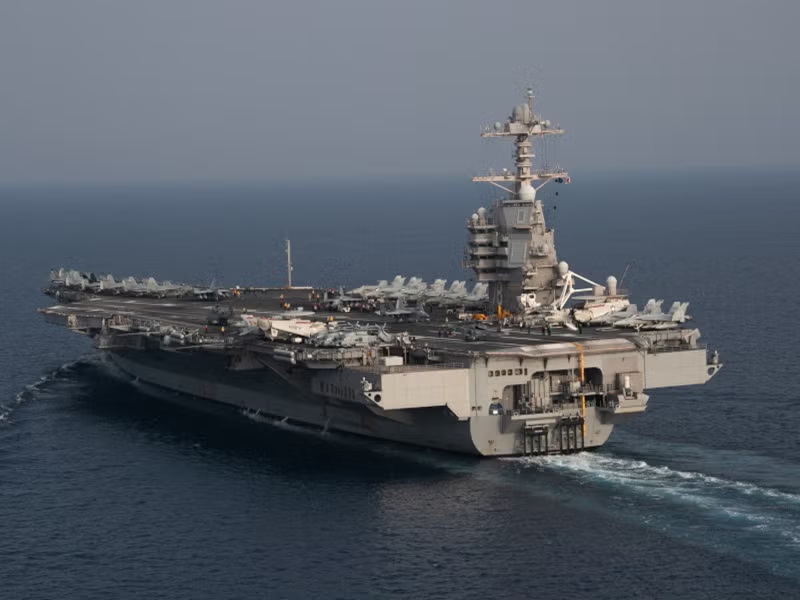
USS Gerald R. Ford (CVN-78): Key Specifications
| Displacement | Approximately 110,000 tons (full load) |
| Length | 337 metres (1,106 feet) |
| Speed | 30+ knots |
| Endurance | Unlimited (nuclear propulsion); 90-day stores limit |
| Crew | Approximately 4,660 including air wing |
| Aircraft | 75+ including F-35C, F/A-18E/F Super Hornet, EA-18G Growler, E-2D Hawkeye, MH-60 |
| Propulsion | Two A1B pressurised-water nuclear reactors |
| Radar / Sensors | Dual-band radar: S-band AN/SPY-3 MFR + X-band AN/VSR volume search; AN/SLQ-32C(V)6 EW suite |
| Self-defence | 2× RIM-162 ESSM launchers, 2× SeaRAM CIWS, 2× Phalanx CIWS |
| Launch system | Electromagnetic Aircraft Launch System (EMALS); Advanced Arresting Gear (AAG) |
| Status 2026 | Active; deployed to Red Sea supporting Operation Epic Fury, March 2026 |
The EMALS, or Electromagnetic Aircraft Launch System, replaces the steam catapults used on every previous American carrier. A steam catapult uses high-pressure steam to accelerate an aircraft down the flight deck. EMALS uses a linear induction motor instead. A linear induction motor converts electrical current into a moving magnetic field that propels the aircraft sled along the catapult track. The result is a smoother, more controllable acceleration curve. It reduces peak stress on airframes by up to 29 percent compared to steam. It allows CVN-78 to launch lighter unmanned aircraft and heavier strike packages on the same day from the same deck. The system is software-controlled, which means launch energy can be adjusted for each aircraft type in seconds. The design goal was a 25 percent increase in sortie generation rate over the Nimitz class. Early operational data from Epic Fury deployments suggests Ford consistently exceeds that target.
The dual-band radar integrated into Ford’s island superstructure is a generation ahead of anything previously installed on a carrier. The AN/SPY-3 is an S-band multifunction radar that handles medium-range tracking, weapons guidance, and low-observable target detection. The AN/VSR is an X-band volume search radar that handles long-range air and ballistic missile threat detection. Both operate from the same integrated radar aperture. The result is a single coherent air picture across two frequency bands simultaneously. No previous carrier had this capability.
Ford experienced significant reliability problems with both EMALS and the Advanced Arresting Gear in its first years of service. The AAG, which replaces the arresting wire system that catches landing aircraft, suffered repeated actuator failures during initial deployments. The Navy resolved the most critical reliability issues through software updates and component redesigns before Ford’s 2022 deployment and subsequent 2026 Red Sea operations. The system performed without major incident during Epic Fury flight operations. The Nimitz-class carriers also had early-service technical problems. Every new ship class does. The question is whether the problems are corrected, and in Ford’s case, they were.
Combat edge: CVN-78 can sustain more than 160 combat sorties per day in surge operations, representing more tactical air power than most nations’ entire air forces. EMALS allows Ford to launch the full spectrum from lightweight surveillance drones to fully armed F-35Cs without deck reconfiguration, giving strike planners flexibility no previous carrier possessed.
Why it ranks here: Ford ranks first because it is the most capable platform ever placed into operational service. Its nuclear propulsion provides unlimited range. Its EMALS installation enables a sortie rate no other carrier class can match. Its dual-band radar gives the carrier strike group a sensor capability that did not exist on any previous carrier. Its real-world deployment to the Red Sea in 2026 was not an exercise. It was combat. The ship performed. That is the ultimate validation.
2. Ohio Class Ballistic Missile Submarines | United States
Nuclear Ballistic Missile Submarine
Somewhere in the world’s oceans right now, at least one Ohio-class submarine is on patrol. No one outside a very small circle in the US Navy knows exactly where. That uncertainty is the entire point. The Ohio class carries the Trident II D5LE, a submarine-launched ballistic missile (SLBM) with a range of 12,000 kilometres and a circular error probable (CEP) of under 90 metres. CEP is the radius within which 50 percent of warheads will land. At 90 metres CEP from 12,000 kilometres, the Trident II D5LE is a precision weapon. Each missile can carry up to eight independently targetable warheads. A single submarine can hold 24 missiles. One boat can engage 192 separate targets on the other side of the planet with no warning.
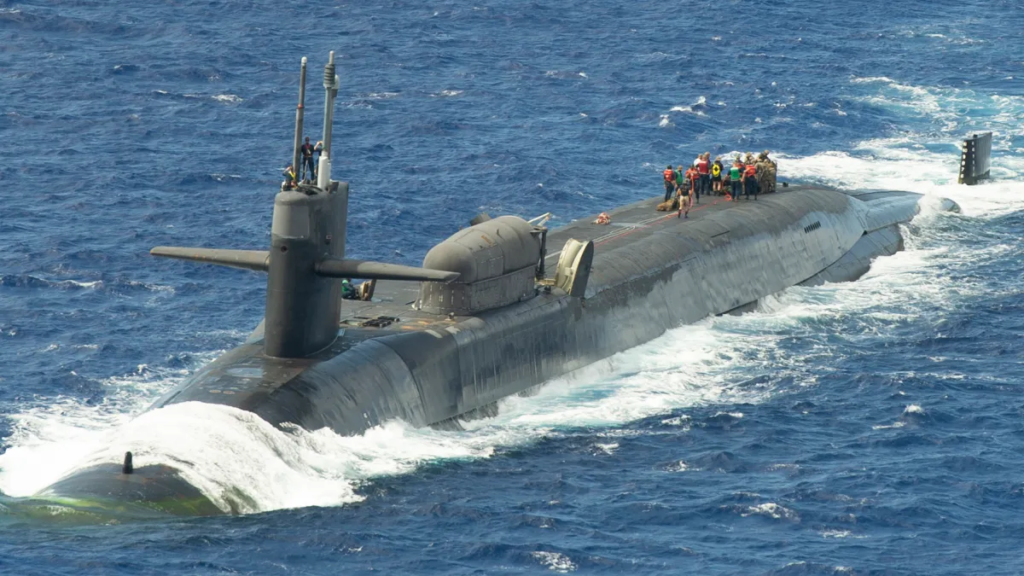
Ohio Class SSBN: Key Specifications
| Displacement | Approximately 18,750 tons (surfaced); 16,764 tons standard |
| Length | 170.7 metres (560 feet) |
| Speed | 20+ knots submerged |
| Endurance | Unlimited (nuclear); 70-90 days on patrol cycle |
| Crew | 155 (two alternating Blue and Gold crews per boat) |
| Primary weapons | 24× Trident II D5LE SLBM; 4× Mk-48 torpedo tubes |
| Warhead yield | Up to 8 W88 (475 kt) or W76-1 (90 kt) MIRVs per missile |
| Propulsion | One S8G pressurised-water nuclear reactor |
| Radar / Sensors | BQQ-10 ARCI sonar suite; BPS-15 navigation radar; TB-29 towed array |
| Boats in service | 14 operational SSBNs as of 2026 (18 original hulls, 4 converted to SSGN) |
| Status 2026 | Active, continuous at-sea deterrence patrols; Columbia class successor in production |
The Trident II D5LE is the Life Extension variant of the original D5. The upgrade replaced aging guidance electronics, extended service life to 2042, and maintained the missile’s accuracy at range. The D5LE can carry multiple independently targeted reentry vehicles (MIRVs), meaning a single missile separates into multiple warheads mid-flight, each steered to a different target. No surface-based missile defence system in the world can simultaneously intercept eight separate warheads descending at hypersonic speeds from a single ICBM trajectory.
The Ohio class operates on a continuous at-sea deterrence (CASD) patrol cycle. Two crews, designated Blue and Gold, rotate for each submarine. One crew takes the boat on a 70-day patrol while the other rests and trains ashore. The result is that 14 submarines maintain approximately 8 to 10 boats on patrol at any given time. This means at least eight separate targeting solutions, each capable of engaging 192 targets, are always at sea. The strategic mathematics of this are significant. An adversary cannot disarm US sea-based nuclear forces with a first strike unless it simultaneously locates and destroys every boat on patrol. That is effectively impossible with current detection technology.
The Columbia class, the Ohio’s replacement, is under construction with the lead boat USS Columbia scheduled for delivery in 2027. Columbia will carry 16 Trident II D5LE missiles per boat. The Ohio class will remain operational through the transition period. The US strategic deterrence posture will not experience a gap.
Combat edge: A single Ohio-class submarine at sea represents a nuclear retaliatory capacity that no combination of conventional military forces can neutralise or preempt. The CASD cycle means that a successful first strike against the continental United States does not eliminate US nuclear retaliatory capability; the boats at sea survive and respond.
Why it ranks here: The Ohio class ranks second rather than first because its mission is deterrence, not power projection. It cannot control sea lanes, launch conventional airstrikes, or support ground operations. What it can do is guarantee that any nation contemplating a nuclear first strike against the United States faces certain civilisational destruction in response. That is the single most strategically significant capability in the world. It ranks second only to a platform that combines nuclear deterrence with the ability to project conventional military power across every operational domain simultaneously.
3. USS Zumwalt (DDG-1000) | United States
Stealth Destroyer / Hypersonic Strike Platform
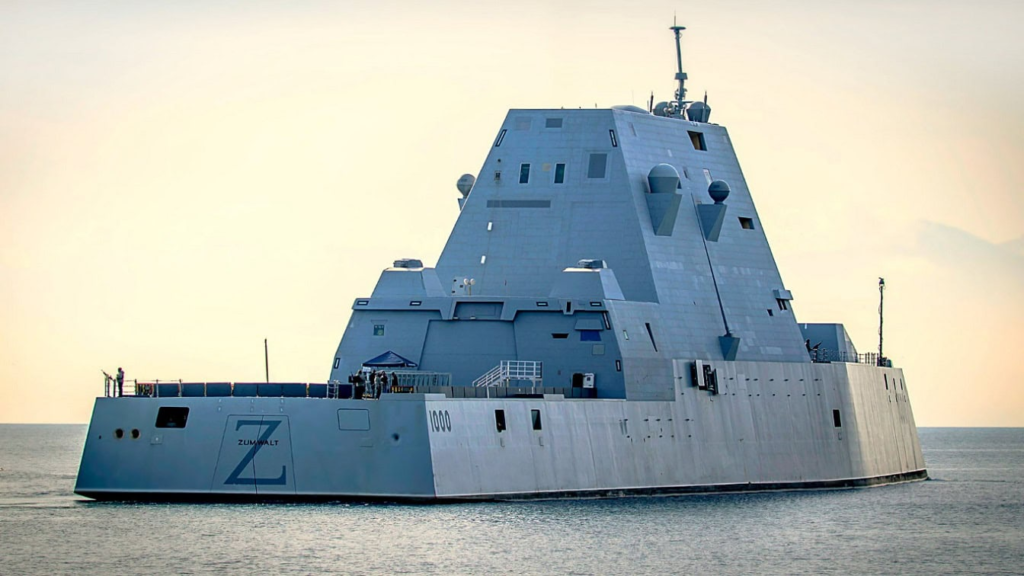
When USS Zumwalt commissioned in 2016, it looked like nothing in any other navy. The hull slopes inward above the waterline. The superstructure is a composite deckhouse with no external fittings. Every antenna, radar aperture, and weapon system is enclosed within the hull envelope. The radar cross-section of a 15,600-ton warship is roughly equivalent to a fishing boat on enemy radar screens. No ship this size had ever been built to be this invisible. Zumwalt was also designed as something far more dangerous than a stealth platform. It is being converted into the delivery system for the Conventional Prompt Strike (CPS) hypersonic weapon, which will give the United States the ability to hit any target on earth within 30 minutes using a conventional warhead launched from a surface ship.
USS Zumwalt (DDG-1000): Key Specifications
| Displacement | Approximately 15,600 tons (full load) |
| Length | 182.9 metres (600 feet) |
| Speed | 30+ knots |
| Range | ~14,000 km at 20 knots |
| Crew | Approximately 147 (automated systems reduce crew requirements dramatically) |
| Primary weapons | 80× Mk-57 Peripheral VLS cells; 2× CPS hypersonic launchers (under conversion); Mk-46 torpedoes |
| Propulsion | Integrated Power System (IPS); two Rolls-Royce MT30 gas turbines generating 78 MW |
| Radar / Sensors | AN/SPY-3 S-band multifunction radar; AN/SQS-61 bow sonar; integrated EW suite |
| Ships in class | 3 — USS Zumwalt (DDG-1000), USS Michael Monsoor (DDG-1001), USS Lyndon B. Johnson (DDG-1002) |
| Status 2026 | Active; DDG-1000 and DDG-1001 undergoing CPS hypersonic weapon conversion |
The tumblehome hull is the defining visual characteristic of the Zumwalt class. Conventional warship hulls flare outward above the waterline to increase deck space and improve sea-keeping. The Zumwalt hull does the opposite. It angles inward, meaning the ship’s widest point is below the waterline. This shape deflects radar energy downward rather than reflecting it back to the source. Combined with the composite deckhouse and the elimination of every external radar reflector, the result is a ship that generates a radar return roughly 50 times smaller than a conventional destroyer of comparable size. In a contested environment with anti-ship missile systems that use radar guidance, appearing small is surviving.
The Integrated Power System (IPS) is the second major innovation. Rather than dedicating separate engines to propulsion and separate generators to shipboard power, the IPS generates all electricity from two Rolls-Royce MT30 gas turbines and routes it electrically to both the propulsion motors and every other system on the ship. When the ship is cruising, surplus power is available for high-energy systems. This is designed explicitly for directed-energy weapons. A high-energy laser or railgun requires massive amounts of electricity delivered in milliseconds. No conventional propulsion system can provide that. The IPS can. The CPS hypersonic launcher also requires very high electrical power for its launch cycle. The IPS makes that possible from a surface ship.
The original 155mm Advanced Gun System (AGS) has been removed from all three Zumwalt-class ships. The AGS was designed to fire Long Range Land Attack Projectiles (LRLAP) to support amphibious operations. The procurement cost of LRLAP rounds reached 800,000 dollars each, making the system unaffordable in combat volume. The guns were removed and the deck space repurposed for CPS launchers. The Conventional Prompt Strike system uses a common hypersonic glide vehicle launched from a large-diameter tube. It reaches speeds above Mach 5. It can strike targets at ranges exceeding 1,600 kilometres. No current ballistic missile defence system can reliably intercept a hypersonic glide vehicle at these speeds and altitudes. The original programme planned 32 Zumwalt-class ships. Cost overruns and changing doctrine cut the class to three. Those three hulls are now being transformed into hypersonic strike platforms that no other navy currently operates.
Combat edge: CPS gives each Zumwalt-class destroyer the ability to strike any target within 1,600 km in under 30 minutes, faster than any ballistic missile defence system can respond to a conventionally armed threat. The IPS architecture makes the Zumwalt class the only surface warship currently capable of sustained high-energy directed-energy weapon operations without auxiliary power generation.
Why it ranks here: Zumwalt ranks third because it combines genuine stealth, an unprecedented power generation architecture, and an emerging hypersonic strike capability in a single hull. Its ranking reflects both current capability and near-term potential. The CPS conversion will make these three ships among the most tactically threatening surface combatants ever built. Their limitation is numbers. Three hulls cannot be everywhere.
4. Type 055 Renhai Class Destroyer | China
Heavy Destroyer / Cruiser
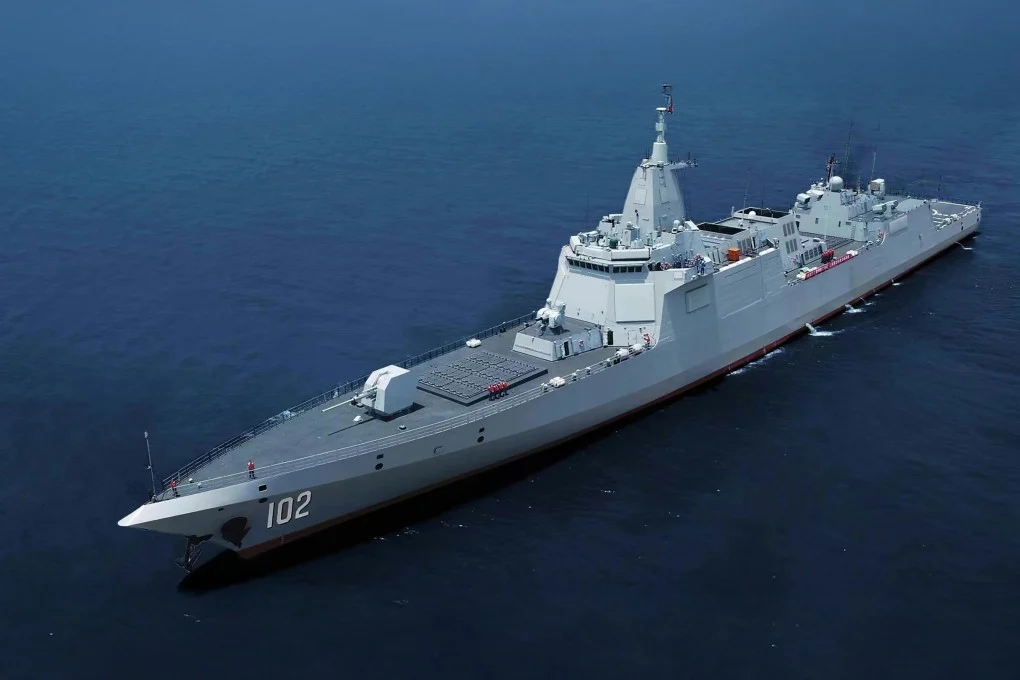
The US Pentagon classifies the Type 055 as a cruiser. The Chinese People’s Liberation Army Navy (PLAN) calls it a destroyer. The semantic argument matters because it reveals something important: the Type 055 is the most heavily armed surface combatant currently in serial production by any nation on earth. When the first Type 055, CNS Nanchang, commissioned in 2020, it introduced a ship class that outguns the American Ticonderoga-class cruiser in VLS capacity. By 2026 China has commissioned more than ten Type 055s and production continues.
Type 055 Renhai Class: Key Specifications
| Displacement | 12,000 to 13,000 tons (full load) |
| Length | Approximately 180 metres |
| Speed | ~30 knots |
| Range | ~5,000 nautical miles |
| Crew | Approximately 300 |
| VLS Cells | 112 universal VLS cells (64 forward, 48 aft) |
| Missiles | HQ-9B SAM, YJ-18 anti-ship cruise missile, CJ-10 land attack, Yu-8 anti-submarine rocket |
| Gun | 130mm H/PJ-38 dual-purpose naval gun |
| Propulsion | CODAG: gas turbines and diesel engines |
| Radar / Sensors | Type 346B Dragon Eye S-band AESA; X-band fire control AESA; Type 518 L-band search radar |
| Status 2026 | 10+ ships commissioned and operational; production ongoing |
The 112 universal vertical launch cells are the defining number for the Type 055. The Arleigh Burke Flight III destroyer, America’s most capable current surface combatant, carries 96 VLS cells. The Ticonderoga-class cruiser, which is being retired, carried 122 cells but is no longer in production. The Type 055’s universal cell design means each launch position can fire anti-ship missiles, land-attack missiles, surface-to-air missiles, or anti-submarine rockets interchangeably. Mission flexibility is decided by magazine loading, not hardware. A commander can shift the ship’s tactical emphasis between air defence, surface strike, and land attack by changing what is loaded into the cells before deployment.
The HQ-9B is China’s primary long-range surface-to-air missile (SAM). It provides area air defence out to approximately 200 kilometres. The YJ-18 is a two-stage anti-ship cruise missile. Its first stage flies subsonically to within approximately 40 kilometres of the target. The second stage then separates and accelerates to Mach 3 in the terminal phase. This supersonic final approach significantly complicates interception by a defending ship’s CIWS. The CJ-10 is a land-attack cruise missile with a range exceeding 1,500 kilometres, giving each Type 055 the ability to strike land targets far beyond the visual horizon.
The dual-band radar architecture mirrors the approach the US Navy uses on the Ford class. The Type 346B Dragon Eye operates in S-band for long-range search and tracking. Four X-band AESA arrays provide fire control for multiple engagements simultaneously. AESA stands for Active Electronically Scanned Array, a radar type that steers its beam electronically rather than mechanically, enabling simultaneous tracking and engagement of dozens of targets. The combination of S-band search and X-band fire control in a single integrated system gives the Type 055 a sensor architecture that was previously only found on American capital ships.
In PLAN fleet doctrine, the Type 055 operates as the primary air defence and surface action commander for Chinese carrier strike groups. CNS Nanchang and subsequent ships routinely escort the Liaoning, Shandong, and now Fujian carrier groups on South China Sea operations. The Type 055 provides the long-range air defence umbrella that allows the carrier to operate without being within range of enemy strike aircraft.
Combat edge: With 112 VLS cells firing simultaneously, a single Type 055 can engage more concurrent aerial threats than any other surface warship currently in production. The YJ-18’s Mach 3 terminal phase creates an intercept window of under five seconds for a defending ship’s CIWS, effectively making it one of the most difficult anti-ship missiles in current service to defeat.
Why it ranks here: The Type 055 ranks fourth because its armament density and radar capability are genuinely world-class. Its limitation against the Zumwalt class is its conventional propulsion, which caps sustained high-energy system operation, and its lack of the stealth geometry that makes Zumwalt tactically survivable in a near-peer contested environment. Against everything below it on this list, the Type 055 is the heavier-armed surface combatant. Its serial production gives China a surface fleet depth no Western navy currently matches.
5. Fujian (CV-18) | China
CATOBAR Aircraft Carrier
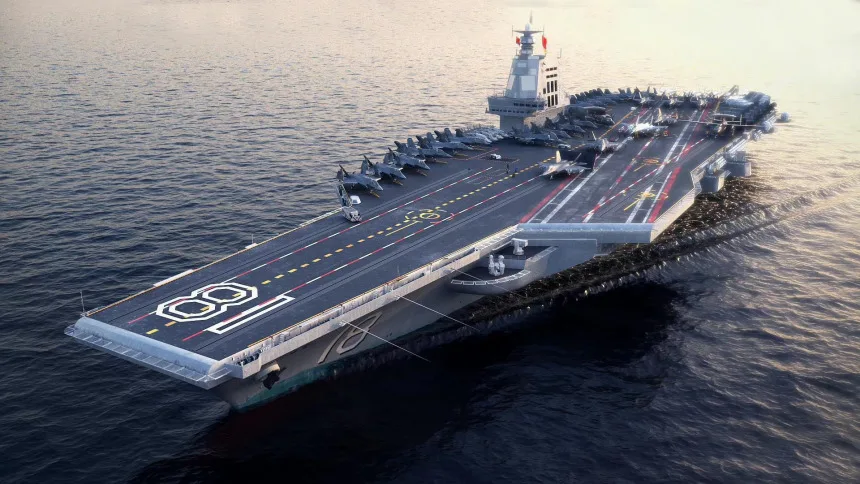
The commissioning of CV-18 Fujian on 5 November 2025, in a ceremony presided over by President Xi Jinping at Sanya naval base, marked the end of one era of Chinese carrier aviation and the beginning of another. China’s first two carriers, Liaoning and Shandong, used ski-jump launch systems inherited from Soviet design philosophy. A ski-jump is a curved ramp at the bow of the carrier. Aircraft taxi to the ramp under their own power and use the upward curve to gain enough altitude to become airborne. It works, but it places a hard limit on takeoff weight. Heavier aircraft with full fuel loads and full weapons loadouts cannot generate enough speed on their own to safely launch. Fujian eliminates that constraint entirely.
Fujian (CV-18): Key Specifications
| Displacement | Approximately 80,000 to 85,000 tons (full load) |
| Length | Approximately 316 metres |
| Speed | ~30 knots |
| Endurance | Limited by fuel (conventional propulsion); stores approximately 45 days |
| Crew | Approximately 2,000 ship’s company plus aviation wing |
| Aircraft | 40+ fixed-wing: J-35 stealth fighter, J-15T multirole, J-15DT EW aircraft, KJ-600 AEW; Z-20J helicopters |
| Launch system | 3× EMALS electromagnetic catapults; advanced arresting gear |
| Self-defence | HHQ-10 short-range SAM, H/PJ-11 CIWS |
| Propulsion | Conventional steam turbines (approximately 280,000 shaft horsepower total) |
| Radar / Sensors | Type 346 series AESA radar; integrated EW suite |
| Status 2026 | Commissioned November 2025; working up to full operational capability |
Fujian’s EMALS installation makes China only the second nation in history to operate electromagnetic catapults on a carrier. The system allows Fujian to launch the J-35 stealth fighter with full internal weapons and fuel, something Liaoning and Shandong’s air wings could never achieve. The J-35 is a carrier-based twin-engine fifth-generation stealth fighter. Fifth generation refers to stealth shaping, internal weapons carriage, sensor fusion, and supercruise capability as a combined package. The J-35 carries weapons internally to avoid radar-reflecting external pylons. Operating from a CATOBAR carrier rather than a ski-jump, it can reach its operational radius with a full weapons and fuel load, transforming it from a compromised platform to a genuine stealth strike aircraft.
The KJ-600 airborne early warning and control (AEW&C) aircraft is perhaps the most significant non-stealth addition to Fujian’s air wing. An AEW&C aircraft uses a large radar mounted above the fuselage to look hundreds of kilometres in every direction simultaneously. It can detect low-flying aircraft and missiles that a ship’s radar, constrained by the curvature of the earth, cannot see. Liaison and Shandong could not operate fixed-wing AEW aircraft because their ski-jump decks could not launch heavy radar-platform aircraft at sufficient weight. EMALS makes KJ-600 operations from Fujian routine. The tactical difference is transformative: Fujian’s strike group now has airborne radar reach that extends the battle space awareness of the entire carrier group by hundreds of kilometres in every direction.
Fujian’s limitation is its conventional propulsion. Steam turbines require fuel. A nuclear carrier carries no aviation fuel constraint other than the physical size of its storage tanks. A conventionally powered carrier must balance its own fuel consumption against the fuel available for its aircraft. Extended high-tempo operations in contested waters far from logistics support become fuel management exercises. The Ford class does not face this constraint. China’s naval leadership is aware of this. Two nuclear-powered carrier projects are reported to be in design or early construction phase. Fujian is likely the last conventionally powered carrier China will build.
Combat edge: Fujian can operate the J-35 stealth fighter and KJ-600 AEW aircraft simultaneously, a combination that gives China a carrier-based airborne strike and surveillance package previously impossible from any PLAN vessel. The addition of KJ-600 to the Fujian air wing extends the carrier strike group’s radar detection range to over 600 km, effectively doubling the battle space available to the group commander.
Why it ranks here: Fujian ranks fifth because it is the most capable non-American carrier ever commissioned. It brings genuine fifth-generation stealth aviation to PLAN carrier operations and eliminates the payload restrictions of ski-jump launch. It ranks below the Type 055 on this list because its strategic impact currently depends on the air wing it is working to integrate, and full operational capability has not yet been demonstrated in contested conditions. It ranks above the Arleigh Burke class because its combination of EMALS, fifth-generation aircraft, and AEW capability represents a qualitative leap in PLAN power projection potential.
6. Arleigh Burke Class Flight III Destroyers | United States
Guided Missile Destroyer
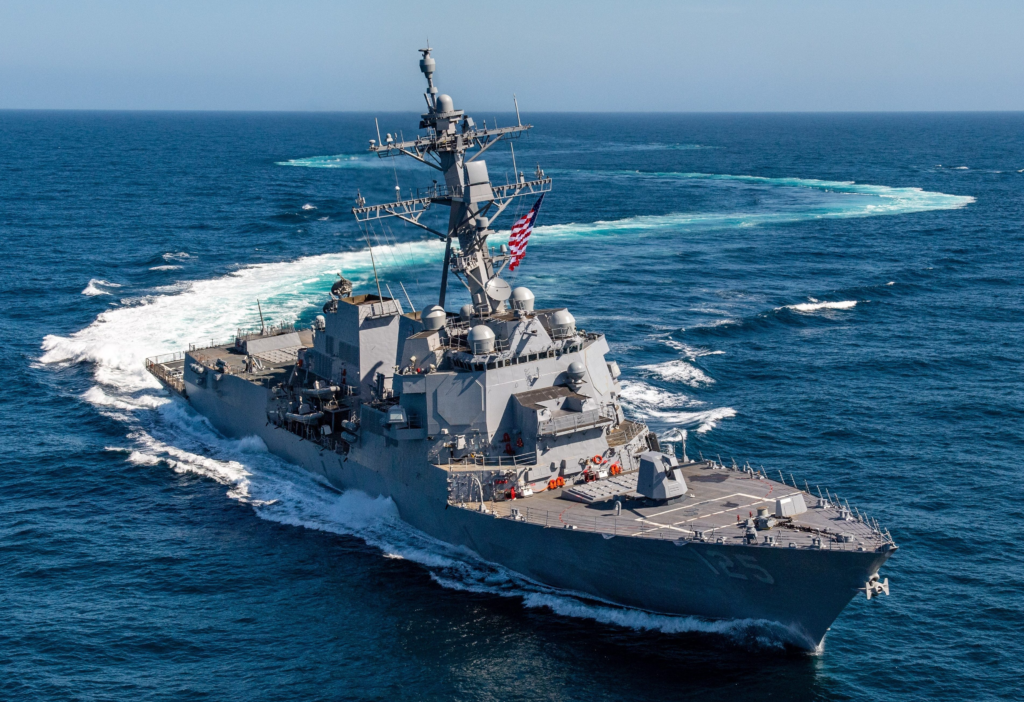
No warship class in the world has a more extensive combat record than the Arleigh Burke. Over 74 ships are in service across the US Navy as of 2026, with Flight III variants entering service from October 2023. These destroyers have performed ballistic missile defence intercepts in the Middle East, conducted surface action operations in the Red Sea, launched Tomahawk cruise missile strikes on land targets, and sustained continuous forward deployments across every ocean simultaneously. The Flight III variant, beginning with USS Jack H. Lucas (DDG-125), centres on a single transformative upgrade: the AN/SPY-6(V)1 Air and Missile Defense Radar.
Arleigh Burke Flight III: Key Specifications
| Displacement | Approximately 9,200 tons (full load) |
| Length | 155.3 metres (509 feet) |
| Speed | 30+ knots |
| Range | ~4,400 nautical miles at 20 knots |
| Crew | Approximately 329 |
| VLS Cells | 96× Mk-41 VLS cells |
| Missiles | SM-6 area air defence, SM-3 ballistic missile intercept, Tomahawk LACM, ASROC anti-submarine, ESSM short-range SAM |
| Guns | 1× 5-inch/62 Mk-45 naval gun; 2× 25mm Mk-38 chain guns |
| Propulsion | COGAG: 4× General Electric LM2500 gas turbines |
| Radar / Sensors | AN/SPY-6(V)1 AMDR AESA (Flight III); Aegis Baseline 10 combat system |
| Status 2026 | 74+ ships in service; Flight III production ongoing; multiple ships deployed globally |
The AN/SPY-6(V)1, also called the Air and Missile Defense Radar (AMDR), represents a generational improvement over the legacy AN/SPY-1D that Flight I and II Burkes carry. The SPY-6 uses 37 modular radar assembly elements, each of which is itself a complete radar. These elements can be combined or reconfigured to change the radar’s power, coverage, and resolution. The system detects threats at significantly longer ranges than SPY-1D. More importantly, it detects much smaller targets. A ballistic missile warhead in the terminal phase, a cruise missile flying at low altitude, or an approaching drone all have small radar signatures. SPY-6’s sensitivity improvements over SPY-1D are measured in orders of magnitude, not increments.
The Aegis combat system is the software architecture that ties the SPY-6 radar, all 96 VLS cells, the ship’s electronic warfare suite, and the tactical data link network into a single coherent picture. Aegis was designed from the beginning to share this picture across multiple ships simultaneously. Cooperative Engagement Capability (CEC) allows one Arleigh Burke to provide targeting data to another ship’s missiles, meaning a destroyer can guide weapons to targets it cannot itself detect. In a carrier strike group, the Burkes effectively extend the carrier’s sensor reach across a wide ocean area and provide its layered defence architecture. The SM-6 Standard Missile can engage aircraft, cruise missiles, ballistic missile warheads, and surface ships. The SM-3 Block IIA can intercept intermediate-range ballistic missiles in the mid-course phase, above the atmosphere.
Arleigh Burke destroyers have performed real ballistic missile defence intercepts in the Red Sea during 2024 and 2025 Houthi attack campaigns, shooting down Iranian-supplied ballistic missiles in flight. USS Carney (DDG-64) set a record in October 2023 by intercepting multiple ballistic missiles and cruise missiles in a single engagement sequence. These are not exercise results. They are operational intercepts under combat conditions.
Combat edge: A Flight III Arleigh Burke with SPY-6 radar can detect and track ballistic missile warheads at ranges that give the battle group time to engage with both SM-3 midcourse intercept missiles and SM-6 terminal defence, creating a two-layer interception opportunity. Cooperative Engagement Capability allows a single Arleigh Burke to guide SM-6 missiles using targeting data from an E-2D Hawkeye or another ship, enabling engagements against targets below the ship’s own radar horizon.
Why it ranks here: The Arleigh Burke class ranks sixth not because of any individual capability deficiency but because the class is a known quantity. Its 96 cells are fewer than the Type 055’s 112. Its radar, while excellent, covers one frequency band to the Type 055’s dual-band architecture. Its strategic value is in numbers, operational depth, and the proven Aegis system. No other navy comes close to deploying 74 ships of this capability class. That mass is itself a form of power, but it does not place any individual ship above a platform with more cells, superior stealth geometry, or hypersonic strike range.
7. Borei-A Class (Project 955A) | Russia
Nuclear Ballistic Missile Submarine
Russia’s nuclear deterrent at sea rests primarily on the Borei-A class submarine. The Project 955A boats are the most modern nuclear weapons delivery platforms in the Russian Navy and represent Russia’s most credible answer to the Ohio class. They are also significantly larger. A submerged Borei-A displaces approximately 24,000 tons, making it the largest SSBN class in current active service in any navy. That size houses one of the most powerful nuclear payloads deployed by any submarine in history.
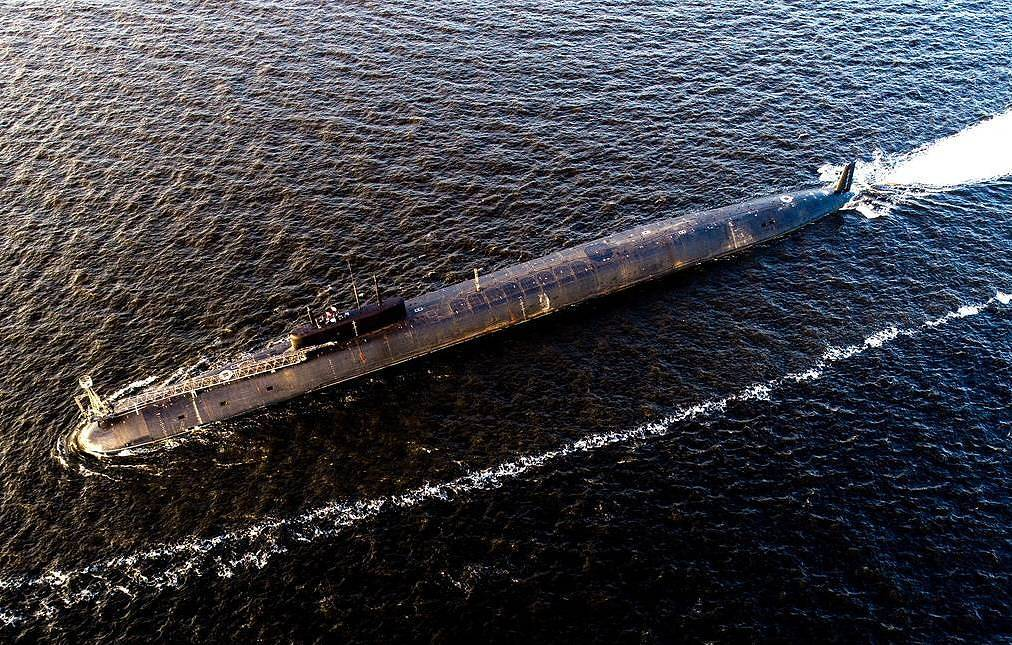
Borei-A Class (Project 955A): Key Specifications
| Displacement | ~14,700 tons surfaced; ~24,000 tons submerged |
| Length | 170 metres |
| Speed | ~29 knots submerged |
| Endurance | Approximately 90 days; unlimited range (nuclear propulsion) |
| Crew | Approximately 107 |
| Primary weapons | 16× RSM-56 Bulava SLBM; 6× torpedo tubes (533mm Mk-48 equivalent) |
| Warheads | 6 to 10 MIRVs per Bulava missile; 96 to 160 warheads per boat |
| Range | Bulava: approximately 8,000 km |
| Propulsion | One OK-650V pressurised-water nuclear reactor; pump-jet propulsor |
| Boats in service | K-549 Knyaz Vladimir, K-553 Generalissimus Suvorov, plus additional commissioned boats; 5+ Borei-A as of 2026 |
| Status 2026 | Active; operational patrols continue despite industrial strain from Ukraine conflict |
The RSM-56 Bulava SLBM is the product of one of Russia’s most troubled weapons development programmes. The missile suffered 11 launch failures in its first 17 tests between 2004 and 2009. Each failure delayed the Borei class deployment by months. The causes ranged from manufacturing quality failures to guidance system faults. Russia persisted. The Bulava eventually achieved reliability, and subsequent operational test launches have demonstrated consistent performance. The operational version carries 6 to 10 MIRVs with a range of approximately 8,000 kilometres. That range is shorter than the Trident II D5LE’s 12,000 km, but it is sufficient to strike any target in North America or Europe from patrol areas in the Arctic or North Atlantic.
The pump-jet propulsor is the acoustic signature reduction measure that defines the Borei-A’s stealth design. A conventional submarine propeller creates cavitation, the formation of vapour bubbles as water pressure drops around the blade tips. Cavitation noise is detectable at significant ranges by passive sonar. A pump-jet encloses the propeller in a duct. Water is drawn in, accelerated through the duct, and expelled. The duct suppresses cavitation noise significantly. The Borei-A is considered substantially quieter than its predecessor Delta IV class submarines. It is not considered as quiet as the Virginia class, but at ocean depths and patrol areas distant from likely US tracking assets, it retains meaningful tactical concealment.
Russia’s submarine force has faced significant challenges since 2022. The war in Ukraine has diverted defence industrial resources, strained the maintenance pipeline for submarine systems, and reduced the pace of new construction. A number of older Russian submarines have experienced reduced readiness rates. The Borei-A class has been partially insulated from this strain because it represents Russia’s top strategic priority. However, the broader context is that Russia’s ability to sustain a credible sea-based nuclear deterrent is under industrial pressure in a way that did not exist five years ago.
Combat edge: The Borei-A’s pump-jet propulsion makes it significantly harder to detect on passive sonar than its predecessors, extending the uncertainty any adversary must account for when modelling Russian submarine patrol areas. With 160 potential warheads per boat and multiple submarines on patrol simultaneously, the Borei-A class maintains Russia’s second-strike nuclear capability independent of land-based ICBM survivability.
Why it ranks here: The Borei-A ranks seventh because its nuclear deterrence capability is real and sustained, but its overall operational context is significantly constrained compared to the Ohio class. It carries 16 missiles to the Ohio’s 24. Its SLBM range of 8,000 km is shorter. Its acoustic quieting, while improved, lags behind American and British equivalents. The industrial strain on Russia’s submarine force is a material factor. The Borei-A remains a credible second-strike platform. It is not the equal of what it is designed to deter.
8. HMS Queen Elizabeth (R08) and HMS Prince of Wales (R09) | United Kingdom
STOVL Aircraft Carrier
The United Kingdom’s ability to project independent military power anywhere on earth rests entirely on two ships. HMS Queen Elizabeth and HMS Prince of Wales are the largest warships Britain has ever built. They are also the first British carriers capable of operating fixed-wing combat aircraft since HMS Ark Royal decommissioned in 1978. The 28-year gap in British carrier aviation is the strategic context that makes these ships so significant. Their return to service restored a capability that a medium naval power without them simply does not have.
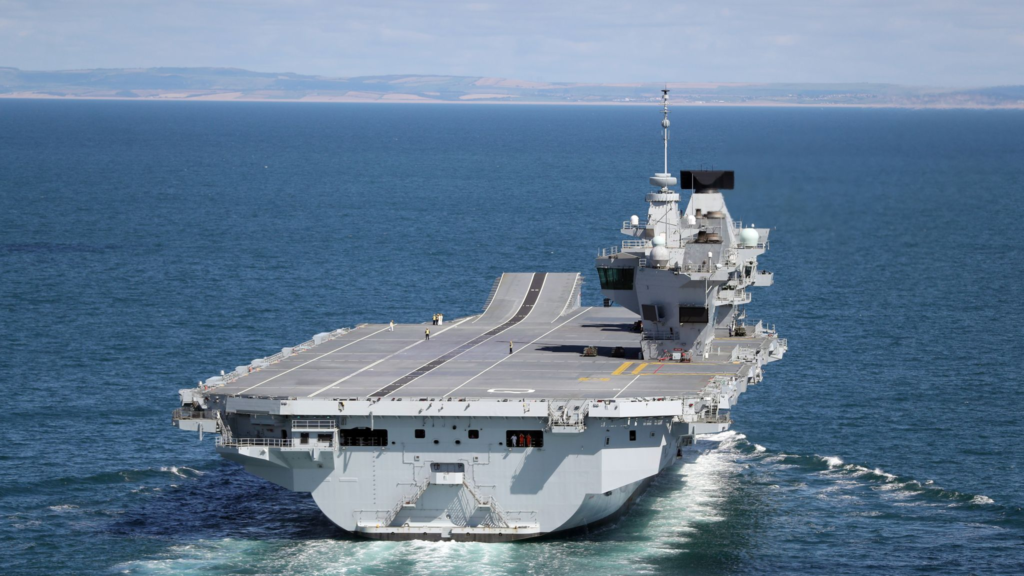
HMS Queen Elizabeth (R08): Key Specifications
| Displacement | Approximately 65,000 tons (full load) |
| Length | 280 metres (919 feet) |
| Speed | 25+ knots |
| Range | ~10,000 nautical miles |
| Crew | Approximately 700 ship’s company; up to 1,600 with full air wing and staff |
| Aircraft | Up to 36 F-35B in high-intensity operations; 18 standard; helicopters including Merlin AEW |
| Launch system | Ski-jump ramp; STOVL (Short Take-Off Vertical Landing) aircraft only |
| Self-defence | 3× Phalanx Mk-15 CIWS; Sea Ceptor short-range SAM; DS30M 30mm cannons |
| Propulsion | Integrated Electric Propulsion (IEP): 2× Rolls-Royce MT30 gas turbines + 4× diesel generators |
| Radar / Sensors | Type 997 Artisan 3D medium-range radar; Type 1046 navigation; Boeing Insitu Scan Eagle UAV |
| Status 2026 | HMS Queen Elizabeth: active (Carrier Strike Group operations); HMS Prince of Wales: operational |
The F-35B is the short take-off vertical landing (STOVL) variant of Lockheed Martin’s F-35 Joint Strike Fighter. It uses a combination of a conventional turbofan engine and a shaft-driven lift fan located just behind the cockpit to generate thrust for vertical landing. In flight, the F-35B performs like a conventional fifth-generation fighter, with radar-evading stealth shaping, an AN/APG-81 AESA radar, and sensor fusion that combines data from all onboard sensors into a single tactical picture. In the STOVL approach, the lift fan provides enough downward thrust to hover and land vertically on the carrier deck.
The ski-jump launch system imposes a meaningful operational constraint. Aircraft accelerate up the curved ramp under their own engine power. The ramp angle, typically 12 to 13 degrees on the Queen Elizabeth class, provides initial upward trajectory. The aircraft must be light enough to become airborne within the length of the deck at the speed it reaches at the ramp. This limits takeoff weight. An F-35B launching from HMS Queen Elizabeth cannot carry the same combination of fuel and weapons as an F-35C launching from a catapult carrier. For short-range missions with modest weapons loads, the constraint is manageable. For long-range deep-strike missions requiring maximum fuel and weapons, it means the Queen Elizabeth class operates the F-35B below its maximum design performance. A CATOBAR carrier with electromagnetic catapults does not face this limitation.
HMS Queen Elizabeth led Carrier Strike Group 21 in 2021, the UK’s largest maritime deployment since the Falklands. The group transited from the Atlantic through the Mediterranean, Red Sea, Indian Ocean, and into the Indo-Pacific, covering 26,000 nautical miles over 28 weeks. F-35Bs from both the Royal Navy and US Marine Corps flew from the carrier simultaneously. The deployment demonstrated the UK’s ability to project power globally and its interoperability with NATO and Indo-Pacific partners. It also demonstrated the class’s single persistent limitation: only one carrier can typically be deployed at any given time, since the Royal Navy’s manpower and maintenance schedule require one ship to be at reduced readiness while the other deploys.
Combat edge: The F-35B’s sensor fusion capability means HMS Queen Elizabeth’s air wing can see, classify, and engage targets across a 500-nautical-mile radius simultaneously, giving the carrier group a tactical picture that no adversary within that radius can easily counter. The joint UK and US Marine Corps F-35B operation model means that in high-intensity conflict, HMS Queen Elizabeth can embark up to 36 F-35Bs by drawing from both national inventories, approximately doubling the strike capacity available from a single UK carrier alone.
Why it ranks here: HMS Queen Elizabeth ranks eighth because the class represents genuine global power projection with a proven deployment record, stealth aviation capability, and NATO interoperability. Its ski-jump launch limitation, conventional propulsion, and single-carrier operational constraint prevent it from ranking higher. For the UK specifically, these ships are irreplaceable. They are the sole means by which Britain can project independent airpower beyond the range of land-based aircraft. For the global ranking, they are technically outclassed by nuclear-powered carriers with catapult launch systems.
9. Virginia Class Attack Submarines Block V | United States
Nuclear Attack Submarine
The Block V Virginia class is the most heavily armed conventional attack submarine ever built. The key to understanding Block V is a single modification: the Virginia Payload Module (VPM). Block I through IV Virginia class boats are outstanding attack submarines. They are quiet, fast, and well-armed. Block V adds an 84-foot hull plug containing four additional Large-Diameter Payload Tubes (LDPTs). Each LDPT holds seven Tomahawk land-attack cruise missiles. The VPM transforms a hunter-killer submarine into a strategic strike platform capable of launching a 28-missile Tomahawk salvo in addition to its standard torpedo room weapons load. The combined strike package available from a single Block V boat exceeds 65 weapons.
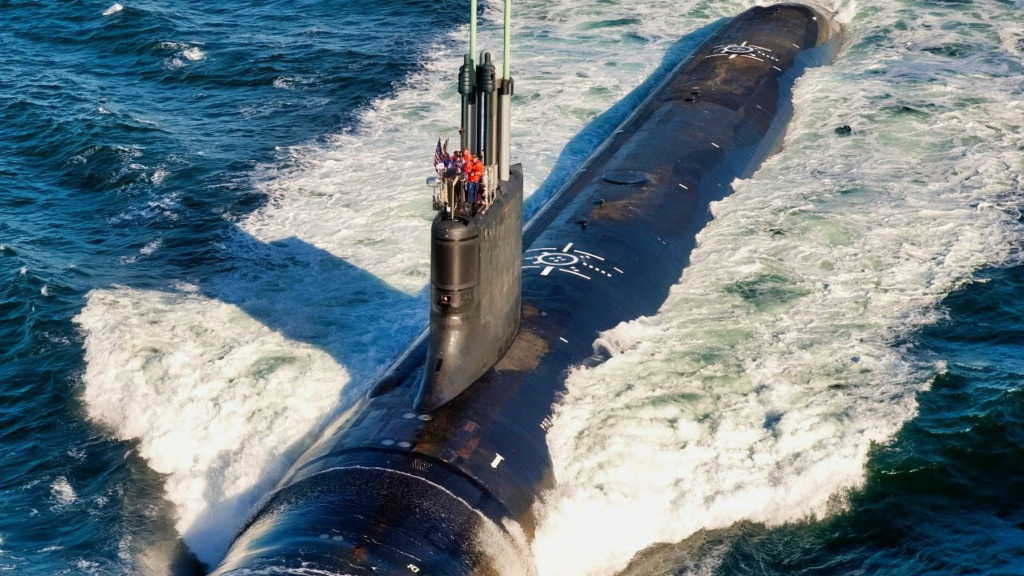
Virginia Class Block V: Key Specifications
| Displacement | ~8,000 tons surfaced; ~10,200 tons submerged |
| Length | ~140 metres (with VPM plug; base hull 115 metres) |
| Speed | 25+ knots submerged |
| Endurance | Unlimited (nuclear); 90-day patrol limit by crew and stores |
| Crew | Approximately 135 |
| Strike capacity | 28× Tomahawk from VPM tubes; 12× Tomahawk from standard VLS; 26× Mk-48 ADCAP torpedoes; total 65+ weapons |
| Torpedo tubes | 4× 533mm bow-mounted torpedo tubes |
| Propulsion | One S9G pressurised-water nuclear reactor; pump-jet propulsor |
| Radar / Sensors | BQQ-10 wide-aperture array sonar; TB-29A towed array; BPS-16 navigation radar; photonic mast (no traditional periscope) |
| Status 2026 | Active; production rate under pressure to meet AUKUS submarine deliveries while sustaining US Navy fleet build |
The Tomahawk Block IV is a subsonic land-attack cruise missile with a range of approximately 1,600 kilometres. It uses terrain-contour matching and GPS guidance to strike fixed targets with a CEP of approximately 10 metres. The extended version, Tomahawk Block V, adds a maritime strike capability against moving surface ships. A Virginia Block V loaded with 40 Tomahawks can strike 40 separate targets 1,600 kilometres apart with no surface signature, no radar detection, and no warning to the target. It approaches below the radar horizon, launches, and repositions. The attacking submarine may never be detected.
The Virginia class’s acoustic advantage over its predecessors and competitors is significant. The S9G reactor’s natural circulation design eliminates the need for primary coolant pumps at low power settings. Pumps are a significant noise source. Natural circulation means the coolant moves through the reactor by convective flow at slow speeds, requiring no pumps and generating no pump noise. The boat is also fitted with an advanced machinery mounting system that isolates noise-generating equipment from the pressure hull. The combination makes the Virginia class quieter than the Los Angeles class it replaces and competitive with the latest fourth-generation Russian submarines.
The AUKUS agreement, signed in 2021 and operationalised through 2024 and 2025, commits the United States to provide Australia with nuclear-powered attack submarines. The initial plan involves US Virginia class boats operating from Australian bases, followed by a new AUKUS-specific submarine design. The industrial challenge is severe. The US Navy is currently building Virginia class submarines at approximately 1.2 boats per year. The Navy’s stated requirement is 2 per year to maintain fleet size. AUKUS demands additional production for Australia. Newport News Shipbuilding and General Dynamics Electric Boat, the two US submarine builders, are expanding capacity, but the timeline is under pressure.
Combat edge: A Virginia Block V can fire a 28-Tomahawk salvo from underwater with no detectable surface presence, providing a land-attack strike capability equivalent to a surface ship strike group with zero radar signature. The natural-circulation S9G reactor and advanced vibration isolation system make Block V Virginia class submarines acoustically competitive with the quietest submarines any adversary currently deploys.
Why it ranks here: The Virginia Block V ranks ninth because its combination of stealth, endurance, and strike capacity is extraordinary for a single hull. It ranks below surface combatants and SSBNs because its strategic role is narrower: it cannot project air power, it cannot defend a fleet against air attack, and its nuclear payload is conventional rather than strategic. Within its mission envelope of subsurface strike, anti-submarine warfare, and intelligence gathering, no other attack submarine in the world currently matches it.
10. INS Vikrant (IAC-1) | India
STOBAR Aircraft Carrier
INS Vikrant is not on this list because it is the most capable ship ranked. It is here because of what it represents in the context of global naval power: the entry of India’s defence industrial base into the top tier of warship construction. India designed and built Vikrant domestically. No other nation outside the US, Russia, China, and France has built a carrier above 40,000 tons in the post-Cold War era. The United Kingdom built the Queen Elizabeth class. Every other nation with a carrier purchased, inherited, or converted existing hulls. India built its own from the keel up. That matters for what comes next.
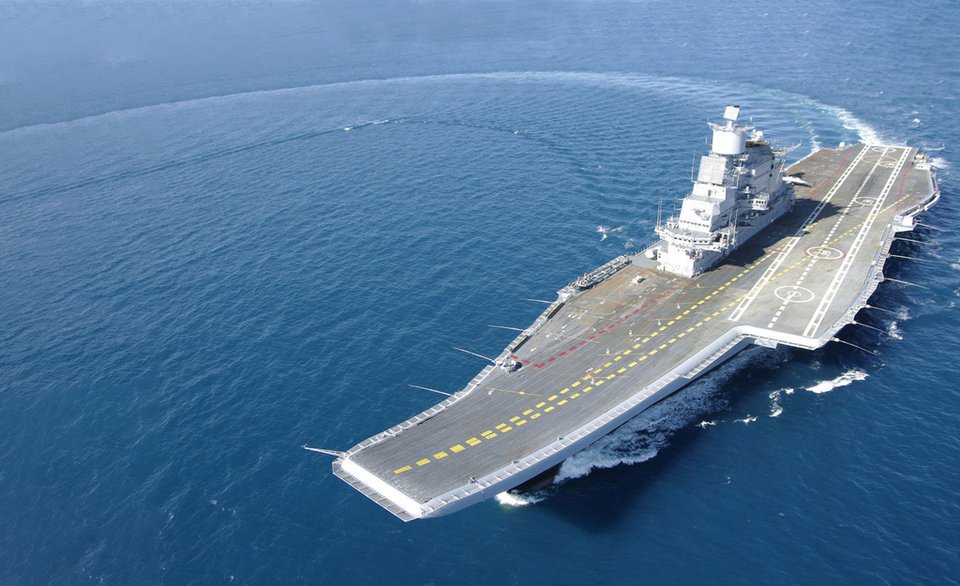
INS Vikrant (IAC-1): Key Specifications
| Displacement | Approximately 45,000 tons (full load) |
| Length | 262 metres |
| Speed | ~28 knots |
| Range | ~7,500 nautical miles at 18 knots |
| Crew | Approximately 1,700 (including air wing) |
| Aircraft | Up to 30 aircraft: MiG-29K multirole fighters, Kamov Ka-31 helicopter AEW, MH-60R, HAL Dhruv helicopters |
| Launch system | Ski-jump ramp; STOBAR (Short Take-Off But Arrested Recovery) |
| Self-defence | Barak-1 point-defence SAM; AK-630 CIWS |
| Propulsion | 4× General Electric LM2500+ and Rolls-Royce Trent 30 gas turbines; 88,000 shaft horsepower |
| Radar / Sensors | EL/M-2248 MF-STAR AESA multifunction radar (Israeli); BEL RAWL-02 long-range air search |
| Status 2026 | Commissioned August 2022; operational with Indian Western Fleet; air wing qualification ongoing |
The Indian Ocean is the world’s third-largest ocean. It carries approximately 80 percent of global seaborne oil trade. India sits at its northern apex. For decades, the Indian Navy argued that its strategic responsibility across this maritime space was not matched by its fleet composition. The arrival of Vikrant changes that calculus. A carrier battle group anchored by INS Vikrant extends Indian maritime air power across the Arabian Sea, Bay of Bengal, and into the Indian Ocean approaches. Adversary surface ships operating within the group’s strike range must contend with air threat from a direction and at distances that shore-based air power alone cannot achieve. This is the core of what a carrier does for a navy: it makes the ocean itself contested rather than merely adjacent to contested shores.
The MiG-29K is the primary fixed-wing strike aircraft currently embarked. The MiG-29K is a navalised variant of the MiG-29 twin-engine multirole fighter. It was designed in the Soviet era and has been in Indian service since 2009. The aircraft is reliable and capable for its generation, but it predates stealth design, modern AESA radar integration as standard, and the sensor fusion architectures found on current fifth-generation aircraft. The honest assessment is that India’s carrier aviation gap is not the ship. The gap is the aircraft. India currently has no carrier-capable fifth-generation stealth fighter in service or near-term development. That means Vikrant operates without the kind of qualitative air superiority edge that the Ford class or Fujian bring through their F-35C and J-35 air wings.
India’s next carrier project, INS Vishal, is intended to address the limitations of Vikrant directly. Vishal is planned as a larger vessel, potentially exceeding 65,000 tons, with a CATOBAR catapult system rather than a ski-jump. CATOBAR would allow India to operate heavier aircraft, including future fifth-generation carrier aircraft. The question of aircraft availability and propulsion type for Vishal remains open. India has explored both conventional and nuclear propulsion options. A decision on Vishal’s design and propulsion has not been publicly finalised. What is clear is that Vikrant’s commissioning created the institutional knowledge, the trained workforce, and the operational experience that makes building Vishal feasible. A nation does not skip directly to nuclear-powered CATOBAR carriers. Vikrant is the necessary step.
Combat edge: INS Vikrant’s air group can cover maritime approaches across a 700-km radius, denying enemy surface forces and submarines the ability to operate undetected across the northern Indian Ocean without significant risk. The domestically built carrier demonstrates that India can design, construct, and operate a major capital warship independently, a capability that fundamentally changes the strategic options available to Indian naval planners for the next 40 years.
Why it ranks here: INS Vikrant ranks tenth because it is genuinely the least capable ship on this list in absolute firepower and technological terms. It ranks on this list at all because of its strategic significance to the Indian Ocean balance, because the threshold for inclusion is more than raw capability, and because India’s entry into indigenous carrier construction represents a permanent shift in the tier of naval power India can project. With MiG-29Ks, limited defensive armament, and a ski-jump launch constraint, it ranks tenth. As a signal of where Indian naval power is heading, it belongs in this company.
The Power Balance at Sea in 2026
Step back from the individual rankings and the picture they form is clear. The United States holds five of the top ten positions. China holds two. Russia holds one. The United Kingdom and India hold one each. That distribution reflects two decades of sustained American naval investment and one decade of Chinese strategic acceleration. It reflects Russia’s concentrated but strained sea-based deterrent. It reflects the United Kingdom maintaining genuine global reach at medium-power scale. And it reflects India stepping into the top tier of naval construction for the first time in its independent history.
The gap between the United States and China is real, but it is closing. China is commissioning aircraft carriers, heavy destroyers, and nuclear submarines at a pace that has no historical parallel outside the United States during the Cold War build-up of the 1980s. The Type 055 is in serial production at a rate that gives the PLAN a surface strike capability density no other navy approaches. Fujian brings EMALS and fifth-generation carrier aviation to the PLAN. China’s fourth carrier, almost certainly nuclear-powered, is reported to be in early construction. The question is not whether China is building a world-class blue-water navy. It is building one. The question is how quickly the operational gap between hardware and doctrine, training, and combat experience closes.
Russia’s naval power is concentrated and credibly dangerous in its submarine force. The Borei-A class sustains Russia’s sea-based nuclear deterrent through a period of significant industrial and financial strain. Russia’s surface fleet is significantly degraded relative to the early 2020s. Several major surface combatants have been damaged or sunk in the Black Sea conflict. The broader lesson is that naval power is not simply a function of what is built. It is a function of what can be sustained, repaired, and crewed under wartime conditions.
The AUKUS agreement between Australia, the United Kingdom, and the United States will add nuclear-powered attack submarines to the Australian Navy’s order of battle by the early 2030s. This changes the Indo-Pacific submarine balance materially. Australian Virginia-class boats operating from Perth and Darwin will extend American and allied subsurface reach into the South China Sea and the waters approaches to Taiwan. The agreement is the most strategically significant naval partnership development of the decade.
The warships being laid down today will define the naval balance in 2040. China’s next carrier, the US Navy’s Columbia-class replacement for the Ohio class, the AUKUS submarine programme, and India’s INS Vishal are all being designed or built right now. Decisions made in shipyards in 2024 and 2025 will determine who controls the sea lanes in 2045. Every military planner on earth is watching the South China Sea, where those decisions will eventually be tested.
Conclusion
Naval power in 2026 is not measured in displacement or hull count. It is measured in the depth of integration between sensors, weapons, and computing that each ship represents. A single Ohio-class submarine on patrol holds enough nuclear capability to fundamentally alter the political geography of the planet. A single Ford-class carrier represents more sustained tactical air power than most nations’ entire air forces. The gap between the top ten and everyone else is not measured in steel. It is measured in the complexity of the systems these ships carry and in the training, doctrine, and industrial base required to sustain them at operational readiness over decades.
The ships on this list are not ends in themselves. They are the physical expression of doctrine, strategy, and industrial capacity. The nation that wins the naval competition of the coming decades will be the one that integrates fifth-generation aircraft, hypersonic weapons, directed-energy systems, and autonomous platforms with the ships it is building today. That integration race is already underway. The South China Sea will be where it is resolved, and every military planner on earth knows it.