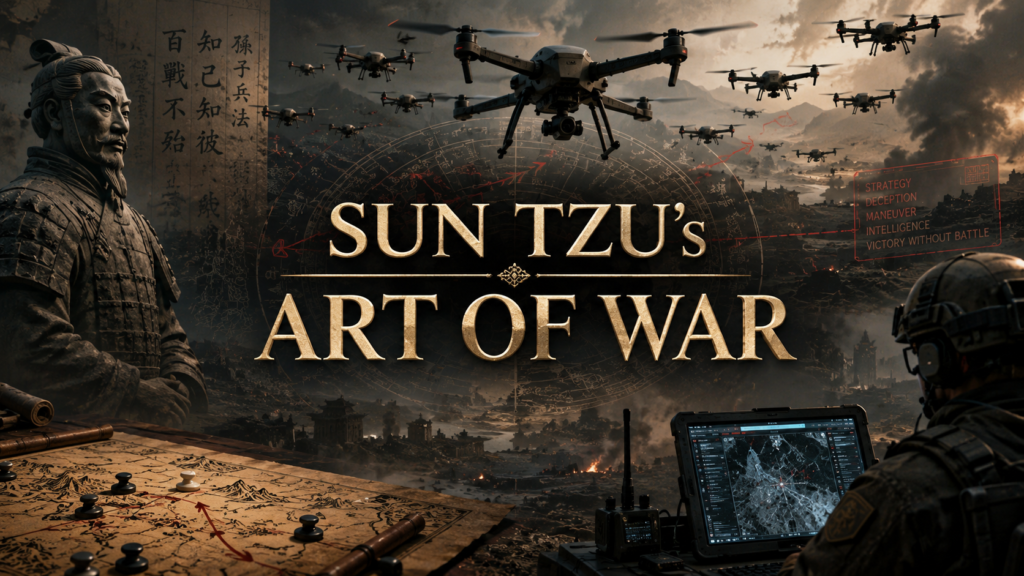
2,500-Year-Old ‘Art of War’ and Still Required Reading at West Point.
How 13 Chapters Written in Ancient China Shaped the Strategies of Napoleon, Mao Zedong, Vo Nguyen Giap, Norman Schwarzkopf and Why They Still Apply in an Age of Drone Swarms and Cyber War
KEY FACTS AT A GLANCE
- Written approximately 500 BCE by Sun Wu, a general serving King Helü of Wu. The text comprises 13 chapters covering every dimension of armed conflict, from strategic planning to the use of spies.
- Required reading at West Point, the US Military Academy, where it is taught in the Military Strategy course (MS 470). Also recommended at the Royal Military Academy Sandhurst.
- Generals Norman Schwarzkopf and Colin Powell cited The Art of War as an influence on Desert Storm’s planning. Vo Nguyen Giap’s Viet Cong officers could recite passages from memory during the Vietnam War.
- Mao Zedong wrote: ‘We must not belittle the saying in the book of Sun Wu Tzu: ‘Know your enemy and know yourself and you can fight a thousand battles without disaster.’
- First translated into a European language in 1782 by French Jesuit Jean Joseph Marie Amiot. Napoleon Bonaparte is believed to have studied it; the French copy was reportedly found in his personal effects.
- The core thesis in six words: ‘Win without fighting whenever possible.’ Every other principle in The Art of War serves this one strategic objective.
There is a book sitting on the required reading lists of military academies from West Point to Sandhurst, translated into over 30 languages, and studied by generals and guerrilla commanders; by intelligence agencies and special operations planners; and by admirals and infantry captains across two and a half millennia of continuous armed conflict. It is 6,000 words long. It was written in China approximately 2,500 years ago by a man whose historical existence is not entirely certain. And despite being separated from its modern readers by the entirety of human history up to the present day, there is not a single principle in its thirteen chapters that a contemporary military commander could dismiss as obsolete.
Sun Tzu’s Art of War is the most influential military text ever written. That is not a claim made by admirers looking for a superlative. It is a documented historical fact measurable in the list of its readers: Mao Zedong, who used it to defeat the Nationalist forces in the Chinese Civil War. General Vo Nguyen Giap, whose Viet Cong forces could recite passages from memory while defeating the most powerful military on Earth. Norman Schwarzkopf, who cited it as an influence on the left-hook deception that destroyed the Iraqi Army in 100 hours in 1991. The KGB, which reportedly made it a required study for intelligence officers during the Cold War. And today, the cyber warfare units, drone swarm doctrine writers, and information operations planners of every major military recognize that the principles governing conflict do not change with the technology.
This Armorexa analysis is the military professional’s guide to The Art of War, not the self-help version, not the business strategy version, but the version that matters to people who study weapons, doctrine, and the real mechanics of how wars are won and lost. We examine Sun Tzu’s thirteen chapters, extract the principles that have most consistently proven their value across 2,500 years of actual warfare, map those principles onto the conflicts where they were applied most decisively, and assess their relevance to the warfare of 2026. The Art of War is not a historical artifact. It is a living strategic document.
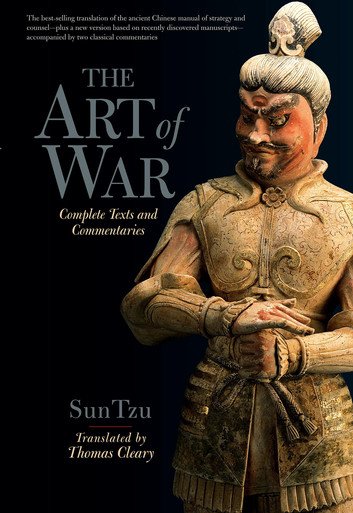
THE MAN, THE MYTH, AND THE MANUSCRIPT
Who Was Sun Tzu, and Does It Matter?
Sun Tzu, whose personal name was Sun Wu and whose honorific title ‘Sun Tzu’ means simply ‘Master Sun,’ is traditionally identified as a general and military strategist who served King Helü of Wu in the late sixth century BCE, during China’s Spring and Autumn period. The Han dynasty historian Sima Qian placed his lifetime at approximately 544 to 496 BCE and recorded a vivid account of how Sun Wu demonstrated his understanding of military discipline to the skeptical king by dividing the royal harem’s 180 concubines into two military units, appointing the king’s two favorite concubines as their commanders, and then having them executed when they disobeyed his orders, after which, Sima Qian tells us, the remaining concubines performed their drills with flawless precision.
Whether this story is historical or legendary, it captures something essential about Sun Tzu’s philosophy: discipline, properly imposed, is the foundation of military effectiveness, and a commander who makes exceptions destroys the authority of every rule he maintains. The historical existence of Sun Wu has been debated by scholars since the 12th century, when some began noting that he is absent from certain ancient Chinese texts that should have mentioned him. Modern scholarship has generally concluded that the text of The Art of War as we have it is probably a compilation, with the earliest portions potentially dating to around the late 5th century BCE and later additions made through the Warring States period.
The discovery in 1972 of bamboo slip manuscripts at Yinqueshan, containing versions of The Art of War that substantially match the received text, has somewhat settled the debate about the text’s antiquity, if not about the precise identity of its author. The authorship question is, ultimately, a matter of historical interest rather than practical military relevance. The principles in The Art of War are not given authority by those who wrote them. They are given authority by the observable fact that commanders who have applied them have consistently outperformed commanders who have not, across an unbroken chain of military engagements spanning 2,500 years and every conceivable variation of technology, terrain, and political context. Sun Tzu’s ideas work. That is a more enduring credential than any biography could provide.
The Text: Thirteen Chapters, One Argument
The Art of War is divided into thirteen chapters, each addressing a distinct dimension of armed conflict. The chapters are: Laying Plans, Waging War, Attack by Stratagem, Tactical Dispositions, Energy, Weak Points and Strong, Maneuvering, Variations in Tactics, The Army on the March, Terrain, The Nine Situations, The Attack by Fire, and The Use of Spies. These chapters are not thirteen independent essays. They are thirteen facets of a single, unified strategic argument whose core thesis can be stated in six words: win without fighting whenever possible.
Every principle Sun Tzu advances: know your enemy and yourself; use deception; strike weakness, not strength; move fast, preserve your resources; and use intelligence to serve this central purpose. War is expensive in every currency that matters: lives, money, time, political capital, and national will. The commander who can achieve his strategic objective at the lowest possible cost, ideally by making the enemy’s resistance unnecessary through superior positioning, intelligence, and psychological effect is the commander who has mastered the art of war. The commander who wins by attrition and brute force has merely demonstrated that he had more resources to waste than his opponent.
‘The supreme art of war is to subdue the enemy without fighting.’ In two and a half millennia of military history, no strategic principle has been more consistently validated or more consistently ignored. Every commander who has applied it won. Many who ignored it lost everything they had.
THE THIRTEEN PRINCIPLES
Principle 1: Know Yourself and Know Your Enemy
“If you know the enemy and know yourself, you need not fear the result of a hundred battles. If you know yourself but not the enemy, for every victory gained you will also suffer a defeat. If you know neither the enemy nor yourself, you will succumb in every battle.”
This is the most quoted and most universally applied principle in The Art of War, and it is also the most frequently misunderstood. Sun Tzu is not merely advocating good intelligence, though intelligence is essential. He is arguing that self-knowledge and enemy-knowledge are inseparable and equally important. A commander who thoroughly understands his adversary’s capabilities, dispositions, and intentions but does not honestly assess his own army’s strengths, weaknesses, morale, and logistical condition will still make catastrophic mistakes. Both sides of the equation are required.
The military history of the 20th century is littered with the wreckage of commanders who knew their enemy but not themselves. The Imperial Japanese Navy’s planning for the Battle of Midway in 1942 reflected sophisticated knowledge of American capabilities but a catastrophic overconfidence in their own operations security, which had been broken by US cryptanalysts. Saddam Hussein’s assessment of coalition forces in 1991 reflected a genuine misunderstanding of what American precision warfare had become, compounded by an inflated belief in the defensive value of his own prepared positions. Both failures fit Sun Tzu’s formula with precise accuracy: knowing the enemy without knowing yourself.
Principle 2: All Warfare Is Based on Deception
“All warfare is based on deception. Hence, when able to attack, we must seem unable. When using our forces, we must seem inactive. When we are near, we must make the enemy believe we are far away. When far away, we must make him believe we are near.”
Sun Tzu’s second foundational principle is not merely a tactical observation. It is a philosophical claim about the nature of conflict: reality matters less than the enemy’s perception of reality. The commander who can systematically distort the adversary’s understanding of his own strength, position, and intention has, in effect, already defeated him because the adversary will make his decisions based on a false model of the battlefield, and false models produce wrong decisions.
The most consequential application of this principle in the 20th century was Operation Bodyguard, the Allied deception program that preceded the D-Day landings at Normandy in June 1944. The entire edifice of Operation Overlord, the greatest amphibious operation in history, was built on a deception architecture that convinced Hitler’s High Command that the real invasion would come at Pas-de-Calais rather than Normandy. The imaginary First United States Army Group, complete with fake radio traffic, dummy vehicles, and the deliberate sacrifice of agents’ credibility to feed false information, successfully froze 15 German divisions at Pas-de-Calais for weeks after the real landings had occurred. This deception saved tens of thousands of Allied lives and was the direct application, at industrial scale, of Sun Tzu’s 2,400-year-old principle.
In 1991, General Schwarzkopf’s famous left-hook maneuver in Desert Storm was preceded by weeks of ostentatious preparation for an amphibious assault on Kuwait City’s coast. The US Marine Corps conducted extensive exercises visible to Iraqi reconnaissance. Intelligence suggested that Saddam Hussein positioned significant forces to defend the anticipated coastal assault. While Iraq watched the coast, 250,000 American soldiers and their vehicles were driving 300 kilometers west through the desert, positioning themselves for the flanking attack that would destroy the Iraqi Army. Sun Tzu’s deception principle, applied at corps scale in the Arabian Desert, produced one of the most lopsided victories in modern military history.
Principle 3: Supreme Excellence Is Breaking the Enemy’s Resistance Without Fighting
“Supreme excellence consists in breaking the enemy’s resistance without fighting.”
This principle is the philosophical centerpiece of The Art of War and the one most resistant to application by commanders whose cultures glorify combat. Sun Tzu’s hierarchy of military achievement places the destruction of the enemy’s strategy as the highest form of victory, followed by disrupting his alliances, then defeating his army in the field, and finally besieging his cities, which Sun Tzu explicitly identifies as the worst option, to be pursued only when all others have been exhausted. Every step down this hierarchy represents an increase in cost, risk, and the expenditure of resources.
The strategic application of this principle can be observed in the Cold War’s denouement. The United States’ containment strategy, Reaganomics-driven defense expenditure designed to force the Soviet Union into an unsustainable arms race, and the CIA’s support for Solidarity in Poland and the Mujahideen in Afghanistan achieved the destruction of the Soviet strategic position without a direct military engagement between the two superpowers. The Soviet Union collapsed not because it was defeated in battle but because its strategy was broken from within, precisely the outcome Sun Tzu identifies as supreme excellence.
The People’s Republic of China’s contemporary strategic approach in the South China Sea and Taiwan Strait reflects this principle with remarkable fidelity. Rather than pursuing direct military confrontation with the United States Navy, China has systematically built artificial islands, established administrative control over disputed maritime zones, developed anti-access/area-denial capabilities that raise the cost of American intervention, and prosecuted what analysts call ‘grey zone’ operations that shift the strategic reality without ever providing a clear justification for a military response. Whether or not PLA planners consciously apply Sun Tzu, the strategic logic is identical: achieve strategic objectives by breaking the adversary’s resistance through means that preclude his ability to respond.
Principle 4: Speed and Initiative Are Decisive
“Let your plans be dark and impenetrable as night, and when you move, fall like a thunderbolt.”
Sun Tzu’s emphasis on speed is not simply tactical advice about moving quickly. It is a systemic argument about the relationship between decision cycles and strategic outcomes. The commander who decides and acts faster than his adversary is not merely faster; he is operating in a different temporal reality. While his adversary is processing what has just happened, the faster commander is already acting in response to what is happening now. This compounding tempo advantage is the mechanism by which smaller or less powerful forces consistently defeat larger, slower ones.
The OODA Loop, Observe, Orient, Decide, Act, formulated by US Air Force Colonel John Boyd after studying aerial combat in the Korean War, is the modern military expression of this Sun Tzu principle. Boyd demonstrated that pilots who cycled through the OODA loop faster than their adversaries consistently won engagements regardless of the relative performance of their aircraft. The F-86 Sabre’s victory ratio over the technically superior MiG-15 in Korea, Boyd argued, was attributable largely to the F-86’s clear bubble canopy and responsive hydraulic controls that allowed American pilots to cycle through their OODA loop faster than MiG pilots could respond. Sun Tzu’s thunderbolt, two and a half millennia later, was still winning.
Principle 5: Attack Weakness, Not Strength
“In war, the way is to avoid what is strong and strike at what is weak.”
Sun Tzu’s principle of attacking weakness rather than strength is the foundation of every asymmetric warfare doctrine ever written, and it is simultaneously the most intuitive principle in The Art of War and the most frequently violated by commanders whose professional culture rewards aggression and direct confrontation. The logic is irrefutable: any attack on an enemy’s strength requires that your own strength exceed his at the point of contact, while an attack on his weakness can succeed with a fraction of the resources required for a frontal engagement. Concentration of force at a weak point costs less and produces the same or better result.
The most elegant military application of this principle in modern history was General Erich von Manstein’s Case Yellow, the 1940 German invasion of France. When the German High Command proposed a repeat of the 1914 Schlieffen Plan, swinging through Belgium and the Netherlands to attack the Allied forces directly, Manstein instead proposed routing the main armored thrust through the Ardennes Forest, which Allied planners had dismissed as impassable to tanks and therefore left defended by weaker forces. The Ardennes was the enemy’s weakness. France fell in six weeks. Sun Tzu’s principle, applied with armored precision through a Belgian forest, produced the fastest conquest of a major European power in history.
Principle 6: Adaptability — Be Like Water
“Water shapes its course according to the nature of the ground over which it flows. The soldier works out his victory in relation to the foe he is facing. Therefore, just as water retains no constant shape, so in warfare there are no constant conditions.”
This principle is perhaps Sun Tzu’s most philosophically sophisticated and the one most easily dismissed as a metaphor by commanders whose doctrine emphasizes standardized procedures. Sun Tzu’s argument is that fixed plans, regardless of their quality, become liabilities the moment contact is made with an adversary who does not conform to them. The commander who can instantly adapt his approach to the actual conditions he faces rather than the conditions he planned for holds an inherent advantage over a more rigid adversary.
The military counterpoint to this principle is provided by the First World War’s Western Front, where both sides’ rigid adherence to tactical doctrines had already demonstrably failed. The British infantry assault at the Somme, the French élan offensive doctrine in Alsace-Lorraine, and the German frontal attacks at Verdun continued to produce catastrophic casualties that any flexible reevaluation of the tactical reality would have precluded. The commanders who broke from this rigidity, Bruchmüller’s German infiltration tactics of 1918 and the British’s progressive adoption of combined-arms operations by 1917, achieved results disproportionately superior to those obtained by conventional assault doctrine. The water found the ground’s shape. The rock did not.
Principle 7: Intelligence Is the Foundation of All Strategy
“If you know the enemy and know yourself, your victory will not stand in doubt… foreknowledge cannot be elicited from spirits; it cannot be obtained inductively from experience, nor by any deductive calculation. Knowledge of the enemy’s dispositions can only be obtained from other men.”
Sun Tzu’s final chapter on the use of spies and intelligence is the capstone of the entire work because Sun Tzu explicitly argues that all the preceding principles cannot be effectively applied without intelligence. You cannot know your enemy without spies. You cannot identify his weakness without intelligence. You cannot deceive him without knowing what he already believes. You cannot adapt to conditions you have not accurately assessed. Intelligence is not a supporting element of strategy in Sun Tzu’s framework; it is the prerequisite for strategy itself.
Sun Tzu identifies five types of intelligence agents: local spies recruited from the enemy’s own population; inward spies recruited from enemy officials; converted spies, captured enemy agents turned to work for you; doomed spies fed disinformation they will carry back to the enemy; and living spies who penetrate enemy headquarters and return with information. This taxonomy of intelligence types, developed in 500 BCE, maps with remarkable precision onto the categories of modern intelligence tradecraft: HUMINT (human intelligence), SIGINT (signals intelligence), counterintelligence, deception operations, and strategic intelligence gathering. The categories have not changed. The technology has.
THE ART OF WAR IN ACTION
Mao Zedong: Sun Tzu Scaled to Revolution
Mao Zedong’s application of Sun Tzu’s principles to the Chinese Communist Party’s military campaign against Chiang Kai-Shek’s Nationalist forces between 1927 and 1949 is the most consequential single demonstration of The Art of War’s principles in the modern era. The CCP’s military position was, for most of this period, one of absolute inferiority: inferior in numbers, weapons, logistics, international support, and territory controlled. Applying Sun Tzu’s principle of winning without fighting and its corollary, avoiding battle when conditions do not favor you, Mao explicitly built a doctrine of protracted warfare in which direct engagement with superior Nationalist forces was deliberately avoided while the CCP built its political base, exhausted its adversary’s resources, and waited for the correlation of forces to shift.
Mao’s Three Rules of Discipline and Eight Points for Attention, the code governing how the People’s Liberation Army treated the civilian population in liberated areas, directly reflect Sun Tzu’s principle that the population’s support is a strategic resource. His writings ‘On Guerrilla Warfare’ and ‘On Protracted War’ cite Sun Tzu explicitly. The strategy they describe, disperse when the enemy is strong, concentrate when he is weak, and mobilize the population as the army’s ocean in which it swims, is Sun Tzu’s asymmetric warfare doctrine applied to a 20th-century revolutionary context with precise fidelity.
General Vo Nguyen Giap: The Man Who Defeated Two World Powers
Vo Nguyen Giap is the military commander whose career most completely vindicates Sun Tzu’s principles in the 20th century. Beginning with the Viet Minh’s campaign against French colonial rule and culminating in the North Vietnamese Army’s eventual victory over the United States, Giap consistently defeated adversaries whose material superiority was overwhelming by applying Sun Tzu’s principles with the patience and precision that 2,500 years of documented military experience validated.
His decisive operational application of Sun Tzu came at Dien Bien Phu in 1954, where Giap’s forces besieged the French garrison in a remote valley of northwestern Vietnam. The French commander, General Henri Navarre, had selected Dien Bien Phu as a base precisely because he believed the Viet Minh could not supply heavy artillery through the jungle terrain surrounding it. Giap’s assessment of French thinking and his knowledge of the enemy told him exactly where the French believed their strength lay. His response of disassembling artillery pieces and carrying them through jungle trails on human backs to positions the French had deemed inaccessible, then reassembling them in carefully camouflaged positions on the surrounding hills was the direct application of Sun Tzu’s strike where he is weak, not where he is strong. French artillery and air power, which Navarre had counted on to dominate the valley, were destroyed on the ground by weapons the French had never imagined could be there. The French garrison surrendered on 7 May 1954. France’s Indochina empire died with it.
During the Vietnam War, Giap explicitly instructed his officers to study Sun Tzu. Viet Cong officers reportedly could recite passages from memory. Giap’s strategy against the United States, avoiding decisive engagement, imposing continuous attritional cost through guerrilla operations, and exploiting the political dimension of the conflict by making American domestic opinion the decisive strategic battleground, is Sun Tzu’s supreme excellence applied against the most powerful military force in the history of the world. America did not lose the Vietnam War on the battlefield. It lost it in the strategic dimension that Sun Tzu had identified as decisive: the enemy’s will to continue.
Norman Schwarzkopf and the Desert Storm Left Hook
General Norman Schwarzkopf, Supreme Commander of coalition forces in Operation Desert Storm, cited The Art of War as required reading for his staff. The operational design of the ground campaign reflects Sun Tzu’s principles with textbook precision. The deception operation that fixed Iraqi attention on Kuwait City’s coast while the XVIII Airborne Corps and VII Corps drove 300 kilometers west through the desert is Sun Tzu’s principle of deception applied at operational scale. The targeting of Iraq’s command and communications infrastructure in the 38-day air campaign before a single ground soldier crossed the border is Sun Tzu’s principle of attacking the enemy’s strategy at its nervous system rather than its army in the field. The crushing speed of the 100-hour ground campaign, which ended before Iraqi forces could effectively reorganize or respond, is Sun Tzu’s thunderbolt, executed by the most powerful armored force ever assembled.
Vo Nguyen Giap defeated France with artillery carried through the jungle by hand. Schwarzkopf drove 300,000 soldiers through an ‘impassable’ desert in secret. Both were applying the same principle, written in China 2,500 years earlier: strike where the enemy believes you cannot be at the moment he is looking somewhere else entirely.
THE ART OF WAR AND MODERN WARFARE
Sun Tzu in the Age of Drone Swarms
The emergence of drone swarm warfare which Armorexa has analyzed extensively, validates Sun Tzu’s principles with a precision that 2,500 years of technological transformation has done nothing to undermine. The drone swarm’s strategic logic is Sun Tzu’s attack weakness, not strength, applied at a mechanical scale: instead of attacking the adversary’s air defense system where it is strongest at the point of its heaviest missile coverage and its most concentrated radar networks, a swarm attacks the adversary’s weakness, which is the finite capacity of any point defense to engage simultaneous threats. The swarm finds the gap in the enemy’s strength and flows through it, exactly as Sun Tzu’s water finds the cracks in rock.
HIMARS’ operational impact in Ukraine, also detailed in Armorexa’s earlier analysis, is the strike-weakness principle at its most effective: rather than attacking Russian front-line forces where they were strongest, in prepared defensive positions, Ukrainian HIMARS batteries attacked the logistical infrastructure behind the front, which was the weakest link in Russia’s operational architecture. Within 30 days, Russia’s entire forward supply system had been forced to relocate to distances that degraded its effectiveness. Sun Tzu’s principle of attacking the enemy’s strategy rather than his army, applied with precision rocket artillery and GPS guidance, changed the trajectory of a major European war.
Cyber Warfare as the New Art of War
Cyber warfare is perhaps the domain where Sun Tzu’s principles find their most direct modern expression. The principle that supreme excellence is winning without fighting is the operational goal of every offensive cyber operation: achieve a strategic effect disrupting the adversary’s command systems, degrading his infrastructure, and corrupting his intelligence without a kinetic engagement that triggers a conventional military response. The Stuxnet worm, which destroyed approximately 1,000 Iranian uranium enrichment centrifuges at the Natanz facility without a single shot being fired or a single soldier crossing a border, is the closest modern equivalent to Sun Tzu’s supreme excellence: strategic objectives achieved without the costs and risks of open warfare.
Sun Tzu’s principle of deception, “All warfare is based on deception,” is the foundational doctrine of information operations, the fastest-growing dimension of modern military competition. The Russian information operations preceding and accompanying the 2014 annexation of Crimea, which created sufficient confusion about events’ nature and authorship that the international community struggled to formulate a coherent response for weeks, are a direct application of Sun Tzu’s principle that the commander who can make the enemy uncertain about basic facts has already won a significant advantage. China’s sustained gray-zone operations in the South China Sea, deliberately calibrated to remain below the threshold that would justify a clear military response, apply the same principle: appear not to be doing what you are doing until what you are doing is irreversible.
Intelligence in the Age of AI
Sun Tzu’s insistence that foreknowledge/intelligence is the foundation of all effective strategy has never been more practically validated than in the era of satellite imagery, signals intelligence, and AI-assisted data fusion that characterizes 21st-century military operations. The US military’s JSTARS platform, which tracked Iraqi ground force movements in real time during Desert Storm and fed that targeting data to coalition commanders, is Sun Tzu’s intelligence principle implemented in airborne radar. The NSA’s global signals collection architecture is Sun Tzu’s network of spies scaled to planetary coverage. The AI targeting systems that are being integrated into HIMARS, F-22, and drone swarm platforms in 2026 are Sun Tzu’s principle that victory is decided before battle through superior information, implemented in machine learning algorithms.
THE THIRTEEN CHAPTERS
| Chapter | Title | Core Principle | Modern Military Application |
| 1 | Laying Plans | Assess the five factors: moral law, heaven, earth, commander, doctrine | Pre-deployment assessment: political will, weather, terrain, leadership, doctrine |
| 2 | Waging War | War is expensive: victory must be swift | Avoid protracted conflict; NATO’s rapid dominance doctrine |
| 3 | Attack by Stratagem | Supreme excellence: win without fighting | Grey-zone operations, cyber warfare, economic coercion |
| 4 | Tactical Dispositions | Secure yourself; then seek victory | Defensive preparation before offensive action |
| 5 | Energy | Combine orthodox and unorthodox forces | Combined arms: fixed force holds; manoeuvre force strikes |
| 6 | Weak Points and Strong | Water avoids high ground; attack weakness | Flanking manoeuvres, asymmetric warfare |
| 7 | Maneuvering | Turn the roundabout into the direct | Desert Storm left hook, Inchon landing |
| 8 | Variation in Tactics | Nine variations; adapt to circumstances | Mission command, OODA loop, decentralised execution |
| 9 | The Army on the March | Read terrain and enemy behaviour signs | ISR interpretation; pattern-of-life analysis |
| 10 | Terrain | Six terrains; six mistakes | Operational planning; combined arms integration |
| 11 | The Nine Situations | Nine situations demand different postures | Escalation management; nuclear deterrence postures |
| 12 | The Attack by Fire | Five uses of fire: timing is everything | Precision fires: suppression of enemy air defence |
| 13 | The Use of Spies | Intelligence is the foundation of all strategy | HUMINT, SIGINT, cyber espionage, satellite reconnaissance |
SUN TZU VS CLAUSEWITZ: THE TWO POLES OF STRATEGIC THOUGHT
No discussion of Sun Tzu’s place in military thought is complete without addressing his relationship to Carl von Clausewitz, the Prussian military theorist whose On War (1832) represents the other great pole of Western strategic thinking. Understanding their differences clarifies why Sun Tzu remains uniquely relevant to the current strategic environment.
Clausewitz argued that war is the continuation of policy by other means, that military force is an extension of political will, and that the purpose of war is to break the enemy’s will to resist through the destruction of his military forces. Clausewitz’s framework is fundamentally attritional: war is won by grinding down the adversary’s capacity and willingness to continue fighting. His concept of friction, the sum of all the unpredictable factors that make the execution of war plans more difficult than their design suggests, and his emphasis on the ‘fog of war’ reflect a theory of warfare in which mass, persistence, and willingness to absorb punishment are decisive.
Sun Tzu’s framework is fundamentally different. Where Clausewitz accepts friction and fog as inherent features of war to be managed, Sun Tzu treats them as conditions to be eliminated through superior intelligence and preparation. Where Clausewitz accepts the destruction of the enemy’s forces as the primary military objective, Sun Tzu argues that the best outcome is one in which the enemy’s forces are intact but rendered irrelevant. Where Clausewitz’s theory tends toward the escalation of force and total war as the logical extreme of his framework, Sun Tzu’s theory tends toward the minimum force consistent with the political objective.
The RAND Corporation’s assessment of DTIC studies on strategic philosophy consistently finds that contemporary US military doctrine attempts to synthesise both traditions: Clausewitz’s acknowledgement of war’s political nature and his analytical rigor about friction and uncertainty, combined with Sun Tzu’s emphasis on intelligence, deception, and the achievement of strategic objectives at minimum cost. The US military’s doctrine of full-spectrum dominance, effects-based operations, and information superiority reflects the Sun Tzu heritage more directly than the Clausewitzian one. China’s People’s Liberation Army’s Unrestricted Warfare doctrine, developed in the 1990s specifically in response to Desert Storm, is explicit Sun Tzu applied to the constraints of a nation that recognizes it cannot currently match the US conventional military power.
Clausewitz said, “Win by destroying the enemy’s forces and breaking his will.” Sun Tzu said, “Win by making the fight unnecessary.” The 20th century gave us the First World War as the definitive illustration of Clausewitz taken to its logical extreme. It gave us every successful insurgency since 1945 as the definitive illustration of Sun Tzu. The 21st century brings us cyber warfare, gray-zone operations, and information dominance are Sun Tzu’s framework applied with digital tools.
FREQUENTLY ASKED QUESTIONS ABOUT SUN TZU’S ART OF WAR
Q1. What is Sun Tzu’s Art of War about?
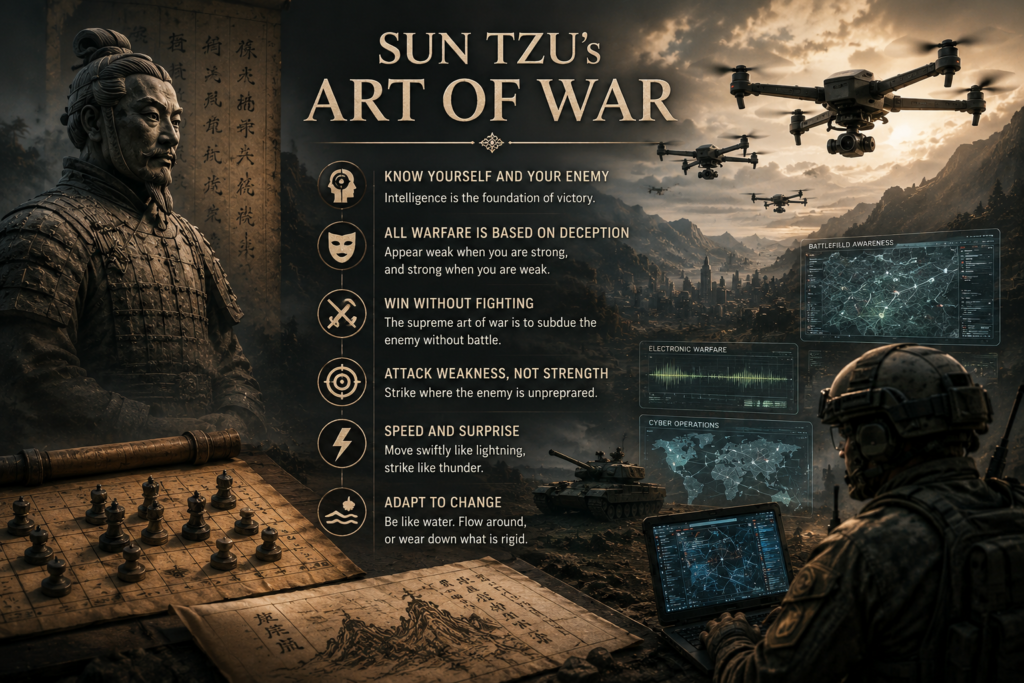
Sun Tzu’s Art of War is a military strategy text written in ancient China approximately 500 BCE, comprising 13 chapters each addressing a distinct aspect of armed conflict. Its central argument is that the supreme achievement in warfare is winning without fighting, defeating the enemy through superior strategy, intelligence, and positioning rather than direct military engagement. Key principles include knowing yourself and your enemy; all warfare is based on deception; attacking weakness, not strength; moving with speed and surprise; adapting to changing conditions like water; and using intelligence as the foundation of all strategy. It is required reading at West Point and Sandhurst.
Q2. Why is the Art of War still relevant today?
Sun Tzu’s Art of War remains relevant because its principles address the fundamental constants of armed conflict that technology cannot change: the importance of understanding your adversary, the decisive value of information superiority, the advantage of speed and surprise, and the principle that the best victory is one achieved at minimum cost. Modern warfare applications include cyber warfare (winning without fighting), drone swarm tactics (attacking weakness, not strength), grey-zone operations (deception and indirect approach), and AI-assisted intelligence systems (foreknowledge as the foundation of strategy). Generals from Schwarzkopf to the PLA’s current doctrine writers have applied its principles directly.
Q3. What is Sun Tzu’s most famous quote?
Sun Tzu’s most famous and most universally cited quote is ‘If you know the enemy and know yourself, you need not fear the result of a hundred battles.’ His second most cited principle is ‘All warfare is based on deception.’ And his most philosophically important principle is ‘The supreme art of war is to subdue the enemy without fighting.’ These three quotations together capture the essence of Sun Tzu’s strategic framework: intelligence, deception, and the achievement of objectives at minimum cost and violence.
Q4. Who has been influenced by Sun Tzu’s Art of War?
The Art of War’s confirmed readers and practitioners include: Mao Zedong, who cited it as essential to his victory in the Chinese Civil War; General Vo Nguyen Giap, whose Viet Cong officers memorized passages and whose strategy defeated both France and the United States; Generals Norman Schwarzkopf and Colin Powell, who cited it in the context of Desert Storm; Douglas MacArthur; Napoleon Bonaparte (a French translation was reportedly in his possession); Japanese daimyo Takeda Shingen; and KGB intelligence officers during the Cold War. It is required curriculum at the US Military Academy at West Point.
Q5. What are the 13 chapters of the Art of War?
The 13 chapters of The Art of War are (1) Laying Plans: assess the five strategic factors; (2) Waging War: the economics of conflict; (3) Attack by Stratagem: win without fighting; (4) Tactical Dispositions: secure before attacking; (5) Energy: orthodox and unorthodox forces; (6) Weak Points and Strong: attack weakness; (7) Maneuvering: indirect approach; (8) Variation in Tactics: adaptability; (9) The Army on the March: reading signs; (10) Terrain: six terrain types; (11) The Nine Situations: nine tactical scenarios; (12) The Attack by Fire: timing and destruction; and (13) The Use of Spies: intelligence as the foundation of strategy.
Q6. How did Sun Tzu influence the Vietnam War?
Sun Tzu’s influence on the Vietnam War operated primarily through General Vo Nguyen Giap, who was an explicit student and practitioner of The Art of War. Giap applied Sun Tzu’s principles of attacking weakness (the Battle of Dien Bien Phu, where artillery was carried through supposedly impassable jungle to positions the French had not defended), winning without direct engagement (protracted guerrilla warfare that exhausted American will rather than defeating American forces in the field), and identifying the political will of the adversary as the decisive strategic target. Viet Cong officers reportedly could recite entire passages from the text from memory.
Q7. What is the difference between Sun Tzu and Clausewitz?
Sun Tzu and Clausewitz represent the two foundational poles of strategic thought. Clausewitz (On War, 1832) argued that war is the continuation of policy by other means, that military victory is achieved by destroying the enemy’s forces and breaking his will, and that friction and fog are inherent features of warfare to be managed. Sun Tzu argued that the best victory is achieved without fighting, that intelligence eliminates fog, that deception eliminates friction, and that the destruction of the enemy’s strategy is more efficient than the destruction of his forces. Modern Western military doctrine attempts to synthesize both; China’s Unrestricted Warfare doctrine is explicitly more Sun Tzu than Clausewitz.
Q8. Is the Art of War applicable to modern warfare like drone swarms and cyber attacks?
Yes, directly and precisely. Drone swarm warfare is the embodiment of Sun Tzu’s principle of attacking weakness, not strength/defenses overwhelming the finite capacity of point defenses and synthesizing rather than engaging their strongest elements. Cyber warfare is the purest modern expression of Sun Tzu’s supreme excellence: achieving strategic objectives without kinetic fighting (Stuxnet destroyed Iranian centrifuges without a single military engagement). Information operations and grey-zone warfare are Sun Tzu’s deception principle applied at a strategic scale. AI-assisted targeting and intelligence fusion are Sun Tzu’s foreknowledge principle implemented in machine learning. The technology changes; the principles do not.
CONCLUSION: THE ENDURING ARGUMENT
There is a reason the Art of War has never been out of print, never been replaced, and never been made obsolete by any development in the technology of warfare. That reason is not tradition or cultural reverence. It is that Sun Tzu’s framework addresses something more fundamental than the specific conditions of any particular war: it addresses the structural constants of all armed conflict, the variables that govern every contest of opposing wills regardless of the weapons each side carries.
Knowledge of your adversary and honest assessment of yourself will always matter. Deception will always be cheaper than direct assault. Speed and surprise will always compound advantage. Attacking weakness rather than strength will always be more efficient than the reverse. Intelligence will always be the prerequisite for effective action. And the victory achieved at minimum cost will always be superior to the victory achieved at maximum cost, however impressive the latter appears in the historical record.
These are not ancient Chinese aphorisms repurposed for motivational posters. They are the distilled lessons of a lifetime spent studying armed conflict in one of history’s most violent and strategically complex environments. Written by S. Võ Nguyên Giáp, who understood that the purpose of war is not to fight but to win, not overwhelming strength defenses against cyberattacks, and that winning without fighting is the supreme achievement. Every military commander who has internalized this distinction from Giap in the jungle to Schwarzkopf in the desert has performed above the level that their resources alone would predict.
Sun Tzu’s Art of War is 6,000 words long. It can be read in an afternoon. Every professional who studies armed conflict should read it at least once a decade and find something new each time. The principles do not age because war does not change. Only its instruments do.