

For seven decades, air defense doctrine rested on a comforting assumption: an incoming missile follows a predictable arc, and a radar that sees it early enough gives a defender time to react. Hypersonic weapons have quietly dismantled that assumption. Travelling above Mach 5, more than five times the speed of sound, and, in their most advanced forms, manoeuvring unpredictably throughout flight, these hypersonic missiles compress decision timelines from minutes to seconds and force air defenders to rethink sensor placement, interceptor design, and command architecture from the ground up.
The shift is no longer theoretical. Kinzhal and Zircon strikes over Ukraine, the Pentagon’s Golden Dome program, South Korea’s L-SAM II, India’s Republic Day unveiling of its first hypersonic anti-ship missile, and a wave of counter-hypersonic radar and interceptor development across NATO and the Indo-Pacific all point to the same conclusion: hypersonic weapons have moved from laboratory curiosity to a defining feature of contemporary warfare. This article examines what makes these weapons different, how they are performing in real combat, and how air defense, from Patriot batteries in Kyiv to emerging systems across South Asia is adapting to a threat that arrives before the alarm has finished sounding.
| KEY FACTS: HYPERSONIC MISSILES & AIR DEFENCE |
| “Hypersonic” means sustained flight above Mach 5 (~6,150 km/h at sea level); some glide vehicles reportedly exceed Mach 20 in the upper atmosphere. Two main families exist: Hypersonic Glide Vehicles (HGVs), boosted by a rocket and then gliding unpowered, and Hypersonic Cruise Missiles (HCMs), powered throughout flight by air-breathing scramjet engines. Russia, China, and the United States field the most mature programs; India, France, Japan, Australia, and North Korea are advancing their own systems, with India’s DRDO scramjet combustor completing a 1,200-second test run in mid-2026. Ukraine’s Patriot batteries, using PAC-3 interceptors, achieved the first confirmed combat intercept of a Kinzhal missile in May 2023 and have since intercepted well over a hundred ballistic and aeroballistic threats. The United States’ Golden Dome program has drawn budget commitments running into tens of billions of dollars for a layered, space-enabled architecture built explicitly to counter hypersonic threats. South Korea’s L-SAM II, Japan’s Glide Phase Interceptor collaboration with Washington, and China’s HQ-19 all represent parallel efforts to build a credible counter-hypersonic layer in the Indo-Pacific. |
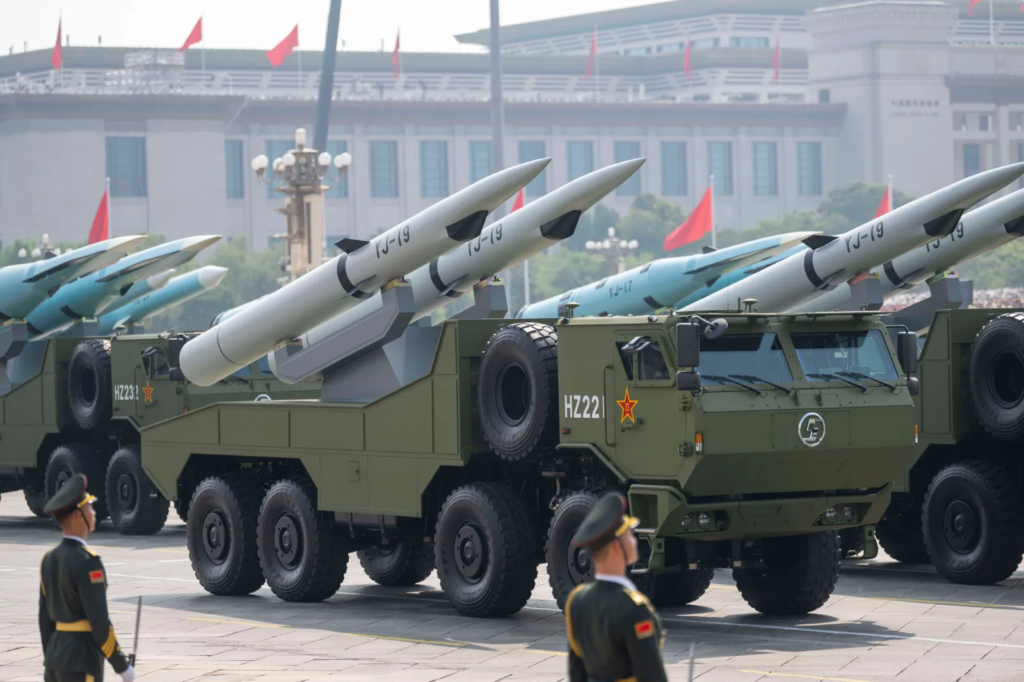
What Actually Makes a Missile ‘Hypersonic’?
The word “hypersonic” gets attached loosely to almost any fast-moving missile these days, which muddies a debate that badly needs precision. Technically, any object travelling faster than Mach 5 is hypersonic, and by that narrow definition, the reentry vehicle of an old intercontinental ballistic missile already qualifies, since it can exceed Mach 20 on its way down. What distinguishes the new generation of hypersonic weapons is not raw speed alone but the combination of speed, sustained atmospheric flight, and maneuverability.
Hypersonic Glide Vehicles (HGVs)
An HGV is boosted to hypersonic speed by a rocket and then released to glide, unpowered, through the upper atmosphere toward its target. Unlike a ballistic warhead, which follows a fixed, calculable parabola, a glide vehicle can pull lift-generated maneuvers throughout its flight, weaving to avoid interceptors and disguising its final aim point until late in the engagement. Russia’s Avangard, reportedly capable of Mach 20 to 27, and China’s DF-ZF are the best-known examples; India’s newly unveiled Long-Range Anti-Ship Missile (LR-AShM) and the United States’ Common Hypersonic Glide Body (C-HGB), which underpins both the Army’s Dark Eagle and the Navy’s Conventional Prompt Strike, follow the same basic concept.
Hypersonic Cruise Missiles (HCMs)
An HCM stays powered for most or all of its flight, typically using a scramjet, a supersonic combustion ramjet with no moving parts, which can only function once the missile is already moving at high supersonic speed. Because the engine keeps running, an HCM can sustain maneuvering flight at low altitude for extended distances, which is what makes it especially hard for ground-based radar to track early. The U.S. Air Force’s Hypersonic Attack Cruise Missile (HACM) and China’s developmental scramjet-powered systems fall into this category. Scramjet propulsion remains the harder engineering problem, which is why glide vehicles currently dominate operational inventories worldwide.
The In-Between Category: Manoeuvring Ballistic and Aeroballistic Missiles
A third category causes most of the public confusion. Russia’s Kh-47M2 Kinzhal, widely reported as hypersonic and capable of roughly Mach 10, is technically an air-launched ballistic missile fitted with fins that let it maneuver during its terminal dive. It does not glide across a significant share of its flight path the way a true HGV does, and defense analysts have noted that its speed drops sharply as it descends into denser air, a property that, as Ukraine’s experience has shown, matters enormously for whether existing interceptors can catch it. The label ‘hypersonic’ is accurate for Kinzhal’s top speed, but the engineering and therefore the defensive challenge differ meaningfully from a true boost-glide weapon like Avangard or DF-17.
Speed alone does not make a missile unstoppable. What makes hypersonic and aeroballistic weapons dangerous is the combination of speed, unpredictable maneuver, and the compressed decision window they leave defenders often under a minute from detection to intercept.
The Current Global Hypersonic Arsenal
The hypersonic race has moved well past the two-player contest between Washington and Moscow that dominated headlines a decade ago. At least a dozen states now have active programs at varying stages of maturity, and the gap between ‘in testing’ and ‘fielded’ is closing fast across Asia in particular. The table below summarizes the systems most relevant to current air defense planning.
| Country | System | Type | Reported Speed / Range | Status (2026) |
| Russia | Avangard | HGV (strategic) | Mach 20–27 / intercontinental | Operational since 2019 |
| Russia | Kh-47M2 Kinzhal | Aeroballistic (air-launched) | ~Mach 10 / ~2,000 km | Combat was used extensively in Ukraine. |
| Russia | 3M22 Zircon | HCM (naval) | Mach 8–9 / ~1,000 km | Operational; combat-used against Ukraine |
| China | DF-17 | HGV (theatre) | Mach 5–10 / 1,800–2,500 km | Operational |
| China | DF-ZF | HGV (strategic) | Mach 5–10 / regional-intercontinental | Operational / expanding |
| USA | Dark Eagle (LRHW) | HGV (Army, C-HGB) | Mach 5+ / >2,700 km | Fielding; under USSTRATCOM |
| USA | Conventional Prompt Strike | HGV (Navy, C-HGB) | Mach 5+ / >2,700 km | Integration on Zumwalt-class submarines from FY25 |
| USA | HACM | HCM (Air Force) | Mach 5+ / classified | Moving into production |
| India | LR-AShM | HGV (anti-ship) | ~Mach 10 / ~1,500 km | Publicly unveiled Jan 2026, advanced development |
| India | BrahMos-II | HCM (Scramjet) | Mach 7 (target) / ~600 km | Scramjet ground tested; fielding targeted ~2027–28 |
| Japan | HVGP | HGV (ground-launched) | Hypersonic/theater range | Fielding from 2026 |
| North Korea | Hwasong-8 class | HGV (theatre) | Claimed hypersonic / regional | Tested; maturity disputed |
A few patterns stand out. First, glide vehicles remain far more common than true scramjet cruise missiles, simply because boost-glide propulsion is the more mature engineering path. Second, the strategic and theatre-range systems (Avangard, Dark Eagle, DF-ZF) sit in a different category from the shorter-range, already-combat-tested weapons like Kinzhal and Zircon and it is the latter group that is actually teaching today’s air defenders the most, because it is the group being fired at and intercepted in real conflicts. Third, the Indo-Pacific and South Asian entrants, India, Japan, and by extension the states that must plan against them, are compressing what was once a decade-long development curve into a few years, driven largely by regional threat perception rather than superpower competition.
The Combat Test: What Ukraine’s Skies Have Revealed
Ukraine has become the only live laboratory in which hypersonic and aeroballistic weapons are being fired at and intercepted by modern air defense systems in sustained combat. The result has complicated the narrative that hypersonic weapons are simply unstoppable.
The turning point came in May 2023, when a Ukrainian Patriot battery achieved what Kyiv and the Pentagon both confirmed as the first combat intercept of a Kinzhal missile by any air defense system in history. That single event mattered because Kinzhal had been marketed and widely reported, as an unstoppable wonder weapon. The physics behind the intercept turned out to be more mundane than the marketing: Kinzhal’s blistering top speed of roughly Mach 10 occurs mid-flight, but as it dives through the increasingly dense lower atmosphere toward its target, it sheds velocity rapidly — and Patriot, a system optimised for exactly this kind of low-altitude terminal engagement, was able to close the gap, particularly once Ukraine received the newer, 25-percent-faster PAC-3 MSE variant.
The pattern has repeated at scale rather than as a one-off. By January 2026, Ukraine’s Air Force reported that the Patriot battery credited with that first Kinzhal kill had gone on to destroy more than 140 ballistic missiles and nearly 250 aerial targets in total. Germany’s continued transfers of PAC-3 interceptors through Ramstein-format coordination explicitly justified by Kyiv’s Ministry of Defence as the most effective tool against Iskander, Kinzhal and Zircon threats underline that this is now a settled operational judgement, not an isolated success. Ukrainian officials have also detailed a practical loadout doctrine: PAC-2 variants are reserved for cruise missiles and aircraft at longer range, while PAC-3’s hit-to-kill interceptors, smaller and faster, and able to fit sixteen rounds on a launcher that once carried four—are held back specifically for ballistic and aeroballistic threats in their terminal phase.
The claim that hypersonic weapons are simply invincible does not survive contact with Ukraine’s experience. What has proven true is narrower and more useful for planners: certain classes of maneuvering and high-speed missiles are interceptable during the terminal phase of flight, provided the defending system, the interceptor variant, and the fire-control doctrine are all matched correctly to the threat.
Two caveats matter, though, and Armorexa readers tracking regional threats should weigh them carefully. First, Kinzhal is not a true hypersonic glide vehicle; it does not sustain maneuvering flight across a long unpowered glide phase the way Avangard or DF-17 are designed to. Analysts have specifically cautioned that its intercept record should not be read as proof that true boost-glide weapons are equally vulnerable; a genuine HGV retains far more maneuvering energy at lower altitudes and a far less predictable terminal trajectory. Second, interception rates in real combat remain contested. Ukrainian and Russian claims about how many missiles were fired versus intercepted have diverged sharply in individual engagements, a reminder that battle-damage assessment for high-speed, high-altitude threats is inherently difficult and that headline ‘intercept rate’ figures deserve scrutiny rather than blanket acceptance.
Why Traditional Air Defense Struggles Against Hypersonic Threats
Even where intercepts have succeeded, as in Ukraine, the underlying physics still work against the defender far more than they did against Cold War-era ballistic missiles. Four structural problems recur across every serious technical assessment of the hypersonic challenge.
1. Compressed decision time
A traditional intercontinental ballistic missile follows a long, high, predictable arc that gives defenders many minutes of warning and tracking data before the terminal phase. A glide vehicle flying at lower altitude and higher relative speed compresses that window dramatically—in some engagement geometries down to a matter of seconds between the point a threat becomes trackable and the point it must be engaged. That leaves little to no margin for human decision-making, which is why modern air defense architectures increasingly push toward automated, machine-speed engagement logic with a human retaining only override authority.
2. Radar horizon and detection gaps
Ground-based radar is limited by the curvature of the earth; a missile flying at low-to-medium altitude simply isn’t visible to a ground station until it crosses the radar horizon, by which point much of the available reaction time has already been consumed. This is the single biggest argument behind the current push toward space-based sensor layers—a missile in boost phase, glowing brightly against the cold background of space, is far easier to detect early from orbit than from the ground.
3. Unpredictable, in-flight maneuver
Legacy interceptors, including many earlier-generation systems, were designed around the assumption that a target’s flight path could be extrapolated from a handful of tracking points, because ballistic warheads don’t change course. A glide vehicle capable of cross-range maneuvers of hundreds of kilometers invalidates that assumption outright, forcing interceptor guidance systems to continuously re-solve the intercept geometry rather than aim at a predicted future point.
4. Terminal-phase speed and thermal/plasma effects
At the very high end of the speed envelope, a vehicle travelling through the atmosphere generates a plasma sheath around itself that can degrade radar returns and complicate the final seeker lock of an interceptor. Even where an interceptor can theoretically reach the required closing speed, achieving a clean hit-to-kill lock in the last fraction of a second against a maneuvering, plasma-shrouded target is a substantially harder engineering problem than intercepting a coasting ballistic warhead.
How Air Defense Is Adapting
Faced with these structural challenges, air defense planners worldwide have converged on a broadly similar answer: no single interceptor or radar can solve the hypersonic problem, so the response has to be architectural—layered sensing, layered interception, and much tighter integration between space, air, and ground assets.
The United States: Golden Dome
Washington’s most visible answer is Golden Dome for America, a homeland missile-shield concept formally directed under a January 2025 executive order and detailed in the Pentagon’s FY2027 budget submission in April 2026. Rather than a single procurement program, Golden Dome is explicitly described as a ‘system of systems,’ space-based infrared sensors for early warning, a proliferated constellation supporting tracking and potential boost-phase intercept, and layered ground-, sea-, and air-based interceptors tied together by a unified command-and-control network. Budget estimates vary enormously depending on the source, ranging from the White House’s own figure of roughly 175 billion dollars to considerably higher long-run projections from independent budget analysts, and the Missile Defense Agency has already begun awarding contracts across satellite manufacturing, sensor development, and AI-enabled battle management.
Defense Secretary Pete Hegseth has summarized the underlying logic simply: it’s a layered defense, so if you miss at one layer, you catch it at the next. The first space-based interceptor prototype tests are planned before the end of 2026, with orbital flight demonstrations following in 2027, an aggressive schedule that most independent observers regard as the program’s single biggest execution risk.
Regional Counter-Hypersonic Programmes
Golden Dome is the highest-profile effort, but far from the only one. South Korea’s Defense Acquisition and Program Administration formally launched development of the L-SAM II in January 2025, backed by an investment package worth roughly 390 million dollars through 2028 and explicitly designed to intercept threats at higher altitude and longer range than the original L-SAM. Japan is fielding its own truck-launched Hyper-Velocity Guided Projectile from 2026, accelerated by three years in response to a deteriorating regional threat picture while separately co-developing the Glide Phase Interceptor with Washington, a system aimed specifically at catching hypersonic glide vehicles during the middle portion of their flight, before terminal manoeuvres make interception harder. China, for its part, has continued developing the HQ-19, widely assessed as its answer to a mid-course and terminal counter-hypersonic requirement.
| Program | Country/Bloc | Primary Focus | Notable 2025–26 Development |
| Golden Dome | United States | Homeland, layered space-to-ground shield | First space interceptor prototype tests due before end-2026 |
| L-SAM II | South Korea | High-altitude, long-range terminal intercept | Development formally launched in Jan 2025, ~$390M through 2028 |
| Glide Phase Interceptor | USA + Japan | Mid-course intercept of HGVs | Joint development continuing through 2026 |
| HVGP (defensive posture) | Japan | Deterrent hypersonic fielding, layered defense | Fielding accelerated to 2026. |
| HQ-19 | China | Mid-course/terminal counter-hypersonic | Continued development and testing |
| PAC-3 MSE upgrades | USA/NATO allies | Terminal, low-altitude intercept | Combat-proven against Kinzhal/Iskander in Ukraine |
The South Asian Dimension: A Region Recalculating Its Air Defense
For readers following the regional balance, the hypersonic question is no longer an abstraction confined to Moscow, Washington, and Beijing. India’s Republic Day parade in January 2026 marked the public debut of its Long-Range Anti-Ship Missile (LR-AShM), a truck-launched hypersonic glide vehicle developed by DRDO, reportedly capable of Mach 10 over a range of roughly 1,500 kilometers and intended for coastal-battery and naval deployment against high-value maritime targets. Days later, DRDO’s Defence Research and Development Laboratory logged a long-duration scramjet combustor test exceeding twelve minutes of continuous operation, a milestone aimed squarely at validating the air-breathing propulsion that the BrahMos-II program will eventually need. A further extended-duration test in May 2026, running past 1,200 seconds, reinforced that India is treating scramjet maturity as a near-term priority rather than a distant research goal.
India’s own defense commentary has been explicit that this push is shaped by its two-front threat perception, regional rivalry with both Pakistan and China. Indian defense media have framed systems like the RudraM-II anti-radiation missile, tested from a Su-30MKI in June 2026 with a reported 350-kilometer range, as tools designed in part to suppress and degrade Pakistani and Chinese integrated air-defense networks ahead of any strike package. Separately, a large, unannounced long-range missile launch over the Bay of Bengal in May 2026 assessed by regional analysts as either an Agni-series test or an early hypersonic strategic system added to the sense that India’s missile posture is entering a period of rapid, and at times deliberately ambiguous, evolution.
The Russia-Ukraine war and the 2025 Israel-Iran conflict have both reinforced the same lesson for regional planners: conventional missiles are increasingly vulnerable to preemptive strikes and layered interception, while genuinely hypersonic systems remain far harder to defend against reliably. (Paraphrased from regional strategic commentary, Small Wars Journal / Asia Times, December 2025–January 2026)
The practical implication for Pakistani air defense planning is threefold. First, the traditional reliance on layered, radar-cued surface-to-air systems and forward-deployed interceptors needs to be re-examined against threats that compress engagement timelines to seconds rather than minutes—a challenge already well documented in Western and Ukrainian experience. Second, anti-radiation and long-range strike capabilities aimed at suppressing air-defense radar before it can even track an inbound hypersonic system add a new layer of urgency to radar survivability, mobility, and redundancy. Third, the May 2025 India-Pakistan crisis already demonstrated, in a compressed and lower-intensity form, how quickly airpower and missile exchanges can escalate in South Asia—underlining why regional analysts increasingly argue that credible air and missile defense architecture, not just offensive deterrence, will shape the next phase of strategic stability on the subcontinent.
Doctrinal Shifts: How Air Defense Thinking Is Changing
Beyond individual hardware programs, the hypersonic era is quietly rewriting several long-standing assumptions in air defense doctrine.
- From single-shot interception to layered defense-in-depth: no single system is expected to achieve a high enough single-shot probability of kill against a maneuvering hypersonic target, so architectures increasingly plan for boost-phase, mid-course, and terminal-phase engagement opportunities stacked on top of one another.
- From ground-based to space-enabled early warning: infrared-sensing satellite constellations are moving from a ‘nice to have’ to a structural requirement, because ground radar’s horizon limitation is one of the hardest physical constraints to engineer around.
- From human-in-the-loop to human-on-the-loop: with usable reaction windows shrinking toward single-digit seconds in some engagement geometries, automated battle-management systems are taking on more of the detect-track-engage sequence, with human operators shifting toward a supervisory and override role rather than a step-by-step decision-maker.
- From symmetric deterrence to suppression-first strike packages: because hypersonic systems are so hard to intercept reliably, several air forces are placing renewed emphasis on destroying launch platforms and radar before a hypersonic weapon is even fired, a preference for left-of-launch and SEAD-style operations over reliance on terminal defense alone.
- From national to allied/coalition sensor-sharing: Golden Dome, the U.S.-Japan Glide Phase Interceptor, and NATO’s continued Patriot resupply to Ukraine all point toward pooled tracking data and shared interceptor stockpiles as the only economically sustainable way to field a credible counter-hypersonic layer.
The Road Ahead
Three trends look set to define the next several years of the hypersonic-versus-air-defense contest. First, offense continues to widen its technical lead in raw physics. DARPA’s own August 2026 request for a next-generation hypersonic cruise missile is explicitly framed around outrunning and outsmarting the very air defences currently being built to stop it, a reminder that this is an iterative arms race rather than a problem either side will solve outright.
Second, the defensive side is betting heavily on space: whether it succeeds depends less on any single interceptor’s kill probability and more on whether early-warning satellite constellations, ground radar, and command-and-control networks can be integrated fast enough and cheaply enough to matter, the ‘track continuity, data quality, and decision time’ problem that missile-defense architects increasingly describe as the real bottleneck, ahead of the interceptor hardware itself.
Third, and most relevant for regional readers, the hypersonic contest is no longer confined to great-power theaters. With India accelerating scramjet testing, Japan fielding truck-launched glide weapons in 2026, and South Korea funding a next-generation interceptor through the end of the decade, the Indo-Pacific and South Asian security environment is being reshaped by exactly the same technology curve that is already testing NATO’s air defenses over Ukraine.
Conclusion
Hypersonic weapons have not made air defense obsolete, but they have made the old assumptions behind it dangerously outdated. Ukraine’s Patriot batteries have proven that at least some classes of high-speed, maneuvering threat can be intercepted reliably in real combat—but that success rests on matched interceptors, disciplined loadout doctrine, and a threat (Kinzhal) that is not, strictly speaking, a true hypersonic glide vehicle. Against the harder problem of a genuine boost-glide weapon flying an unpredictable path at Mach 20, the world’s most capable militaries are still building the answer, betting billions of dollars on space-based sensing, layered interception, and tighter automation. For air forces and defense planners across South Asia, the message is not that hypersonic weapons are unstoppable, it is that the region’s air defense architecture, sensor survivability, and decision-making speed all need to evolve at the same pace as the threat now entering regional inventories.
Frequently Asked Questions
Q: What speed counts as ‘hypersonic’?
A: Any sustained speed above Mach 5, roughly 6,150 km/h at sea level is classified as hypersonic. What matters more for air defense purposes is whether the missile also maneuvers unpredictably during flight, since a fast but non-manoeuvring object is generally easier to track and engage than a slower, more agile one.
Q: Can Patriot really intercept hypersonic missiles?
A: Ukraine’s combat record shows Patriot, using PAC-3 interceptors, can intercept Kinzhal, an aeroballistic missile marketed as hypersonic, once it slows during its terminal dive through the lower atmosphere. This should not be read as proof. Patriot can reliably stop a true hypersonic glide vehicle like the Avangard or DF-17, which retains far more maneuvering capability at low altitude.
Q: What is the difference between a hypersonic glide vehicle and a hypersonic cruise missile?
A: A glide vehicle (HGV) is boosted to speed by a rocket and then glides unpowered the rest of the way, maneuvering using aerodynamic lift. A cruise missile (HCM) stays powered throughout its flight using an air-breathing scramjet engine, which allows sustained low-altitude maneuvering but is a harder engineering problem to master.
Q: Why is space-based sensing so central to counter-hypersonic defense?
A: Ground-based radar is limited by the curvature of the earth and cannot see a low-flying, maneuvering missile until it crosses the radar horizon, by which point much of the available reaction time is gone. A satellite can detect the bright infrared signature of a missile’s boost phase far earlier, buying defenders critical extra seconds.
Q: Which countries currently have operational hypersonic weapons?
A: Russia and China field the most mature, combat-tested, or near-operational systems. The United States is fielding its Common Hypersonic Glide Body-based systems (Dark Eagle, Conventional Prompt Strike) through 2026. India has publicly unveiled its first hypersonic system, the LR-AShM, and is targeting a broader operational capability by roughly 2027–2028.
Q: What is Golden Dome, and how does it relate to hypersonic threats?
A: Golden Dome is a U.S. homeland missile-defense architecture, directed under a 2025 executive order, that combines space-based sensors, proliferated interceptor constellations, and ground/sea/air interceptor layers into one integrated system built explicitly to counter ballistic, hypersonic, and advanced cruise-missile threats.
Q: How is South Asia’s air defense balance affected by hypersonic weapons?
A: India’s accelerating hypersonic and anti-radiation missile programs are explicitly framed by Indian defense commentary as tools to pressure Pakistani and Chinese air-defense networks. This raises the priority, for regional air defense planning, of radar survivability, mobility, and layered interception against threats with sharply compressed reaction windows.